If chemicals hit your concrete floor, bare concrete will fail sooner or later. I’d narrow the choice fast: use epoxy for general splash and traffic, novolac epoxy for stronger acids and solvents, urethane cement for hot washdowns and thermal shock, and polyaspartic or polyurea when downtime has to stay short. This is one of the primary polyaspartic fast-cure advantages.
Here’s the short version in plain English:
- I’d judge the floor by 4 things: chemical type, concentration, temperature, and contact time.
- Hotter spills and longer dwell time hit coatings harder.
- Areas like battery rooms, washdown zones, blending lines, loading docks, and containment areas usually need different systems.
- Thicker systems for immersion service often run around 20–40 mils.
- Moisture testing matters before install. If vapor rates are above 3–5 lbs./1,000 sq. ft./24 hours, a moisture layer may add about $2–$4 per sq. ft.
- Installed cost can range from about $3 to $14+ per sq. ft., while service life can range from 3–5 years for thin films to 20–25 years for urethane cement systems.
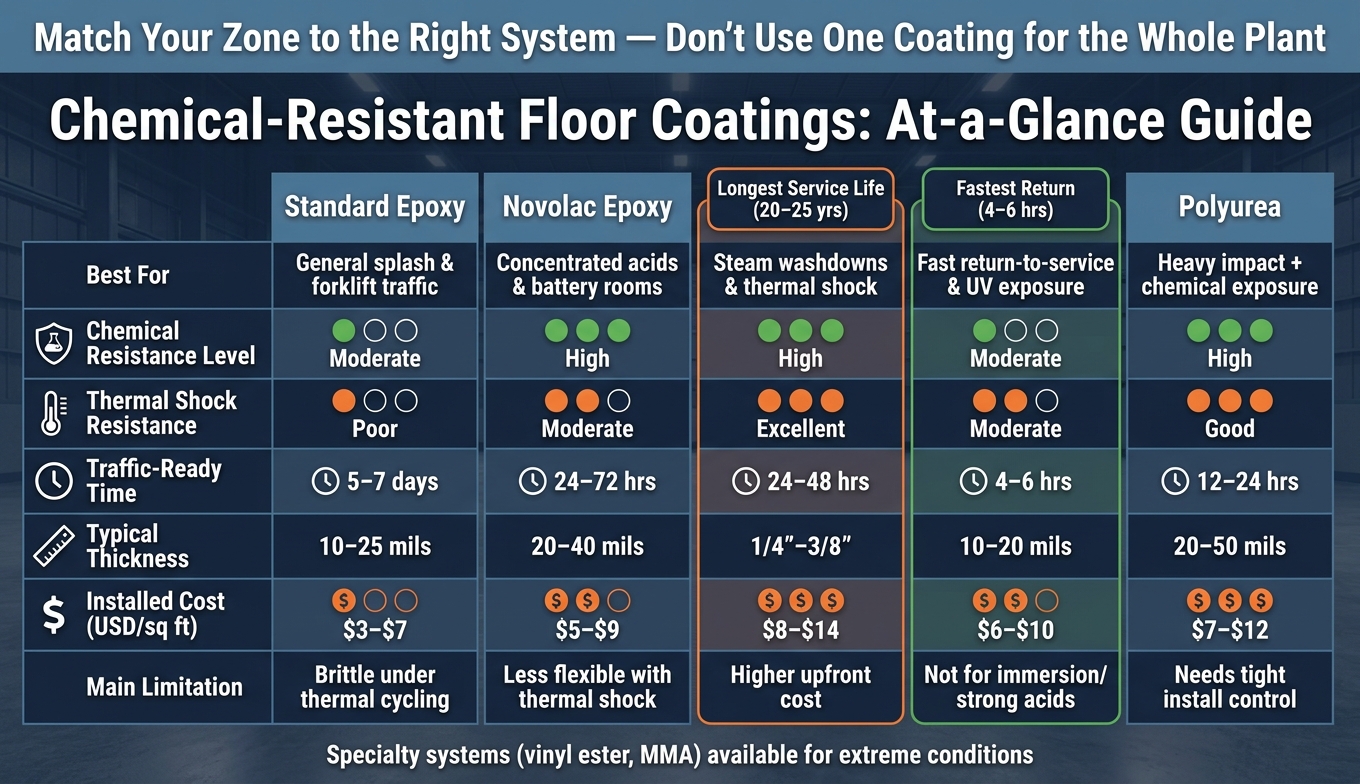
Chemical-Resistant Floor Coatings: Side-by-Side Comparison Guide
Quick Comparison
| System | Best fit | Main limit | Traffic-ready time | Typical cost |
|---|---|---|---|---|
| Standard epoxy and polyaspartic | General industrial splash, oils, forklift traffic | Can crack under thermal cycling | 5–7 days | $3–$7/sq. ft. |
| Novolac epoxy | Concentrated acids, solvents, battery areas | Less forgiving with thermal shock than cement systems | 24–72 hours | $5–$9/sq. ft. |
| Urethane cement | Steam cleaning, hot-water washdown, caustics | Higher upfront cost | 24–48 hours | $8–$14/sq. ft. |
| Polyaspartic | Fast return areas, UV exposure, light-to-moderate spills | Not for long immersion or strong acid service | 4–6 hours | $6–$10/sq. ft. |
| Polyurea | Heavy impact plus chemical exposure | Needs tight install control | 12–24 hours | $7–$12/sq. ft. |
What I take from this article is simple: don’t pick one floor system for the whole plant by default. Match each zone to its exposure using industrial coatings for chemical storage, prep the slab the right way, confirm cure before chemical service, and watch early signs like softening, blistering, discoloration, and texture loss. That’s usually what keeps repair costs and downtime from getting out of hand.
sbb-itb-a0e5ae3
Chemical Exposure and Floor Performance Requirements
Chemical resistance comes down to three things: the chemical itself, how long it sits on the floor, and the temperature. A coating that stands up to a mild acid rinse might still fail when a concentrated solvent spill hits the same surface. That’s why floor specs often need to separate splash protection, immersion resistance, or both.
Chemicals That Commonly Attack Manufacturing Floors
Acids can eat into concrete and break down standard coatings. Caustics and alkalis, which show up a lot in industrial cleaners and washdown chemicals, can soften epoxy films over time. Oils, fuels, and solvents bring a different kind of trouble. They can cause swelling, softening, and loss of adhesion.
Concentration also changes fast once a spill hits the floor. A 2% solution can dry down to a 50% to 60% concentration, which puts far more stress on the coating than the original liquid did. Temperature makes that worse. Heat speeds up chemical penetration through the film, so a coating that performs fine at 77°F (25°C) may suffer clear damage at 140°F (60°C).
How Chemical Resistance Is Measured and Rated
Not all chemical exposure is the same. There’s a big difference between splash-and-spill resistance, fume resistance, and continuous immersion resistance. That last category is common in secondary containment areas and usually needs thicker systems, often 20–40 mils dry film thickness, along with denser resin systems. Those ratings shape the floor system choice in the next section.
Manufacturers usually publish chemical resistance charts that show how products perform against specific substances at set concentrations and temperatures. In the field, ASTM D5402 solvent rub testing is used to confirm that a coating has fully cured before harsh chemicals are allowed on the floor. Pull-off adhesion testing under ASTM D4541 is also common. Specs often call for at least 200 psi (1.38 MPa) for standard industrial use and 400 psi or more in heavy-traffic areas.
| Factor | Effect on Coating Performance |
|---|---|
| Concentration | Higher concentrations speed up chemical attack; evaporation can multiply surface concentration |
| Temperature | Heat speeds up chemical reactions and increases coating permeability |
| Dwell Time | Longer contact calls for thicker film builds and resins with stronger chemical resistance |
| Thermal Shock | Fast temperature swings can cause different rates of expansion and lead to delamination in rigid coatings |
| Mechanical Load | Forklift traffic can create micro-fractures that let chemicals reach the substrate |
Safety and Compliance Considerations
Chemical resistance also has to work alongside traction and containment needs. In wet spaces, slip resistance is a top concern. Coatings with broadcast aggregates such as aluminum oxide or quartz help improve slip resistance in those areas.
In secondary containment zones, the floor system must be chemically compatible with the hazardous waste being stored to meet EPA 40 CFR Part 265 requirements. A coating can look fine on the surface, but if it is not rated for the exact chemical it contains, that can still lead to regulatory violations. Seamless cove bases, usually installed 4 to 6 inches up the wall, help contain spills at the wall line and stop chemicals from migrating under walls.
Coating Systems Used on Chemical-Resistant Manufacturing Floors
The right floor coating depends on four things: which chemicals hit the floor, how long they sit there, the temperature, and how much shutdown time the area can handle. The goal is simple: pick the shortest system that still holds up under the chemical load and work schedule.
Epoxy, Novolac Epoxy, and Urethane Cement Systems
Standard 100% solids epoxy works well for general industrial exposure, including dilute acids, alkalis, and petroleum products. It’s durable, but it’s also brittle. That can be a problem in areas with thermal cycling, where repeated heating and cooling can lead to failure.
Novolac epoxy stands up to concentrated acids better than standard epoxy. Its denser structure makes it a good fit for battery rooms and acid storage areas. These systems are usually built to 20–40 mils and can handle temperatures up to 300°F.
Urethane cement is a strong fit for spaces with frequent hot-water or steam washdowns. It moves with the concrete slab as the slab expands and contracts, so it can take thermal shock across a broad temperature range without cracking. It also helps prevent delamination when moisture vapor comes up through the slab, which can otherwise cause coating failure. From there, the next call is usually system build and install detail.
Polyaspartic, Polyurea, and Fast-Return Systems
Some plants just can’t lose several days to floor work. In those cases, polyaspartic and polyurea systems make sense.
Polyaspartics are traffic-ready in 4–6 hours. They’re also UV-stable, which matters near open bay doors or production areas next to the outside. On chemical exposure, think of them as splash-and-spill rated. They work for incidental contact, not long immersion or concentrated acid exposure.
Polyurea brings high elongation – up to 600% – plus strong impact resistance, which helps it take abuse without cracking. It cures in 12–24 hours and fits areas that combine concentrated acid exposure with heavy mechanical load.
For the harshest chemical settings, vinyl ester and methyl methacrylate (MMA) are specialty choices. Vinyl ester handles continuous immersion in concentrated acids and strong oxidizers. MMA cures in 1–2 hours and can be installed in sub-freezing conditions as low as -30°F.
Coating Chemistry Comparison Table
The table below shows the main tradeoffs at a glance.
| Coating System | Chemical Resistance | Thermal Shock Resistance | Cure Time (Traffic-Ready) | Typical Thickness | Installed Cost (USD/sq ft) |
|---|---|---|---|---|---|
| Standard Epoxy | Moderate – dilute acids, oils | Poor | 5–7 days | 10–25 mils | $3–$7 |
| Novolac Epoxy | High – concentrated acids, solvents | Moderate | 24–72 hours | 20–40 mils | $5–$9 |
| Urethane Cement | High – organic acids, caustics | Excellent | 24–48 hours | 1/4"–3/8" | $8–$14 |
| Polyaspartic | Moderate – splash/spill | Moderate | 4–6 hours | 10–20 mils | $6–$10 |
| Polyurea | High – concentrated acids | Good | 12–24 hours | 20–50 mils | $7–$12 |
Specialty systems (vinyl ester, MMA) are available for extreme chemical or temperature conditions and require separate evaluation.
How to Select and Install the Right Floor System
Match the Coating to Chemicals, Traffic, and Cleaning Methods
Start with the exposure profile. That means listing every chemical that hits the floor, along with its concentration, temperature, and how long it usually sits before cleanup. Those three details matter more than many teams expect. A mild chemical at room temperature for a few seconds is one thing. The same chemical, hotter and left sitting longer, can be a very different problem.
You also need to check that adhesion lines up with the project’s traffic load and service demands. A floor that handles chemical contact but fails under forklifts or constant cart traffic isn’t built for the job.
Cleaning method matters too. Residues can turn much harsher as water evaporates. If the plant uses steam or hot-water washdowns, that’s a strong signal toward urethane cement.
Two physical details get missed all the time: slope and joints. In wet-process areas, floors need a minimum slope of 1/8 inch per foot toward drains so chemicals don’t pond on the surface. Active cracks and expansion joints also need attention before coating starts, because resinous systems can’t bridge moving structural defects. And when you install integral cove bases at wall-to-floor transitions, you create a sealed transition that helps stop chemicals from moving under walls and attacking the structure.
Once you know the exposure profile, layout details like slope, joints, and containment often decide whether the system will hold up.
A simple way to spec the floor without overdoing it is to divide the plant into 3–4 distinct zones based on actual exposure, such as production, packaging, chemical blending, and labs. That lets you match each area to the right system instead of over-specifying the whole floor.
Build the System from Primer to Topcoat
Picking the right system is only half the job. It also has to be installed to spec.
A high-performance floor system has five layers: the concrete substrate, an optional moisture vapor barrier, a primer, a body or base coat, and a topcoat. Each layer does a different job. Skip one, or build it too thin, and that’s where many failures begin. In fact, most floor failures start with poor substrate preparation.
For surface prep, mechanical profiling is the standard approach. Use shot blasting for large areas and diamond grinding for edges and thinner systems. For high-build chemical-resistant systems, the target is a Concrete Surface Profile (CSP) of 3 to 5.
Before that work starts on a slab-on-grade, run moisture testing with ASTM F1869 (calcium chloride) or ASTM F2170 (relative humidity probe). If moisture vapor transmission is above 3–5 lbs per 1,000 sq ft per 24 hours, you’ll need a dedicated moisture mitigation layer. That can add about $2–$4 per sq ft to the project.
The body coat is what provides the chemical barrier and helps distribute loads. For immersion-rated systems, use holiday testing before return to service. And don’t rush startup: confirm full cure before exposing the floor to chemicals.
| Layer | Purpose | Typical Thickness |
|---|---|---|
| Moisture Barrier | Prevents delamination from vapor drive | 15–25 mils |
| Primer | Penetrates pores, promotes adhesion | 5–10 mils |
| Body/Base Coat | Load distribution and chemical barrier | 40–250 mils |
| Topcoat/Wear Layer | Slip resistance, UV stability, hardness | 10–30 mils |
Floor System Designs for Common Manufacturing Areas
Different parts of the same plant can need very different floor systems. A production area and a washdown room might sit a few feet apart, but the demands on the floor aren’t even close.
The table below maps common manufacturing zones to practical system choices based on exposure and load profile.
| Manufacturing Area | Exposure Level | Mechanical Load | Recommended System | Approx. Thickness |
|---|---|---|---|---|
| Production areas | Moderate: splash and spill | High – forklifts, pallet jacks | Epoxy | 10–30 mils |
| Chemical blending zone | High – concentrated acids, solvents | Moderate | Novolac epoxy | 20–40+ mils |
| Washdown rooms | High – organic acids, caustics, steam | High | Urethane cement | 1/4 to 3/8 in. |
This area-by-area method keeps the floor matched to actual exposure instead of forcing one system across the whole plant.
Service Life, Maintenance, and Lifecycle Cost
What Affects Service Life and When to Recoat
Even a well-specified floor can fail if the service conditions push past what the coating can handle.
Chemical resistance drops fast as concentration and temperature go up. Urethane cement deals with thermal cycling better than rigid epoxy vs. polyaspartic systems, as the former can delaminate under repeated temperature swings. Forklift traffic adds another layer of stress, especially at the bond line.
Early warning signs matter. Look for:
- Discoloration, which can point to chemical attack
- Softening, often tied to solvent absorption
- Loss of texture, which means abrasion is wearing down slip resistance
- Blistering near drains and joints
Once wear begins, the next move matters a lot. Good cleaning and fast spot repair can keep damage small. If not, it tends to spread.
Routine Cleaning, Inspection, and Spot Repair
Spills need to come off the floor right away. When chemicals sit and pond, even on a rated floor, contact time goes up and breakdown speeds up. Use only cleaners approved for the coating resin.
Regular walkthroughs help you catch trouble before it gets expensive. Check for pinholes, microcracks, and signs of softening. A small failure found early often means a local repair. Wait too long, and the damage can reach the substrate, turning a simple fix into a full section replacement with a much bigger bill.
For active cracks, flexible polyurea fillers are usually the better call than rigid patching compounds. The reason is simple: the repair needs to move with the slab instead of cracking all over again.
Those day-to-day choices shape total lifecycle cost more than many teams expect.
Lifecycle Cost Comparison and Choosing a Qualified Installer
Purchase price by itself doesn’t tell you much. The bigger cost drivers are shutdown time, contamination control, and replacement labor.
| System Type | Est. Installed Cost (USD/sq ft) | Avg. Service Life | Annual Maintenance | Likely Lifecycle Cost |
|---|---|---|---|---|
| Thin-Film Systems | $2–$5 | 3–5 years | High (Frequent recoats) | High |
| High-Build Epoxy/Novolac | $5–$15 | 10–15 years | Moderate | Moderate |
| Urethane Cement Systems | $10–$20 | 20–25 years | Low | Low |
| Polyurea/Polyaspartic Systems | $8–$15 | 15–20+ years | Low | Low (Fast return-to-service) |
A lower upfront price can look good on paper, then hurt later when recoats, downtime, and labor pile up.
Match the system to the actual exposure, not the worst-case case across the whole facility. A zoned approach often makes more sense. For example, production, blending, and washdown areas don’t all need the same floor. Dividing the space by use can cut total project costs by 30%–40% while helping each area last longer.
FAQs
How do I choose the right coating for each area of my plant?
Start with a site-specific assessment of each area. Look at the chemicals in use, their concentration, the type of exposure, temperature, traffic, thermal shock, and moisture conditions.
Then match each zone to the right system:
- Standard epoxy for general areas
- Novolac epoxy for concentrated acids or higher temperatures
- Cementitious urethane for thermal shock and caustic cleaners
- Vinyl ester for extremely aggressive chemicals
- Fast-curing polyaspartic or MMA where downtime must be kept to a minimum
When is urethane cement better than epoxy or novolac epoxy?
Urethane cement makes more sense in facilities that deal with thermal shock, frequent hot-water washdowns, or steam cleaning. Why? It stands up to sharp temperature swings from -40°F to 250°F without cracking or delaminating.
It can also beat standard epoxy and novolac epoxy when the floor is exposed to certain organic acids, fats, and blood. And because it handles moisture well, it’s a strong fit for concrete slabs with high moisture-vapor drive.
What tests should be done before installing a chemical-resistant floor coating?
Before you install a chemical-resistant coating, check the substrate carefully. That prep work can make the difference between a floor that holds up and one that starts peeling far too soon.
Focus on these key checks:
- MVER testing to spot moisture that can lead to delamination
- Concrete surface profile assessment
- Crack and joint repairs
- Verification that the surface is free of contaminants
It also helps to build a chemical exposure matrix for your facility. List each chemical, its concentration, the temperature, and how often the surface is exposed. That gives you a much clearer picture of what the coating will need to handle day after day.