Key Takeaways
- Polyaspartic/polyurea coatings cost $7–$9/sq ft vs epoxy at $5–$7/sq ft — on a standard two-car garage (roughly 400 sq ft), that’s about $2,800–$3,600 vs $2,000–$2,800.
- Polyaspartic lasts 15–20+ years with a lifetime manufacturer warranty; epoxy typically needs recoating every 3–5 years.
- Over 15 years, a single polyaspartic install actually costs less than epoxy once you factor in redo cycles — the savings can be $2,400–$5,600 or more.
- The one-day install means zero disruption; epoxy takes 3–5 days with VOC fumes and cure time.
- Epoxy does have its place — short-term homeowners, tight budgets, and rental properties can be reasonable use cases.
The Upfront Cost: What You’ll Actually Pay
Let’s start with the question every homeowner asks when they see the estimate: is polyaspartic worth the money when the initial price tag is higher?
The answer depends on how far out you’re willing to look — but first, the numbers.
Polyaspartic vs Epoxy: Real Numbers Per Square Foot
Here is what you can expect to pay in most markets for a professionally installed garage floor coating:
| Coating Type | Cost Per Square Foot (Installed) | Typical Lifespan | Warranty |
|---|---|---|---|
| Polyaspartic/Polyurea | $7–$9 | 15–20+ years | Lifetime (manufacturer) |
| Epoxy (professional-grade) | $5–$7 | 3–5 years | 1–3 years (typical) |
| DIY Epoxy Kit | $1–$3 | 1–2 years | None meaningful |
These are real ranges — not the lowball numbers you sometimes see in ads that exclude surface prep. A proper polyaspartic installation requires diamond-grinding the concrete, repairing cracks, applying a moisture-vapor barrier, and then building up the base coat, broadcast layer, and top coat. That labor and material cost is built into the $7–$9 figure. If a quote comes in well below that, ask what they’re leaving out.
For a deeper dive into what drives these numbers, see our breakdown of the 5 cost factors that determine your floor coating price.
What a Standard Garage Looks Like at Each Price Point
A typical two-car garage runs about 400 square feet. Here is how the math plays out:
- Polyaspartic/polyurea (400 sq ft × $7–$9): $2,800–$3,600
- Professional epoxy (400 sq ft × $5–$7): $2,000–$2,800
- DIY epoxy kit (400 sq ft × $1–$3): $400–$1,200
The premium for polyaspartic is real — roughly $800–$1,600 more upfront on an average garage. That is the number that makes homeowners pause. But the upfront price only tells the first chapter of the story.
For a complete picture of current pricing by region, project size, and finish options, read our full polyaspartic floor coating cost guide.
What the Premium Buys You
That extra $800–$1,600 is not just buying a fancier name. It buys measurable differences in how the floor performs, how long it lasts, and what life looks like while it’s being installed.
4x Stronger — and What That Actually Means
Polyaspartic and polyurea coatings are approximately four times stronger than epoxy and 98–100% more flexible. That flexibility is the part that matters most in a garage: concrete expands and contracts with temperature swings, and a coating that can’t flex with it will eventually delaminate.
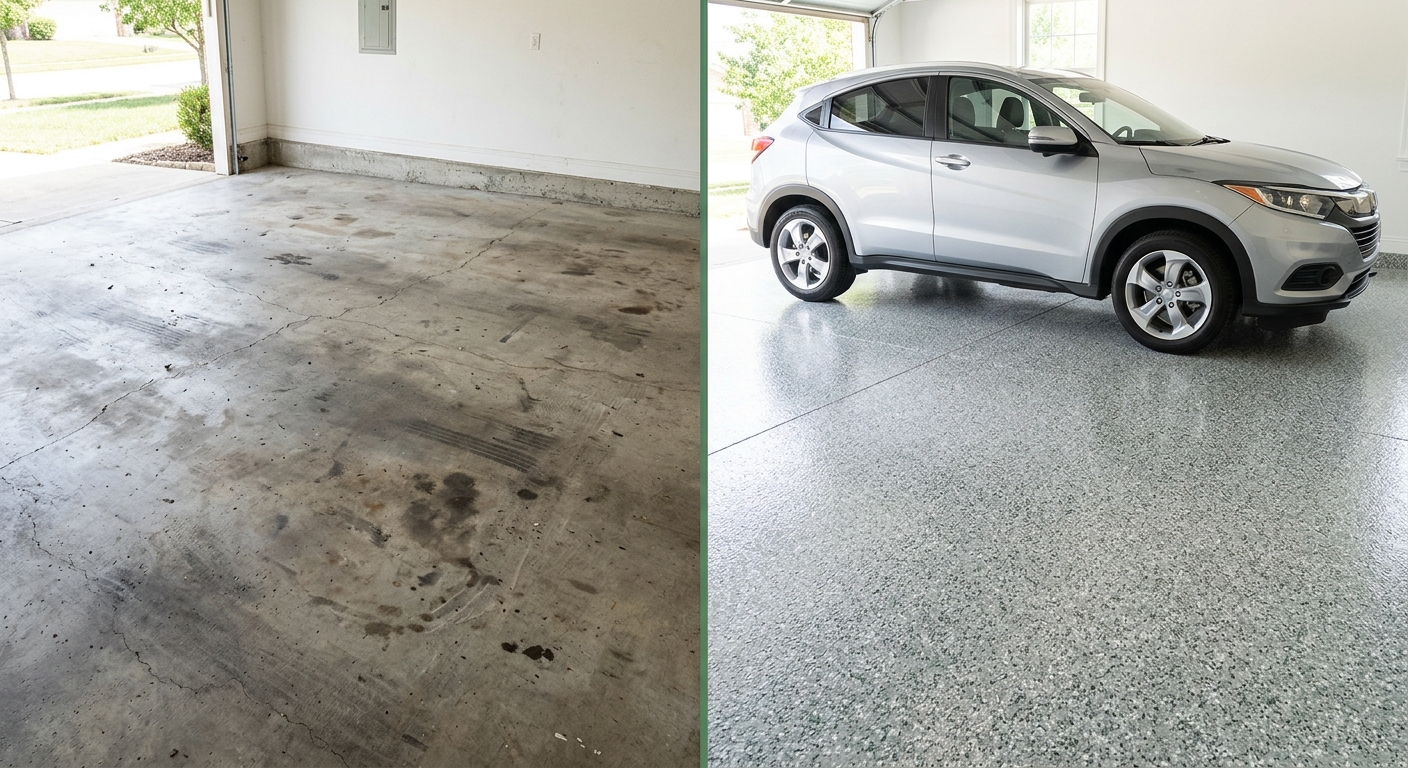
Epoxy cures into a hard, brittle film. It looks great on day one. But drive a hot tire onto it every evening, drag a toolbox across it, or let a freeze-thaw cycle work on the slab, and the bond between the epoxy and the concrete starts to fail. That is why epoxy floors peel — not because the material is defective, but because concrete moves and epoxy cannot.
Polyaspartic moves with the slab. That is the difference between a coating that sits on top of your concrete and one that stays bonded to it for decades.
15–20+ Years vs 3–5 Years: The Lifespan Gap
A professionally installed epoxy floor in a working garage typically lasts 3–5 years before it shows meaningful wear — peeling edges, hot-tire marks, fading, or chips. Some homeowners get more; many get less, especially in climates with hot summers and cold winters.
A polyaspartic floor installed by a certified installer is expected to last 15–20 years or more. That is not a marketing claim — it is backed by a lifetime manufacturer warranty from Penntek, the industry leader in polyurea coating systems.
Looked at annually, a $3,000 polyaspartic floor over 20 years costs about $150 per year. A $2,000 epoxy floor that lasts 7 years (generous) averages about $285 per year. The "cheaper" option costs nearly twice as much per year of service.
One-Day Install: No Disruption, No Fumes
Epoxy installations typically take 3–5 days from start to finish. Most of that is cure time — you cannot park on the floor, walk on it, or even be in the garage without breathing VOCs for several days.
Polyaspartic cures fast enough that the entire installation — grinding, base coat, broadcast, top coat — happens in a single day. You can walk on it the same evening and park on it within 24 hours. There are no solvent fumes to ventilate. For a family that uses the garage daily, that difference is worth real money.
UV Stability, Chemical Resistance, and Slip Safety
Three things epoxy cannot claim:
- UV stability. Epoxy yellows and chalks in sunlight. If your garage door stays open or you are coating a patio or pool deck, epoxy will look aged within a year or two. Polyaspartic is UV-stable and holds its color.
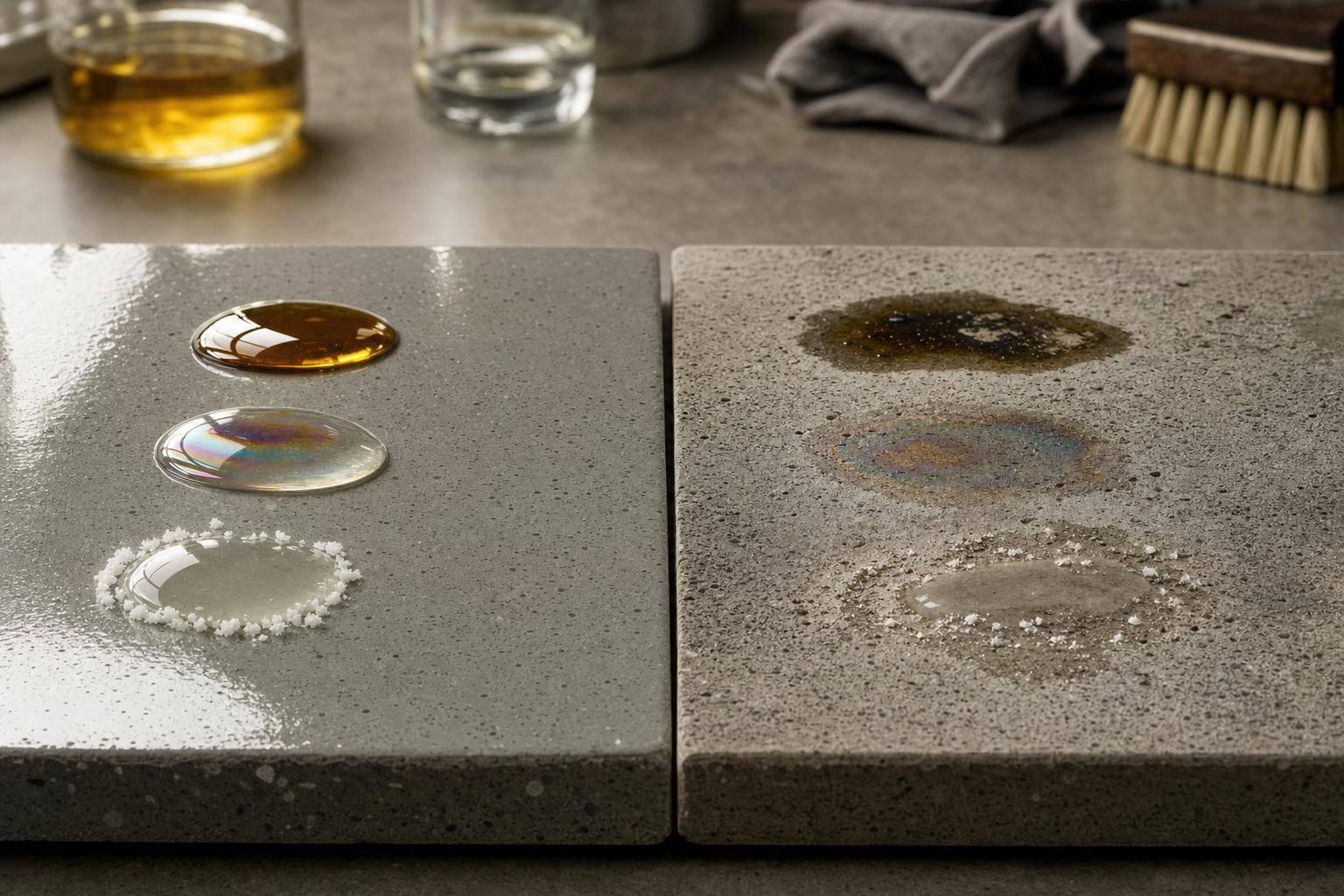
- Chemical resistance. Road salt, oil, gasoline, brake fluid — polyaspartic resists all of them. Epoxy stains and softens with prolonged chemical exposure.
- Slip resistance. A broadcast polyaspartic floor has a textured, slip-resistant surface even when wet. Epoxy can be slick, especially with moisture or garage fluids.
If you want to see the full list of trade-offs side by side, we break them down in our polyaspartic coating pros and cons guide.
Lifetime Warranty Backed by a Real Company
A lifetime manufacturer warranty sounds great — but it only matters if the company behind it will still be around to honor it. Croc Coatings has completed over 1,700 projects across North Idaho and Eastern Washington, with 340+ five-star reviews. As the exclusive Penntek-certified installer in the region, the warranty is backed by both the manufacturer and a local team you can call.
That matters because most epoxy warranties cover a year or two at most — and only if you can prove the installation was flawless and the concrete was perfectly prepared. A lifetime warranty that actually gets honored changes the risk equation entirely.
The Long-Term Math: Polyaspartic Saves Money Over Time
This is the section where the "more expensive" option flips. Let’s walk through the numbers on a standard two-car garage (400 sq ft).
Assume you plan to live in your home for 15 years. You have two paths:
Path A: Professional Epoxy ($2,500 initial install)
| Year | Action | Cost |
|---|---|---|
| 0 | Initial install | $2,500 |
| 4 | Recoat (peeling, wear) | $2,500 |
| 8 | Recoat | $2,500 |
| 12 | Recoat | $2,500 |
| 15-Year Total | $10,000 |
Path B: Polyaspartic/Polyurea ($3,200 initial install)
| Year | Action | Cost |
|---|---|---|
| 0 | Initial install | $3,200 |
| 4 | — | $0 |
| 8 | — | $0 |
| 12 | — | $0 |
| 15-Year Total | $3,200 |
Polyaspartic saves $6,800 over 15 years — more than double the initial premium.
Even if you assume a best-case epoxy scenario where it somehow lasts 7 years per coat (unlikely in a working garage, but let’s be generous):
- Epoxy: initial $2,500 + one recoat at year 7 ($2,500) = $5,000
- Polyaspartic: $3,200 once
Polyaspartic still wins by $1,800 — and you never dealt with a single redo.
Stretch the timeline to 30 years, and the gap becomes staggering. Independent analysis from the concrete coating industry estimates that budget epoxy with regular redo cycles can cost $40,000–$45,000 over three decades, while a single Penntek polyurea installation at $4,500–$9,000 covers the same period. The math is not close.
For a more detailed side-by-side, our polyaspartic vs epoxy cost breakdown goes deeper into the numbers across different project sizes and finish levels.
What the Dollar Signs Don’t Capture: Non-Financial Value
Some things resist a line item but matter just as much:
Your garage stays usable. A one-day install means you park inside that night. With epoxy, the garage is off-limits for the better part of a week — tools, bikes, and cars displaced to the driveway or street.
No fumes in your home. Epoxy off-gasses VOCs for days. If your garage is attached, those fumes migrate into the house. Polyaspartic systems are low-VOC and solvent-free — no headache, no ventilation setup, no "maybe the kids should stay at grandma’s."
It still looks good five years later. Walk through any neighborhood and find a five-year-old epoxy floor. It is probably chalking at the edges, yellowed near the garage door, and peeling where the tires sit. A five-year-old polyaspartic floor looks essentially new. That matters if you take pride in your home — or if you plan to sell it.
Speaking of which: garage improvements typically return 60–80% of their cost in added home value, according to the National Association of Realtors. A polyurea garage floor specifically can recover 20–25% of the investment in increased home value. A polyaspartic floor that still looks new during a showing sends a different signal than a peeling epoxy floor the buyer is already budgeting to replace.
For a broader look at how coating choices affect your wallet over time, see our long-term savings analysis for concrete coatings.
When Epoxy Actually Makes Sense
No honest guide can claim polyaspartic is always the right call. Here is when epoxy is the smarter choice:
You are selling within 2–3 years. If the house hits the market in 2026, a $2,500 epoxy floor looks fresh during showings and you never live long enough to see it peel. The buyer inherits the recoat, not you.
The upfront budget is genuinely tight. If the $800–$1,600 premium is the difference between doing the floor and leaving bare concrete, epoxy is better than nothing. A coated floor — even epoxy — still looks better than raw, stained concrete and offers some protection.
It is a rental property. Tenants are unlikely to treat any floor gently, and the landlord’s calculus is different from a homeowner’s. Epoxy at $2,000–$2,800 every 4–5 years may pencil out for a rental where the floor takes abuse and the turnover timeline is shorter than a polyaspartic lifespan.
You are coating a low-traffic area. A basement floor that sees storage and occasional foot traffic, or a workshop corner that never sees vehicles, does not need 4x strength and chemical resistance. Epoxy works fine in light-duty settings.
The point is not that epoxy is bad. It is that epoxy is a shorter-term solution, and whether that matters depends on your timeline. For most homeowners planning to stay in their home, the math favors polyaspartic — but that math only works when you actually stay long enough to collect the savings.
If you are trying to decide which path fits your situation, our short-term vs long-term cost comparison walks through the decision more thoroughly.
Two Neighbors, Two Choices: A 15-Year Story
Mike and Dave live next door to each other in the same subdivision. Same floor plan, same two-car garage, same concrete slab poured by the same crew.
In 2026, both decide to coat their garage floors.
Mike goes with epoxy. He pays $2,500. The floor looks great — glossy, clean, a real upgrade from bare concrete. By 2029, the edges near the garage door have started to yellow. By 2031, there is a patch where the hot tires sit that has dulled and begun to lift. He recoats in 2032 for another $2,500. By 2037, the second coat is showing the same wear pattern, and he recoats again — $2,500 more. By 2041, his 15-year garage floor journey has cost him $7,500–$10,000, and he has cleared out his garage three separate times for multi-day installations.
Dave goes with polyaspartic. He pays $3,200. The floor also looks great on day one. In 2029, it looks the same. In 2031, the hot-tire patch is unmarked. In 2037, after 11 years, there is a small scuff near the workbench where a toolbox dragged, but the coating is intact, the color is unchanged, and the warranty still covers it. By 2041, his 15-year total is $3,200 — and the floor still looks showroom-ready.
Mike paid more than twice as much. He also spent three weeks of his life with his garage torn apart for recoat cycles. Dave spent one day.
That is not marketing. That is math.
The Honest Downsides of Polyaspartic
Every flooring system has drawbacks, and polyaspartic is no exception. Here are the real ones — the kind homeowners on forums like Garage Journal and Reddit raise, and the kind worth knowing before you write a check.
Higher upfront cost. We have been clear about this: you pay $800–$1,600 more on day one for a standard garage. If that stretches your budget past the breaking point, it is a real barrier.
Professional installation required. Polyaspartic is not a DIY product. The chemistry is fast-curing — pot life is measured in minutes, not hours — and the surface preparation (diamond grinding, moisture testing, crack repair) requires equipment and expertise most homeowners do not have. You cannot buy a polyaspartic kit at a home center and roll it on over a Saturday. That means the labor cost is baked in permanently.
Moisture-sensitive substrate prep. If your concrete slab has high moisture vapor transmission, a proper moisture barrier must be applied before the coating. Skip this step, and any coating — polyaspartic included — will fail. A reputable installer tests for this; a cheap one does not. Ask about it.
Not infinitely repairable. If a polyaspartic floor does get damaged — a deep gouge from dropped machinery, for example — spot repairs are possible but not invisible. The repair area may show a slight texture or sheen difference. With epoxy, you can often sand and recoat the whole floor relatively easily. With polyaspartic, a full recoat is rarely needed, but a cosmetic touch-up is more involved.
Limited DIY recourse. If something goes wrong with an epoxy floor you installed yourself, you can grind it off and try again, or patch and recoat. With polyaspartic, the installation window is so tight and the chemistry so specific that DIY attempts almost always end badly. You are committed to hiring a pro — and that pro needs to be certified and experienced with the specific system.
These are not reasons to avoid polyaspartic. They are reasons to choose your installer carefully and understand what you are buying. A coating that lasts 20 years is only as good as the crew that puts it down.
So, Is Polyaspartic Worth the Money?
For most homeowners who plan to stay in their home for more than 5 years, yes — polyaspartic is worth the money.
The math is not ambiguous. Over 15–20 years, you pay less for a floor that looks better, lasts longer, installs faster, and carries a real warranty. The $800–$1,600 premium buys you a floor that costs roughly half as much per year of service and spares you the disruption, fumes, and frustration of repeated epoxy recoats.
But "worth it" depends on your timeline:
- Staying 10+ years? Polyaspartic wins easily.
- Staying 3–7 years? The math narrows — polyaspartic may still win, but the margin is smaller and you should weigh the upfront premium honestly.
- Selling within 2–3 years? Epoxy may be the smarter financial move. The floor looks fresh for showings, and the buyer absorbs the recoat timeline.
The key is that polyaspartic is not "more expensive" in any honest long-term comparison. It is cheaper — it just asks you to pay for the quality upfront instead of spreading the cost across a series of redo cycles.
If you are in North Idaho or Eastern Washington and want to see what a polyaspartic floor would cost for your specific garage, patio, or basement, Croc Coatings offers a free in-home consultation with a detailed quote — no pressure, just real numbers for your actual space.
Frequently Asked Questions
Does a polyaspartic garage floor increase home value?
Yes. The National Association of Realtors reports that garage improvements typically return 60–80% of their cost in added home value. A polyurea garage floor specifically can recoup 20–25% of the investment. More importantly, a clean, finished garage floor makes a strong first impression during showings — it signals a well-maintained home. A peeling epoxy floor sends the opposite signal, and buyers mentally deduct the cost of replacement from their offer.
Is polyaspartic really better than epoxy?
Objectively, yes — on nearly every performance metric. Polyaspartic is roughly 4x stronger, more flexible (so it does not delaminate from moving concrete), UV-stable, chemical-resistant, and installs in one day instead of 3–5. It lasts 15–20+ years vs epoxy’s 3–5. The only dimension where epoxy wins is upfront price. Whether that trade-off makes sense for your situation is what this entire guide is about.
What are the common problems with polyaspartic floors?
The most common problem is installer error, not material failure. Polyaspartic cures quickly — if the crew is not experienced, the coating can set before it is properly applied, leaving uneven texture or weak adhesion. Moisture in the slab is another culprit: without proper testing and a vapor barrier, any coating will eventually fail. Other issues include UV degradation of low-quality topcoats (not an issue with Penntek systems) and cosmetic touch-up complexity. The takeaway: choose a certified installer with a track record, not the lowest bid.
How long does a polyaspartic floor actually last?
A professionally installed polyaspartic/polyurea floor from a certified installer typically lasts 15–20 years or more in a working residential garage. The Penntek system Croc Coatings installs carries a lifetime manufacturer warranty. Real-world longevity depends on surface prep quality, climate, and how hard the floor is used — but 15+ years is a conservative baseline, not an outlier.
Can I install polyaspartic myself to save money?
In almost all cases, no. Polyaspartic coatings are not sold as consumer DIY kits — the chemistry is too fast and the surface preparation too demanding. Diamond grinding, moisture testing, crack repair, and timed multi-coat application all require professional equipment and training. Attempting a DIY polyaspartic install typically results in a failed floor that costs more to remove and redo than hiring a pro from the start. If you are set on a DIY floor, epoxy is the more practical (though shorter-lived) option.