What Goes Into Pool Deck Coating Costs?
- Pool deck coating costs range from $4 to $20 per square foot installed, depending on the material you choose — with most residential projects landing between $5 and $9 per square foot.
- The total price for a typical 500–900 square foot pool deck runs $1,500 to $10,800 nationally, with coatings being far more affordable than a full tear-out and replacement.
- The single biggest cost driver is your deck’s square footage, followed by the condition of the existing concrete and how much prep work it needs.
- Choosing the right coating isn’t just about the upfront price tag — a cheaper material that needs reapplication every two years can cost more over a decade than a premium coating installed once.
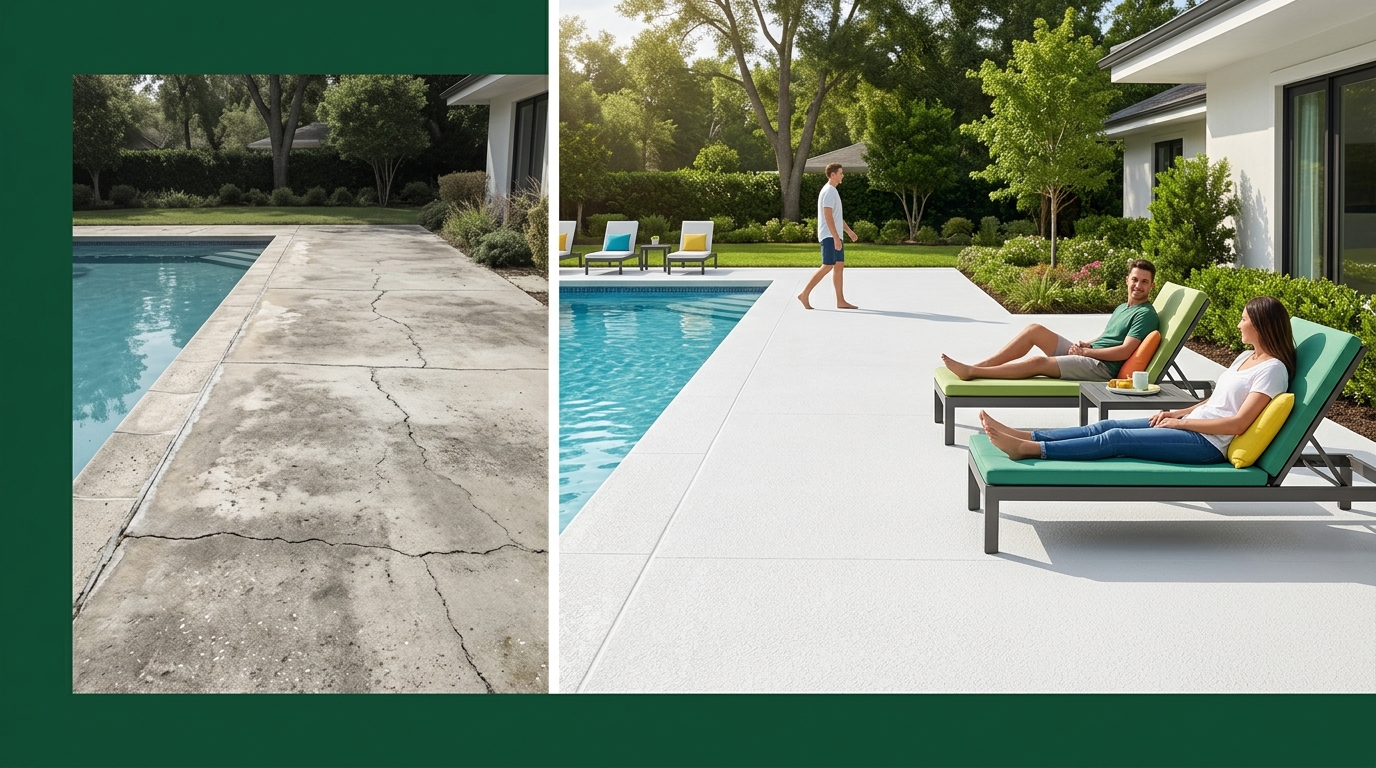
If you’re researching pool deck coating costs, you’re probably staring at a worn, cracked, or faded deck and trying to figure out what a realistic budget looks like. The numbers vary a lot — and for good reason. The coating material itself, the size and condition of your deck, and where you live all push the final price up or down.
This guide walks you through exactly what to expect: per-square-foot pricing for every major coating type, the cost factors that actually matter, a side-by-side comparison of what you’ll pay over 10 years, and what homeowners in North Idaho and Eastern Washington should budget for their local climate.
Pool Deck Coating Costs by Material Type
The coating you pick sets the baseline for your entire budget. Prices below reflect professionally installed costs per square foot — including materials, labor, and standard surface preparation. They’re based on national data from HomeGuide and ConcreteNetwork, adjusted for the coatings commonly used on residential pool decks.
Acrylic Coatings ($4–$6/sq ft)
Acrylic is the entry-level option and the most common budget choice for pool decks. It’s a water-based coating that goes down quickly and costs the least upfront.
A 500-square-foot deck in acrylic runs roughly $2,000 to $3,000 installed. It provides decent slip resistance and comes in a range of colors. The tradeoff is durability: acrylic wears thin in high-traffic areas, fades under direct sun, and typically needs a full reapplication every 1 to 3 years depending on climate and use.
For a seasonal cabin pool or a deck you don’t mind recoating regularly, acrylic keeps the initial check small. For a primary residence where you want to coat it and move on, the long-term math gets expensive.
Epoxy Coatings ($5–$7/sq ft)
Epoxy is a step up in durability and the most widely known concrete coating. At $5 to $7 per square foot installed, a 600-square-foot deck costs about $3,000 to $4,200.
Epoxy bonds well to concrete and creates a hard, glossy finish that resists chemicals and pool water. The catch with outdoor pool decks is UV exposure: epoxy yellows and chalks over time in direct sunlight. It also turns brittle as it ages, which makes it prone to chipping and cracking — especially in climates with freeze-thaw cycles. Most epoxy pool decks last 3 to 7 years before they need significant repair or recoating.
It’s a solid mid-range option if your deck is mostly shaded or under a pool enclosure. In full sun — which describes most pool decks in the Inland Northwest — epoxy’s lifespan trends toward the lower end of that range.
Polyurea Coatings ($7–$9/sq ft)
Polyurea sits at the top of the residential coating market for good reason. At $7 to $9 per square foot installed, a 600-square-foot pool deck runs about $4,200 to $5,400.
What sets polyurea apart is the combination of speed and longevity. It cures in hours — most installations are finished in a single day — and it carries a lifetime manufacturer warranty. Polyurea is UV-stable, so it won’t yellow or fade, and it flexes with concrete through freeze-thaw cycles instead of cracking. It’s also 4x stronger than epoxy and naturally slip-resistant even when wet.
Learn more about why polyurea is the top-performing pool deck material.
In North Idaho and Eastern Washington, Croc Coatings installs Penntek polyurea coatings as the region’s exclusive certified installer. They offer free in-home consultations and custom quotes — call for pricing on your specific deck. For homeowners who want to pay once and be done, polyurea delivers the best long-term value despite the higher upfront cost.
Rubberized Coatings ($8–$12/sq ft)
Rubberized pool deck coatings — often made from recycled rubber granules bound with a polyurethane binder — are the safety-first option. At $8 to $12 per square foot, a 500-square-foot deck costs $4,000 to $6,000 installed.
The surface is soft, cushioned, and highly slip-resistant, which makes it popular for commercial pools, senior living communities, and families with young children. It handles freeze-thaw cycles well and drains water effectively through its porous surface.
The downsides: rubberized coatings show wear in heavy foot-traffic lanes, can trap dirt and debris in the textured surface, and typically last 8 to 12 years before needing replacement. For most residential pool decks, the cost premium over polyurea is hard to justify unless safety is the overriding priority.
Stamped Concrete Overlays ($10–$20/sq ft)
Stamped overlays are the high-end aesthetic choice. A thin layer of polymer-modified concrete is applied over your existing deck, then stamped and stained to mimic natural stone, brick, tile, or wood. At $10 to $20 per square foot, a 600-square-foot deck runs $6,000 to $12,000.
The result is a custom, luxury look at a fraction of what a full teardown and decorative concrete pour would cost. Stamped overlays last 10 to 20 years with proper sealing and maintenance. The tradeoffs are price — it’s the most expensive coating option by a wide margin — and the fact that it still needs resealing every 2 to 3 years to protect the decorative finish.
If your top priority is aesthetics and curb appeal, and your budget can absorb it, a stamped overlay transforms a pool deck into a design feature. If you’re optimizing for durability and cost, polyurea or epoxy deliver more practical value.
Cost Factors That Drive the Final Price
The material you pick sets the range. These six factors determine where inside that range your project lands.
Deck Size: The Biggest Cost Driver
Square footage is the multiplier for everything else on this list. Most residential pool decks fall between 300 and 900 square feet, with 500 to 600 being the most common.
Here’s what that means in real dollars for three common sizes, using polyurea at the midpoint ($8/sq ft) as the example:
| Deck Size | Total Cost (Polyurea @ $8/sq ft) |
|---|---|
| 300 sq ft (small plunge pool) | $2,400 |
| 600 sq ft (standard residential) | $4,800 |
| 900 sq ft (large family pool) | $7,200 |
Your actual cost will land higher or lower depending on prep work, repairs, and upgrades — but square footage is the number that anchors the quote. Not sure of your deck’s exact dimensions? Use our pool deck coverage estimator — enter your measurements and get a quick material estimate.
Concrete Condition and Surface Prep
This is the wildcard in any pool deck quote. A deck in good condition — solid concrete with no major cracks, spalling, or delamination — needs only standard cleaning, etching, and priming before coating. That’s built into the base per-square-foot price.
A deck with moderate damage changes the math. Grinding down high spots, filling hairline cracks, and patching small spalled areas adds $0.50 to $2.00 per square foot depending on severity. A deck that’s severely deteriorated — deep cracks, heaved sections, widespread spalling — may need partial concrete replacement or extensive grinding before any coating can go down. That prep work can add $2 to $5 per square foot or more.
The lesson: get an on-site inspection and a line-item quote. A contractor who gives you a number over the phone without seeing the deck is guessing.
Repairs Needed Before Coating
Separate from surface prep, some decks need structural repairs that go beyond what the coating installer typically handles. Large cracks wider than 1/4 inch, sunken or heaved sections from freeze-thaw cycles, and concrete that’s delaminating in sheets all need to be addressed first.
Crack repair runs $1 to $3 per linear foot on average. Mudjacking or polyurethane foam leveling to fix a sunken slab costs $500 to $1,500 depending on the area. Full section replacement is $8 to $12 per square foot for the concrete work before coating.
If your deck has structural issues, budget for the repairs separately — they’ll come before the coating quote and can double the total project cost if the damage is extensive.
Decorative Upgrades and Custom Finishes
Most coating systems offer aesthetic upgrades that affect the final price:
- Decorative flakes and chips added to the base coat for a speckled, stone-like finish: $0.50 to $2.00 per square foot depending on flake density and color blend.
- Custom colors beyond the standard palette: $0.50 to $1.50 per square foot.
- Borders, bands, and accent patterns: $2 to $5 per linear foot for taped or stenciled designs.
- Metallic or quartz finishes: $2 to $5 per square foot for specialty topcoats.
These add 15% to 40% to the base material cost depending on how elaborate you go. For a 600-square-foot mid-range polyurea deck at $4,800, expect to add $700 to $1,900 for a fully customized finish.
Want to see how different colors and finishes look on a pool deck? Try our pool deck color selector to browse options that fit your style and budget.
Slip-Resistant Additives
Pool decks get wet, and wet concrete gets slippery. Most quality coatings include a base level of slip resistance in the formulation itself — polyurea and rubberized coatings are naturally slip-resistant without additives.
If you’re choosing a coating that needs a slip-resistant boost or you want extra grip for an area with heavy kid traffic, additives like aluminum oxide grit or polymer beads add $0.25 to $1.00 per square foot. It’s an inexpensive upgrade that’s worth every penny around a pool.
Read our full guide on slip-resistant pool deck coatings and textured finishes.
Labor Rates and Regional Pricing
Labor rates for concrete coating contractors vary significantly by region. In major metros on the coasts, expect $60 to $100 per hour for skilled coating installers. In the Inland Northwest — including Coeur d’Alene, Spokane, Sandpoint, and the Tri-Cities — rates tend to run $45 to $75 per hour, which keeps total project costs at or slightly below the national mid-range.
The regional tradeoff: lower labor rates, but a climate that demands a more durable coating. More on that in the regional pricing section below.
Upfront Cost vs. Long-Term Value: A 10-Year Comparison
The price you pay today is only part of the story. A coating that costs half as much upfront but needs replacing three times over a decade ends up being the more expensive choice. This table compares the true 10-year cost of each material, factoring in typical lifespan and reapplication frequency for a standard 600-square-foot pool deck.
| Coating Type | Cost/sq ft | Upfront Cost (600 sq ft) | Typical Lifespan | Reapplications Over 10 Years | True Cost Over 10 Years |
|---|---|---|---|---|---|
| Acrylic | $4–$6 | $2,400–$3,600 | 1–3 years | 3–5 reapplications | $9,600–$21,600 |
| Epoxy | $5–$7 | $3,000–$4,200 | 3–7 years | 1–2 reapplications | $6,000–$12,600 |
| Polyurea | $7–$9 | $4,200–$5,400 | 15+ years (lifetime warranty) | 0 | $4,200–$5,400 |
| Rubberized | $8–$12 | $4,800–$7,200 | 8–12 years | 0–1 reapplication | $4,800–$14,400 |
| Stamped Overlay | $10–$20 | $6,000–$12,000 | 10–20 years | 0 reapplications (reseal every 2–3 yrs: $0.50–$1.50/sq ft) | $9,000–$21,000 |
The numbers tell a clear story: acrylic and epoxy look cheaper on day one but cost more over time because they don’t last. Polyurea and stamped overlays cost more upfront but deliver the lowest 10-year total. Rubberized coatings land in the middle — competitive with polyurea at the low end of their range, expensive at the high end.
Resealing costs for stamped overlays ($0.50–$1.50 per square foot every 2–3 years) add $3,000 to $9,000 over a decade on a 600-square-foot deck — pushing the total well past polyurea. That’s worth factoring in if you’re drawn to the stamped overlay aesthetic.
Regional Pricing: What North Idaho & Eastern Washington Homeowners Should Expect
Pool deck coatings in the Inland Northwest face conditions that milder climates don’t. Freeze-thaw cycles from November through March subject the coating to repeated expansion and contraction. Summer brings intense UV exposure with weeks of 90°F+ temperatures. Both extremes punish coatings that aren’t built for them.
What this means for your budget:
- The material matters more here than it does in, say, Phoenix or Southern California. Acrylic in this climate may need reapplication every year instead of every 2–3. Epoxy’s brittleness in cold weather shortens its outdoor lifespan toward the 3-year end of its range. Spending more on a UV-stable, flexible coating like polyurea isn’t an upgrade — it’s a practical hedge against the climate.
- Prep work often costs more here. Years of freeze-thaw cycling leave concrete with hairline cracks, minor spalling, and surface degradation that a deck in a warm climate might not have. Budget an extra $0.50 to $1.50 per square foot for prep if your deck is more than 10 years old and has seen Inland Northwest winters.
- Labor rates in the region are reasonable. At $45 to $75 per hour for skilled installers, you’re paying less for labor than homeowners in Seattle, Portland, or Boise — and the finished cost per square foot reflects that.
For a standard 600-square-foot pool deck in Coeur d’Alene, Spokane, or Sandpoint, expect to pay:
- $2,700–$4,200 for acrylic (with the understanding you’ll reapply frequently)
- $3,300–$4,800 for epoxy
- $4,500–$5,700 for polyurea (one-day install, lifetime warranty)
- $5,100–$7,800 for rubberized
- $6,600–$13,200 for a stamped overlay
These ranges account for typical local labor rates and moderate surface prep. Every deck is different — the only way to get a firm number is an on-site inspection and measurement.
Frequently Asked Questions
Can I DIY my pool deck coating to save money?
You can, and the material savings are real — DIY acrylic kits run $1.50 to $3.00 per square foot versus $4 to $6 installed. DIY epoxy kits are $2 to $4 per square foot versus $5 to $7 professionally installed.
The hidden costs are what catch people. Renting a concrete grinder, buying proper etching and priming chemicals, fixing cracks you discover mid-project, and correcting mistakes all eat into the savings. Surface prep is the part most DIYers underestimate — if the concrete isn’t properly cleaned, profiled, and primed, the coating peels within months regardless of how carefully it was applied.
For acrylic on a small deck in good condition, DIY is a reasonable weekend project. For epoxy, polyurea, rubberized, or stamped overlays on anything bigger than 200 square feet, professional installation pays for itself in longevity. Polyurea in particular requires specialized equipment and training — it’s not sold as a DIY product.
Does homeowners insurance cover pool deck coatings?
Generally, no — not as a standard maintenance or upgrade expense. Pool deck coating is considered home improvement, not a covered repair, unless the damage that made the coating necessary was caused by a covered peril (a tree falling on the deck, for example).
There’s one exception worth checking: if your pool deck coating includes slip-resistant properties that demonstrably reduce liability risk, some insurers offer a small discount on your premium. It won’t offset the cost of the coating, but it’s worth a phone call to your agent.
How long after coating can I use the pool deck?
It depends on the material:
- Polyurea: walk on it in 4–6 hours, full use in 24 hours. Most installations are finished in one day and ready the next morning.
- Epoxy: light foot traffic in 12–24 hours, full cure in 48–72 hours.
- Acrylic: light foot traffic in 4–8 hours, full cure in 24–48 hours depending on humidity.
- Rubberized: walkable in 12–24 hours, full cure in 24–48 hours.
- Stamped overlay: foot traffic in 24 hours, full cure in 48–72 hours before furniture or heavy use.
Weather affects all of these — high humidity or cool temperatures extend cure times. Your installer should give you a specific timeline based on the product and conditions on install day.
Is financing available for pool deck coatings?
Yes. Several financing routes are available for concrete coating projects:
- Many coating contractors partner with third-party lenders to offer payment plans. Croc Coatings offers 0% interest financing for 12 months on qualifying projects — your coating goes in now and you pay it off over the year with no interest added.
- A home equity line of credit (HELOC) or home improvement loan from your bank typically offers lower rates than unsecured financing for larger projects.
- Some homeowners bundle pool deck coating into a broader exterior renovation and finance the whole project through a cash-out refinance or renovation loan.
Financing makes sense when the coating you want will last 15+ years — you’re spreading the cost of a long-term upgrade over a fraction of its useful life.
Is painting my pool deck a good alternative to coating?
Painting a concrete pool deck costs $4 to $8.50 per square foot professionally, according to Angi — not dramatically cheaper than acrylic or epoxy coatings. The bigger issue is longevity: pool deck paint typically lasts 1 to 2 years before it peels, fades, and needs redoing, especially in a climate with freeze-thaw cycles.
Coating systems bond to the concrete at a chemical level and are formulated for outdoor foot traffic, UV exposure, and water immersion. Paint sits on top of the concrete and isn’t. Over a 5-year span, painting a 600-square-foot deck three times at $4 per square foot costs $7,200 — more than a polyurea coating installed once with a lifetime warranty.
Paint makes sense as a temporary seasonal refresh on a deck you plan to replace within a couple of years. For anything longer-term, a proper coating system costs less over time.
Ready to Budget Your Pool Deck Project?
Pool deck coating costs come down to three things: the material you pick, the size and condition of your deck, and where you live. Acrylic and epoxy keep the upfront number low but cost more over time. Polyurea and stamped overlays cost more today and less over a decade. Which one makes sense depends on how long you plan to be in the home and how often you’re willing to redo the surface.
If you’re in North Idaho or Eastern Washington, the climate tilts the math toward a durable, UV-stable, freeze-thaw-resistant coating — and the local labor rates keep the total price competitive with national averages.
For a firm quote on your specific deck, schedule a free in-home consultation with Croc Coatings. We’ll measure, inspect the concrete, walk you through your options, and give you a line-item price — no pressure, no obligation.
Related reading:
- 5 Best Concrete Coatings for Pool Decks — A detailed comparison of every material option
- Why Polyurea Is Ideal for Pool Decks — What makes polyurea the top performer
- Decorative Coatings for Pool Decks: Slip Resistance Guide — Safety and texture options
- Pool Deck Resurfacing: Pros & Cons — Weighing resurfacing against replacement
- Best Non-Slip Pool Deck Coatings — Safety-first coating options
- Cool, Heat-Reducing Pool Deck Coatings — Coatings that keep surfaces comfortable underfoot