Key Takeaways
- Three paths, not two: Most guides frame this as "resurface vs. replace." The reality is three options — a polyurea coating overlay, a full concrete resurfacing, or a complete tear-out and replacement — and the right one depends entirely on your deck’s condition.
- Coating is the fastest, least disruptive path: A professional polyurea coating installs in one day, costs $7–$9 per square foot, and adds 10–15+ years of life — without the mess of demolition.
- Full resurfacing costs more and takes longer: Pouring a new concrete overlay runs $8–$15 per square foot and requires several days of work plus cure time. It’s a solid middle ground for moderate surface damage.
- Replacement is the nuclear option: At $15–$25+ per square foot and weeks of disruption, tearing out and repouring is only necessary when the concrete is structurally failing.
- Your deck’s condition is the decision-maker: Surface cracks and cosmetic wear? Coating. Moderate spalling and minor settling? Coating or resurfacing. Major heaving, crumbling, or drainage problems? Replacement.
Introduction: Your Pool Deck Needs Work — Now What?
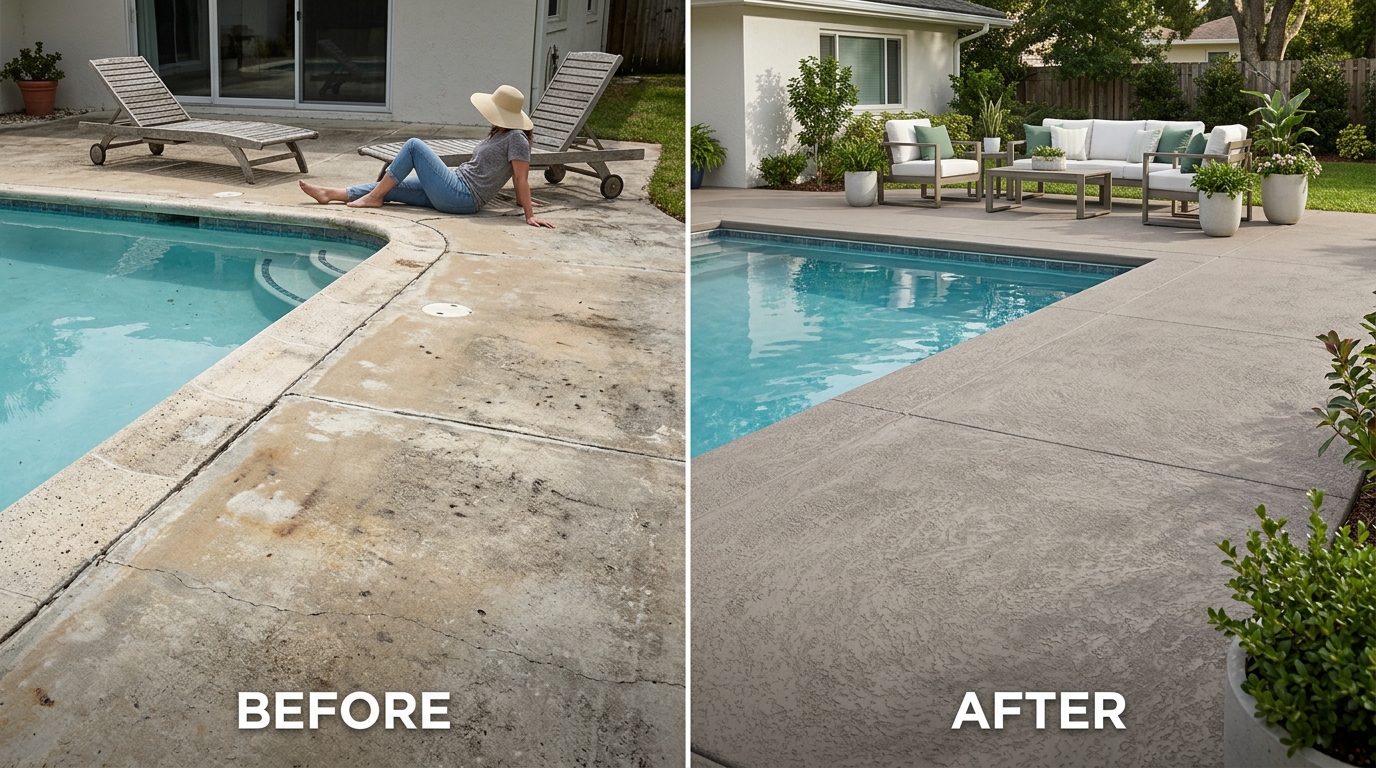
A worn-out pool deck is more than an eyesore. Cracks catch bare feet. Spalled concrete gets slick when wet. And every summer you spend ignoring it is another summer your pool area looks tired instead of inviting.
When you start searching "pool deck resurfacing pros and cons," you’ll quickly find that most advice frames the decision as a binary choice: resurface or replace. But that misses a critical third option — a high-performance concrete coating — that delivers most of what homeowners want from a new deck without the cost, time, or disruption of either traditional path.
This guide walks you through all three options side by side. By the end, you’ll know exactly which path fits your deck’s condition, your budget, and your timeline.
Path 1: Concrete Coating / Overlay ($7–$9/sq ft)
A concrete coating is the least invasive way to transform a tired pool deck. Instead of pouring new material over the old surface, a professional coating system bonds directly to the existing concrete after thorough preparation.
How It Works
The process starts with grinding or shot-blasting the concrete to open its pores, followed by crack repair and priming. Then a base coat is applied, broadcast with decorative flakes or quartz for texture and slip resistance, and sealed with a UV-stable clear topcoat. The result is a brand-new surface that’s bonded at the molecular level — not just sitting on top.
Pros
- One-day installation: Most residential pool decks are finished in a single day, with full cure in 24 hours. No waiting a week to use your pool.
- Minimal disruption: No demolition, no heavy equipment, no debris pile in your yard. The crew grinds, coats, and leaves.
- Slip-resistant finish: Unlike bare concrete or smooth overlays, a properly textured coating provides reliable traction even when wet — a critical safety upgrade.
- Wide design range: Flake blends, quartz finishes, metallic effects, and custom colors let you match any aesthetic. You’re not stuck with plain gray.
- 10–15+ year lifespan: High-quality polyurea and polyaspartic coatings routinely last 15 years or more with basic care. By contrast, standard outdoor epoxy breaks down in 3–5 years under UV exposure.
- UV-stable and chemical-resistant: Advanced polyurea coatings won’t yellow, chalk, or degrade from pool chemicals and sunlight the way acrylics and epoxies do.
- Seamless, low-maintenance surface: Unlike paver pool decks — which shift over time, trap weeds between joints, and typically cost more to install — a coated concrete deck is one continuous, easy-to-clean surface with no gaps for debris to collect.
Cons
- Not a structural fix: A coating bonds to the existing concrete — it can’t correct major heaving, deep structural cracks, or drainage problems. If your deck is actively failing beneath the surface, a coating is the wrong call.
- Requires a sound base: The concrete must be in good enough condition to accept the coating. Large spalled areas, delamination, or crumbling edges need repair before coating — and in severe cases, those repairs may push you toward resurfacing or replacement.
- Not DIY-friendly: Proper surface preparation requires industrial grinding equipment and diamond tooling. This isn’t a paint-and-pray weekend project.
Path 2: Full Resurfacing ($8–$15/sq ft)
Full resurfacing — sometimes called a concrete overlay or micro-topping — involves pouring a new layer of concrete or polymer-modified cement over the existing slab. It’s a step up in both cost and invasiveness from a coating, but still avoids full demolition.
How It Works
The old surface is cleaned and profiled (usually by grinding or acid etching), a bonding agent is applied, and a new layer — typically ¼ inch to 2 inches thick — is poured, leveled, and finished. Stamped patterns, broomed textures, and tinted colors are all possible during the pour.
Pros
- Addresses moderate surface damage: Spalling, minor surface cracking, and light wear that’s too deep for a coating to bridge can be covered by a fresh overlay.
- Smoother, more uniform finish: An overlay can correct years of uneven wear, giving you a clean slate without removing the original slab.
- Cheaper than replacement: At $8–$15 per square foot, resurfacing typically costs 30% to 50% less than full demolition and replacement.
Cons
- Longer timeline: Resurfacing takes 2–5 days for the pour and finishing, plus cure time before the deck can handle foot traffic and furniture. Your pool area is out of commission for at least several days — and often longer if weather delays curing.
- Bonding risks: The new overlay and the old slab expand and contract at different rates. In regions with freeze-thaw cycles — like North Idaho and Eastern Washington — this thermal mismatch can cause delamination over time.
- Still not structural: Like a coating, an overlay sits on top of the existing concrete. It masks moderate problems but doesn’t fix deep structural issues.
- Maintenance adds up: Most concrete overlays need resealing every 3–5 years to prevent staining, water absorption, and surface wear.
Path 3: Rip-and-Replace ($15–$25+/sq ft)
Full replacement is exactly what it sounds like: the existing deck is demolished, hauled away, and replaced with a brand-new concrete pour. It’s the most expensive and disruptive option — and only necessary in specific circumstances.
How It Works
Crews break up and remove the old concrete with jackhammers or heavy machinery, grade and compact the sub-base, set forms, and pour new concrete. The new slab then cures — a process that takes 28 days for full strength, though light use is often possible after 7 days.
Pros
- Brand-new deck: Everything is fresh — concrete, reinforcement, joints, drainage. No underlying problems carry forward.
- Fixes everything: Major heaving from frost, deep structural cracks, crumbling concrete, and drainage failures are all solved by starting over.
- Longest lifespan: A properly poured and maintained concrete pool deck can last 25–30 years.
Cons
- Highest cost: At $15–$25 per square foot — and often $15 to $35 in some markets — replacement is 2–3x the cost of a coating. For a 500-square-foot deck, that’s the difference between roughly $4,000 and $10,000+.
- Weeks of disruption: Demolition, grading, pouring, and curing can stretch to 2–3 weeks or more before the pool area is fully usable again. Heavy equipment tears up landscaping, and demolition debris needs a disposal plan.
- Overkill for most decks: The majority of worn pool decks are structurally sound — they just look bad. Spending tens of thousands on a problem that a coating or overlay would solve is hard to justify.
Head-to-Head Comparison: Coating vs. Resurfacing vs. Replacement
| Coating / Overlay | Full Resurfacing | Rip-and-Replace | |
|---|---|---|---|
| Cost per sq ft | $7–$9 | $8–$15 | $15–$25+ |
| Timeline | 1 day + 24-hour cure | 2–5 days + cure time | 2–3+ weeks |
| Lifespan | 10–15+ years | 10–15 years | 25–30 years |
| Disruption | Minimal — no demolition | Moderate — pouring and finishing | Major — demolition, grading, pouring |
| Best for | Surface cracks, cosmetic wear, minor pitting — structurally sound decks | Moderate spalling, surface wear, unevenness — decks with no major structural issues | Major heaving, deep structural cracks, crumbling concrete, drainage failure |
| Limitations | Can’t fix structural problems; requires a sound base | Bonding risks in freeze-thaw climates; doesn’t fix deep structural issues | Extreme cost and disruption; overkill for most decks |
| Slip resistance | Excellent — textured finish built in | Good — depends on finish (broomed, stamped) | Good — depends on finish |
| Design options | Wide — flakes, quartz, metallic, custom colors | Moderate — stamps, tints, broomed textures | Moderate — stamps, tints, exposed aggregate |
Which Path Is Right for Your Pool Deck?
This is the question that matters most. Instead of a generic recommendation, use the three tiers below to diagnose your deck honestly. Be ruthless — overestimating your deck’s condition leads to expensive rework; underestimating it wastes money on a coating that won’t hold.
Good Candidate for Coating
Your deck has surface-level issues: hairline cracks, cosmetic wear, minor pitting, or fading from years of sun exposure. The concrete itself is solid — no heaving, no large structural cracks, no sections that have separated or sunk.
What to do: A polyurea coating is your best path. It restores the surface in one day, adds slip resistance, and extends the deck’s life by 10–15+ years at the lowest cost of the three options. The existing concrete becomes the structural base; the coating handles everything above it.
If you’re in this camp, learn more about why polyurea is ideal for pool decks — it’s 4x stronger than epoxy, UV-stable, and backed by a lifetime manufacturer warranty.
Once you’ve decided, take the next step: use our pool deck coating design tool to visualize how your deck could look, and browse the pool deck coating color selector to find the finish that fits your outdoor space.
Borderline — Coating Can Still Work, But Get an Expert Eye
Your deck shows some spalling (the surface flaking off in patches), minor settling that created uneven areas, or cracks wider than a hairline but not structural. You’re not sure if the base is sound enough for a coating.
What to do: Don’t guess. A professional assessment will tell you whether the concrete can be repaired enough to accept a coating, or whether you need to step up to resurfacing. In many borderline cases, proper crack repair and surface grinding make a coating viable — especially polyurea, which has the flexibility to bridge minor movement that would crack a rigid overlay. But if the damage runs deeper than the surface, full resurfacing is the safer bet.
For a deeper look at traction and finish options, see our slip resistance guide for decorative pool deck coatings.
Too Far Gone — Replacement Is the Honest Answer
Your deck has major heaving (sections pushed up or sunk by frost), deep structural cracks that run through the full slab thickness, crumbling concrete edges, or drainage issues that pool water against the house. These are structural failures, not surface problems.
What to do: A coating or overlay applied over failing concrete will fail along with it — sometimes within months. Save your money for a full replacement. It’s expensive and disruptive, but it’s the only option that solves the root cause. Once the new concrete has cured for a full season, you can still apply a polyurea coating for slip resistance, aesthetics, and long-term protection.
Climate Matters: Why Your Region Affects the Decision
The pool deck advice that works in Phoenix doesn’t necessarily apply in Coeur d’Alene. Climate directly affects how each path performs over time.
Freeze-thaw regions (North Idaho, Eastern Washington, the Midwest, Northeast): Water seeps into concrete pores and cracks, freezes, expands, and slowly breaks the slab apart. This is the primary failure mode for pool decks in cold climates. Coatings help by sealing the surface — polyurea in particular is flexible enough to move with minor thermal expansion — but a deck that’s already heaved or deeply cracked won’t be saved by any surface treatment. If you’re in a freeze-thaw zone and your deck has survived several winters without structural movement, you’re likely a strong coating candidate.
Hot, high-UV regions (Arizona, Texas, Florida): Sun degradation and heat absorption are the bigger threats here. Epoxy coatings chalk and yellow within a few years; acrylics fade. UV-stable polyurea holds its color and gloss far longer. If heat is your main concern — bare concrete can hit 130°F+ in direct sun — cool, heat-reducing pool deck coatings are worth exploring.
The takeaway: don’t apply generic advice to a region-specific problem. Your local climate should be part of the decision.
Why Polyurea Coatings Excel for Pool Decks
If your deck falls into the "good candidate" or even "borderline" tier, a polyurea coating deserves a hard look. Here’s why it outperforms both traditional resurfacing and the older coating technologies your competitors’ guides talk about:
- One-day installation: Most pool decks are finished and ready for light use in 24 hours. Compare that to 3–5 days for resurfacing or 2–3 weeks for replacement, and the disruption difference is dramatic.
- 4x stronger than epoxy: Polyurea’s tensile and flexural strength dramatically outperforms epoxy, which gets brittle outdoors and cracks under thermal movement.
- UV-stable — no yellowing, no chalking: Unlike epoxy and standard acrylics, polyurea won’t discolor in direct sun. The clear topcoat stays clear.
- Built-in slip resistance: The textured finish — typically broadcast with decorative flakes or quartz — provides reliable traction wet or dry. See our comparison of the best non-slip pool deck coatings for more detail.
- Lifetime manufacturer warranty: Croc Coatings is a Penntek-certified installer serving North Idaho and Eastern Washington. That means your polyurea pool deck coating is backed by a lifetime manufacturer warranty — not the 1–3 year coverage typical of epoxy or acrylic products.
- Chemical and stain resistant: Pool chemicals, sunscreen, and spilled drinks won’t etch or discolor the surface.
For a full breakdown of what polyurea costs compared to other coating materials, see our polyurea coating cost guide.
What About Maintenance?
Every pool deck surface needs some care. Here’s what to expect from each path:
Coating (polyurea): The lowest-maintenance option. An occasional rinse with a garden hose and a mild cleaner keeps it looking new. No resealing required. At the 10–15 year mark, a fresh clear topcoat can be applied to reset the surface — a fraction of the original installation cost.
Resurfacing (concrete overlay): Needs periodic resealing — typically every 3–5 years — to prevent staining and water penetration. Cracks that develop in the overlay over time should be filled promptly to prevent water from reaching the bond line. Missed maintenance shortens lifespan significantly.
Replacement (new concrete): Requires standard concrete care: sealing every 2–4 years, joint maintenance, and winter de-icing with calcium chloride (never rock salt, which spalls concrete). Concrete is porous — left unsealed, it stains and absorbs water that accelerates freeze-thaw damage.
Conclusion: Make the Call With Confidence
Pool deck resurfacing pros and cons ultimately come down to one question: what kind of shape is your concrete really in?
If it’s structurally sound with surface-level wear, a polyurea coating gives you a like-new deck in one day at the lowest cost — with better slip resistance, UV stability, and longevity than either a traditional overlay or a DIY epoxy job.
If the surface is rough but the base is good, resurfacing buys you a fresh layer without the cost of demolition.
And if the concrete is truly failing, replacement is the only honest answer — expensive, disruptive, and unavoidable.
The best next step? Have a professional look at your deck in person. What looks like a structural crack to an untrained eye might be a surface issue that a coating can handle. What looks minor could be the early sign of a slab that’s shifting.
If you’re in North Idaho or Eastern Washington, explore our full guide to the best concrete coatings for pool decks or reach out for a free, no-pressure assessment of your deck.
Frequently Asked Questions
Is pool deck resurfacing worth it?
Yes — if your deck has surface-level wear and the concrete base is sound. Resurfacing (or better yet, coating) costs 30–50% less than replacement and can extend your deck’s usable life by 10–15+ years. The key is matching the method to the damage: a coating for cosmetic and minor surface issues, a full overlay for moderate spalling, and replacement only when the slab is structurally failing.
What’s the difference between pool deck resurfacing and coating?
Resurfacing pours a new layer of concrete or polymer-modified cement (typically ¼–2 inches thick) over the existing slab. A coating is a thinner, high-performance system — usually polyurea or polyaspartic — that bonds to the prepared concrete at the molecular level. Coatings install faster (one day vs. several), tend to be more flexible and UV-stable, and don’t carry the bonding risks that overlays can in freeze-thaw climates.
How much does pool deck resurfacing cost?
Industry ranges vary by region and method. A coating/overlay typically runs $7–$9 per square foot. Full resurfacing with a concrete overlay averages $8–$15 per square foot. Complete tear-out and replacement runs $15–$25+ per square foot. For a 500-square-foot deck, that’s roughly $3,500–$4,500 for a coating, $4,000–$7,500 for resurfacing, and $7,500–$12,500+ for replacement. Use our pool deck coating coverage estimator to measure your deck’s square footage and get a personalized budget range.
How long does pool deck resurfacing last?
A quality concrete overlay pool deck resurfacing lasts 10–15 years or more with proper maintenance. Polyurea coatings can last 15+ years, dramatically outlasting standard epoxy which fails in 3–5 years outdoors. A new concrete pour can last 25–30 years.
Can you resurface a pool deck that has cracks?
It depends on the cracks. Hairline surface cracks are fine — a coating bridges them easily. Wider cracks (⅛ inch or more) need to be filled and repaired before coating or resurfacing. Deep structural cracks that run through the full slab thickness and show signs of movement are a red flag — they usually indicate a failing base that needs replacement, not a surface fix.