Key Takeaways
- Bare concrete pool decks can reach 130–150°F in direct summer sun — hot enough to cause first-degree burns in under five seconds.
- Lighter-colored coatings with reflective properties can reduce surface temperatures by 15–30°F compared to standard dark finishes.
- Polyurea coatings (like Penntek) offer the best combination of heat reduction, UV stability, and one-day installation — without the maintenance tradeoffs of traditional Kool Deck.
- Even without resurfacing, shade sails, outdoor rugs, and misting systems can make an existing deck bearable this weekend.
- In a four-season climate like North Idaho and Eastern Washington, freeze-thaw durability matters just as much as summer heat performance.
Why Your Pool Deck Burns Your Feet (And It’s Not Just the Sun)
If you’ve ever done the hot-foot hop across your pool deck on a 95-degree afternoon, you know the problem firsthand. But the real culprit isn’t just the air temperature — it’s what concrete does with that heat.
Thermal Mass: How Concrete Stores and Radiates Heat
Concrete is a thermal battery. It absorbs solar radiation all day long, stores that energy in its mass, and then radiates it back out — straight into your bare feet and the air above the deck. This property, called thermal mass, is excellent for passive solar home design but terrible for poolside comfort.
On a summer afternoon with direct sun exposure, untreated concrete pool decks routinely reach surface temperatures of 130°F to 150°F. At 140°F, human skin can sustain a first-degree burn in under five seconds. That’s not just discomfort — it’s a safety hazard for kids, pets, and anyone walking barefoot.
The problem compounds throughout the day. Concrete doesn’t cool down quickly; it continues releasing stored heat well into the evening, turning what should be a relaxing sunset swim into an uncomfortable sprint across scorching ground.
The Role of Color in Heat Absorption
Dark surfaces absorb more solar radiation. It’s the same reason a black car interior is unbearable in July while a white one stays noticeably cooler. Bare concrete — especially older, weathered gray concrete that has darkened with age — soaks up a large percentage of the sunlight that hits it.
New gray concrete has a Solar Reflectance Index (SRI) of just 35 on a 0–100 scale. Weathered gray drops even lower, to around 19. The lower the number, the more heat the surface absorbs. For comparison, new white concrete sits at an SRI of 86 — and even weathered white holds at 45, according to SRI data compiled by HDG Building Materials. That’s not a small gap; it’s the difference between a surface you can walk on and one you can’t.
The Science of a Cooler Pool Deck: SRI and Solar Reflectance Explained
Before comparing coatings, it helps to understand the metric that separates a genuinely cool deck from a hot one.
What Solar Reflectance Index (SRI) Means for Your Deck
The Solar Reflectance Index combines two properties into a single number:
- Solar reflectance (albedo): The percentage of sunlight the surface bounces back rather than absorbing. A surface with 0.60 solar reflectance reflects 60% of incoming solar radiation.
- Thermal emittance: How efficiently the surface releases absorbed heat rather than holding onto it.
The SRI scale runs from 0 (a standard black surface that absorbs nearly everything) to 100 (a standard white surface that reflects nearly everything). It’s the same standard used for cool roofing materials — and the same principle applies directly to your pool deck.
A dark-stained concrete deck might have an SRI in the single digits. A light-colored acrylic or polyurea coating can push that number above 50 or 60, depending on the specific color and formulation. That shift means the difference between a deck surface at 150°F and one at 115°F — still warm, but walkable.
Why Light Colors Stay Cooler Under Direct Sun
This part is straightforward: lighter colors reflect more sunlight. A beige, sand, or light-gray coating reflects significantly more solar radiation than dark gray, brown, or charcoal. The physics isn’t complicated — dark absorbs, light reflects — but the practical impact is dramatic.
A properly specified heat-reflective pool deck coating can reduce surface temperature by 15°F to 30°F compared to a standard finish under identical conditions, according to industry data cited in 343 Epoxy’s guide to pool deck coatings for hot climates.
Light-reflective, cool-toned pigments — specifically light tans, grays, and sand colors — can lower surface temperatures by 20% to 30% compared to untreated dark concrete, per Encore Coatings’ research on keeping pool decks cool.
Cool Pool Deck Coating Options: The Complete Comparison
Not all cool deck coatings work the same way. Some rely on texture, some on color, and some on the material’s own thermal properties. Here’s how the four main options stack up — and which one makes sense for your deck.
Acrylic Cool-Deck Systems (Traditional Kool Deck)
Kool Deck is the name most homeowners recognize — and for good reason. Mortex’s Kool Deck system, a spray-applied acrylic texture coat, has been the go-to pool deck solution for decades. It reduces heat through two mechanisms:
- Light color: The system is typically applied in white, cream, or light pastel tones that reflect a high percentage of sunlight.
- Textured surface: The signature lace/knockdown texture creates peaks and valleys that reduce foot-to-surface contact. With acrylic lace texture, only approximately 50% of a bare foot touches the surface at any moment, significantly reducing perceived heat, as noted by Imagine Concrete’s guide to cool deck surfaces.
The downside? Traditional Kool Deck has well-documented durability issues. Modern pool chemicals — particularly saltwater chlorine systems — accelerate surface wear. The textured profile can trap dirt and develop pitting over time, and recoating requires stripping the old layer first.
Acrylic cool-deck systems remain a viable option, but they’re no longer the only one — and for many homeowners, they’re no longer the best.
Light-Colored Polyurea Coatings — The Modern Solution
Polyurea pool deck coatings address the heat problem differently — and in several ways, more effectively — than traditional acrylic systems. Croc Coatings installs Penntek polyurea coatings, and here’s what makes them a strong cool-deck candidate:
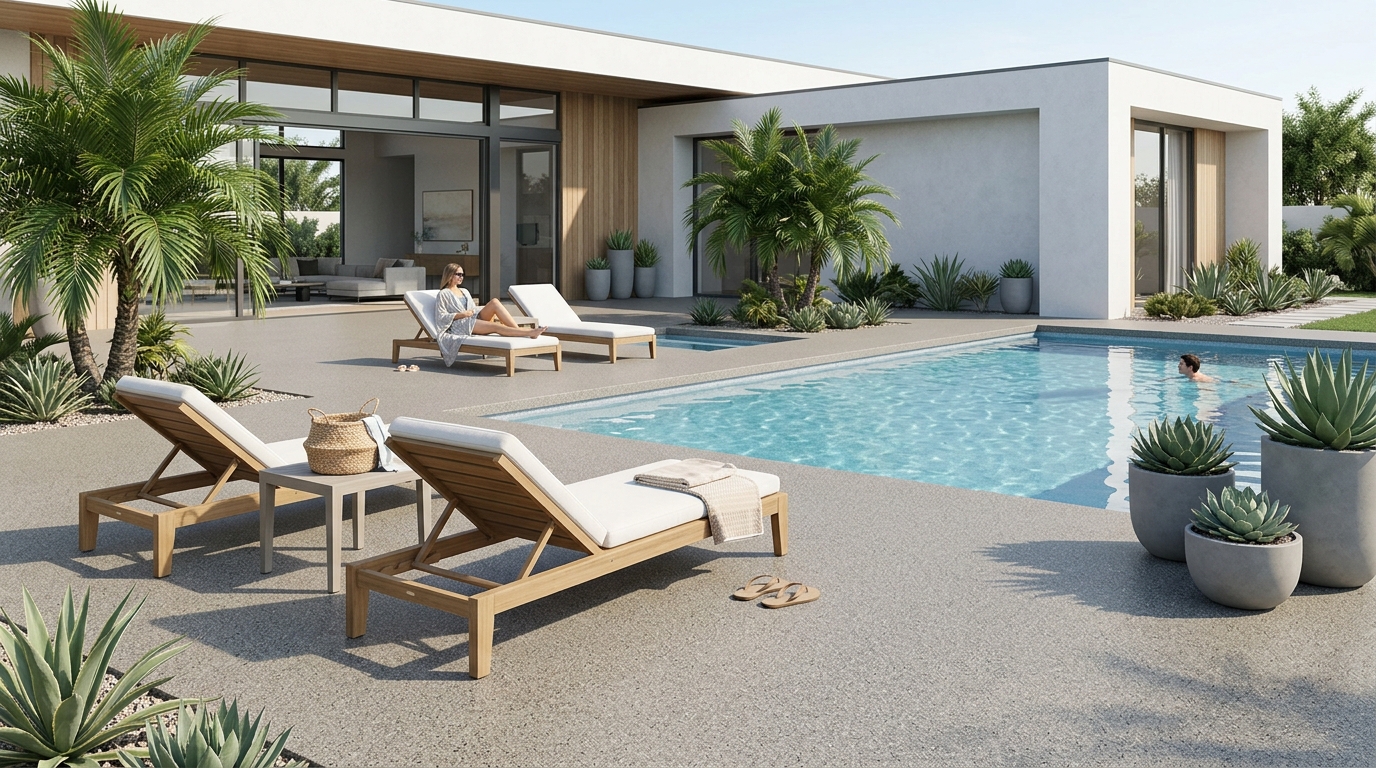
Color-driven reflectance without texture dependency. Polyurea doesn’t rely on a rough profile to reduce heat. Instead, the coating’s light color options — Sand, Light Gray, and Beige — reflect solar radiation at the surface level. The result is a smooth, modern finish that stays cooler through reflectivity rather than reduced foot contact.
Full-flake and partial-flake blends. The decorative vinyl flakes broadcast into the coating aren’t just for looks. Lighter flake blends — cream, tan, and gray chips — scatter incoming sunlight across multiple angles and colors, disrupting absorption. A full-flake broadcast in a light tone creates a speckled surface that’s visually interesting and measurably cooler than a solid dark color.
UV-stable formulation. Unlike epoxy coatings that yellow, chalk, and degrade under constant sun exposure, polyurea is inherently UV-stable. It doesn’t break down under solar radiation, so its reflective properties don’t diminish over time the way a painted or epoxy surface does.
One-day installation with immediate usability. Penntek polyurea cures in hours, not days. A pool deck coated in the morning is ready for foot traffic by evening — and fully cured for furniture and heavy use within 24 hours.
For a deeper dive into why polyurea outperforms traditional coatings on pool decks, see Croc Coatings’ detailed breakdown of why polyurea is ideal for pool decks.
Rubberized Pool Deck Coatings
Rubberized coatings — including poured-in-place rubber surfaces and products like Revaflex — keep decks cool through a fundamentally different mechanism: the material itself is a poor heat conductor.
Rubber doesn’t absorb and transfer heat the way concrete and stone do. A rubberized surface can feel noticeably cooler underfoot even in direct sun because it doesn’t pull heat from your skin on contact. These coatings are also inherently slip-resistant and soft underfoot, making them popular for family pools and commercial waterparks.
The tradeoff is aesthetic. Rubberized surfaces have a distinct look — often compared to playground or track surfacing — that doesn’t suit every home’s style. They also tend to cost more per square foot than acrylic or polyurea options.
Croc Coatings offers Revaflex rubberized coatings as an alternative for homeowners who prioritize safety and softness over a traditional concrete look. For the full comparison against traditional coatings, see the benefits of Revaflex rubberized pool coatings.
Coating Comparison Table
| Coating Type | Cooling Method | Surface Temp Reduction | Durability | UV Stability | Slip Resistance | Install Time |
|---|---|---|---|---|---|---|
| Light-Colored Polyurea (Penntek) | Color reflectance + flake scatter | 15–30°F | Excellent — lifetime warranty | High — won’t yellow | Additive available | 1 day |
| Acrylic Kool Deck | Light color + textured profile | Significant reduction | Moderate — pitting, chemical wear | Moderate | Good — from texture | 2–3 days |
| Rubberized (Revaflex) | Low thermal conductivity | Significant reduction | Good | High | Excellent | 1–2 days |
| Cool Deck Paint (DIY) | Light color only | Minimal reduction | Poor — peels, chalks | Low | Poor | 1–2 days (DIY) |
The Best Colors and Flake Blends for a Cooler Pool Deck
Color isn’t just an aesthetic decision for a pool deck — it’s the single biggest factor in how hot the surface gets. Here’s what works and what doesn’t.
Light Tones That Reflect Heat: Sand, Beige, and Light Gray
The most effective cool-deck colors fall into three families:
- Sand and tan tones: Warm neutrals that blend with natural landscaping while reflecting a high percentage of solar radiation. These are the most popular choice for homeowners who want a natural stone look without the heat penalty.
- Light gray: A cooler-toned option that performs nearly as well as white for reflectance while hiding dirt and debris better than pure white. Light gray polyurea with a partial flake broadcast is one of the most versatile combinations available.
- Off-white and cream: Maximum reflectance — the coolest possible surface. Best for full-sun decks with no shade cover.
Croc Coatings’ pool deck coating color selector lets you preview these exact combinations before committing to a choice.
Full-Flake and Partial-Flake Blends That Scatter Sunlight
Decorative flakes do more than add visual depth — they improve reflectance by breaking up the surface into thousands of tiny, multi-angled facets. Each chip reflects light at a slightly different angle, disrupting the absorption pattern you’d get from a solid, uniform color.
For maximum cooling, the best flake combinations use predominantly light-colored chips:
- Full-flake broadcast in Sand Blend: A dense coverage of cream, tan, and light brown chips over a sand-toned base coat. The multi-color scatter effect is significant.
- Partial-flake broadcast in Light Gray: Gray base with scattered white and silver flakes. Clean, modern, and substantially cooler than a solid gray slab.
The flake system isn’t just decorative — it’s a functional part of the cooling strategy. To see how different colors and flake patterns would look on your actual deck before committing, try Croc Coatings’ pool deck design tool for a live preview.
Colors to Avoid: Why Dark Epoxy Makes the Problem Worse
Dark epoxy coatings are popular for garage floors, but on a pool deck they’re a heat disaster. Charcoal, dark brown, and black coatings absorb the vast majority of solar radiation, pushing surface temperatures well beyond bare concrete — sometimes exceeding 160°F.
Even mid-tone colors like terracotta and medium brown offer minimal reflectance benefits. If heat reduction is a priority — and for any pool deck in a climate with real summers, it should be — stick to the light end of the spectrum.
Quick Fixes: How to Cool Down an Existing Pool Deck Today
Not every homeowner is ready for a full resurfacing project. If your deck is too hot right now and you need relief this season, here are the stopgaps that actually work.
Outdoor Rugs and Shade Sails
A large outdoor rug or runner creates an instant cool zone on any deck surface. Look for polypropylene or solution-dyed acrylic rugs designed for outdoor use — they won’t mildew, and they dry quickly after splashing. Even a 4’×6′ rug in a light color can give you a comfortable path from the pool to the lounger.
Shade sails are the other high-impact, low-effort solution. A properly tensioned triangular or rectangular shade sail positioned over the main walkway can reduce direct sun exposure by 70–90% during peak hours. When the deck surface isn’t in direct sun, the temperature difference is immediate and dramatic — expect a 20–40°F reduction on the shaded portion of the deck versus the unshaded area.
Misting Systems and Other Stopgaps
- Misting systems: Low-pressure misting lines around the pool perimeter cool the air and lightly wet the deck surface. Evaporative cooling can drop surface temperatures by 10–15°F while running, though the effect is temporary.
- Potted plants and umbrellas: Large planters with tall greenery and strategically placed cantilever umbrellas provide partial shade at minimal cost.
- Foot baths or splash zones: A small, dedicated splash area near the pool entry keeps feet wet and comfortable for the walk to the water.
These are band-aids, not permanent solutions — but they work, and they cost a fraction of a full resurfacing.
Professional Installation vs. DIY: What Actually Lasts
Why One-Day Polyurea Installation Matters
Polyurea’s cure time isn’t just a convenience — it’s a genuine practical advantage. Traditional acrylic and epoxy coatings require 24–72 hours of cure time before foot traffic and up to a week before you can place furniture or heavy items on the surface. For a pool deck in peak swimming season, that’s a significant disruption.
Penntek polyurea cures to foot-traffic readiness in 4–6 hours and reaches full cure in 24 hours. A Friday installation means the pool is fully usable by Saturday afternoon. For families with a short Northwest swimming season, losing a week of pool time to a coating project is a real cost.
The Problem With Big-Box Cool Deck Paint
Home improvement stores sell "cool deck" or "pool deck" paint products that promise heat reduction at a fraction of professional coating costs. The appeal is obvious — but so are the failure modes.
These products are essentially heavy-duty acrylic paints. They provide a lighter color, which does reflect some heat, but they lack the thickness, flexibility, and adhesion of a professionally installed coating system. Expect peeling within one to two seasons, particularly in freeze-thaw climates where moisture works its way under the paint film and lifts it from the concrete.
More importantly, big-box paint provides no meaningful texture or slip resistance, and the thin film does almost nothing to protect the underlying concrete from pool-chemical damage. The result is a deck that looks worse after two years than it did before painting — and costs more to fix because the failed paint must be stripped before a real coating can be applied.
Beyond Heat: Slip Resistance and UV Stability Matter Too
A cool deck that’s slippery when wet is a different kind of hazard. The best cool pool deck coating addresses both problems simultaneously.
How Texture Adds Safety Without Sacrificing Coolness
Polyurea coatings can incorporate a fine aggregate additive — typically aluminum oxide or silica sand — broadcast into the top coat for a slip-resistant finish that doesn’t compromise the coating’s reflective properties. Unlike the heavy knockdown texture of traditional Kool Deck, modern slip-resistant additives create a fine-grit surface that’s grippy under wet feet but smooth enough to walk on comfortably.
For a full breakdown of coating options that prioritize safety, see Croc Coatings’ slip resistance guide for decorative pool deck coatings.
UV-Stable Formulations: No Yellowing, No Chalking
Sun exposure doesn’t just heat a deck — it breaks down the coating. UV radiation degrades epoxy resins, causing the amber-yellow discoloration and powdery surface chalking that make older epoxy-coated decks look neglected years before their time.
Polyurea is chemically different. Its aliphatic formulation is inherently UV-stable: it doesn’t yellow, doesn’t chalk, and maintains its original color and reflectivity for the life of the coating. In a pool deck context, that means the cooling performance you get on day one is the cooling performance you get ten years later — no degradation curve.
Why a Four-Season Coating Matters in North Idaho and Eastern Washington
Most pool deck coating guides are written for Sun Belt climates — Arizona, Florida, Southern California — where freeze-thaw cycling isn’t a concern. North Idaho and Eastern Washington are different. Summer temperatures routinely reach the mid-90s, but winter brings hard freezes, snow cover, and repeated freeze-thaw cycles that can destroy a coating that wasn’t designed for them.
Polyurea’s flexibility is the key here. Unlike rigid epoxy and brittle acrylic coatings, polyurea retains enough elasticity to expand and contract with the concrete substrate through temperature swings. When water seeps into a microscopic crack in an epoxy coating and freezes, the expansion widens the crack. Repeat that cycle a hundred times over a few winters and the coating delaminates. Polyurea’s elongation properties — it stretches rather than fractures — prevent this failure mode.
The same property that makes polyurea a great cool-deck solution in July — UV stability and color retention — is what keeps it intact through January. In a climate that demands both heat management and freeze-thaw durability, polyurea doesn’t force you to choose.
Frequently Asked Questions
What is the coolest pool deck surface available?
Light-colored polyurea and rubberized coatings offer the greatest surface temperature reduction — typically 15–30°F cooler than untreated concrete. Rubberized surfaces feel coolest to the touch because of the material’s low thermal conductivity, but polyurea offers better overall durability and a more traditional concrete look.
Is Kool Deck still a good option?
Traditional Kool Deck still works for heat reduction — the light color and textured surface are effective. However, the textured profile requires more maintenance, modern pool chemicals accelerate surface wear, and recoating is labor-intensive. Many homeowners are switching to polyurea coatings that achieve comparable cooling without the maintenance downsides.
Can I just paint my pool deck a lighter color?
You can, but expect it to peel within one to two seasons — especially in a freeze-thaw climate. Big-box pool deck paints lack the thickness, flexibility, and adhesion of a professional coating system and provide no meaningful protection for the concrete underneath.
How much does a cool pool deck coating cost?
Professional polyurea pool deck coating typically runs $7–$9 per square foot installed, depending on the deck’s condition, square footage, and flake system selected. That’s comparable to the cost of a high-quality acrylic cool-deck system but with significantly better longevity. Croc Coatings provides a free in-home consultation and custom quote for every project.
How long does a cool deck coating last?
Penntek polyurea pool deck coatings carry a lifetime manufacturer warranty. Acrylic cool-deck systems typically require recoating every 5–10 years depending on use and chemical exposure. DIY paint products seldom last more than two full seasons.
Will a lighter-colored deck show dirt more easily?
Light gray and sand tones with a flake broadcast actually hide dirt, debris, and foot traffic better than solid dark colors, which show every dust footprint and water spot. The speckled pattern of a flake system is naturally forgiving.
Ready for a Pool Deck You Can Actually Walk On?
If your pool deck turns into a skillet every summer, a coating upgrade is the most permanent fix — and it’s more affordable than most homeowners expect. Croc Coatings offers free in-home consultations across North Idaho and Eastern Washington, including Coeur d’Alene, Spokane, Sandpoint, and the Tri-Cities.
We’ll assess your deck, talk through color and flake options that optimize for heat reduction, and give you a custom quote — no pressure, no obligation.
Related Posts
- Best Non-Slip Pool Deck Coatings: Safe Surface Options
- 5 Best Concrete Coatings for Pool Decks — The complete comparison of every pool deck coating type
- Why Polyurea Is Ideal for Pool Decks — Deep dive into polyurea’s advantages for pool environments
- Decorative Coatings for Pool Decks: Slip Resistance Guide — How to balance safety and style
- Benefits of Revaflex Rubberized Pool Coatings — The rubberized alternative explained