If your basement gets used every day, the best floor usually comes down to 3 things: moisture control, slip resistance, and how much wear the room takes. In many basements, floor paint, carpet, laminate, and wood fail because concrete pulls in moisture and heavy use wears surfaces down fast.
Here’s the short version:
- Decorative chip works well for family rooms and mixed-use spaces because it hides dirt and adds grip.
- Quartz fits gyms and work areas where traction matters most.
- Metallic is more about looks and fits bars, lounges, or media rooms.
- Solid-color is a simple pick for laundry, utility, and storage areas.
A few numbers matter too. If your slab tests above 3 lbs. of moisture per 1,000 sq. ft. in 24 hours, you’ll often need a moisture-blocking primer first. And prep does a lot of the heavy lifting – about 80% of long-term floor performance comes from surface prep. Polyurea also has 300%+ elongation and tensile strength above 6,000 PSI, which helps it move with the slab instead of cracking when the concrete shifts.
Before I pick a basement floor, I’d look at:
- Moisture vapor
- Cracks, pits, or spalling
- Daily traffic
- Wet shoes, mud, snow, or pets
- How easy the floor is to clean
Quick Comparison
| Floor system | Best fit | Grip | Look | Upkeep |
|---|---|---|---|---|
| Decorative chip | Family rooms, multi-use basements | High | Granite-like | Low |
| Quartz | Gyms, workshops | Very high | Speckled | Medium |
| Metallic | Bars, lounges, media rooms | Medium | Glossy, marbled | Medium |
| Solid-color | Laundry, utility, storage | Medium with additive | Clean, uniform | Higher |
If you want a basement floor that lasts, I’d start with the slab first, then match the coating to the room’s traffic and moisture level.
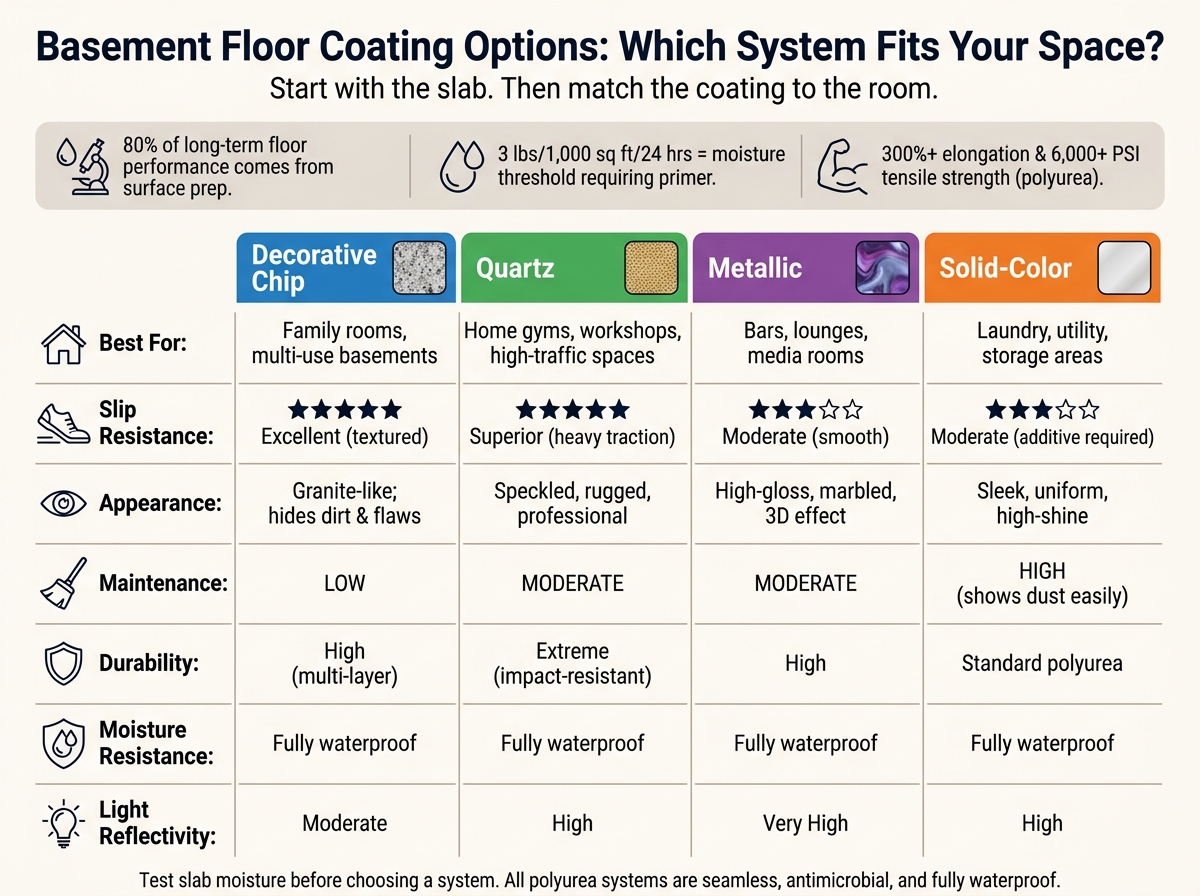
Basement Floor Coating Comparison: Decorative Chip vs Quartz vs Metallic vs Solid-Color
How To Choose The Best Basement Floor Coating For You
sbb-itb-a0e5ae3
Before You Choose: Basement Conditions That Shape Your Floor Option
Start with the slab. In the Inland Northwest, freeze-thaw cycles, tracked-in snow, mud, and older slabs with no vapor barrier often decide which basement floor system makes sense.
Moisture, Cracks, and Surface Prep
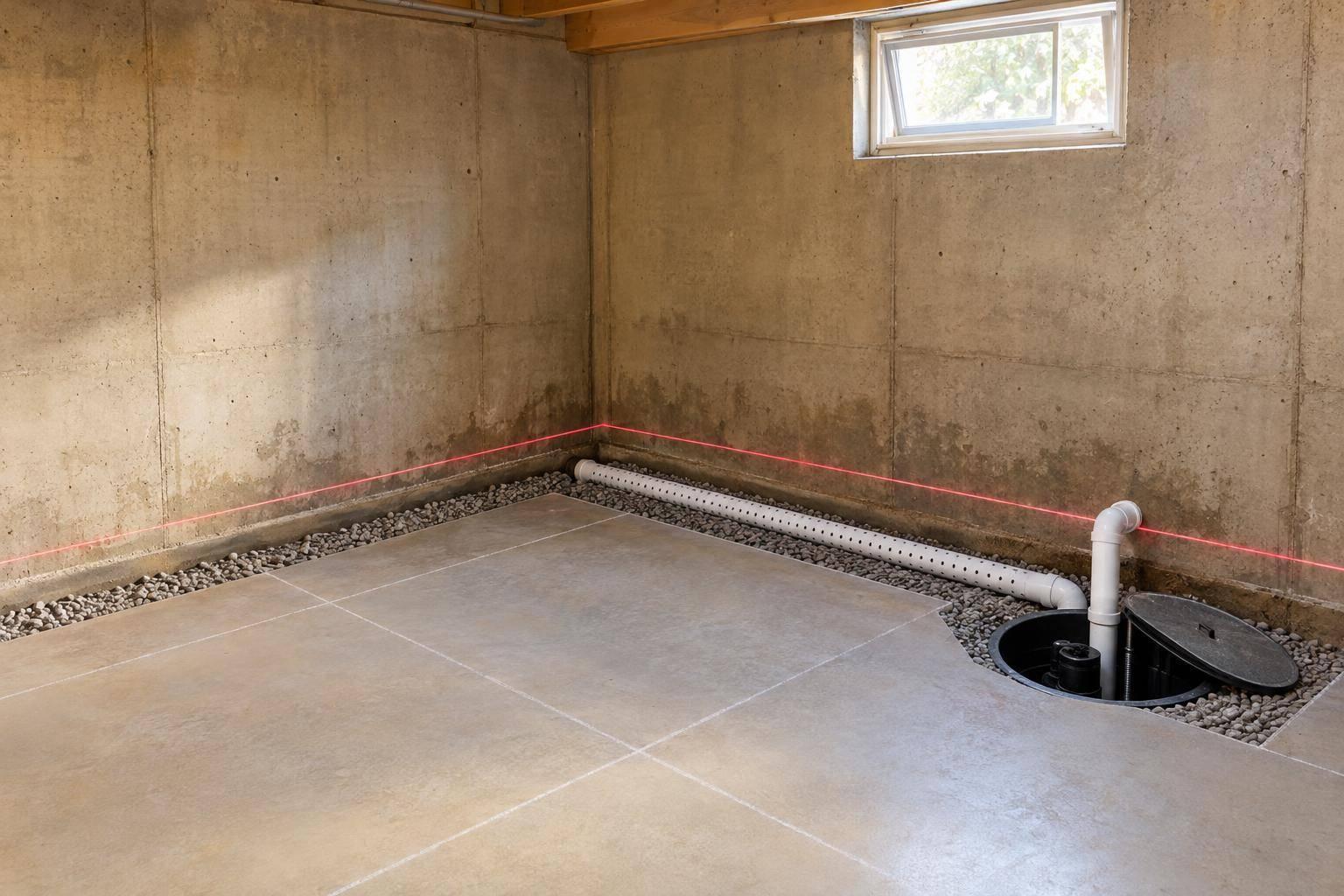
Concrete is porous, so it can pull water vapor up from the soil through hydrostatic pressure. And in homes built between the 1960s and 1980s, there often isn’t a vapor barrier under the slab. That means moisture can keep moving through the concrete on a steady basis.
Before you pick a system, test the slab with a calcium chloride test or a moisture meter. If the reading is above 3 lbs per 1,000 square feet in 24 hours, you’ll usually need a moisture-mitigation primer.
Also watch for efflorescence – that white, powdery residue that points to moisture movement. If you see cracks, pits, or spalling, repair them first. Then remove any residue or old coatings before the base coat goes down. These details matter more than many homeowners expect. They often decide whether the floor holds up over time or starts failing early.
Surface prep is a BIG deal. Roughly 80% of long-term performance comes from the prep work. Use mechanical diamond grinding, not acid etching, to open the pores and create the right surface profile.
Traffic, Safety, and Daily Use
Once the slab is in good shape, shift your focus to how the basement works day to day. A home gym doesn’t ask the same things from a floor as a family room, workshop, storage area, or utility room. Dropped weights, heavy equipment, chemical spills, and muddy boots all put stress on the surface in different ways.
In basements that also work as entryways or mudrooms – a common setup in North Idaho and Eastern Washington – slip resistance matters when snow and moisture get tracked inside. The floor should also be easy to clean and able to resist stains. Put simply, the right finish should match how the room gets used, not just how you want it to look. Those conditions help narrow down which polyurea design fits the space best.
Polyurea Basement Floor Design Options: A Roundup
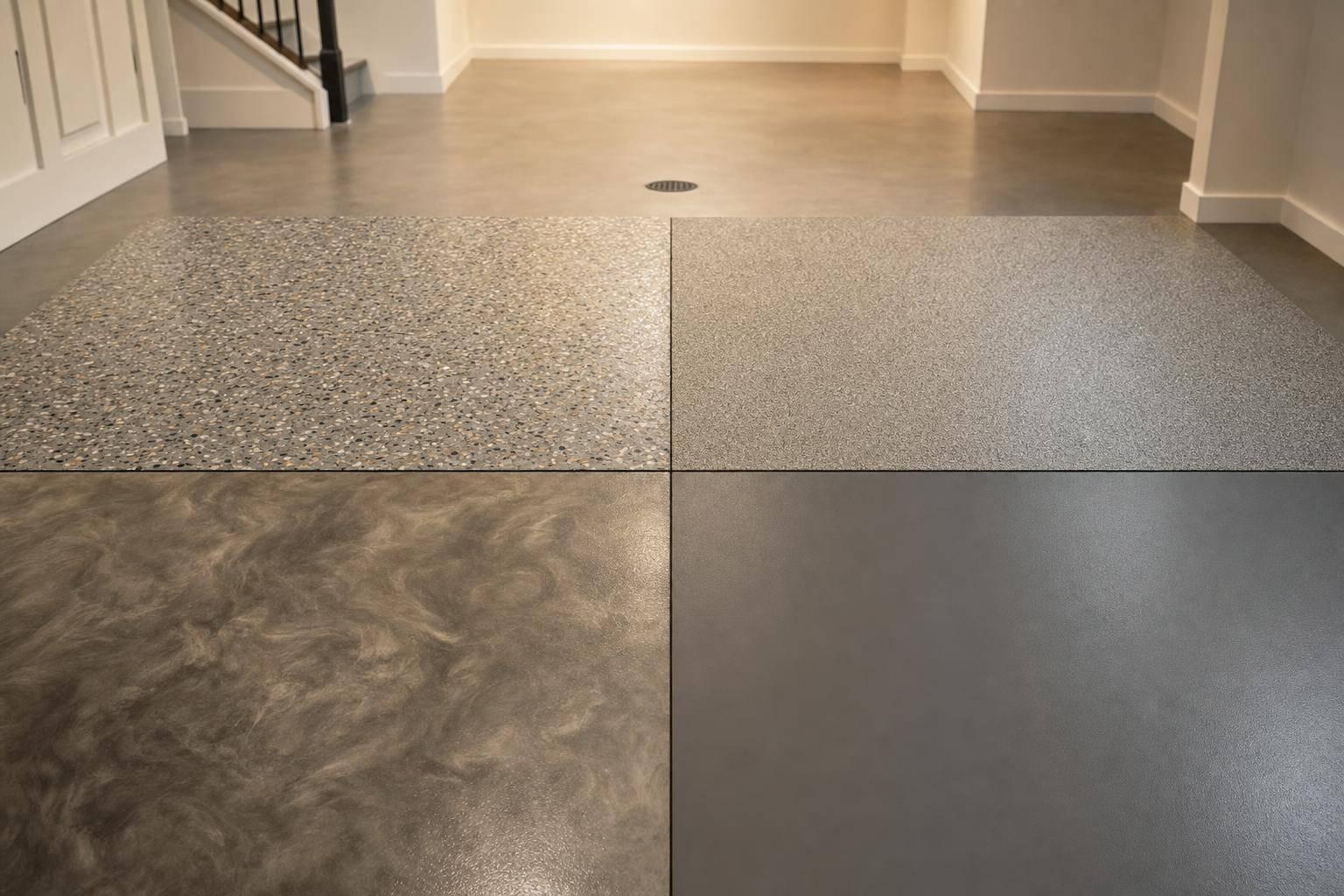
Once the slab is ready, following proper concrete preparation, the next step is picking a finish that fits how the basement will actually be used. The main polyurea choices are decorative chip, quartz, metallic, and solid-color. A good rule of thumb: start with traction, then look at appearance and how much cleanup the floor will need.
Decorative Chip Systems for Family Rooms and Multi-Use Basements
The decorative chip system, also called a full-flake system, is the most popular pick for residential basements. It uses colored vinyl flakes broadcast over a polyurea base coat, then locks the whole surface under a clear polyaspartic topcoat.
The end result looks a lot like granite or terrazzo, which gives the floor more visual depth than a plain coating. It also helps hide dirt and small slab flaws. That matters in a basement that does a bit of everything, from movie nights to kids’ play space to storage overflow. The textured finish also prevents slippery basement floors naturally, making it a smart choice for busy family rooms and multi-use basements.
Quartz and Metallic Systems for Gyms, Workspaces, and Entertainment Areas
Quartz systems replace vinyl flakes with colored quartz sand, which creates a fine, sandpaper-like texture that adds traction. That makes quartz a strong match for home gyms and workshops, where grip matters more than shine. If texture is the top goal, quartz comes out ahead.
Metallic systems go in the other direction. They focus on appearance, not texture. These floors have a smooth, high-gloss, marbled, three-dimensional look that fits bars, lounges, and media rooms well. They can look dramatic in the best way, but there’s a tradeoff: the slick surface shows smudges more easily than chip or quartz finishes. Use metallic when the look of the room matters more than extra traction.
Solid-Color Systems for Utility Basements and Basic Remodels
Solid-color systems are the simple option for laundry rooms, utility spaces, and storage areas. The finish is uniform, high-shine, and easy to mop, which makes day-to-day cleanup pretty simple. It works well in spaces where function comes first.
The downside is that solid-color floors show dust more easily:
"A solid color is beautiful, but be aware that it will show every bit of dust and dirt, just like a solid-color tile floor." – Floortek
If the space tends to get wet, an anti-slip additive can be mixed into the topcoat to add traction. That makes solid-color polyurea a good fit for utility zones that need a polished look without the extra layers of a decorative system.
Use the chart below to compare finish, texture, and upkeep side by side.
| System Type | Best Use | Texture & Slip Resistance | Appearance | Maintenance Level |
|---|---|---|---|---|
| Decorative Chip | Family rooms, multi-use basements | Textured; excellent natural traction | Granite-like; hides dirt and imperfections well | Low |
| Quartz | Home gyms, workshops, high-traffic spaces | Fine sandpaper texture; high slip resistance | Speckled, professional, rugged | Moderate |
| Metallic | Bars, lounges, media rooms | Smooth, high-gloss | High-impact, marbled, 3D effect | Moderate |
| Solid-Color | Laundry, utility, minimalist layouts | Smooth; optional anti-slip additive | Sleek, uniform, high-shine | High |
How These Floor Systems Hold Up in Real Basement Conditions
Here’s the day-to-day view: each finish looks a little different once it’s living in an actual basement.
Durability, Moisture Resistance, and Easy Cleaning
Polyurea keeps spills sitting on the surface instead of soaking in, so cleanup is pretty simple. In most cases, a sweep and a pH-neutral mop will do the job. Skip wax and harsh chemicals, though. Over time, they can dull the topcoat.
It also has enough give to move with the slab, which helps keep small cracks from showing through the coating. With 300%+ elongation and tensile strength over 6,000 PSI, polyurea moves with the concrete instead of working against it.
The table below shows how the main finish types compare in the areas that tend to matter most in a busy basement.
| System Type | Durability | Moisture Resistance | Slip Resistance | Hygiene | Light Reflectivity |
|---|---|---|---|---|---|
| Decorative Chip | High (multi-layer) | Fully waterproof | Excellent (textured) | Antimicrobial; easy to sanitize | Moderate (varies by chip color) |
| Quartz | Extreme (impact-resistant) | Fully waterproof | Superior (heavy traction) | Antimicrobial; easy to sanitize | High |
| Metallic | High | Fully waterproof | Moderate (smooth surface) | Antimicrobial; easy to sanitize | Very high (maximum reflection) |
| Solid-Color | Standard polyurea durability | Fully waterproof | Moderate (additive required) | Antimicrobial; easy to sanitize | High (glossy finish) |
Slip Resistance, Light Reflection, and Indoor Hygiene
Slip resistance is where these finishes separate the most. Chip and quartz systems build grip right into the surface texture. That can make a big difference in basements used by kids, older adults, or anyone hauling laundry, tools, or sports gear up and down the stairs.
Metallic and solid-color floors are smoother. They can still work well, but in wet or busy areas, it makes sense to ask for slip-resistant additives in the topcoat.
Low-VOC, 100% solids formulas are a good match for enclosed basement spaces. And because the surface is non-porous, it can help limit the damp conditions mold and mildew need to grow. There’s a visual upside too: lighter chip blends and metallic finishes bounce overhead light back into the room, which can help a low-ceiling basement feel a bit more open.
How These Systems Fit North Idaho and Eastern Washington Homes
These differences matter even more in cold-climate basements, where floors deal with more abuse than people sometimes expect. Freeze-thaw stress, tracked-in grit, and moisture put extra pressure on the surface, so flexibility, traction, and easy cleanup matter a lot.
In North Idaho and Eastern Washington, freeze-thaw cycles and tracked-in salt, sand, and mud make flexible, easy-clean polyurea a strong long-term fit.
Conclusion: Matching Your Basement Floor to Traffic, Moisture, and Daily Use
At the end of the day, the best basement floor is the one that fits how the space is used every single day. Start with the basics: traffic, moisture, and traction.
That also makes the finish choice much easier. Decorative chip, quartz, metallic, and solid-color systems each make sense for a different kind of basement, from busy family hangouts to simple utility rooms.
Looks matter, sure. But there’s more going on here. A well-installed coating cuts down on maintenance and cleaning and helps protect the slab. This often involves choosing between epoxy vs. polyurea for basement floor repairs to ensure the best long-term value. Professionally installed polyurea systems are seamless, moisture-resistant, and built to last.
For homeowners in North Idaho and Eastern Washington, Croc Coatings offers basement coating projects tailored to local conditions.
FAQs
How do I know if my basement slab has too much moisture for a coating?
Look for warning signs like dark patches, efflorescence (a white, chalky residue), peeling paint, bubbling wallpaper, mold, a musty smell after rain, damp air, or rust and rot on nearby items.
If you want a more exact check, Croc Coatings uses specialized moisture meters to make sure the concrete moisture content is below 4% before application.
Which polyurea finish is safest for wet, high-traffic basements?
The safest polyurea finish for wet, high-traffic basements includes slip-resistant additives to improve traction.
Polyurea works well in these spaces because it forms a seamless, moisture-resistant barrier that helps block water intrusion, mold growth, and surface damage. Its flexible chemistry also allows it to move with the concrete, which can lower the risk of peeling.
Can a polyurea coating cover small cracks and slab imperfections?
Yes. Before the base coat goes down, installers patch small cracks, pits, and spalls so the slab is smooth and level.
After that, the polyurea system forms a seamless, waterproof surface that’s built to last. It also has some flex, which helps it span small cracks and move with the slab as temperatures change.