If your garage floor keeps making gray powder, the concrete itself is wearing down. A polyurea coating helps stop that by sealing the slab, blocking moisture, and keeping fine dust from getting loose in the first place.
Here’s the short version:
- Bare concrete sheds dust from traffic, scraping, weak surface layers, and freeze-thaw damage.
- Moisture and road salt make it worse, especially in North Idaho and Eastern Washington.
- Airflow and foot traffic spread the dust onto cars, shelves, tools, and into attached homes.
- Polyurea seals the concrete pores, so the floor stops shedding powder.
- A coated floor is easier to clean because dust and dirt stay on top.
- Good prep matters, including diamond grinding and moisture testing.
- A pro-installed system can last 15–20 years with basic care and can be ready for vehicles in about 24 hours.
A few facts stand out: concrete dust may contain crystalline silica, and repeated freeze-thaw cycles below 32°F can speed up slab wear. So this is not just about sweeping less. It’s also about stopping floor damage at the source.
| Floor Type | Dust | Cleaning | Moisture/Salt Protection | Lifespan |
|---|---|---|---|---|
| Bare concrete | High | Harder | Low | Surface keeps wearing down |
| Polyurea-coated | Low to none | Easier | High | About 15–20 years |
If you want a cleaner garage, the fix is simple: seal the slab, don’t just sweep the dust.
6 Months & Oil Spill Later: Cleaning my Polyurea Garage Floor 1st Time!
sbb-itb-a0e5ae3
How Concrete Dust Forms and Spreads Through a Garage
That chalky residue shows up when the slab itself starts to break down.
Why Uncoated Slabs Keep Shedding Fine Particles
Concrete is hard, but it’s also porous. And that porosity makes it easier for the top layer to wear down into dust.
Most of that wear comes from everyday use. Vehicle tires, foot traffic, and heavy bins dragged across the floor grind away at the surface. Over time, that friction releases fine concrete dust – the microscopic particles behind the chalky film you see on the floor.
If the slab was poorly cured or made with a weak mix, the surface is softer from the start. That makes dusting more likely and lets the top layer break down faster.
Once those particles come loose, normal garage airflow can carry them all over the space.
How Dust Moves Through the Garage
Dust doesn’t just stay where it starts. Fans, airflow from the overhead door, and simple foot traffic keep it floating and push it across the garage. Concrete dust is light enough to stay airborne for a long time.
Soon, it settles on workbenches, shelves, stored boxes, and the tops of vehicles. In attached garages, those particles can also move through the entry door and into the home.
Health and Moisture Factors That Make Dust Worse
The problem gets worse when dust enters the air and the slab keeps losing strength.
Concrete dust can contain crystalline silica, which can scar lung tissue and make asthma or COPD worse.
In North Idaho and Eastern Washington, freeze-thaw cycles and tracked-in road salt speed up slab breakdown and lead to more dusting. Since the dust begins in the slab itself, sealing the surface stops the issue at the source.
How Polyurea Coatings Stop Dust at the Source
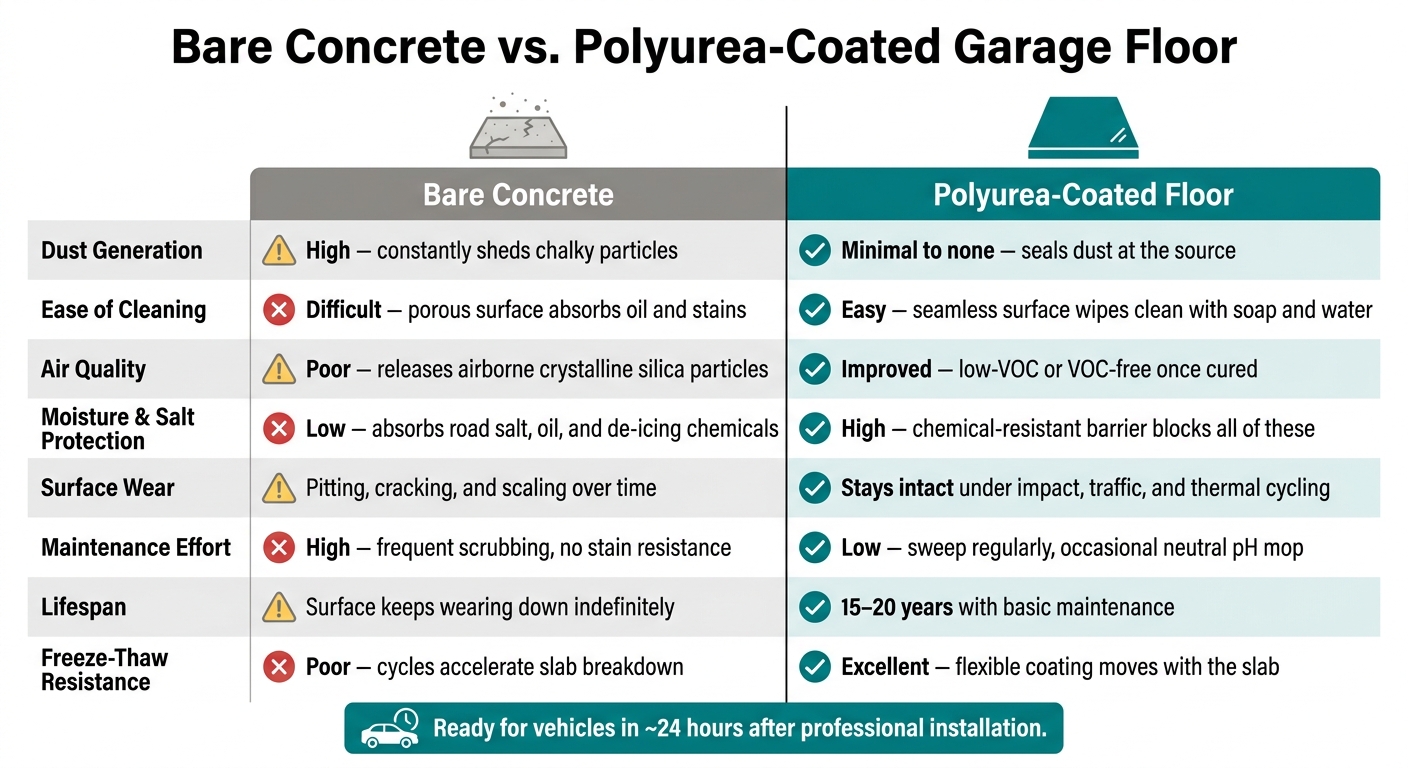
Bare Concrete vs. Polyurea-Coated Garage Floor: Side-by-Side Comparison
Polyurea stops dust by sealing the slab where those fine particles start.
How a Sealed Slab Stops Dust From Forming
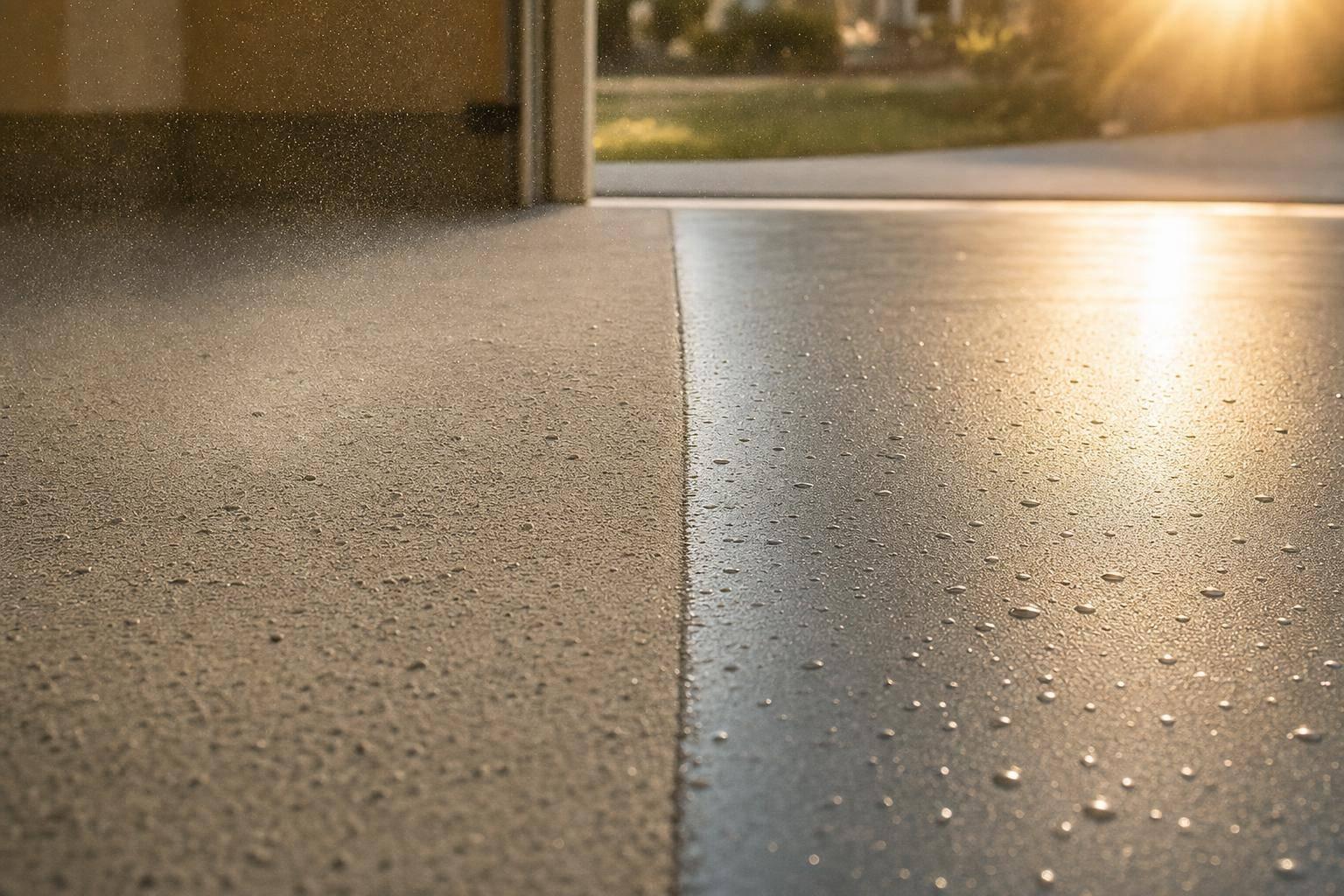
Polyurea sinks into the concrete pores and forms a seamless, non-porous barrier across the surface. Once that layer is in place, the concrete below can’t keep shedding fine particles from daily wear. It also seals weak surface areas, so they stop breaking down under foot traffic and vehicle traffic.
That seamless surface helps in another way too. Dust, pollen, and pet dander stay on top instead of settling into the floor, which makes them much easier to sweep up.
In attached garages, low-VOC or VOC-free systems can help limit indoor air impact after curing.
For that seal to last, the coating also needs enough flex to stay in one piece.
Why Polyurea Holds Up Under Daily Garage Use
If a coating chips or peels, it turns into a new source of dust. So the seal matters, but so does how well the coating holds up day after day.
Polyurea stays flexible, resists chipping, and moves with the slab during freeze-thaw cycles. This durability is a key part of year-round garage floor protection in the Pacific Northwest. That matters in North Idaho and Eastern Washington, where those temperature swings can be hard on garage floors. When a rigid coating cracks, raw concrete gets exposed again, and the dusting cycle starts all over.
A professionally installed system can provide 15–20 years of dust control with basic maintenance.
Bare Concrete vs. Polyurea-Coated Floors: A Side-by-Side Look
| Feature | Bare Concrete | Polyurea-Coated Floor |
|---|---|---|
| Dust Generation | High; naturally sheds chalky particles | Minimal to none; seals dust at the source |
| Ease of Cleaning | Difficult; porous surface absorbs oil and stains | Easy; seamless surface wipes clean with soap and water |
| Air Quality | Poor; releases airborne particles | Improved; low-VOC or VOC-free once cured |
| Surface Wear | Pitting, cracking, and salt damage over time | Stays intact under impact, traffic, and chemicals |
Performance, Maintenance, and Local Fit for North Idaho and Eastern Washington
A dust-control floor only pays off over time if it can handle local weather and day-to-day wear.
How Polyurea Handles Climate, UV, and Chemical Exposure
Winters in this region bring repeated freeze-thaw cycles, road salt, and de-icing chemicals tracked in from driveways and parking lots. Bare concrete soaks that in, which speeds up surface scaling and keeps the dusting cycle going. A properly installed polyurea system forms a chemical-resistant barrier that keeps road salt, oil, brake fluid, and moisture from reaching the slab.
Summer creates a different set of problems. UV-stable polyaspartic topcoats stop the yellowing that epoxy often shows over time. Hot tires can also soften lower-grade coatings and lead to peeling. Polyurea is built to stand up to that. Croc Coatings installs the Penntek Evolution polyurea system across North Idaho and Eastern Washington for floor protection in every season.
Even a tough coating can fail if the prep work is poor.
What Proper Installation Does for Dust Control
Professional installation starts with inspecting the concrete and diamond grinding to remove weak surface material and open the concrete so the coating can bond well. It also includes moisture testing to help stop failure caused by moisture vapor under the slab.
A moisture-blocking primer, flake broadcast, and polyaspartic topcoats seal the slab so dust can’t keep rising out of the concrete. In snowy areas, the flake layer also adds grip when winter slush gets tracked indoors.
Once the slab is sealed the right way, maintenance gets much easier.
Maintenance and Long-Term Value: Coated vs. Uncoated Floors
After installation, a polyurea-coated floor is simple to maintain. Regular sweeping or dust mopping clears away grit before it can wear down the finish. When the floor needs more than that, a neutral pH cleaner and a soft mop will do the job. No heavy scrubbing. No special products. In winter, a quick rinse or mop after heavy road salt exposure helps keep the coating clear over time.
That gap becomes obvious in cleaning time and long-term upkeep:
| Feature | Uncoated Concrete | Polyurea-Coated Floor (Penntek Evolution) |
|---|---|---|
| Maintenance Effort | High; porous surface absorbs stains and dirt | Low; sweep regularly, mop occasionally with neutral cleaner |
| Chemical Resistance | Poor; absorbs road salts, oil, gas, and other fluids | Excellent; resists road salt, oil, gas, and brake fluid |
| Long-Term Performance | Prone to freeze-thaw scaling and deterioration | Flexible and impact-resistant; handles thermal cycling |
For homeowners and small business owners across North Idaho and Eastern Washington, that adds up fast: less time spent cleaning, less dust floating around, and better slab protection through harsh seasonal swings.
Conclusion: A Cleaner Garage Starts With a Sealed Floor
The main point is simple: a sealed polyurea floor stops dust at the source and helps keep the garage cleaner with less day-to-day work.
For property owners in North Idaho and Eastern Washington, Croc Coatings installs the Penntek Evolution polyurea system with a UV-stable topcoat, a lifetime residential warranty against chipping and peeling, and vehicle-ready use within 24 hours. That matters because a floor coating only does its job over time if it stays in one piece.
How a Coated Floor Makes the Whole Garage Easier to Maintain
A sealed floor can change how the whole garage feels and works. The surface is smooth and seamless, so dust and allergens stay on top instead of settling deep into raw concrete. That makes them much easier to sweep up or remove with a damp mop. In plain terms, cleaning gets simpler.
There’s another upside too. You end up with less dust collecting on tools, shelving, and stored items. And with less fine grit underfoot, less of it gets tracked into the rest of the house.
With basic maintenance, a professionally installed polyurea system can last 15 to 20 years. A sealed slab helps keep dust from coming back.
FAQs
Can a dusty garage floor be repaired without replacing the concrete?
Yes. If your garage floor is dusty, you usually don’t need to replace the concrete.
As concrete gets older, it can start to shed fine dust. That’s common. The good news is that a professional coating can stop it.
Croc Coatings uses the Penntek Evolution industrial polyurea coating system to seal the existing floor after mechanical grinding. That process creates a durable, non-porous surface that helps stop future dusting.
It also makes cleanup simple. In most cases, all you need is soap and water.
Will polyurea still work if my garage already has salt damage or small cracks?
Yes. Polyurea can still work well if your garage floor has salt damage or small cracks.
The big thing is surface prep. Cracks, pits, and joints need to be repaired with polyurea-based fillers, and salt plus other contaminants need to be cleaned off completely. If that step gets skipped, the coating can peel or blister later.
Croc Coatings includes this prep work in its professional one-day installation process.
How do I know if moisture is causing my garage floor dust?
Concrete is porous. That means it can soak up moisture over time, which can weaken the surface and lead to dust. If you’re seeing peeling, delamination, or blistering, moisture may be part of the problem.
Professional installers can test the slab’s moisture content before coating. For concrete, the level should stay below 8% for the coating to perform as it should. Croc Coatings uses an impermeable polyurea barrier to block moisture and help prevent dust.