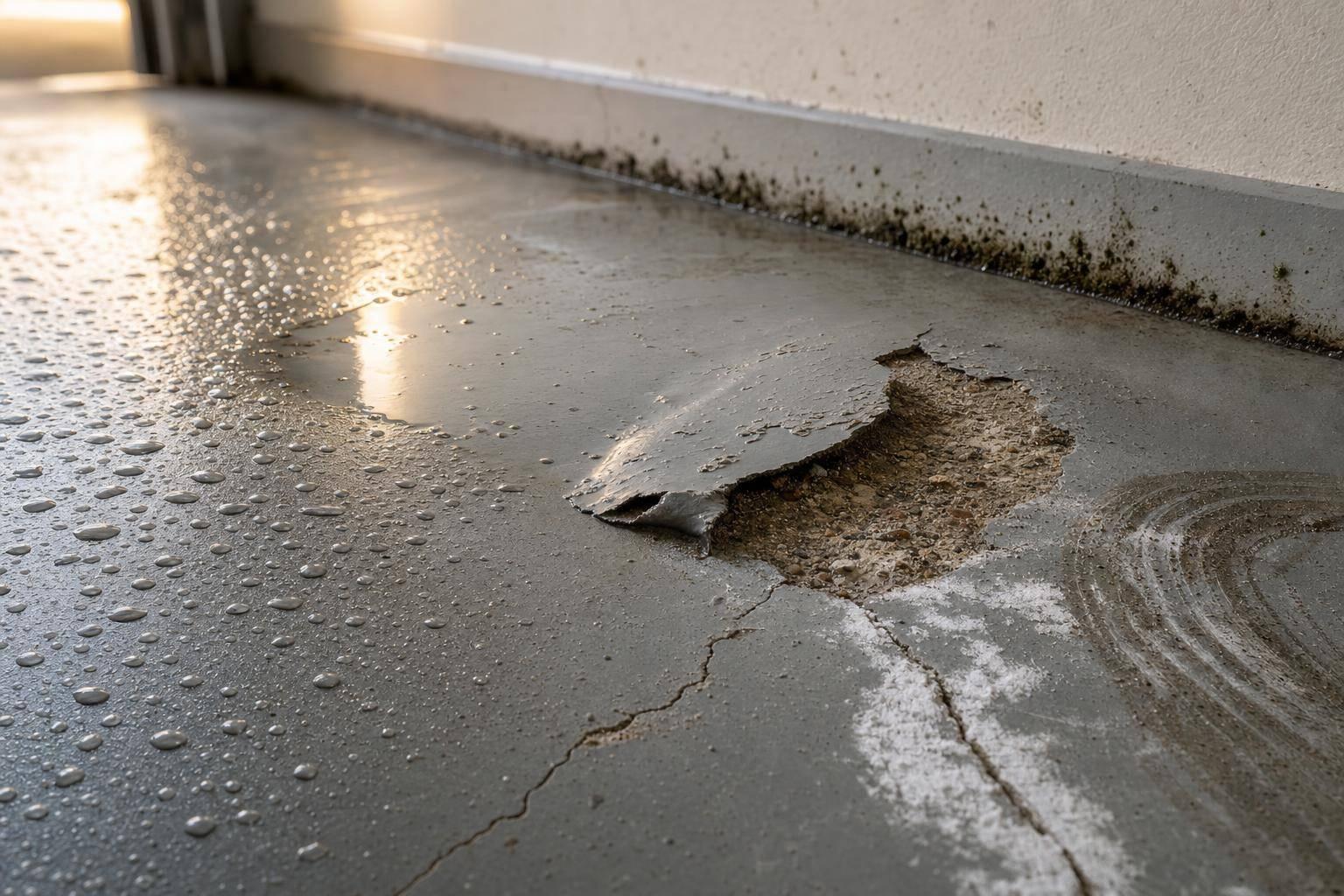
A sweating concrete floor is more than a damp spot. It can turn slick, break down the surface, ruin paint or coatings, feed mold, and leave behind white residue or rust stains.
Here’s the short version: if warm, humid air hits a cold slab, water can form on the surface. And if moisture is also moving up through the concrete, the damage can get worse. In many U.S. garages, basements, warehouses, and shops, trouble starts when indoor humidity gets above 60%, and slip risk can climb when humidity goes above 70% and slab temperature drops below 55°F.
What I’d watch for first:
- Wet-looking patches on a dry day
- Slippery spots or light puddling
- Peeling paint or bubbling coatings
- Musty odor or dark stains
- White powder (efflorescence) or rust marks
The five main ways condensation harms concrete floors are:
- Slip and fall hazards
- Spalling, cracking, and surface wear
- Causes of concrete coating failure and adhesive issues
- Mold, mildew, and poor indoor air
- Efflorescence, staining, and metal corrosion
A simple first step is to keep indoor humidity around 40% to 60%, clean up tracked-in water, and figure out whether the moisture is on top of the slab or coming through it.
Quick Comparison
| Problem | What you may see | Why it matters |
|---|---|---|
| Slips and falls | Damp film, slick spots, puddles | People can lose footing fast |
| Surface breakdown | Flaking, pitting, cracks | The slab surface starts to fail |
| Coating failure | Bubbling, peeling, tacky glue | Finishes and floor coverings let go |
| Mold and mildew | Musty smell, dark patches | Air inside the space gets worse |
| Staining and corrosion | White residue, dark marks, rust | Moisture keeps coming back and spreads damage |
If your floor keeps “sweating,” I’d treat it as a moisture problem early – before a damp patch turns into a repair bill. Professional concrete moisture testing can identify the source before you apply a new finish.
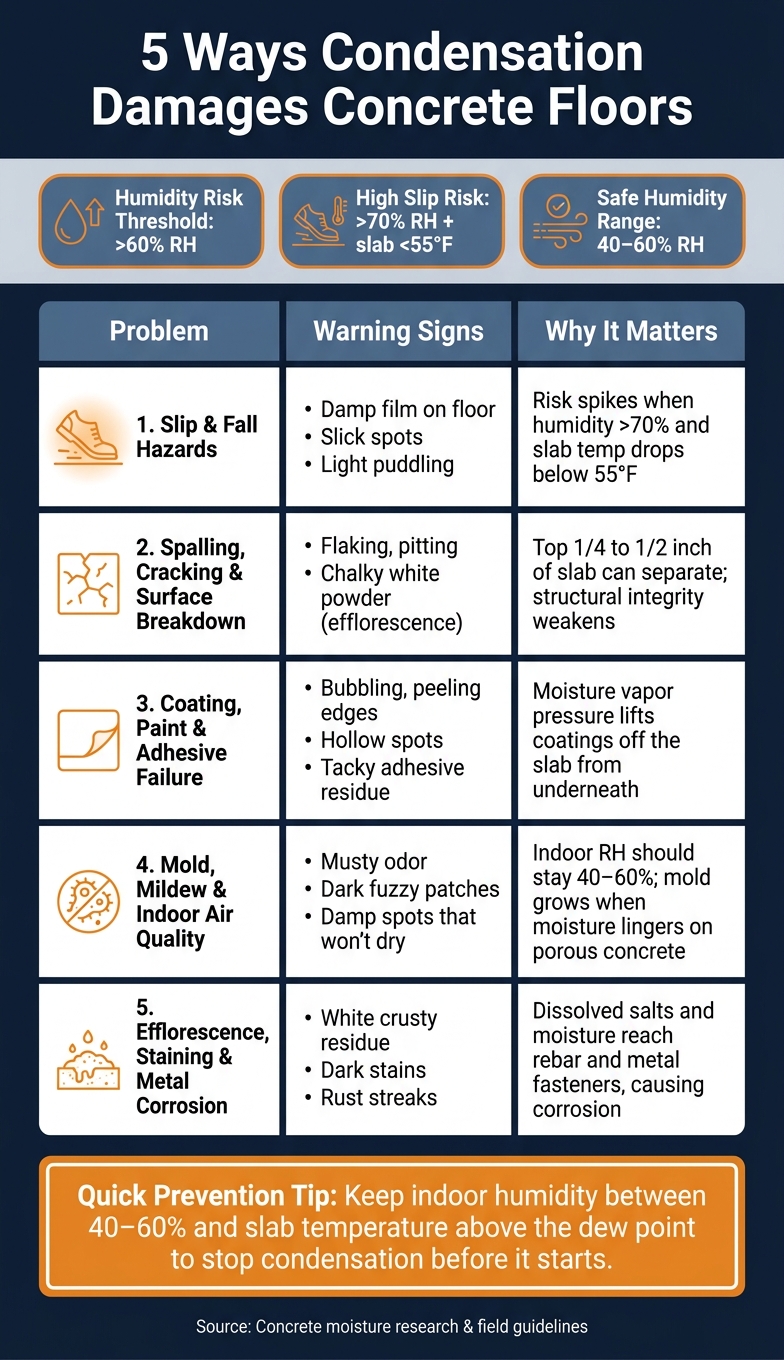
5 Ways Condensation Damages Concrete Floors: Signs, Risks & Fixes
How to fix a sweaty concrete floor
Proper moisture control is also essential for preventing mold growth on concrete floors.
sbb-itb-a0e5ae3
Why Concrete Floors Sweat in Common U.S. Spaces
Concrete floors sweat when warm, humid air lands on a surface that’s colder than the air’s dew point. And concrete tends to stay cool longer than the air around it, so it’s a common spot for condensation to show up.
You’ll see this most often in attached garages, unfinished basements, and commercial shops. Why those places? Cold slabs meet warmer incoming air, and there’s often not much insulation or airflow to soften that clash. In spaces that sit in the low 70s°F, humidity above 60% can be enough to cause visible condensation. It tends to get worse in spring and fall, when sharp temperature swings throw things out of balance.
The same issue plays out a little differently depending on the space:
- Garages: door openings let in warm air, and wet vehicles add extra moisture.
- Basements: poor ventilation and below-grade cooling keep the slab cold.
- Ground-level slabs: missing vapor barriers and thermal bridging to cold ground can feed the problem.
That surface moisture is what creates the first risk: a slick floor.
1. Slips, Falls, and Surface Safety Hazards
Condensation can leave a thin film of water on concrete floors, and that’s when things get slippery fast. The risk goes up when indoor humidity climbs above 70% and the slab temperature drops below 55°F. You’ll see that setup a lot in unheated garages, basements, and other cool areas where concrete stays colder than the air around it.
A few warning signs tend to show up again and again: damp patches, puddles, slick footing, musty odors, or bubbles in a floor coating. If those signs keep coming back, it’s worth checking whether you’re dealing with surface condensation or moisture moving up through the slab.
A simple way to check is the 12-by-12-inch plastic-sheet test. Leave it in place for 24–48 hours. If moisture forms on top of the plastic, that points to condensation. If it shows up underneath, the moisture is coming through the slab.
To cut the risk, dry out the indoor air and keep the slab above the dew point. Dehumidifiers, exhaust fans, and added heat can help. If the floor keeps sweating, the moisture may also start wearing down the slab over time.
2. Spalling, Cracking, and Surface Breakdown
Once condensation moves past being a surface annoyance, it starts eating away at the slab itself. Repeated moisture can soak the slab’s pores. And when the top 3/4 in. stays wet, water and dissolved salts move up to the surface, which weakens the concrete.
That can lead to spalling or delamination. In plain English, the top 1/4 to 1/2 in. of concrete starts separating from the slab below. The warning signs are often easy to spot:
- Flaking
- Pitting
- A chalky white powder on the surface, known as efflorescence
Want a simple field check? Tap the area with a ball-peen hammer. A sharp ring usually means the concrete is still sound. A dull thud is a red flag for delamination.
Seasonal temperature and moisture swings make this worse, especially in basements, garages, slab-on-grade foundations, and refrigerated spaces. If you catch it early, delamination can often be repaired. But not every concrete surface issue should be treated the same way.
| Crack or Surface Issue | Size | Recommended Action |
|---|---|---|
| Hairline Cracks | Under 1/16 in. | Fill with crack filler before coating |
| Working Cracks | 1/16 to 1/4 in. | Use flexible polyurethane filler; monitor for movement |
| Structural Cracks | Over 1/4 in. | Consult a structural engineer |
| Delamination | Top 1/4 to 1/2 in. separation | Grind loose material and apply resurfacing compound |
A hairline crack usually needs a simple filler before any coating goes down. A working crack is different because it may keep moving, so a flexible polyurethane filler makes more sense. Once a crack is over 1/4 in., you’re no longer looking at a simple surface repair. That’s the point where a structural engineer should step in. And if the surface layer is already separating, the usual fix is to grind away the loose material and apply a resurfacing compound.
3. Coating, Paint, and Adhesive Failure
Coating failure usually starts under the surface. Moisture vapor rises through concrete, and when a sealed finish blocks that vapor, pressure builds underneath. Over time, that pressure can push the coating right off the slab. In many cases, the finish is the first part of the floor to give way.
That same moisture can also wear down paint and flooring adhesives. Vapor moving through the slab can soften glue, weaken the bond, and leave adhesive residue tacky. Standard concrete floor paint has very low vapor resistance too, so it often does little to stop moisture from moving up through the concrete.
A few warning signs tend to show up early:
- Bubbling
- Peeling edges
- Hollow-sounding spots
- Tacky adhesive residue
If you see any of those, moisture is likely already affecting the finish.
This kind of failure shows up most often in garages, basements, and slab-on-grade floors, especially during warm, humid months. Before you fix the surface, figure out where the moisture is coming from. Is it condensation on top, or moisture moving up through the slab? A plastic-sheet test can help confirm the source, but that’s all it should do. If the issue is condensation, adding a vapor-suppressing coating won’t keep the moisture from coming back.
4. Mold, Mildew, and Indoor Air Quality Problems
When condensation keeps concrete damp, mold and mildew can start to grow. Concrete is porous, and even a thin film of moisture can mix with dust and dirt and give mold something to feed on. At that point, the issue is no longer just a slick floor. It becomes a moisture and air-quality problem.
Visible mold or mildew points to moisture that has been sitting on the slab for a while.
In many cases, the first clue is the smell, not the stain. A musty odor is often the first sign. After that, check for dark, fuzzy, or discolored patches that stay damp even after the rest of the floor has dried. When dampness sticks around, indoor air quality gets worse too.
Basements, crawl spaces, and garages face the most risk because they tend to stay cool and don’t get much airflow. Use a dehumidifier to keep indoor relative humidity between 40% and 60%, and place a digital hygrometer at floor level so you can track what’s happening near the slab.
Track humidity and inspect any damp spots that keep coming back before mold spreads.
5. Efflorescence, Staining, and Metal Corrosion
When condensation dries, it leaves salts and alkalinity behind as white efflorescence. That same moisture can also weaken coatings and adhesives from underneath, often leading to concrete coating failures.
If the moisture keeps coming back, the slab can start to stain and nearby metal can begin to corrode. The water that brings salts to the surface also reaches metal fasteners, rebar, and stored hardware – and that’s when rust starts. Dark patches that stay damp longer than the rest of the slab are an early warning sign. Rust stains can point to corroding rebar or nearby metal hardware in garages and basements alike.
Efflorescence, dark staining, and rust streaks are signs of active condensation damage – not surface dirt that a simple cleaning will fix. These marks point to a moisture problem, not a housekeeping issue. Once efflorescence keeps coming back, the next step is to control the moisture source.
How to Prevent and Manage Condensation Damage
All five problems begin the same way: moisture meets a slab that’s too cold, or a room that’s too humid. The fix starts with humidity control, then moves to limiting extreme temperature shifts and keeping outside moisture from getting in.
Control Indoor Humidity and Airflow
Keep indoor RH between 40–60%. In most cases, a properly sized dehumidifier does the heavy lifting. Use exhaust fans that vent outdoors, not into another part of the building. And only open windows or doors when the outdoor air is drier than the air inside.
Once the air is drier, it gets easier to deal with the other things that keep the slab cold and wet.
Keep the Slab Clean, Dry, and Easy to Inspect
Snowmelt and water tracked in by vehicles can cool small parts of the slab, drop the surface temperature, and speed up condensation. That’s why fast cleanup matters. Dry those areas as soon as you can.
A clean, dry floor also makes patterns easier to spot. If the same patch keeps getting damp, you’ll see it sooner.
Fix Outside Drainage and Water Entry Problems
Water pooling near the foundation adds more moisture for the building to deal with. That makes indoor condensation tougher to control. Extend downspouts away from the foundation, regrade soil so it slopes away from the structure, and seal foundation cracks or other water-entry points.
Think of it like this: if water keeps piling up outside, the building starts the day behind.
Check for Cracks, Damp Spots, and Recurring Problem Areas
A quick walk-through after heavy rain or a fast seasonal temperature swing can show trouble early. Look for:
- Wet-looking patches
- Shadows from failed adhesive
- Musty odors
- Areas that dry more slowly than the rest of the floor
Those repeat trouble spots deserve extra attention because damage tends to build there over time. If moisture keeps coming back, the floor may need surface protection. You can learn more about the process during a concrete coating consultation.
Use the Right Vapor Barrier, Insulation, and Installation Conditions
Exterior foundation insulation cuts the temperature gap between the ground and the floor surface. That helps keep the slab from getting cold enough to sweat.
For any coating or floor covering, follow the manufacturer’s installation rules. Most products need the surface temperature above 50°F and room humidity below 85% before application. The HVAC system should be running under normal conditions for at least 48 hours before testing concrete moisture or coating work starts.
Timing matters too. If you apply a coating while the slab is warming, air can get trapped and form bubbles or pinholes. Applying in the late afternoon, when slab temperature is steady or dropping, helps avoid that problem.
When moisture control by itself isn’t enough, the floor needs one of the best coatings for moisture protection.
When a Protective Coating Makes Sense
Once humidity, drainage, and vapor barriers are under control, a protective coating gives you a second layer of defense against day-to-day surface wear.
Spaces That Benefit Most from a Protective Coating
The biggest gains usually show up in spaces that deal with both moisture and heavy traffic. Garages, basements, pool decks, and commercial kitchens are the clearest examples. In those areas, a coated floor is easier to dry, easier to clean, and less likely to end up with staining, spalling, or mold growth.
What a Coating Can and Cannot Do
When it’s installed the right way, a coating creates a sealed surface barrier that resists mold, helps prevent efflorescence, and cuts down on staining. If condensation makes the floor slick, textured finishes can also help with slip resistance.
But a coating has limits. If vapor gets trapped underneath, the coating can fail. It won’t fix poor exterior drainage, replace a missing sub-slab vapor barrier, or stop hydrostatic pressure coming up from below. That’s why testing for hydrostatic pressure and surface prep matter so much.
Why Professional Installation and Product Choice Matter
How well a coating holds up comes down to two things: the product itself and how it’s installed. ASTM F2170 in-situ relative humidity testing checks moisture conditions inside the slab, not just at the surface, and it’s the industry standard before any coating is applied. Diamond grinding opens the concrete’s pores so the coating can bond mechanically to the slab. Skip that step, and even a high-quality product can peel or delaminate.
Conclusion
Once you’ve dealt with humidity and drainage, the next step is spotting the damage condensation leaves behind. If you let it sit, it can hurt the surface, coatings, indoor air quality, and even the slab itself. By the time you notice white residue, peeling coatings, or dark patches that never quite dry, moisture has usually been there for a while.
A slick surface, musty odor, lifting flakes, or a powdery white crust along the edges are all signs to take seriously – and early.
Act early. Testing moisture levels costs far less than floor replacement.
Match the fix to the moisture source: condensation, moisture vapor emission, and how hydrostatic pressure affects concrete floors each need a different solution. Control humidity, improve drainage, and choose the right coating for the conditions. That difference is what stops repeat damage.
FAQs
How can I tell if my floor is sweating or leaking?
Tape a 12-inch by 12-inch sheet of clear polyethylene plastic to the concrete floor. Seal all four edges with duct tape, then leave it there for 24 to 48 hours.
Here’s how to read the result:
- If moisture shows up on top of the plastic, that’s condensation caused by humid air.
- If moisture appears under the plastic, that means moisture vapor is moving up through the slab.
- If you see visible water under the sheet, that points to hydrostatic pressure or an active leak.
It’s a simple test, but it can tell you a lot about where the moisture is coming from.
Can condensation ruin a new floor coating?
Yes. Condensation can ruin a new floor coating because moisture can weaken the bond between the concrete and the coating.
If moisture gets trapped in the slab, or moves through it during application, it can lead to bubbling, peeling, delamination, blushing, and discoloration. Proper moisture testing before application helps prevent these problems.
When should I call a professional for a damp concrete floor?
Bring in a pro if moisture sticks around even after you’ve tried basics like running a dehumidifier and improving airflow. Get help right away if you spot mold or mildew, or if you think groundwater is pushing moisture up through the slab. Common signs include standing water, damp spots that keep coming back, or water collecting near floor drains.
Planning to install flooring or coatings? Use a certified moisture testing firm that performs ASTM-standard testing if you notice bubbling, cupping, adhesive failure, or efflorescence.