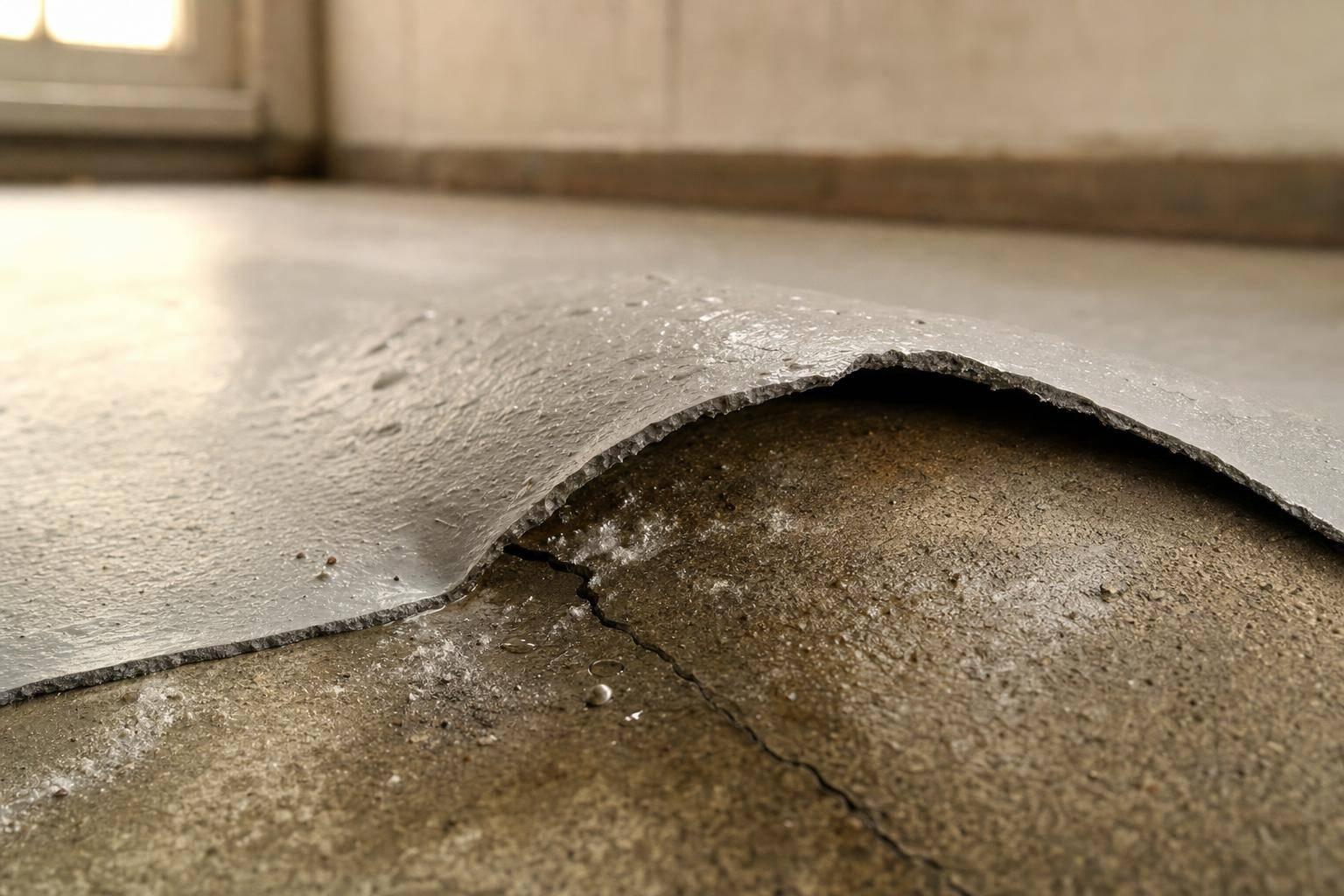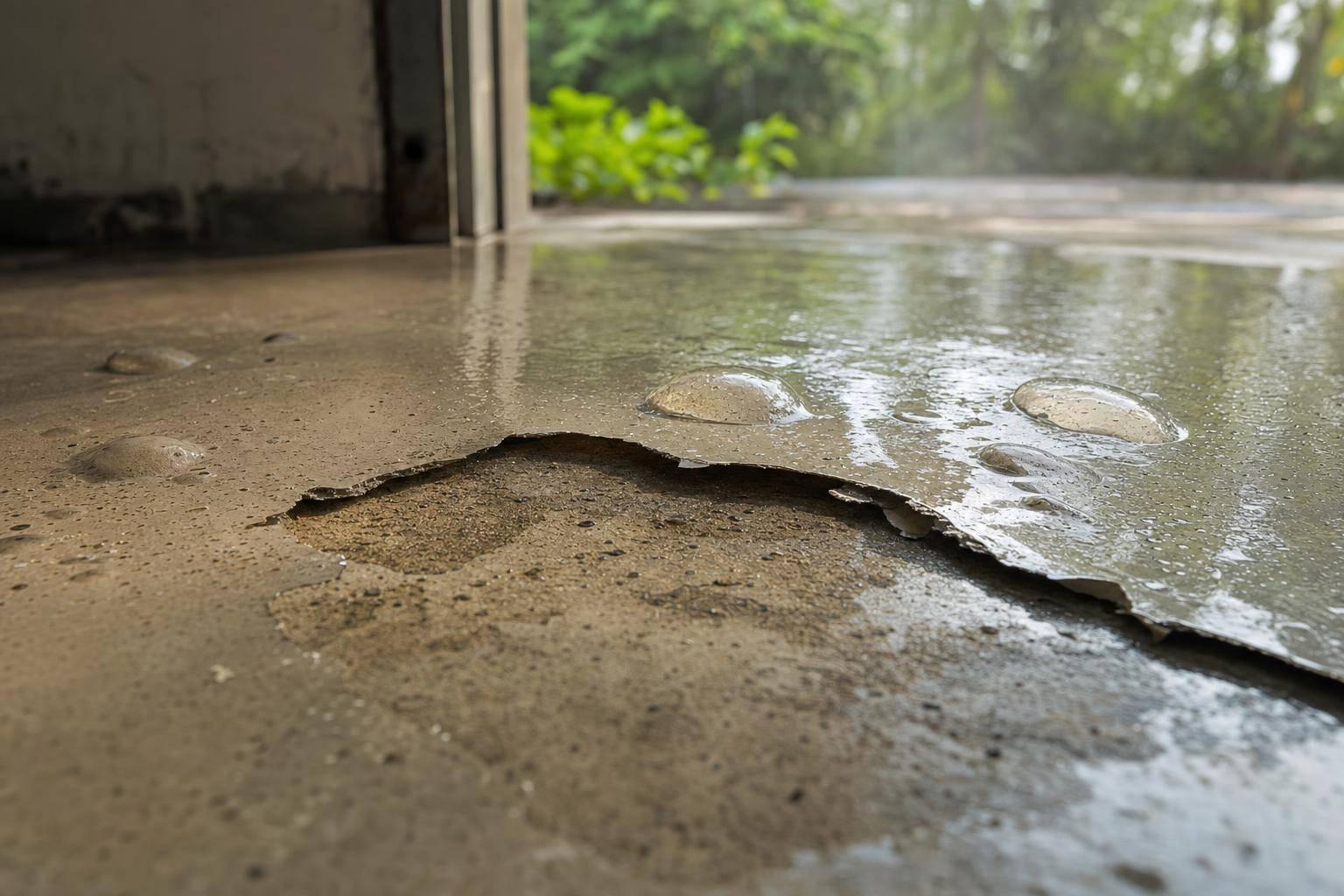
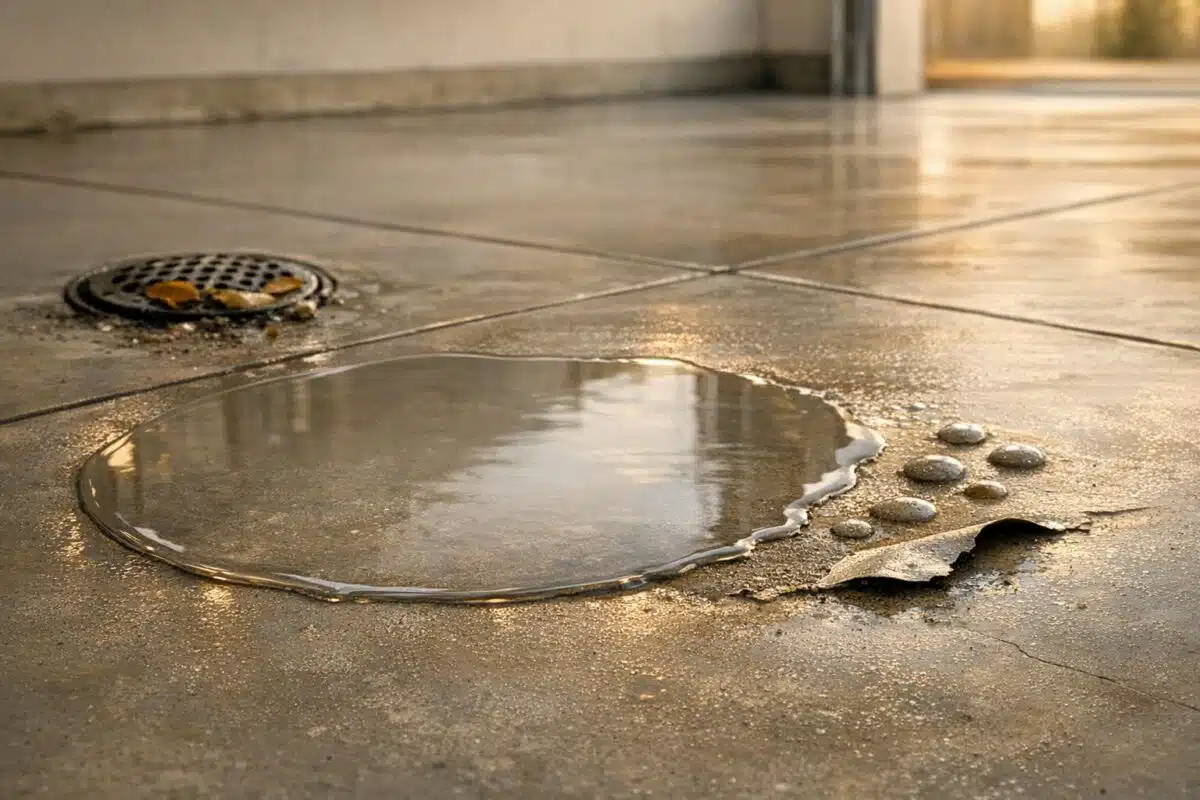
When water isn’t managed properly, concrete coatings fail. Poor drainage lets moisture seep into concrete, creating pressure that causes coatings to peel, blister, or delaminate. Even high-quality coatings can’t withstand the damage caused by water pooling or vapor rising from saturated soil. Here’s why:
- Concrete is porous: It naturally allows moisture to move upward, especially when soil beneath is wet.
- Pressure builds up: Non-breathable coatings, like epoxy, trap moisture, leading to adhesion failure.
- Hydrostatic pressure damages coatings: Water pooling on surfaces pushes moisture into the concrete, weakening bonds and causing structural issues.
Key stats:
- Concrete slabs with over 80% relative humidity (RH) or vapor emission rates above 3 lbs/1,000 sq ft/24 hours significantly increase coating failure risks.
- Adhesion strength in damaged areas drops from 300 psi to just 50–80 psi.
Proper drainage, moisture testing (e.g., ASTM F2170 and F1869), and surface preparation are critical for preventing coating failures. Without these steps, water can erode soil, crack concrete, and shorten the lifespan of infrastructure. Following a pre-installation checklist to fix drainage issues before applying coatings ensures durability and long-term performance.
Webinar: Concrete Moisture and How it Impacts Floor Covering Installation
sbb-itb-a0e5ae3
How Water Pooling Creates Hydrostatic Pressure and Damages Coatings
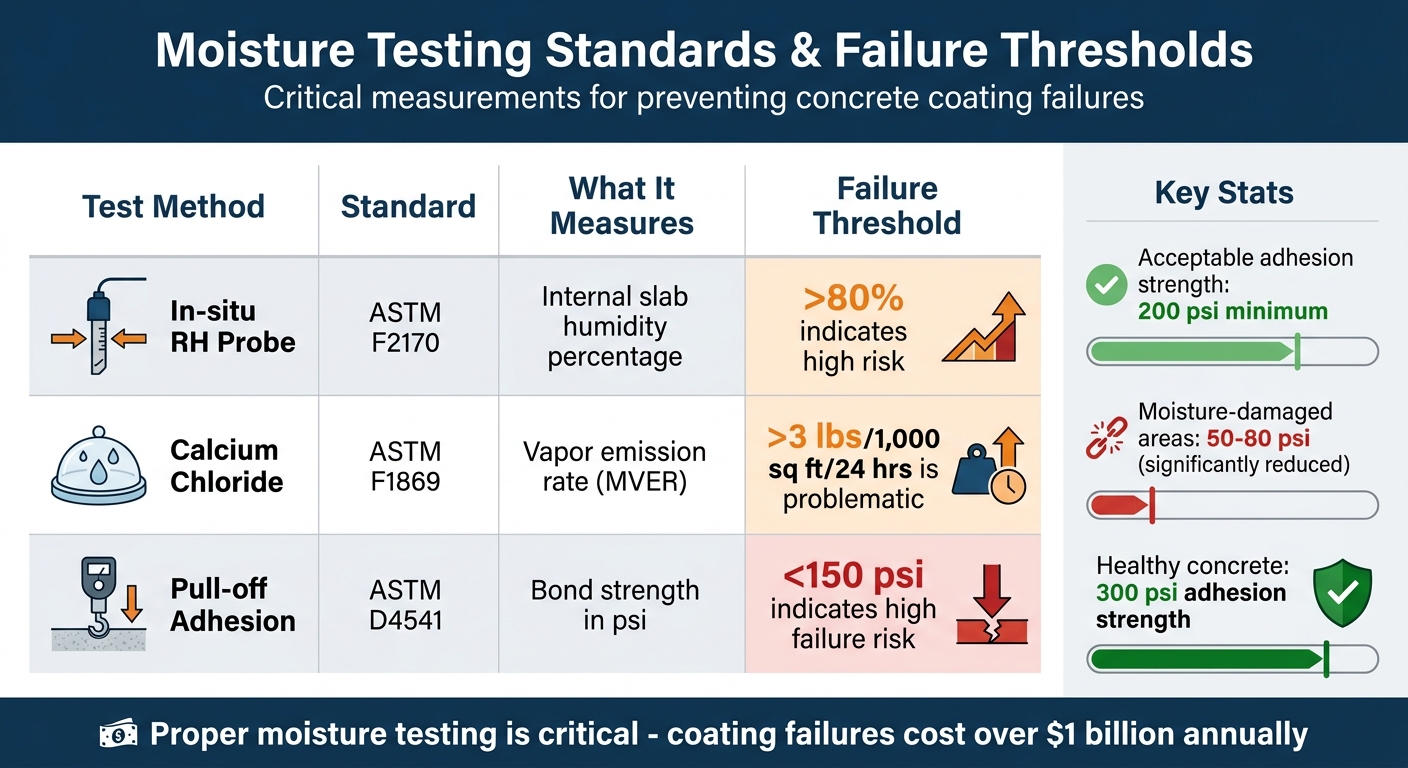
Moisture Testing Standards and Failure Thresholds for Concrete Coatings
Understanding Hydrostatic Pressure
Hydrostatic pressure plays a significant role in concrete coating failures, especially when water pools on concrete surfaces. This pressure is the force exerted by water as it pushes against the concrete, driving moisture through its micro-pores and capillaries. Over time, as water continues to accumulate and the surrounding soil becomes saturated due to poor drainage, the concrete becomes a conduit for moisture. The combination of hydrostatic pressure and capillary action creates a dual mechanism that moves moisture upward, intensifying the damage.
"The invasion of moisture and corrosive ion solutions is considered the primary cause of the shortened lifespan of concrete, and preventing this is crucial." Therefore, it is vital to test for hydrostatic pressure before applying any protective layer. – MDPI Research Article
This moisture intrusion triggers several problems. First, it weakens the adhesive bond between the coating and the concrete, leading to peeling and delamination. Second, it causes osmotic blistering, where water infiltrates the coating and creates pressure imbalances, forming bubbles. Lastly, hydrostatic pressure allows harmful ions like chlorides and sulfates to penetrate the surface pores, attacking steel reinforcements within the concrete. This leads to expansion, internal cracking, and structural degradation. These aren’t abstract concerns – they are real issues seen in countless structures.
Real Examples of Hydrostatic Pressure Failures
Take residential terraces and rooftops as an example. Poor drainage systems often result in severe water buildup, where moisture from the surface penetrates downward through the substrate. In such cases, standing water creates enough pressure to compromise even well-applied surface coatings.
Another example is concrete storage pads. When cracks form and drainage systems fail, moisture seeps through the surface, causing clear sealers to deteriorate completely. This failure doesn’t just harm the coating – it can also lead to soil contamination beneath the pad. These scenarios highlight the importance of effective drainage in protecting both the coating and the concrete structure beneath it.
Moisture Vapor Transmission: A Hidden Cause of Coating Damage
How Moisture Travels Through Concrete
Moisture vapor transmission (MVT) refers to the movement of water vapor through the tiny pores in a concrete slab. Concrete’s porous structure allows moisture from the soil beneath the slab to rise to the surface. When the soil is saturated – often due to poor drainage – it continuously feeds this upward vapor movement.
Applying a non-breathable coating, such as polyurea or epoxy, over concrete with high MVT can trap the moisture. This trapped vapor builds up pressure between the concrete and the coating, eventually causing blistering or peeling. The American Concrete Institute (ACI) has identified high MVT as a leading cause of adhesion failure (ACI 302.2R).
"Many high-quality flooring installations have failed by blistering and peeling due to moisture vapor migration through a concrete slab." – Fred Goodwin, Chemist and Head of Corrosion Competency Center, BASF Construction Chemicals
This interplay between moisture and coatings highlights how critical it is to measure and manage MVT to prevent damage.
Research Data on Moisture Testing and Failure Rates
Testing concrete moisture levels is key to understanding and mitigating failure risks. Standardized tests like ASTM F2170 and ASTM F1869 are widely used to assess moisture levels. These tests have shown that relative humidity (RH) levels above 80% and vapor emission rates exceeding 3 lbs/1,000 sq ft/24 hours are linked to higher failure rates.
- ASTM F2170 uses in-situ probes to measure the RH inside the slab.
- ASTM F1869, also known as the calcium chloride test, measures the moisture vapor emission rate (MVER) over a 24-hour period.
Concrete slabs with RH levels above 80% are far more likely to experience delamination. Similarly, MVERs above 3 lbs/1,000 sq ft/24 hours are often incompatible with many epoxy coatings. For structural floor coatings, a minimum pull-off strength of 200 psi is considered acceptable. However, in areas affected by moisture damage, adhesion strength can drop dramatically, often falling between 50 and 80 psi.
| Test Method | Standard | What It Measures | Failure Threshold |
|---|---|---|---|
| In-situ RH Probe | ASTM F2170 | Internal slab humidity percentage | >80% indicates high risk |
| Calcium Chloride | ASTM F1869 | Vapor emission rate (MVER) | >3 lbs/1,000 sq ft/24 hrs is problematic |
| Pull-off Adhesion | ASTM D4541 | Bond strength in psi | <150 psi indicates high failure risk |
These numbers emphasize how essential proper drainage and moisture control are to maintain coating performance and prevent costly failures.
How Poor Drainage Damages Concrete Structure and Coatings
Structural damage caused by poor drainage goes hand in hand with the moisture-related issues previously discussed. To prevent coating failures and ensure long-lasting repairs, it’s important to understand how water weakens the concrete foundation itself.
How Drainage Problems Cause Soil Erosion and Unstable Concrete
Standing water can erode the soil beneath concrete slabs, washing away the stable base that supports the structure. This erosion creates voids, leaving the ground unstable and causing the concrete to shift, settle unevenly, or crack.
Saturated soil compounds the problem by carrying harmful ions like sulfates and chlorides into the pores of the concrete, speeding up its deterioration. Additionally, wet–dry and freeze–thaw cycles expand water trapped in the concrete’s pores, widening cracks and creating new ones. As the concrete shifts, the coatings applied to its surface are subjected to stress, leading to failure that goes beyond typical moisture-related delamination.
"Understanding why coatings fail enables architects, contractors, and facilities managers to mitigate risks during design, construction, and maintenance." – Charlie "The Grout Geek" Lerman, Alchatek
The financial implications of these failures are massive. Globally, corrosion-related losses make up about 2% to 4% of GDP, with China alone seeing annual concrete corrosion costs equivalent to 3.34% of its GDP. Poor drainage accelerates this decay, slashing the expected lifespan of infrastructure from around 100 years to as little as 30–50 years. These structural problems require thorough surface repairs before any new coatings can be applied.
Preparing Cracked Surfaces for New Coatings
To address damage caused by soil erosion and structural shifts, surface preparation is critical. Fix drainage issues and repair the structural damage before applying a fresh coating.
Start by testing the surface for weak spots. Tap the concrete with a hammer – hollow sounds indicate loose areas. Use a cold chisel and hammer to remove the loose material, then clean the surface with a wire brush, vacuum, and water mixed with mild detergent. Let the area dry for at least 24 hours before proceeding. For cracks wider than 1/8 inch, use repair products like 100% acrylic injection resins or epoxy crack repair solutions to restore the concrete’s integrity.
If soil erosion has undermined the foundation, polyurethane soil stabilizers such as AP Soil 600 or AP Fill 700 can help reinforce the ground beneath the slab. In severe cases, curtain grouting – injecting a resin-soil mixture to seal water pathways – creates a reliable waterproof barrier. Once repairs are complete, dampen the area and apply a cement slurry (a mix of water, cement, and acrylic fortifier) to ensure strong adhesion between the old and new concrete layers.
"A coating system is only as good as its bond to the substrate." – Marvel Industrial Coatings
How to Prevent Coating Failures Through Better Drainage
Avoiding moisture-induced coating failures starts well before the first layer of coating is applied. The secret lies in planning and designing concrete installations with effective water management in mind, combined with thorough moisture testing. Here’s how to set yourself up for success.
Planning for Proper Drainage
Good drainage begins with smart site and subgrade design. Start by grading the landscape to direct water away from the concrete slab. For below-grade structures, exterior urethane coatings are effective at keeping moisture out. Roof drainage systems should also be positioned to divert water away from the building’s foundation to prevent pooling.
In the subgrade, a few key steps can make all the difference:
- Use a 4-inch layer of coarse aggregate as a capillary break.
- Install a continuous moisture barrier with a perm rating below 0.09 (a 10-mil polyethylene sheet meeting ASTM E 154-88/93 standards works well).
- Stick to a water-cement ratio between 0.40 and 0.45, aim for a compressive strength of at least 4,500 psi, and follow a curing process: wet-cure for three days, then allow a 28-day drying period to dissipate 95% of the water.
When it comes to surface preparation, go with mechanical shot blasting instead of acid etching. Acid etching can leave behind salts and add moisture, both of which can interfere with the coating’s ability to adhere properly.
Once the design and curing steps are complete, thorough testing ensures everything is on track.
Testing and Controlling Moisture Levels
Moisture-related issues are the leading cause of floor coating failures, with claims exceeding $1 billion in damages annually. Simply put, testing isn’t optional. Standardized ASTM tests are the gold standard for measuring moisture content. Moisture vapor transmission (MVT) should not exceed 3 lbs per 1,000 square feet per day.
Use calibrated moisture meters like the Tramex CME5 and follow ASTM F2170 guidelines, which require 72 hours of relative humidity (RH) probe stabilization. Additionally, ASTM F1869 tests (conducted over 60–72 hours) can confirm vapor emissions at the surface. Ensure that both the substrate and surrounding environment are conditioned for at least 48 hours before testing.
"Concrete might look dry on the surface – but what’s happening inside the slab can determine whether your coating succeeds or fails." – Aramsco Technical Staff
If moisture levels exceed acceptable limits, increase room temperature and ventilation to help reduce excess moisture. Use electronic meters to map substrate moisture and identify problem areas, and keep an eye on ambient conditions to avoid issues like surface condensation, which can lead to coating failure.
By following these testing protocols, experts can tackle drainage challenges head-on and ensure the durability of the coating.
How Croc Coatings Handles Drainage Challenges

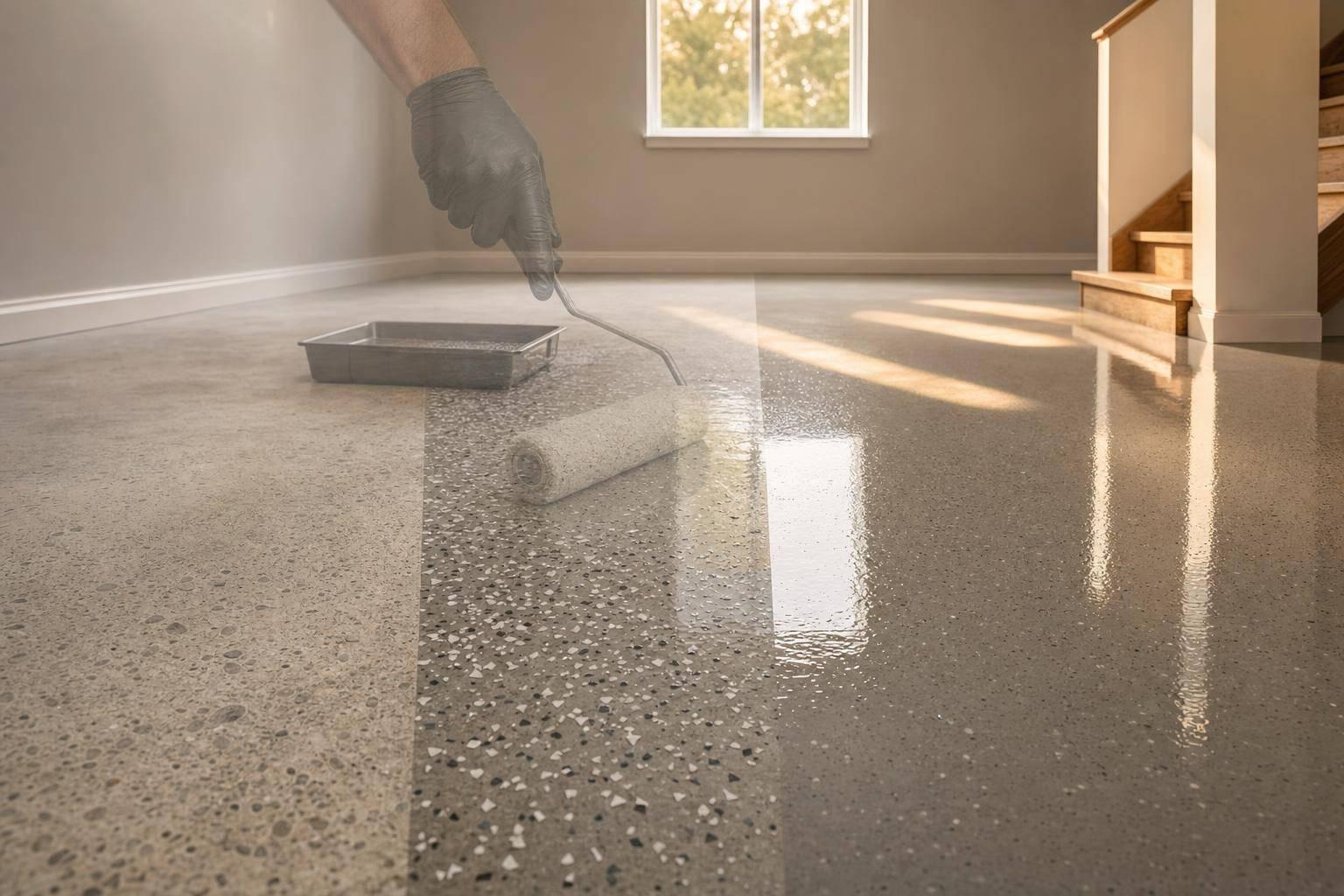
Croc Coatings takes a comprehensive approach to concrete coatings, treating them as complete systems rather than just surface treatments. Every slab undergoes moisture testing to determine whether moisture-mitigation primers are needed. Mechanical grinding is used to clean the surface and open up pores, ensuring a strong bond.
"Preparation is the most common reason garage floor coatings fail. Not the product. Not the brand. The prep." – Spray ‘n Coat Painting
Croc Coatings relies on the Penntek Evolution system, which is tailored to site-specific conditions like local humidity, temperature changes, and intended use. Installers also fill concrete joints to create a seamless surface, preventing moisture from gathering in cracks. Timing and curing conditions are carefully controlled to ensure proper adhesion, even in climates with extreme temperature swings. With this level of preparation and moisture management, professionally installed coatings can last 10–12 years, even in challenging environments.
Conclusion: Preventing Drainage-Related Coating Failures
Concrete coating failures linked to poor drainage can be avoided with a thorough approach to moisture management. From site planning to surface preparation and testing, every step plays a role in ensuring coatings last. Research highlights key culprits like water pooling, hydrostatic pressure control, and moisture vapor transmission, which can lead to issues such as delamination, blistering, and even structural damage – problems that often come with hefty repair bills. This underscores how both water pooling and vapor transmission, as detailed earlier, contribute significantly to coating breakdowns.
The process starts with smart site design: grading landscapes to divert water away from concrete slabs, installing reliable vapor barriers beneath the concrete, and opting for mechanical surface preparation over acid etching. Before applying any coating, ASTM F 1869 testing should confirm that vapor emissions stay below 3 lbs per 1,000 sq ft over 24 hours.
"Some people refer to concrete as a rigid sponge. It absorbs liquids, including solvents. Sometimes a small amount of solvents entrapped in concrete can result in massive coating failures." – Mike O’Brien
Timing is another critical factor. Coatings should be applied when concrete temperatures are on the decline to minimize off-gassing problems like pinholing and cratering. For floors exposed to chemicals, steam cleaning is essential to eliminate deep contaminants that surface degreasing alone can’t reach.
When paired with proper timing, professional installation ensures a durable finish. Croc Coatings tackles drainage challenges head-on by combining moisture testing, mechanical grinding, and its proprietary Penntek Evolution system. This method delivers a resilient coating that can withstand extreme temperature changes and seasonal moisture shifts, offering long-term reliability.
FAQs
How can I tell if poor drainage is causing my coating to peel or blister?
Signs that poor drainage is affecting your coating can include bubbling, lifting, or delamination. These problems often begin at edges or cracks and usually show up 12 to 24 months after installation. The main culprit? Moisture trapped beneath the coating, caused by vapor transmission or hydrostatic pressure.
Which moisture test should I use before coating – ASTM F2170 or ASTM F1869?
Before applying a coating, it’s crucial to conduct the in-situ relative humidity test (ASTM F2170). This method measures the moisture within the slab itself and is favored by most manufacturers. On the other hand, ASTM F1869 tests surface moisture vapor but doesn’t account for internal moisture, making it less dependable for coatings. To ensure proper adhesion and reduce the risk of failure, ASTM F2170 is typically the preferred option.
What drainage fixes should be done before re-coating concrete?
Before applying a new coat to concrete, it’s crucial to tackle any drainage problems. Poor drainage can lead to moisture buildup, which can compromise the coating over time. To manage water effectively, focus on improving drainage systems. This might involve fixing spots where water tends to pool, repairing or installing gutters and drains, or adjusting slopes to channel water away from the area. By addressing these issues, you can minimize moisture penetration and help ensure the re-coating lasts as intended.