Concrete floors can release moisture, leading to issues like flooring failures, mold, and structural damage if not properly managed. To address this, three federal standards regulate moisture barriers:
- ASTM E1745: Sets performance criteria for vapor retarders, focusing on durability (tensile strength, puncture resistance) and low permeance.
- ASTM F710: Provides guidelines for preparing concrete floors, including moisture and pH testing before installing resilient flooring.
- IRC R506.2.3: Requires a 10-mil vapor retarder under residential concrete slabs, meeting ASTM E1745 Class A standards.
These standards aim to prevent adhesive failures, protect warranties, and ensure long-term durability for residential, commercial, and industrial flooring projects. Compliance involves proper material selection, testing, and installation practices to control moisture effectively.
You DON’T Understand Vapor Barriers In Slabs!
sbb-itb-a0e5ae3
1. ASTM E1745
ASTM E1745 outlines the standards for plastic vapor retarders used beneath concrete slabs. It categorizes materials into three classes – A, B, and C – based on their physical strength rather than just their ability to block moisture. Regardless of the class, all materials must maintain a maximum water vapor permeance of 0.1 perms, as determined by ASTM E96 testing standards.
The primary differences between these classes are tensile strength and puncture resistance. For instance, Class A materials must have a minimum puncture resistance of 2,200 grams and a tensile strength of 45 lb/in. In contrast, Class C materials only need 475 grams of puncture resistance and 13.6 lb/in of tensile strength. Even small punctures can significantly compromise the barrier’s effectiveness. For example, a 1/8-inch nail hole can increase permeance to 0.93 perm, while a 5/8-inch stake hole can raise it to 2.2 perm.
"A product with a high puncture resistance but less than adequate permeance is of no value, just as is a product with very low permeance that is more likely to get punctured during the installation." – W. R. Meadows
While ASTM E1745 focuses on material specifications, ASTM E1643 complements it by addressing the selection, design, installation, and inspection of vapor retarders. Performance tests for permeance, tensile strength, and puncture resistance must be conducted on samples from the same production roll. For flooring that is highly sensitive to moisture, ACI 302.2R advises using a vapor retarder with a perm rating of 0.01 or less.
To ensure compliance, manufacturers should provide independent lab test results for all three performance criteria. Additionally, the 2021 International Residential Code (IRC) mandates that vapor retarders under concrete floor slabs meet ASTM E1745 Class A specifications, setting the standard for residential construction. Finally, ASTM F710 outlines the conditions required to confirm that concrete floors are sufficiently dry before installing resilient flooring. This is especially critical when selecting concrete coatings for harsh climates where temperature and moisture fluctuations are extreme.
2. ASTM F710
ASTM F710 outlines the preparation standards for concrete floors to ensure proper moisture control before installing resilient flooring like vinyl or linoleum. Although aimed at resilient flooring, these guidelines are also widely used for carpet and wood flooring installations as well. A key requirement of this standard is mandatory moisture testing for all concrete slabs, along with the installation of a permanent vapor retarder under all on-grade or below-grade concrete floors.
Two main methods are used for moisture testing:
- ASTM F2170 (in-situ probe test): This measures relative humidity (RH) within the slab, with a maximum allowable limit of 75% RH.
- ASTM F1869 (calcium chloride test): This measures the moisture vapor emission rate (MVER), which must not exceed 3 pounds per 1,000 square feet per 24 hours.
Before testing, both the slab and ambient air must remain at service conditions for at least 48 hours. For ASTM F2170, there’s an additional requirement to wait at least 72 hours for the moisture levels in the test hole to stabilize before taking a reading. These tests ensure that the substrate meets the necessary conditions for long-lasting flooring installations.
"Although the standard limits RH to 75%, manufacturers often approve installation above 75% RH, if appropriate moisture mitigation steps are taken." – GCP Applied Technologies
ASTM F710 also addresses other factors critical for floor preparation, like pH levels and surface uniformity. The standard requires pH testing, with an acceptable range of up to 9. Levels below 7 or above 10 can negatively impact adhesives and flooring materials. Additionally, the concrete surface must meet specific flatness standards, with no more than ±3/16 inches of variation over 10 lineal feet, and it must be free of contaminants like dust, paint, oil, or residual adhesives.
For new concrete pours, ASTM F710 recommends:
- A water-to-cement ratio between 0.40 and 0.45
- A minimum of 7 days wet curing
- A drying period of 60 to 90 days
The vapor retarder requirements include a minimum thickness of 0.010 inches (10 mil) and a maximum permeance of 0.1 perms.
"The permeance of vapor retarders should be less than that of the flooring system." – Scott Tarr, President of North American Concrete Consultants
Surface preparation methods must avoid chemical treatments. Instead, techniques like scraping or vacuuming are recommended to prevent residues that could interfere with adhesion. Expansion and moving joints should not be filled with patching compounds; instead, they require specialized joint covering systems.
3. IRC R506.2.3
IRC Section R506.2.3 outlines the minimum requirements for vapor retarders used in residential concrete slabs across the United States. The 2021 edition increased the standard thickness to 10 mil (0.010 inch), replacing the older 6 mil requirement. This change aligns with federal regulations while addressing specific needs in residential construction.
The vapor retarder must meet ASTM E1745 Class A standards, which include maintaining a maximum permeance of 0.1 perms, a tensile strength of 45 lb/in, and a puncture resistance of 2,200g. These specifications ensure the material can resist damage during installation and effectively block moisture.
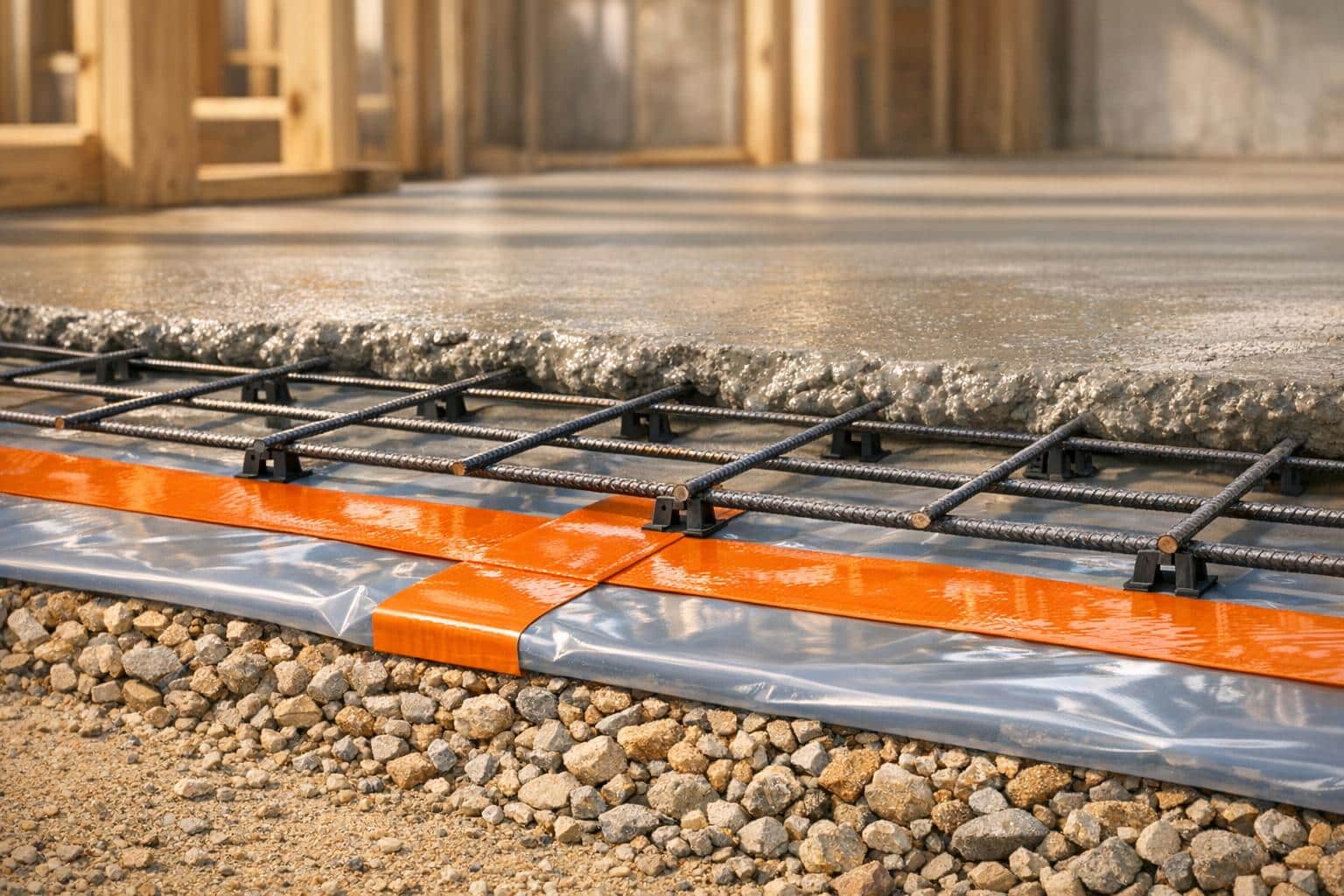
For proper installation, place the vapor retarder between the concrete slab and the base course (or directly on the prepared subgrade). Overlap all joints by at least 6 inches, and seal seams and penetrations to prevent moisture from sneaking through gaps or tears.
There are exceptions to the vapor retarder requirement. For example, it’s not necessary for unheated detached garages, utility buildings, carports, or unheated storage rooms smaller than 70 square feet. Local building officials may also waive this requirement based on specific site conditions. Additionally, the slab must meet the minimum thickness of 3.5 inches, as stated in IRC R506.1.
When securing the vapor retarder, avoid using staples or nails, which can compromise its integrity. Instead, use vapor or butyl tape to seal it. Extend the barrier 6 inches up the foundation walls, and repair any tears with polyethylene or foil tape. These precautions help maintain the barrier’s effectiveness over the life of the structure.
Pros and Cons
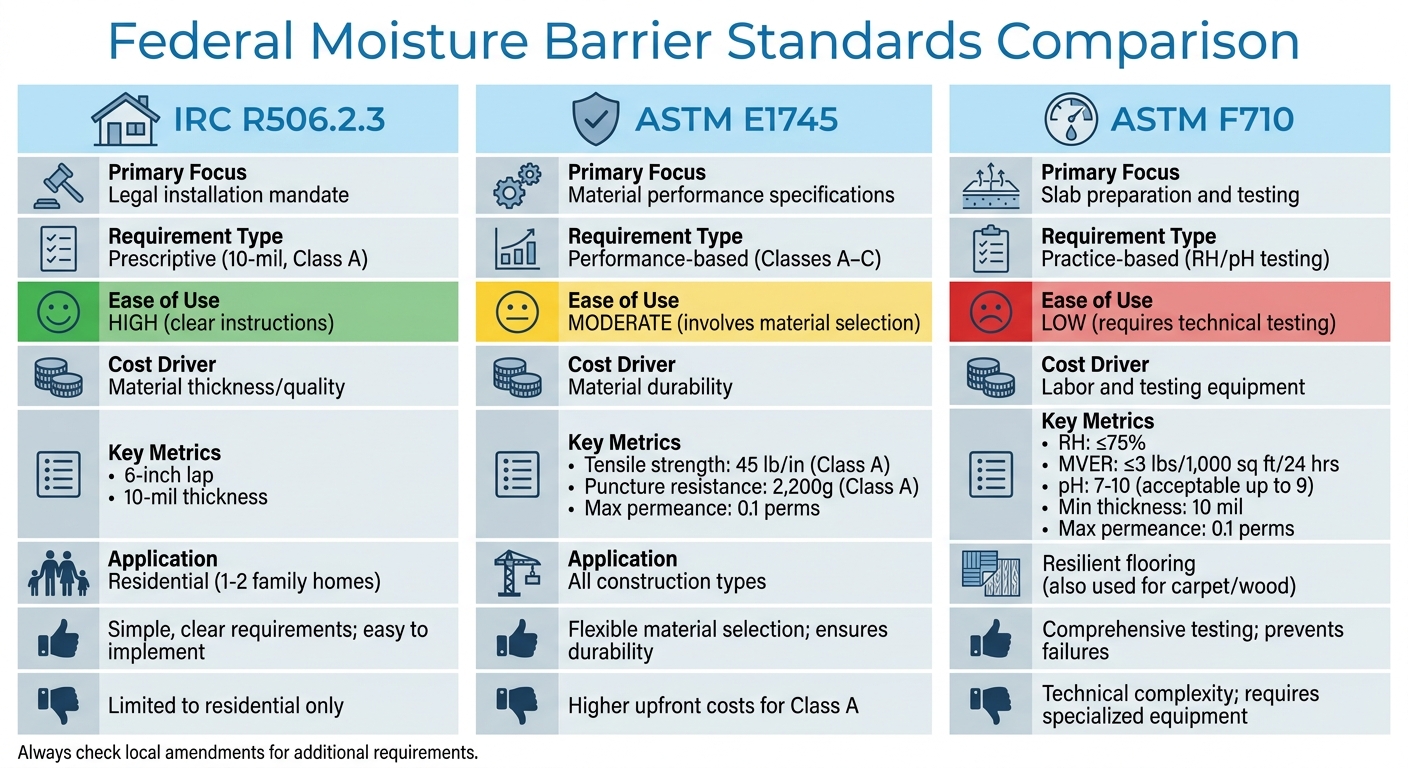
Comparison of Federal Moisture Barrier Standards for Concrete Floors
Taking a closer look at the standards mentioned earlier, let’s break down their strengths and challenges. IRC R506.2.3 is known for its straightforward approach. It lays out clear, simple requirements, such as using a minimum 10-mil vapor retarder with 6-inch laps. This makes it particularly easy to implement on residential job sites. However, its scope is limited – it applies only to one- and two-family homes. For commercial projects, additional standards often come into play to meet the more intricate needs of those environments.
ASTM E1745, on the other hand, prioritizes material performance. Instead of specifying brands or rigid guidelines, it focuses on measurable qualities like tensile strength and puncture resistance. This performance-driven model gives contractors the flexibility to choose materials while ensuring durability. The trade-off? Higher upfront costs for Class A membranes compared to generic 6-mil polyethylene. But over time, these higher-quality materials can save money by reducing the risk of moisture-related flooring problems.
ASTM F710 takes a more technical route, requiring concrete moisture testing and specific slab conditions before flooring installation can proceed. While building codes provide the legal framework, compliance with ASTM moisture standards is often tied to manufacturer warranties and liability concerns rather than direct enforcement by inspectors. As the National Flooring Authority explains:
"These ASTM standards [F2170 and F1869], while not mandated line-by-line by IBC text, are referenced in manufacturer installation specifications that inspectors and flooring professionals treat as minimum compliance thresholds".
Here’s a quick comparison of the three standards:
| Feature | IRC R506.2.3 | ASTM E1745 | ASTM F710 |
|---|---|---|---|
| Primary Focus | Legal installation mandate | Material performance specifications | Slab preparation and testing |
| Requirement Type | Prescriptive (10-mil, Class A) | Performance-based (Classes A–C) | Practice-based (RH/pH testing) |
| Ease of Use | High (clear instructions) | Moderate (involves material selection) | Low (requires technical testing) |
| Cost Driver | Material thickness/quality | Material durability | Labor and testing equipment |
| Key Metric | 6-inch lap; 10-mil thickness | Tensile strength; puncture resistance | RH %; calcium chloride rate; pH |
This breakdown highlights how different standards cater to specific project needs. Always check for local amendments, as some jurisdictions may enforce additional requirements beyond these federal guidelines.
Practical Applications and Industry Relevance
Federal moisture barrier codes play a critical role in avoiding costly installation failures. Before applying any concrete coating, contractors must follow a step-by-step code-compliance process, starting with an environmental assessment. If the area is classified as a "wet" environment under IBC Section 1210, the use of waterproof membranes becomes mandatory. Following this, substrate verification – using either ASTM F2170 (relative humidity testing) or ASTM F1869 (calcium chloride testing) – is essential. These tests ensure the slab’s moisture vapor emission rate (MVER) falls within acceptable limits, guiding the selection of appropriate coating systems.
For epoxy coatings, manufacturers typically require an MVER of no more than 3 lbs per 1,000 sq ft/24 hours, as outlined in ASTM F710. When test results exceed this limit, advanced moisture mitigation systems are necessary. Products like Croc Coatings‘ Penntek Evolution, which complies with ASTM F3010 standards, are specifically designed for high-performance moisture mitigation. These systems can suppress vapor emission rates up to 25 lbs per 1,000 sq ft/24 hours, offering capabilities far beyond standard coating systems.
Industry professionals emphasize the importance of preparation:
"A finish coating applied over untreated vapor-transmitting concrete will fail through delamination, blistering, or efflorescence regardless of product quality".
To ensure effective mechanical adhesion, contractors must follow ICRI Guideline No. 310.2 for proper surface profiling. Contractors must also assess Concrete Surface Profile accurately to ensure long-term bond strength. This ensures the concrete achieves the required Concrete Surface Profile (CSP) for coating application.
In residential projects across North Idaho and Eastern Washington, IRC R506.2.3 requires a 10-mil ASTM E1745 Class A vapor retarder beneath the slab. When paired with a topical system like Penntek Evolution, which achieves a permeance rating of 0.01 US perms or less, property owners benefit from comprehensive moisture protection. This combination not only meets federal standards but also provides the durability needed for spaces like garage floors, basements, and commercial areas.
Contractors should document all test results and product data sheets for project closeout and warranty purposes. Moisture-related failures remain a leading cause of flooring litigation, making compliance with federal standards and manufacturer specifications essential. Proper vapor management is critical, as adhesive bond failures are often traced back to inadequate moisture control.
Conclusion
Grasping the distinctions between ASTM E1745, ASTM F710, and IRC R506.2.3 is key to preventing moisture damage in concrete floors. For residential construction, IRC R506.2.3 sets the legal baseline, requiring a 10-mil vapor retarder under slabs in one- and two-family homes. Meanwhile, ASTM E1745 outlines performance standards – like tensile strength, puncture resistance, and permeance – to ensure vapor retarders can handle construction site demands. On the other hand, ASTM F710 emphasizes proper surface preparation for resilient flooring, including mandatory moisture testing before installation. This includes testing for hydrostatic pressure to identify potential moisture migration issues.
The type of project dictates which standards apply. In residential construction, particularly in areas like North Idaho and Eastern Washington, IRC R506.2.3 compliance is mandatory, with inspectors confirming the use of an approved vapor retarder. For commercial and multi-family buildings, the International Building Code (IBC) – adopted by 49 states and Washington, D.C., as of 2021 – governs compliance. These projects often require adherence to manufacturer specifications that reference ASTM standards to maintain warranty coverage.
As the National Flooring Authority warns, "Adhesive bond failures linked to vapor drive carry significant warranty and liability implications for contractors operating under classification frameworks". Such failures not only breach warranties but can also lead to serious liability concerns.
It’s crucial to confirm which version of the IBC or IRC applies in your area, as local amendments might impose stricter rules. Keeping thorough documentation of moisture test results and material specifications is vital. These records are invaluable for protecting warranties and reducing liability risks should issues arise after project completion.
For guidance on applying these standards and ensuring durable concrete floors, reach out to Croc Coatings in North Idaho and Eastern Washington.
FAQs
Which standard applies to my project – IRC R506.2.3, ASTM E1745, or ASTM F710?
The standard you need to follow depends on the type of project you’re working on. For residential buildings or one- and two-family dwellings, the IRC R506.2.3 standard applies. This requires placing a vapor barrier with a minimum thickness of 10 mil under concrete slabs.
For commercial or multi-family projects, the guidelines are a bit different. In most cases, ASTM E1745 is the standard to reference. However, the exact requirements can vary based on the building codes applicable to your project, such as the IBC or IRC. Always double-check the codes specific to your location to ensure compliance.
What moisture test should I use – RH probes or calcium chloride?
RH probes are used to measure internal humidity by placing sensors directly into the concrete. This method provides fast, detailed readings, making it a great choice for evaluating moisture vapor inside the slab. On the other hand, calcium chloride tests focus on surface-level vapor emissions. They are easy to perform and widely recognized by flooring manufacturers. Whether you opt for RH probes for deeper analysis or calcium chloride tests for simpler surface evaluation depends on your project’s requirements and budget.
What happens if my slab fails the moisture or pH limits?
If your concrete slab doesn’t meet moisture or pH limits, it can lead to several problems. These include poor adhesion of flooring materials, early failure, and moisture-related issues like blistering or peeling of coatings. Such failures can affect both the durability and the look of your flooring.