Garage floor coating prices in North Idaho and Eastern Washington usually fall between $3 and $16 per sq. ft. in 2026, with most 2-car garages landing around $2,500 to $5,500 depending on the system, prep work, and location.
Pricing varies significantly by region — use our cost calculator for a personalized estimate. For a complete epoxy garage floor cost breakdown, see our detailed guide covering material, labor, and regional pricing.
If I were setting a budget, I’d focus on three things first:
- Coating type: epoxy costs less up front, while polyurea and polyaspartic cost more but cure in about 24 hours
- Slab condition: cracks, old coatings, and moisture can add $1 to $4 per sq. ft. or more
- Region: Spokane often runs a bit lower, while North Idaho can cost more due to travel, winter wear, and prep needs
You can also expect local weather to affect the quote. In Coeur d’Alene, Hayden, and Post Falls, freeze-thaw cycles, road salt, and snow grit can push jobs toward heavier prep. In Kennewick, Richland, and Pasco, heat and UV exposure make UV-stable topcoats more important.
Quick Comparison
| Area | Typical Price Range | Common 2-Car Garage Cost | Main Cost Drivers |
|---|---|---|---|
| North Idaho | $4.50–$16.00/sq. ft. | $3,200–$5,500 | Freeze-thaw, salt, cracks, travel |
| Spokane | $4.00–$15.00/sq. ft. | $2,660–$5,175 | Older slabs, winter moisture |
| Tri-Cities | $3.00–$12.00/sq. ft. | $2,500–$4,800 | UV, heat, dust |
The short version: price starts with square footage, but prep work and system choice usually decide whether your quote stays near the low end or climbs fast.
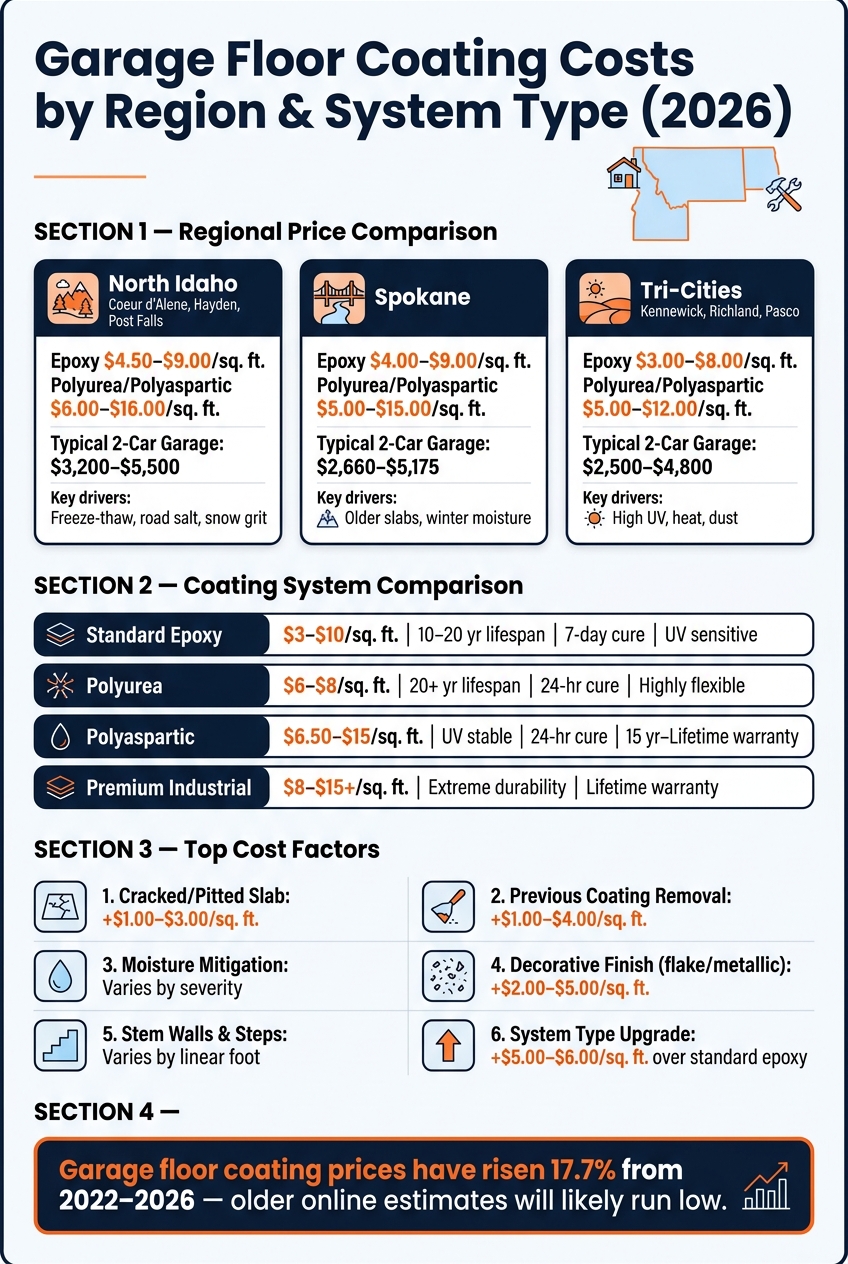
Garage Floor Coating Costs by Region & System Type (2026)
2. Coating Systems and 2026 Cost Benchmarks
Epoxy, Polyurea, Polyaspartic, and Premium Industrial Systems
Coating systems don’t cost the same because they don’t perform the same.
In most cases, paying more gets you faster cure times, better wear resistance, and stronger UV protection. Standard epoxy vs. polyaspartic systems usually run about $3–Standard epoxy usually runs about $3–$10 per sq. ft. installed.0 per sq. ft. installed. It can last 10–20 years, but it often needs about 7 days before you can drive on it, and it may yellow over time.
Polyurea and polyaspartic systems come in at a higher upfront price, usually $6–$15 per sq. ft.. The tradeoff is pretty clear: they cure in about 24 hours, hold up well against UV fading, and often last 20+ years.
Premium industrial-grade systems, including the Penntek Evolution system offered by Croc Coatings, usually land in the $8–$15+ per sq. ft. range. These systems are built for high chemical and impact resistance and often come with lifetime warranties. Learn why Penntek polyurea is worth the premium.
Once you turn those per-square-foot rates into full project totals, the price gap starts to make a lot more sense.
Price by Garage Size: 1-Car, 2-Car, and 3-Car Projects
The coating system sets the rate. The square footage determines the final bill, which you can estimate using a concrete coating cost calculator.
A 1-car garage at roughly 180–250 sq. ft. usually costs $1,200–$2,500 for professional installation. A 2-car garage at 400–500 sq. ft. typically falls between $2,000 and $4,000 for most systems, though premium options can push that number higher. A 3-car garage at 600–700 sq. ft. often lands in the $3,000–$6,000 range, with floor condition and system choice affecting the final price.
Treat these numbers as the starting point for North Idaho and Eastern Washington pricing in the next section.
2026 National Cost Benchmarks by Coating Type
These 2026 benchmarks show the current national high and low end for each system.
| Coating Type | National Cost (per sq. ft.) | Typical 2-Car Garage Total | Durability | Common Warranty |
|---|---|---|---|---|
| Standard Epoxy | $3–$10 | $2,000–$4,000 | 10–20 years; UV sensitive, can yellow | 5–10 years |
| Polyurea | $6–$8 | $2,500–$5,000 | 20+ years; highly flexible | 15 years to Lifetime |
| Polyaspartic | $6.50–$15 | $3,000–$6,500 | UV stable; 24-hour return to service | 15 years to Lifetime |
| Premium Industrial | $8–$15+ | $4,000–$7,500 | Extreme chemical/impact resistance | Lifetime |
These are 2026 national benchmarks, and garage floor coating prices have climbed 17.7% over the last five years (2022–2026). That means older online estimates will likely come in low compared with current pricing. The next section breaks down what these numbers look like in North Idaho and Eastern Washington.
sbb-itb-a0e5ae3
How Much Does Garage Floor Coating Cost? (Factors and Ranges)
When evaluating these price ranges, it is important to consider the DIY vs professional concrete coating costs and how they impact long-term durability.
3. Regional Price Ranges in North Idaho and Eastern Washington
Local labor rates, weather, and slab prep can move pricing up or down, even when the base coating system looks similar on paper.
North Idaho: Coeur d’Alene, Hayden, and Post Falls
North Idaho garages take a beating. Freeze-thaw cycles, road salt, and snow grit are tough on garage floors, especially if the slab is older or was never sealed. That’s why many homeowners end up leaning toward polyurea or polyaspartic systems, along with deeper surface preparation before coating starts.
Typical North Idaho pricing lands around $4.50–$9.00 per sq. ft. for epoxy and $6.00–$16.00 per sq. ft. for polyurea or polyaspartic systems. For a standard 2-car garage, many projects fall in the $3,200–$5,500 range. If the slab has cracks or damaged concrete, repairs can add $1–$3 per sq. ft.. Homes outside denser service areas, including some properties in Hayden or Post Falls, may also get hit with mobilization fees.
Spokane and Tri-Cities: Local Cost Patterns and Use Cases
Spokane comes in at about 2% below the national baseline. A typical 2-car epoxy floor averages about $2,660, with most jobs ranging from $1,330 to $4,750 based on the coating system and the condition of the slab.
The Tri-Cities has a different problem set. In Kennewick, Richland, and Pasco, floors deal with more UV exposure and heat. That makes UV-stable topcoats a big deal if you want to avoid yellowing and surface breakdown over time.
Regional Pricing Table: North Idaho vs. Spokane vs. Tri-Cities
The table below pulls the 2026 pricing ranges into one place.
| Region | Epoxy (per sq. ft.) | Polyurea/Polyaspartic (per sq. ft.) | Typical 2-Car Garage Total | Climate/Usage Notes |
|---|---|---|---|---|
| North Idaho (Coeur d’Alene, Hayden, Post Falls) | $4.50 – $9.00 | $6.00 – $16.00 | $3,200 – $5,500 | Freeze-thaw, road salt, snow grit; mobilization fees may apply |
| Spokane | $4.00 – $9.00 | $5.00 – $15.00 | $2,660 – $5,175 | Older slabs; winter moisture affects prep |
| Tri-Cities | $3.00 – $8.00 | $5.00 – $12.00 | $2,500 – $4,800 | High UV, heat, and dust; UV-stable topcoats matter |
The next section gets into the site conditions, prep work, and finish choices that push quotes toward the low or high end of these ranges.
4. What Drives Garage Floor Coating Costs in This Region
Square footage and coating type matter, but they don’t tell the whole story. The final price usually comes down to the condition of the slab, how much prep the floor needs, and how tricky the garage is to work in.
That’s why regional price ranges only start to make sense when you factor in prep work, moisture issues, and layout details.
Concrete Condition, Prep Work, and Layout Complexity
Concrete condition has the biggest effect on price. In Spokane and North Idaho, prep often accounts for about 13% of total project cost, while repairs add about another 5%. If the floor already has an old coating, removing it adds $1–$4 per sq. ft. before the new system goes down.
Moisture is a big deal in this area. Unheated garages and slabs with a history of dampness often need special vapor barrier primers to help stop peeling or blistering. These and similar factors are often overlooked in initial quotes — see our hidden costs of garage floor coatings guide for a full breakdown of what else can shift your final price. When vapor transmission is high, standard pricing calculators don’t hold up well, so those jobs need an on-site assessment.
Layout matters too. Stem walls, steps, floor drains, and posts all take extra hand-grinding and more careful application, which adds labor time and cost. A plain rectangular slab is almost always cheaper to coat than a garage with several transitions or vertical surfaces.
Climate, Decorative Options, and Durability
Freeze-thaw cycles, snowmelt, and temperature swings are hard on coatings. Because of that, diamond grinding is the standard prep method here, not acid etching.
Eastern Washington also gets hot, sunny summers, which makes UV-stable topcoats more important. Decorative chip blends and metallic pigments usually add about $2–$5 per sq. ft.. Anti-slip texture additives can make the floor safer in wet winter conditions without changing the total much.
For homeowners looking at a higher-end local choice, Croc Coatings offers its Penntek Evolution system with UV stability, slip resistance, antibacterial properties, one-day installation, and a lifetime warranty.
Cost Factors and Their Price Impact
| Cost Factor | Why It Affects Price | Impact Level | Approx. Per Sq. Ft. Adjustment |
|---|---|---|---|
| Cracked/Pitted Slab | Requires patching and surface leveling before coating | Medium | +$1.00 – $3.00 |
| Previous Coating Removal | Old paint or failed epoxy must be mechanically stripped | High | +$1.00 – $4.00 |
| Moisture Mitigation | Specialized primers are needed to help prevent coating failure on damp slabs | High | Varies by slab severity |
| System Type | Premium systems cost more than standard epoxy | High | Higher than standard epoxy by roughly $5.00–$6.00 |
| Decorative Finish | Flake broadcasts and metallic pigments add material and labor steps | Medium | +$2.00 – $5.00 |
| Stem Walls & Steps | Vertical surfaces require hand-grinding and careful application | Medium | Varies by linear foot |
| Anti-Slip Texture | Aluminum oxide or grip additives mixed into topcoat | Low | Usually a small add-on |
The biggest price swings usually come from two things: slab condition and system type. From there, decorative upgrades, layout details, and weather-driven prep add to the total. Those are the factors that move a quote above or below the local average.
With that context, it becomes much easier to look at local competition and seasonal demand and make sense of the numbers.
5. Local Market Pricing and How to Judge Value in 2026
How Local Competition and Seasonality Affect Quotes
Once you understand the base cost drivers, local competition and seasonality explain why two nearby quotes can still look very different.
Spokane pricing tends to stay near the national baseline, while North Idaho quotes often come in higher when travel and prep add labor time. In places like Coeur d’Alene, Hayden, and Post Falls, prices can climb when crews are coming in from Spokane or other service hubs. A smaller pool of local contractors can also mean less pressure on bids. Then there’s the climate piece. Jobs in outlying areas may need extra prep, like moisture mitigation and mechanical grinding, which is essential for preventing moisture-related coating failures to deal with freeze-thaw stress, and that can push costs above metro-area averages.
Timing plays a big role too. In this region, the best installation window usually runs from May through September, when humidity is lower and temperatures stay between 50–85°F for proper curing. That’s also when demand is at its highest, so schedules can fill up fast and quote flexibility can shrink. It’s still smart to ask about off-season openings, but curing conditions need a close look before moving ahead.
Another thing to watch: contractors in this market are using more tiered pricing based on system type, finish, and prep work. That can make one-to-one quote comparisons a headache. But it also gives you a clearer look at what the bid actually includes.
Value Comparison Table and Key Takeaways
In this market, the lowest quote only makes sense if it includes proper prep, climate-ready materials, and a warranty. So when you compare bids, look past the sticker price and check the scope. When weighing options, consider the short-term vs. long-term coating value — a lower upfront price can mean higher costs over time.
| Pricing Approach | Typical Per Sq. Ft. Band | Expected Lifespan | Warranty Style | Installation Timeline | Best Fit |
|---|---|---|---|---|---|
| Standard Epoxy | $7–$10 | 5–10 years | 1–5 years | 3–7 days | Indoor utility spaces |
| Premium Polyaspartic / Polyurea | $12–$17 | 15–20+ years | Lifetime | 1 day | Homeowners & small business owners |
Bands and value profiles above reflect Spokane-area benchmarks and the comparison ranges in the source material.
Regional quotes tend to shift the most when installers need to account for travel, prep, and local climate demands. For homeowners and small business owners in North Idaho and Eastern Washington, Croc Coatings offers climate-ready garage floor coatings with one-day installation and a lifetime warranty.
FAQs
How do I know which coating system is right for my garage?
The right coating comes down to three things: how you use your garage, what you want to spend, and the kind of climate you live in. Start with the basics. Is your garage mostly for parking cars? Do you use it as a workshop? Or is it where you handle weekend projects and hobbies?
Epoxy can be a good fit if you want a lower-cost option for moderate traffic. If your floor takes more wear, a tougher system may make more sense. Products like Penntek Evolution from Croc Coatings offer stronger protection against chemicals, UV rays, and harsh weather. That can make them a smart long-term pick, especially if you want less upkeep over time.
What usually makes one garage quote higher than another?
Garage floor coating quotes can swing quite a bit. Two big reasons are the condition of the concrete and how tricky the job is.
If the floor needs extra prep, the price usually climbs. That can include removing oil stains, fixing cracks, or running moisture tests. In some cases, that prep work can add up to 30% to the total cost.
Labor is also a major part of the quote, often accounting for 33% to 70% of the price. On top of that, your material choice, decorative finishes, and site-access issues can push the number higher.
When is the best time of year to schedule garage floor coating?
The best time depends on the product.
Most epoxy coatings need temperatures between 50°F and 90°F, which makes spring and fall a good fit in many cases. When the weather turns cold, curing can take longer. On top of that, temperature swings can drag out the job and add to labor costs.
Croc Coatings’ Penntek Evolution system gives you more room to work with. It can be installed in temperatures as low as -20°F, so installation is available year-round.