Most epoxy floor quotes hide the main cost drivers. In 2026, most installed systems run about $7 to $12 per sq. ft., but the final price often comes down to slab prep, crew time, and warranty terms.
If I were comparing quotes, I’d focus on these points first:
- Prep: Basic prep may cost $2.50 to $4.00 per sq. ft.; damaged slabs can add $2.00 to $5.00+ per sq. ft.
- Labor: Installation often makes up 33% to 60% of total cost
- Warranty: A low-price system with a short warranty can cost more over time if recoating is needed
- Garage range: A 400–500 sq. ft. two-car garage often lands around $4,000 to $6,000
- Local range: In North Idaho and Eastern Washington, projects can run about $7 to $16 per sq. ft.
A low quote often means less grinding, less repair, fewer layers, or narrower warranty coverage. A higher quote often includes more prep, more labor up front, and longer coverage. That is why the top-line price alone does not tell you much.
| Cost area | What changes the price | Why you should care |
|---|---|---|
| Prep | Cracks, oil, old coatings, moisture | Bad prep can lead to peeling or early failure |
| Labor | Floor size, layout, access, layer count | More crew time means a higher installed cost |
| Warranty | Length, labor coverage, exclusions | Fine print affects what you may pay later |
Bottom line: I’d judge an epoxy floor quote by what is included, not just by the price per square foot. The article below breaks that down in simple terms.
Epoxy Floor Cost Breakdown: Prep, Labor & Warranty Compared
Surface Prep: Where Much of the Budget Goes
Surface prep is a big reason two quotes for the same garage size can end up far apart. It has a direct effect on labor time and on the full installed price.
Basic Prep vs. Heavy Repair Work
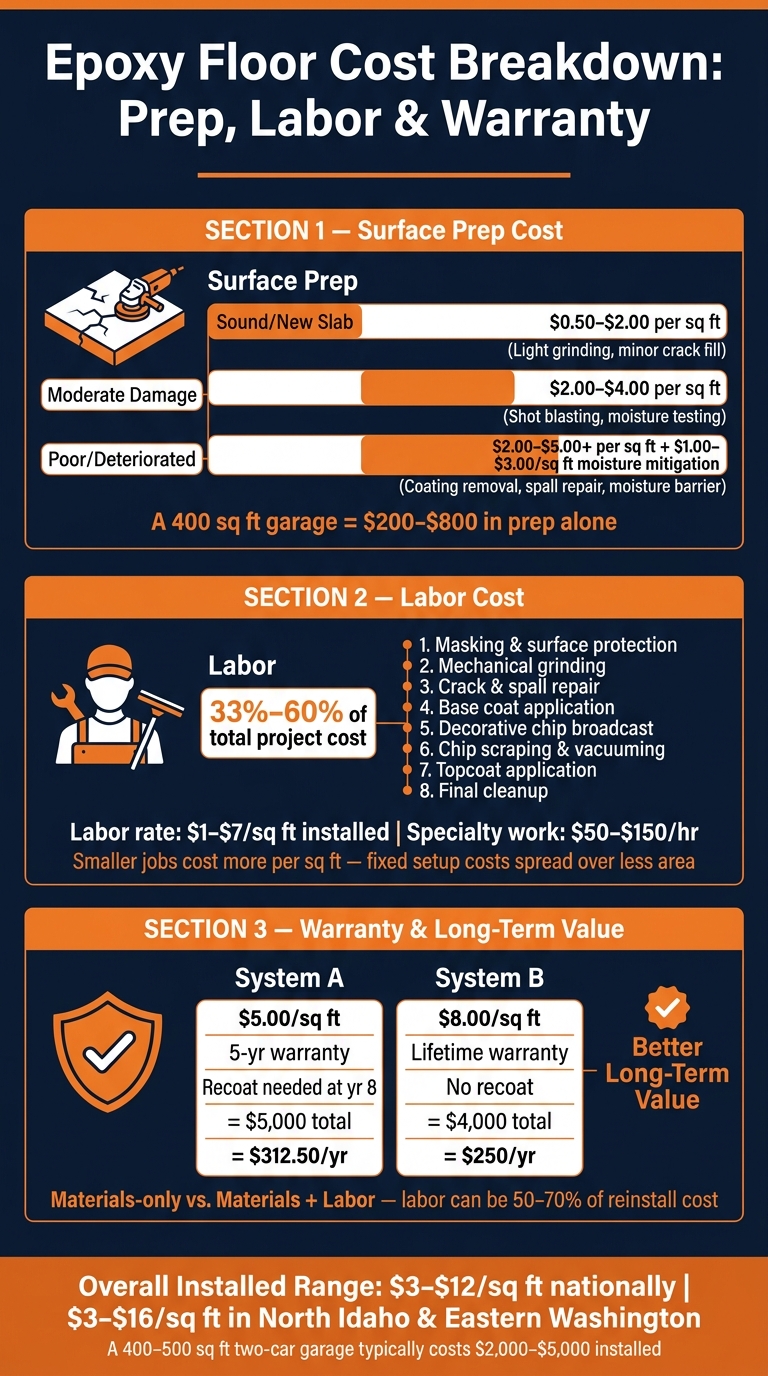
If the slab is in good shape and doesn’t have major damage, basic prep usually covers thorough cleaning, light mechanical diamond grinding and profiling, minor crack filling, and surface profiling to help the coating bond better. That kind of work usually costs about $0.50 to $2.00 per sq ft.
For a 400 sq ft garage, that works out to about $200 to $800 in prep before any coating material goes down.
Once the slab has issues, the price can climb fast. Spalling, oil contamination, active cracks, and failed older coatings all take more labor and more material. U.S. pricing guides show that prep on problem slabs can add $2.00 to $5.00 per sq ft in extra labor, while moisture mitigation can add another $1.00 to $3.00 per sq ft.
Peckham Coatings‘ 2025 pricing data shows this pretty clearly. Good concrete with minor prep runs about $6 to $9 per sq ft, while poor concrete that needs coating removal and moisture barriers can hit $8 to $14+ per sq ft.
| Slab Condition | Typical Prep Scope | Added Cost Range |
|---|---|---|
| Sound / New | Cleaning, light grinding, minor crack filling | $0.50–$2.00 per sq ft |
| Moderate Damage | Crack filling, shot blasting, moisture testing | $2.00–$4.00 per sq ft |
| Poor / Deteriorated | Coating removal, spall repair, moisture barrier | $2.00–$5.00+ per sq ft in added prep labor, plus $1.00–$3.00 per sq ft if moisture mitigation is needed |
How Better Prep Affects Coating Performance
Prep cost matters for a simple reason: it affects bond strength, floor life, and warranty risk.
Poor prep is one of the main causes of early floor failure. Hot-tire pickup, where warm tires pull coating off the slab, is often linked to weak surface profiling or contamination that stayed on the floor before installation.
Mechanical diamond grinding gives the coating a textured surface to grip. Industry standards such as ICRI‘s Concrete Surface Profile scale call for a CSP 3–5 profile for most epoxy and flake systems. That means mechanical grinding, not acid etching. When prep is done well, the floor is less likely to peel, delaminate, or blister over time.
Croc Coatings Prep Standards in a One-Day Process
Croc Coatings uses a one-day installation process for its Penntek Evolution coating system, rated 4x stronger than epoxy and backed by a lifetime residential warranty. Even in a one-day setup, prep is still a big part of the installed price. In other words, a faster timeline doesn’t mean skipping the hard part. That prep work feeds straight into labor cost in the next section.
sbb-itb-a0e5ae3
Labor Cost: Crew Time, Coating Steps, and Job Conditions
Labor is one of the biggest costs in any coating project. In most residential and light commercial jobs, it often makes up 33% to 60% of the total price, with professional installation usually landing between $3 and $7 per sq ft. Specialty work, like complex crack repair or detailed layout work, is often billed on its own at $50 to $150 per hour.
Why such a big range? It mostly comes down to crew time, job difficulty, and site conditions. And more than anything else, prep tends to drive labor cost. If the slab is in rough shape, the quote usually goes up.
What Labor Includes on a Coating Project
A coating crew does a lot more than apply product and head out. The job usually moves through several stages, and each one adds time and labor cost.
That work often includes:
- Masking and protecting nearby surfaces
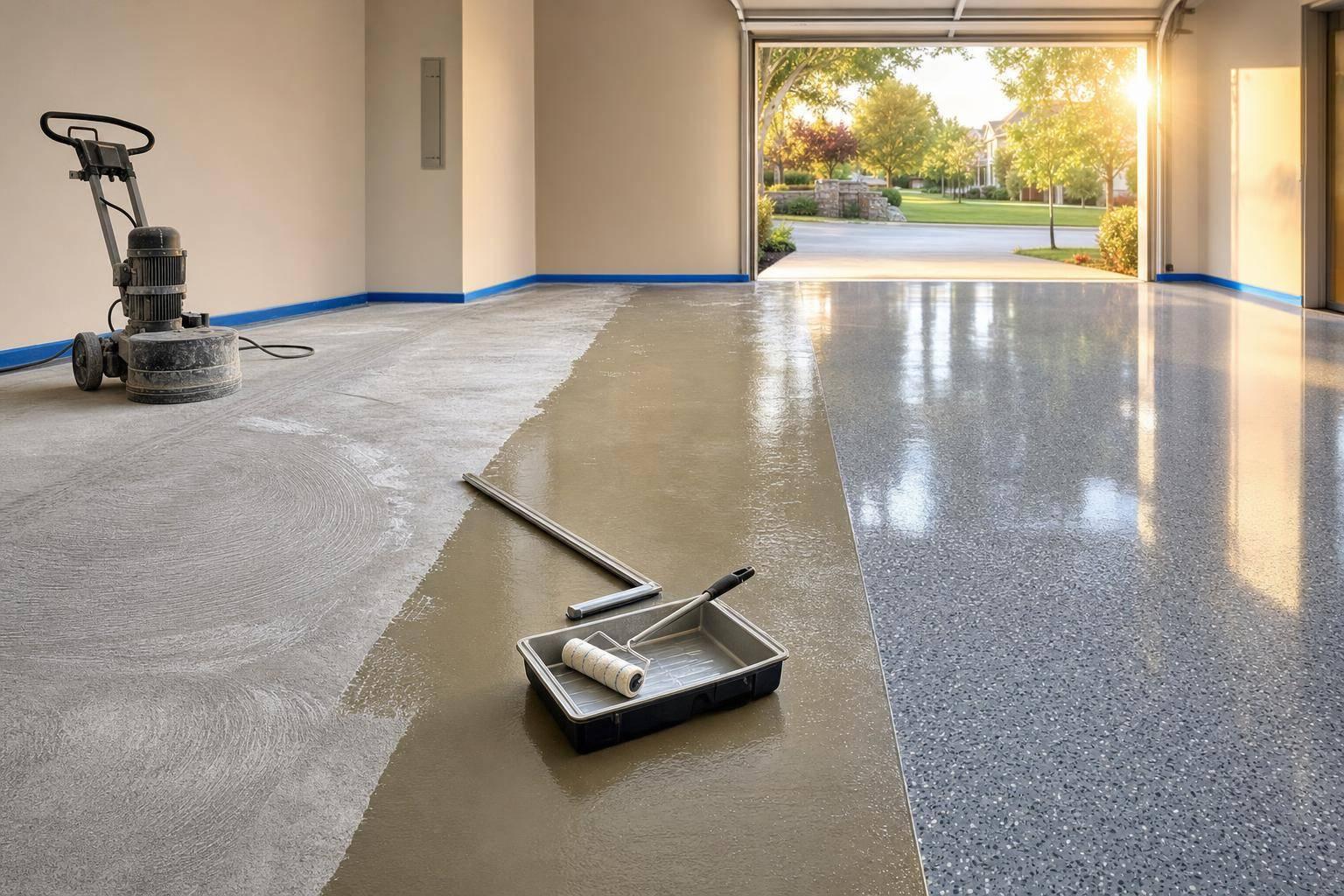
- Mechanical grinding
- Crack and spall repair
- Base coat application
- Decorative chip broadcast
- Chip scraping and vacuuming
- Topcoat application
- Final cleanup
The more steps a floor needs, the more labor it takes. Properly preparing your space can help streamline this process. Prep is usually the biggest driver because damaged or contaminated slabs need extra grinding and repair. In plain English: the slab condition has a direct effect on the installed price.
Why Some Floors Cost More to Install
Even with the same coating system, some job conditions make installation take longer and cost more.
| Condition | Why It Adds Labor Cost |
|---|---|
| Occupied spaces | More masking and protection |
| Difficult access | Slower equipment and material movement |
| Complex floor layout | More hand work and masking |
| Additional coating layers | More mix, apply, and cure time |
| Weather or temperature | Extra scheduling or climate control |
Smaller jobs also tend to cost more per square foot. Setup, equipment transport, and mobilization are mostly fixed costs. So when those costs are spread across a small floor, the price per sq ft goes up. On larger projects, that same setup gets spread out better. Labor cost per sq ft often drops once project size reaches 500 to 1,000 sq ft.
These same labor factors also help explain why faster installation schedules can cut total job time.
One-Day Installation and Labor Efficiency
Croc Coatings installs its Penntek Evolution system in one day on most residential garages. That cuts repeat mobilization and lowers total labor time. For homeowners in Coeur d’Alene, Spokane, the LC-Valley, and the Tri-Cities, it also means the garage or patio is out of use for one day instead of several.
That kind of scheduling keeps labor waste down and makes timing easier to plan around. It also helps explain why one-day systems can have a different price per square foot.
Labor efficiency shapes installed cost, but warranty terms shape what that price means over the long haul.
Warranty Terms: How Coverage Affects Price and Long-Term Value
After surface prep and labor, warranty terms are the third big factor behind price. They affect cost because they shift risk to the installer and often call for stronger materials and better surface prep. Residential warranties usually run 5 to 15 years, while premium systems may include limited lifetime coverage. Commercial warranties are often much shorter – 1 to 5 years – because heavier traffic and rougher use make wear more likely.
What to Check in a Floor Coating Warranty
The number of years on the page is just the starting point. What the warranty actually covers matters more.
The main thing to look at is whether the warranty is materials-only or materials plus labor. A materials-only warranty may replace defective product, but the homeowner still pays for labor, grinding, removal, and reinstallation. Those costs can make up 50% to 70% of the total installed price.
Then look closely at the exclusions. Many warranties do not cover failures tied to moisture vapor transmission, hydrostatic pressure, or new cracks caused by substrate movement. UV fading, chemical damage, and heavy traffic are also often excluded or limited. That fine print matters. It’s what decides whether a low quote stays low later on.
Cost Per Year of Service vs. Cost Per Square Foot Alone
A higher upfront price isn’t always the worse deal.
Take a 500 sq ft garage. System A costs $7.00 per sq ft ($2,500 total) and comes with a 5-year warranty. System B costs $9.00 per sq ft ($4,000 total) and includes a lifetime residential warranty plus a tougher coating system.
If System A needs a recoat in year 8 for another $2,500, the total cost rises to $5,000, or about $312.50 per year. System B, if it avoids a full recoat, stays at $4,000, or about $250 per year. So even though System B costs more at the start, it ends up costing less per year because it lasts longer and skips that extra recoat.
Croc Coatings Warranty in This Study
The Penntek Evolution system installed by Croc Coatings comes with a lifetime residential warranty for qualifying installations. Commercial coverage follows set terms that match the heavier demands of those spaces.
Because the system is built to resist peeling, hot tire pickup, and impact under normal use, the cost-per-year picture shifts in its favor. For North Idaho and Eastern Washington projects, that warranty context plays a direct role in how the full value is measured.
Conclusion: How Prep, Labor, and Warranty Shape the Real Cost
Prep, labor, and warranty shape the real cost of epoxy floors. The per-square-foot quote only tells part of the story.
Use these cost drivers to compare quotes line by line.
| Cost Driver | What It Adds to Price | Why It Matters Long-Term |
|---|---|---|
| Mechanical grinding & slab prep | Often adds about $1.00–$4.00/sq ft | Improves adhesion and lowers the chance of early failure |
| Crack and spall repair | Variable by damage | Fixes weak spots that can show through the coating later |
| Moisture and hardness testing | Modest add-on | Helps spot slab issues before they lead to failure or coverage disputes |
| System type and coating layers | Higher material and labor cost | More layers and advanced systems improve impact, chemical, and UV resistance; polyurea/polyaspartic systems can last 20–25 years vs. 3–5 years for professional epoxy |
| One-day vs. multi-day installation | Affects labor efficiency | Faster installs can cut downtime and make scheduling easier |
| Warranty length and scope | Often built into premium quotes | Longer coverage spreads the investment across more years of protected service |
These trade-offs matter even more in this region. In North Idaho and Eastern Washington, freeze-thaw cycles, road salt, and heavy garage use put extra stress on floor coatings. That makes prep and warranty a much bigger deal than they may seem at first glance.
A lower upfront quote can end up costing more if the floor fails early and needs recoating. On the flip side, a higher-priced system with better prep and broader warranty coverage can cost less per year.
That’s the value case this study points to. Croc Coatings uses this framework locally through its Penntek Evolution system, where prep standards, coating strength, and warranty coverage work together to support long-term value instead of the lowest starting number.
Stronger prep, labor, and warranty can lower cost per year, even when the upfront quote is higher.
FAQs
What prep work do I actually need?
You’ll usually need to prep the slab by:
- Clean and degrease the surface
- Check for cracks, pits, and spalls, repair them, and level low or uneven spots
- Profile the concrete to open up the pores, most often with diamond grinding
Moisture also matters. Test the slab before you start. If water beads on the surface instead of soaking in, strip off old sealers or coatings first. After grinding, use a HEPA vacuum so dust doesn’t get in the way of adhesion.
Why do small garages cost more per square foot?
Small garages often cost more per square foot because the fixed costs don’t get smaller just because the building does.
You still need the same basic setup: equipment, transport, and site prep. That means labor and overhead are being spread across fewer square feet, which pushes the per-square-foot price up.
With larger projects, crews usually work more efficiently, and scale helps bring the unit cost down.
What does a floor coating warranty really cover?
A floor coating warranty usually covers problems tied to materials or installation, like peeling, adhesion problems, delamination, cracking, and sometimes fading. But there’s usually a line in the sand: it often doesn’t cover poor care, harsh conditions, or normal wear beyond the stated terms.
Standard epoxy warranties often run from 1 to 5 years. Most focus on defects, not how the floor holds up over the long haul. By contrast, for Croc Coatings’ Penntek Evolution residential installs, the lifetime warranty is meant to cover peeling, delamination, and both materials and labor under normal use.