If you park in your garage often, plain water-based paint is usually a short-term fix. From what I see in the article, latex/acrylic paint is the cheapest option at about $0.40 to $1.00 per sq. ft., but it often lasts only 1 to 3 years. Water-based 2-part epoxy costs more – about $0.80 to $1.50 per sq. ft. – but it tends to last 3 to 7 years and handles normal car use better. Professional coating systems cost the most at $3.00 to $14.00 per sq. ft. installed, yet they can last 10 to 20+ years.
Here’s the short version:
- Latex/acrylic paint: low cost, easy DIY, low odor, but weak against hot tires, oil, salt, and wear
- Water-based 2-part epoxy: middle-ground option with better bond strength and better stain resistance
- Professional systems: much thicker, much longer-lasting, and built for daily traffic and tough garage conditions
- Best use case for water-based paint: storage-only garages, light use, or a low-cost cosmetic update
- Bad fit for water-based paint: daily parking, workshop use, freeze-thaw weather, damp slabs, or heavy salt exposure
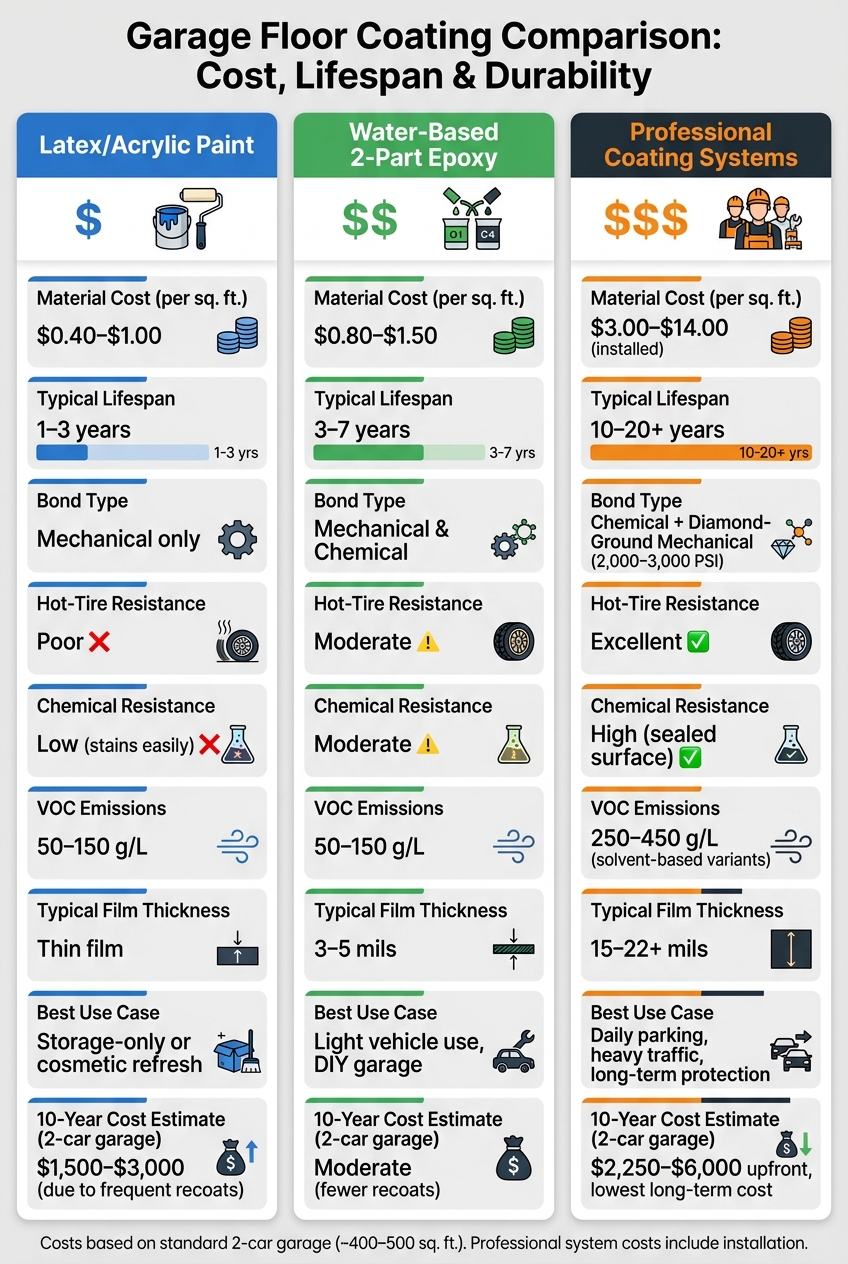
Garage Floor Coating Comparison: Cost, Lifespan & Durability
Garage Floor Paint Review | Garage Guard Waterborne Epoxy
sbb-itb-a0e5ae3
Quick Comparison
| Coating Type | Typical Cost | Typical Lifespan | Main Upside | Main Downside | Best Fit |
|---|---|---|---|---|---|
| Latex/Acrylic Paint | $0.40–$1.00/sq. ft. | 1–3 years | Low upfront cost | Peels and stains easily | Storage-only or light-use garage |
| Water-Based 2-Part Epoxy | $0.80–$1.50/sq. ft. | 3–7 years | Better adhesion and wear resistance | Still not built for heavy abuse | DIY garage with light vehicle use |
| Epoxy and polyaspartic coating systems | $3.00–$14.00/sq. ft. installed | 10–20+ years | Thick, durable surface | High upfront cost | Daily-use garage and long-term protection |
My takeaway: if you want the lowest upfront cost, water-based paint can work in a narrow set of cases. If you want a floor that holds up under cars, road salt, oil drips, and repeat use, paying more at the start often saves money over time.
1. Latex/Acrylic Concrete Floor Paint
Latex and acrylic concrete floor paint are mostly a cosmetic coating, not a long-lasting garage surface. The price is low at $25–$55 per gallon, which sounds good at first. But in a working garage, that lower upfront cost comes with clear trade-offs.
Durability
Latex paint forms a thin film on top of the concrete. It sticks to the slab, but it does not chemically bond with it. That matters more than it might seem.
If you park in the garage often, hot tire pickup can become a problem. After driving, warm tires can lift the coating as you back out, leaving bare patches of concrete behind. So while latex paint can work for light-duty spaces, it usually struggles with regular vehicle use.
Chemical Resistance
Traffic isn’t the only issue. Spills and winter grime can do just as much damage.
Oil and gasoline can soak through fast, reach the concrete underneath, and leave permanent stains. Road salt makes things worse by crystallizing under the paint film and pushing the bond apart from below. In plain English: the floor can start failing from the top and the bottom at the same time.
Cost and Service Life
For a standard 2-car garage (roughly 400–500 sq. ft.), DIY materials usually cost $100–$200. If you hire a pro, installation can add about installation can add about $1–$3 per sq. ft.–$3 per sq. ft. (you can calculate your total project cost for more accuracy).
The bigger issue is how often you may need to do it again. This type of coating usually needs a full recoat every 1–2 years, which can push the 10-year cost to $1,500–$3,000 for a standard garage. After each application, you may also need to wait 5–7 days before parking on the floor.
That lower price can make sense if you only need a short-term fix. If you want a tougher surface, you can compare industrial floor coatings that use hardeners for better durability.
2. Water-Based Two-Part Epoxy Garage Floor Coating
For garages that need more toughness than paint but don’t need a full pro-grade system, water-based two-part epoxy sits in the middle. It bonds to concrete both chemically and mechanically, which is why it holds up better than latex paint under normal garage traffic.
Durability
This type of coating usually builds a dry film of about 3–5 mils and tends to last around 3–7 years with regular vehicle use. Hot-tire pickup can still happen, but its resistance is generally rated moderate to good.
Proper surface prep is the make-or-break step here. Most epoxy failures trace back to poor surface prep, not the coating itself. The concrete should be etched or ground to an 80-grit profile, and you should test for moisture before applying the coating. That’s where a lot of DIY jobs go sideways.
Chemical Resistance
Water-based epoxy stands up to motor oil, transmission fluid, and road salt. But it isn’t built for heavy-duty industrial or automotive settings. If gasoline or harsh automotive fluids sit on the surface too long, they can wear it down. Battery acid is especially rough on it and can etch the surface if it isn’t cleaned up fast.
For day-to-day care, keep it simple:
- Clean spills promptly
- Use pH-neutral cleaners
Installation Cost and Recoat Cycle
DIY kits usually cost about $200–$600 for a 2-car garage. If you hire a pro, compare garage floor coating costs to see how epoxy stacks up against long-term options like polyurea.. Most floors need 24–48 hours before foot traffic and 72 hours to 7 days before you park a vehicle on them.
If you’re adding another coat, apply it within 12–24 hours. Miss that window, and you’ll need to sand before recoating.
It works well for garages that see regular use but don’t need long-term heavy-duty protection. In plain terms, it’s a solid middle-tier option: stronger than paint, but still a step below pro coating systems. When deciding if this is right for your home, it helps to choose a garage floor coating based on your specific durability needs.
3. Advanced Professional Concrete Coating Systems
When water-based epoxy isn’t enough, professional systems step in. For garages with daily traffic, hot tires, oil drips, and road salt, water-based coatings can hit their ceiling fast. Professional systems are made for that kind of abuse.
Most use a multi-layer build: a penetrating primer, a thick body coat, and a UV-stable topcoat. They also go on much thicker than standard paint, usually at 15 to 22+ mils.
Durability
This is where the gap gets hard to ignore.
Professional 100% solids epoxy bonds to concrete at 2,000 to 3,000 PSI, while garage floor paint usually bonds at only 200 to 400 PSI. That difference matters. It helps the coating stay put instead of peeling when tires roll over the same spots day after day.
These systems also depend on mechanical diamond grinding to prep the slab, which creates the concrete surface profile needed for strong bonding. In plain English: prep is a huge part of why pro systems last longer.
With the right install, you can expect 15 to 20+ years of service. Some polyurea systems can last up to 25 years. Croc Coatings offers the Penntek Evolution system with a lifetime warranty.
Chemical Resistance
Professional coatings form a sealed surface. That means oil, fluids, and road salt stay on top instead of soaking in, so they can be wiped away without staining the floor or wearing down the coating.
In places where winter road salt is a constant issue, a polyurea base coat paired with a polyaspartic topcoat holds up well against temperature swings, sunlight, and wear. It costs more up front, but it’s built for a much harder workload.
Installation Cost and Recoat Cycle
The main downside is cost.
Professional systems usually run $5 to $12 per sq. ft. installed. For a standard 2-car garage, that works out to about $2,250 to $6,000. That’s a big jump from paint, especially when considering the polyaspartic vs epoxy cost breakdown. But the upside is fewer recoats and less hassle over time.
There’s also a hidden expense many people miss: removal. If the floor has already been painted and that coating fails, stripping it before installing a new system can add $3 to $8 per sq. ft. in remediation costs.
So while the upfront price is higher, over a 10-year span, starting with a professional system often ends up being the lower-cost path.
Pros and Cons of Water-Based Garage Floor Paints
Water-based garage floor paints stand out for a few simple reasons: low odor, low VOCs, easy cleanup, and easier DIY use. The downside is just as clear. They don’t last as long, and they don’t hold up as well under wear.
That trade-off is the main gap between latex/acrylic paint and water-based epoxy, or more durable options like epoxy vs polyaspartic garage floors.
One of the biggest pluses is low VOC emissions – usually 50 to 150 g/L, compared with 250 to 450 g/L for solvent-based systems. Cleanup is simple too. Soap and water work for tools and spills, so there’s no need for chemical thinners.
The thinner film gives you less protection under vehicle traffic, and hot-tire pickup is one of the most common ways these coatings fail. So while latex paint costs less at the start, it usually needs reapplication sooner than water-based epoxy.
Put them side by side, and the gap shows up fast.
| Feature | Latex/Acrylic Paint | Water-Based 2-Part Epoxy |
|---|---|---|
| Bond Type | Mechanical only | Mechanical & chemical |
| Hot-Tire Resistance | Poor | Moderate |
| Chemical Resistance | Low (stains easily) | Moderate |
| Material Cost | ~$0.15–$0.50/sq. ft. | ~$0.50–$2.00/sq. ft. |
Standard latex paint can also run into trouble on highly alkaline concrete. At a pH of 12+, concrete can slowly break down the binders in standard latex paint. Over time, that leads to chalking and peeling – a process called saponification.
Water-based epoxy handles alkalinity better because it forms both a mechanical and chemical bond. Even so, moisture and poor surface prep can still lead to failure, so you should inspect concrete before coating , making proper surface preparation essential for a lasting bond.
A lower upfront price doesn’t remove the need for repeat maintenance. The main choice comes down to this: do you want a low-cost refresh, or do you need a coating that can stand up to regular vehicle use?
When Water-Based Paint Is the Right Choice
Water-based paint works in only a narrow set of garage situations. It makes the most sense in low-demand spaces, like a storage-only garage with no vehicles or heavy foot traffic, or when you want a fast cosmetic refresh before putting a home on the market.
The biggest weak spot is regular vehicle traffic. Hot tires can soften the film and pull it off the concrete. Freeze-thaw weather and high humidity can also wear it down faster.
Here’s a simple way to think about it:
| Use water-based paint | Do not use water-based paint |
|---|---|
| Storage-only garage (no vehicles) | Daily driver parking (hot tires, road salt) |
| Quick cosmetic refresh before a home sale | Active workshop (oil, chemicals, dropped tools) |
| Tight budget, minimal daily use | High humidity or coastal environment |
| Extreme freeze-thaw climate |
Before you assess your garage floor for a coating, do one simple moisture check. Tape a 2×2 ft plastic sheet to the bare floor and leave it in place for 24 hours. If you see condensation under the plastic, the slab has a moisture problem. Water-based epoxy lets more vapor pass through than epoxy or polyurea coatings, so it can sometimes handle minor vapor transmission. But hydrostatic pressure – water pushing up through the slab – can still lift a paint film.
If you go with water-based epoxy, wait 7 to 14 days before parking on it.
Conclusion
Water-based garage floor paint can work. But it tends to make sense only for light-duty garages. If your garage sees regular parking, heavier traffic, or day-to-day wear, you’ll usually need tougher coatings for high-traffic garages.
The choice between paints and epoxy is pretty simple. Light-duty use can make water-based paint worth it. But if you park in the garage on a regular basis, a stronger system is often the better fit. And over time, having to recoat again and again can wipe out the money you saved at the start. You can use a garage floor coating planner to compare long-term costs and prep requirements.
For homeowners in North Idaho and Eastern Washington, Croc Coatings installs Penntek Evolution coatings with a one-day process and a lifetime warranty.
That said, the coating is only part of the story. It also comes down to the slab underneath. No coating will hold on a slick, contaminated, or moisture-damaged slab. Proper preparation for a 1-day floor coating is essential to ensure the bond lasts.
FAQs
How do I know if my garage floor is too damp for water-based paint?
Do a moisture test before painting. One easy way is the plastic sheet test: tape an 18 x 18-inch piece of plastic to the concrete and leave it there for 16 to 24 hours. If you see condensation underneath, the floor is too damp.
If you want a more exact reading, use a calcium chloride test kit. If vapor transmission is over 3 lbs. per 1,000 sq. ft., don’t apply the coating. Also, wait 24 to 48 hours after washing or etching before you test.
Can I put water-based paint over an old garage floor coating?
Yes – you can paint over old floor paint. But prep is what makes or breaks the job.
If the current coating is still in good shape and stuck down well, scuff-sand the surface with 80-grit sandpaper, vacuum it well, and use a bonding primer so the new paint sticks.
If the old paint is flaking or peeling, take off all loose material first. Before you apply new paint, make sure the floor is clean, dry, and free of oil.
Which option is cheaper long term: repainting or a professional coating?
Garage floor paint costs less at the start. But over time, a professional coating usually costs less.
Here’s why: paint has a thin layer of just 1 to 2 mils. That thin surface can wear out fast under vehicle traffic, hot tires, and chemical spills. In many garages, that means repainting every 1 to 3 years.
Those repeat jobs don’t just cost money. They also take time, effort, and patience. And over 10 years, the total can stack up.
A professional coating works differently. It’s a one-time investment that creates a thicker, tougher barrier on the floor. In many cases, it can last 10 to 20 years or more.