Garage cabinets range from under $100 for a basic plastic shelving unit to $10,000+ for a fully custom system in a three-car garage. Most homeowners land somewhere in the middle — expect to spend between $500 and $6,000 depending on your garage size, the cabinet type you choose, and whether you install yourself or hire a pro.
Here’s what you’ll find in this guide:
- Full cost spectrum: From budget DIY shelving ($50–$100) to premium custom installations ($10,000+), with a quick-reference table
- What drives the price: Garage size is the #1 cost factor most guides skip — we break down 1-car, 2-car, and 3-car costs
- Build vs. buy analysis: Real numbers on DIY costs (tools, materials, time) so you can decide if building your own cabinets actually saves money
- Big-box price benchmarks: How Home Depot, Costco, and IKEA compare on price, quality, and installation
- Project-level scenarios: What a small single-car, standard two-car, and premium three-car garage cabinet project actually costs
- ROI and resale value: Whether garage cabinets pay for themselves when you sell your home
Quick Cost Overview
| Approach | Project Cost Range | Per-Unit Cost | Best For |
|---|---|---|---|
| Basic DIY shelving | $50–$500 | $15–$100/unit | Budget-conscious, light storage |
| DIY wood cabinets | $200–$2,000 | Materials only | Skilled DIYers with tools |
| Prefabricated (stock) | $500–$6,000 | $150–$400/unit | Balance of cost and convenience |
| Big-box (Home Depot/Costco) | $400–$5,500 | $100–$500/unit | Ready-to-assemble, mid-range |
| Custom (Croc Coatings) | $2,000–$12,000+ | $200–$600/unit | Tailored fit, professional install, max durability |
The average homeowner spends about $1,327 on garage organization, with most projects falling between $505 and $2,156, according to HomeAdvisor. But that number can swing dramatically based on what’s actually driving the price — which is exactly what we’ll cover next.
What Drives the Cost of Garage Cabinets?
Before comparing cabinet types, it helps to understand the four factors that have the biggest impact on your final bill. Two homeowners with the exact same cabinet unit can pay wildly different prices depending on these variables.
Garage Size: 1-Car vs. 2-Car vs. 3-Car
Garage size is the single biggest cost driver — and one most cost guides overlook. Cabinets are typically priced by the linear foot, and a larger garage means more wall to cover.
| Garage Size | Typical Dimensions | Linear Feet of Cabinets | Estimated Cabinet Cost Range |
|---|---|---|---|
| 1-car | ~12′ × 22′ (264 sq ft) | 8–16 linear ft | $1,200–$5,600 |
| 2-car | ~20′ × 22′ (440 sq ft) | 16–30 linear ft | $2,400–$10,500 |
| 3-car | ~30′ × 22′ (660 sq ft) | 24–44 linear ft | $3,600–$15,000+ |
These ranges assume mid-to-premium cabinets installed professionally. A basic DIY shelving setup in a one-car garage could run as low as $200; a fully custom system with workbenches, overhead storage, and specialty drawers in a three-car garage can exceed $15,000.
For a deeper dive on how to plan your budget around your specific garage footprint, see our guide to budgeting for custom garage cabinets.
Material Choice
The material you pick changes both the upfront cost and how long your cabinets last. Here’s how the common options stack up:
| Material | Cost (per sq ft) | Cost (per linear ft) | Durability | Best For |
|---|---|---|---|---|
| Plastic/Resin | $10–$30 | $25–$75 | Low — cracks under heavy loads | Light storage, temporary setups |
| Laminate | ~$15 | $40–$100 | Moderate — easy to clean, resists corrosion | Budget-friendly finished look |
| MDF | $40–$80 | $100–$200 | Moderate — smooth finish, can swell with moisture | Climate-controlled garages |
| Plywood | $50–$150 | $125–$375 | Good — strong and versatile | General-purpose storage |
| Premium Wood (maple, oak) | $100–$350 | $250–$1,200 | Good — high-end look, needs sealing | Showpiece garages |
| Metal (steel/aluminum) | $75–$300 | $200–$2,400 | Excellent — moisture-resistant, handles temperature swings | Heavy-duty, unconditioned garages |
Why two pricing units? Square-foot pricing is common for sheet-good materials like plywood and MDF, while linear-foot pricing is standard for pre-built cabinet units and metal systems. When comparing quotes, ask which unit the contractor uses — a $150/linear-foot quote and a $50/square-foot quote might describe the same project but look very different on paper.
Metal cabinets are worth calling out: they accounted for nearly 46% of the garage storage products market in 2025, according to Business Research Insights. Their moisture resistance and tolerance for temperature swings make them the go-to for unconditioned garages.
For a closer look at material trade-offs, see our breakdown of the top five materials for long-lasting garage cabinets.
Installation: DIY vs. Professional Labor
Labor is the single biggest line item most homeowners overlook. Professional installation typically adds $100–$300 per cabinet or $60–$120 per linear foot, depending on your market and the complexity of the job.
Here’s what labor looks like across a typical project:
| Garage Size | Cabinets (linear ft) | DIY Labor Cost | Pro Install Labor Cost |
|---|---|---|---|
| 1-car | 8–16 ft | $0 (+ tools & time) | $480–$1,920 |
| 2-car | 16–30 ft | $0 (+ tools & time) | $960–$3,600 |
| 3-car | 24–44 ft | $0 (+ tools & time) | $1,440–$5,280 |
Going the DIY route eliminates labor costs — but you’ll need tools (a good drill, saw, level, and measuring equipment) and a realistic time budget. Most DIY garage cabinet projects take 2–5 weekends for a first-timer tackling a full wall. We’ll break down exactly what DIY costs in the build-vs-buy section below.
If you do hire a pro, look for a company that includes installation in the project quote rather than charging per-unit. Croc Coatings, for example, bundles installation into the project price and completes most jobs in a single day — no per-cabinet labor surcharge.
For step-by-step guidance on the DIY route, check out our garage cabinet installation guide.
Location and Custom Features
Where you live matters. Custom cabinet projects in major metro areas or high-cost regions can run 20–40% more than the same job in a smaller market. Complete Closet Design, for instance, reports custom garage cabinets in the Chicagoland area run $3,000–$15,000, or $130–$350 per linear foot fully installed.
Custom features also add up fast:
- Soft-close drawers and doors: $15–$50 per hinge/slide set
- Pull-out shelving / rollout trays: $50–$150 per tray
- Integrated workbenches: $300–$1,000 depending on size and material
- Overhead storage racks: $200–$800 installed
- Slatwall panels: $5–$15 per square foot
- Lighting (LED strips, task lighting): $100–$500
These add-ons can easily push a mid-range project into premium territory, but they’re also what make a garage genuinely functional — not just a place cabinets hang.
Garage Cabinet Costs by Type
Now that you know what moves the price, here’s how each cabinet type shakes out on cost, installation, and long-term value.
1. DIY Garage Cabinets: $100–$2,000+
Building your own cabinets is the cheapest route upfront — and the one with the widest range of outcomes. Custom garage cabinets vs. DIY shelves is a decision that hinges on your skills, the tools you already own, and how polished you need the final result to look.
Material costs for DIY cabinets:
| Cabinet Material | Average Cost | Key Benefits |
|---|---|---|
| Laminate | ~$15 per sq ft | Affordable, easy to clean, resists corrosion |
| MDF | $40–$80 per sq ft | Simple to work with, resists warping |
| Plywood | $50–$150 per sq ft | Durable and strong |
| Metal | $200–$2,400 per linear ft | Long-lasting, moisture-resistant |
| Premium wood | $100–$1,200 per linear ft | High-end look and finish |
Installation: DIY eliminates labor costs — which typically make up about 75% of total cabinet installation cost — but you’ll need tools like a drill, circular saw, level, clamps, and pocket-hole jig. If you don’t already own these, budget $150–$400 for basic woodworking tools. For installation tips for beginners, plan your cuts and mounting points before you start — uneven garage walls can turn a weekend project into a multi-week frustration.
Durability depends entirely on your material choices and construction quality. High-grade woods like maple or oak, properly sealed and mounted, can last decades. Skimped-on joinery or unsealed MDF in a humid garage may show sagging and swelling within a year or two.
"Selecting the right materials isn’t just about looks. It’s about ensuring your garage cabinets can survive Arizona’s toughest seasons." – Jake Gibbs, CEO of Triton Cabinets
According to a 2025 Home Improvement Trends report by Statista, 74% of U.S. homeowners prioritize durable and eco-friendly materials when upgrading their homes. With the right materials and techniques, DIY cabinets can be both sturdy and long-lasting — but they demand a real investment of time and attention to detail.
2. Prefabricated Garage Cabinets: $150–$400 Per Unit
Prefabricated cabinets hit the sweet spot between cost and convenience. These ready-made units come pre-designed and pre-constructed — you buy them off the shelf or online, assemble or mount them, and you’re done. Individual units typically cost $150–$400, with full garage systems ranging from $2,000 to $6,000.
| Material Type | Price Range | Key Characteristics |
|---|---|---|
| Plastic | Lowest cost | Affordable but less durable |
| Wood | Varies by type | Price depends on wood species and treatment needs |
| Metal | Highest cost | Strong and long-lasting |
Plastic cabinets are the most economical but struggle with heavy loads. Wood offers a range of pricing and looks — but in an unconditioned garage, it needs protection from moisture. Metal cabinets cost more upfront but hold up best to temperature swings and humidity.
Installation: Professional install adds about $100–$300 per cabinet. Old cabinet removal runs another $300 or so. For those comfortable with a drill and level, prefab cabinets are among the easiest to self-install — most systems use a rail-mounting approach that simplifies alignment.
Customization is limited — you pick from available colors, sizes, and configurations — but you can add upgraded hardware, lighting kits, or storage bins to dial in the functionality. For a comparison of prefab stock cabinets against custom-built options, see our breakdown of custom garage cabinets vs. big-box store cabinets.
3. Custom Garage Cabinets: $200–$600 Per Unit
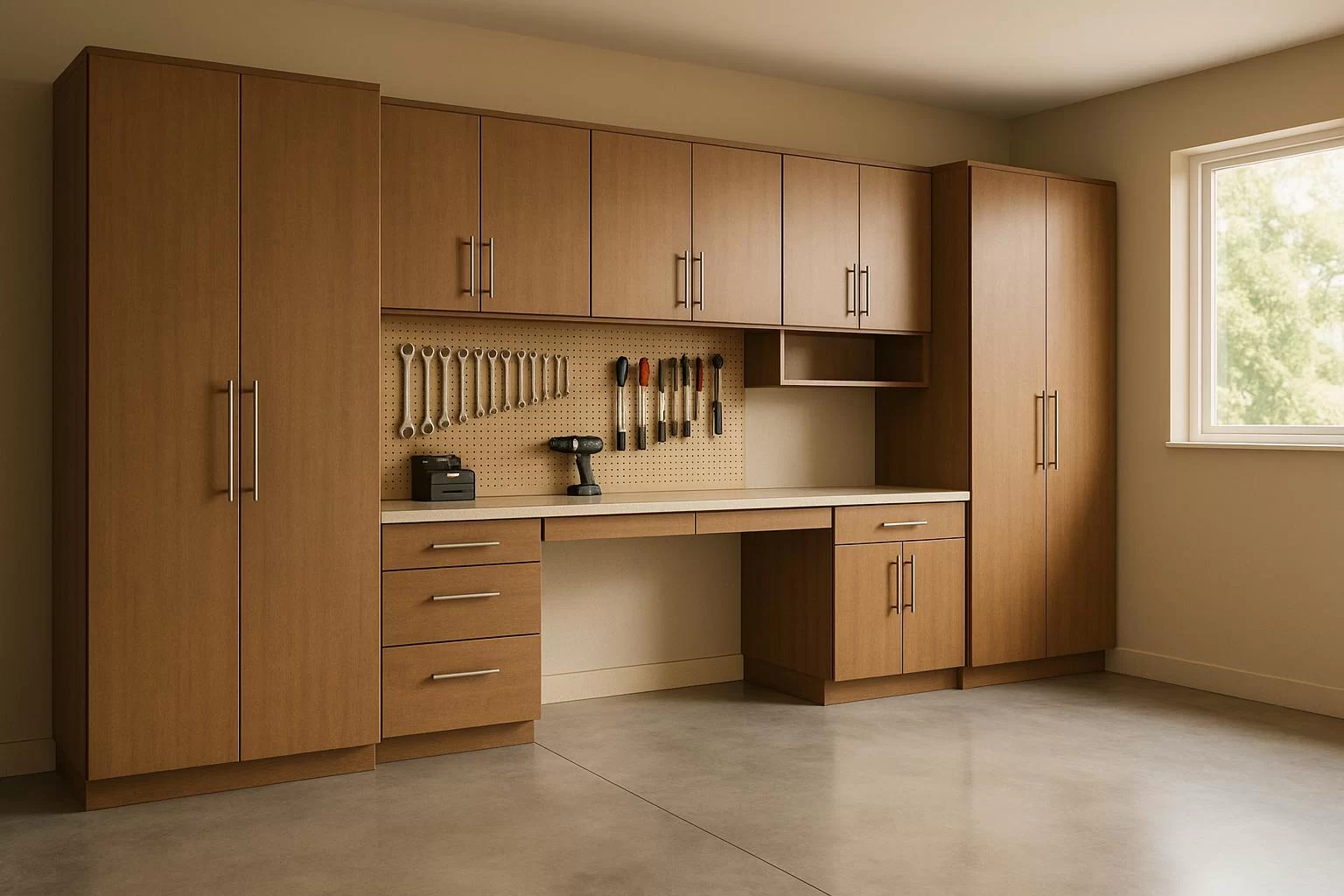
Custom cabinets are the premium tier — built to your garage’s exact dimensions with your choice of materials, finishes, and features. Units range from $200–$600 each, with full projects typically landing between $2,000 and $12,000+ depending on garage size and complexity.
| Material Type | Cost Range | Ideal For |
|---|---|---|
| Laminate | ~$15 per sq ft | Cost-effective projects |
| MDF | $40–$80 per sq ft | Smooth finishes and painted looks |
| Plywood | $50–$150 per sq ft | Strength and versatility |
| Metal | $200–$2,400 per linear ft | Heavy-duty durability |
| Premium Wood | $100–$1,200 per linear ft | High-end, polished aesthetics |
Custom cabinets earn their premium in three ways: they fit your garage perfectly (no gaps, no wasted space), they’re built from higher-grade materials with better joinery, and they include professional installation — no crooked doors, sagging shelves, or mounting mistakes.
How Big-Box Retailers Compare: Home Depot, Costco, and IKEA
Many homeowners start their search at a big-box store, so it’s worth knowing how these options stack up on price, quality, and what’s actually included.
| Retailer | Price Range (Full Garage) | Cabinet Style | Installation | Best For |
|---|---|---|---|---|
| Home Depot | $400–$5,500 | Ready-to-assemble (RTA) and pre-assembled stock cabinets; brands like NewAge, Husky, Gladiator | Professional install available through Home Depot (~$300–$800) | Mid-range buyers who want a known brand and optional pro install |
| Costco | $500–$4,000 | Modular metal systems (NewAge, Trinity, Ulti-MATE) sold in sets | DIY assembly; no in-house installation service | Value-conscious buyers wanting metal cabinets at bulk pricing |
| IKEA | $300–$2,500 | Modular systems (BROR, IVAR, BESTÅ) — not garage-specific but commonly adapted | DIY assembly; third-party installers available through TaskRabbit (~$200–$600) | Budget-friendly, minimalist storage; best for climate-controlled garages |
The catch with big-box cabinets: they’re built to a price point, not to a space. Stock cabinets come in fixed widths and heights — if your garage has an odd corner, a soffit, or uneven walls, you’ll be filling gaps with filler strips or leaving dead space. The materials also lean toward particleboard and thin-gauge metal, which won’t match the durability of a plywood or heavy-gauge steel custom build.
That said, for a straightforward, rectangular garage with basic storage needs, big-box cabinets can be a solid value — especially Costco’s metal modular sets, which often go on sale for $1,500–$3,000 for a full two-car configuration.
For a detailed side-by-side, see our comparison of custom garage cabinets vs. big-box store cabinets.
Project-Level Cost Scenarios
Abstract price ranges only go so far. Here are three real-world scenarios to anchor your expectations.
Scenario 1: Budget Single-Car Garage — $500–$1,500
The project: A 12′ × 22′ single-car garage used for basic storage — seasonal decorations, a few tools, camping gear. Homeowner wants cabinets along one wall (8–10 linear feet).
What you get:
- 2–3 prefabricated metal or laminate base cabinets ($150–$300 each)
- 1–2 wall cabinets for lighter items ($100–$200 each)
- DIY installation — rail-mount system, ~4–6 hours
Total: $500–$1,500, installed yourself. Add $300–$600 for professional installation.
Scenario 2: Standard Two-Car Garage — $2,000–$6,000
The project: A 20′ × 22′ two-car garage that doubles as a workshop. Homeowner wants cabinets along the back wall and one side wall (18–24 linear feet) with a small workbench.
What you get:
- Mid-range prefab or entry-level custom cabinets — plywood or metal — along two walls
- 4–6 base cabinets, 3–4 wall cabinets
- One 4–6 foot workbench ($400–$800)
- Professional installation (1–2 days)
Total: $2,000–$6,000, professionally installed. This is the sweet spot where most two-car garage projects land.
Scenario 3: Premium Three-Car Garage — $5,000–$12,000+
The project: A 30′ × 22′ three-car garage used for vehicles, a workshop, and serious storage. Homeowner wants a full custom system (30–40 linear feet) with specialty storage, a large workbench, and integrated lighting.
What you get:
- Fully custom cabinets — metal or premium plywood — built to exact dimensions
- 8–12 base and wall cabinets with soft-close hardware
- Pull-out shelving, rollout trays, and specialty drawers
- Large integrated workbench with under-cabinet LED lighting
- Overhead storage racks above the garage doors
- Professional one-day installation with 3D-modeled layout
Total: $5,000–$12,000+. At this level, you’re investing in a system that adds measurable resale value and transforms how the garage functions day to day.
Build vs. Buy: Is It Cheaper to Build Your Own Garage Cabinets?
The short answer: yes, building your own cabinets is cheaper on paper — but the real math depends on what you value.
The DIY Equation: Materials + Tools + Time
For a basic two-wall setup (roughly 20 linear feet of cabinets) in a standard two-car garage:
| Cost Category | DIY Build | Buy Prefab | Buy Custom |
|---|---|---|---|
| Materials | $400–$1,500 | N/A (included) | N/A (included) |
| Tools (if you need them) | $150–$400 | $0–$50 (basic assembly tools) | $0 |
| Total product cost | $550–$1,900 | $2,000–$6,000 | $3,000–$8,000 |
| Time investment | 40–80 hours (2–5 weekends) | 4–8 hours (1 weekend) | 0 hours (pro installed) |
| Finish quality | Depends on skill | Consistent, factory finish | Precision fit, premium finish |
| Lifespan (typical) | 5–15 years | 8–15 years | 15–25+ years |
Hidden Costs of DIY
Building cabinets sounds straightforward — cut wood, assemble boxes, hang them. But here’s what first-timers often miss:
- Uneven walls and floors: Garages are rarely square. Shimming, scribing, and adjusting for slopes can eat a full weekend before a single cabinet goes up.
- Finishing takes forever: Sanding, priming, painting, and sealing in a dusty garage — plan on a week of evenings just for a decent painted finish.
- Mistakes aren’t free: A miscut sheet of $75 plywood or a misaligned drawer slide that needs redoing turns savings into sunk cost.
- Hardware adds up: Soft-close hinges ($5–$15 each), drawer slides ($15–$30 per pair), knobs and pulls ($3–$15 each) — a full set of quality hardware for a two-wall project easily hits $200–$400.
When DIY Makes Sense
DIY is the right call when:
- You already own the tools and have woodworking experience
- Your garage is climate-controlled (no moisture worries)
- You have a flexible timeline and enjoy the process
- You’re building a simple setup — open shelving, basic cabinets, no drawers
When to Buy Instead
Skip the sawdust and buy cabinets when:
- Your garage has moisture or temperature swings (metal or properly sealed custom cabinets handle this; DIY MDF won’t)
- You need a precise fit around obstructions, soffits, or sloped floors
- Time matters — a pro install takes a day; DIY takes weeks
- You want a warranty and someone to call if something goes wrong
For most homeowners, the build-vs-buy decision comes down to this: DIY saves money but costs time and trades away precision. Prefab saves time but limits your layout. Custom costs more but fits perfectly and lasts longest.
Are Garage Cabinets Worth the Cost? ROI and Resale Value
If you’re spending $2,000–$6,000 on garage cabinets, it’s fair to ask whether any of that comes back when you sell.
Garage storage consistently ranks among the features buyers look for. While specific ROI data on cabinets alone is limited, related garage improvements give us direction. A garage door replacement returns an average of 103% of its cost at resale, according to CNBC data cited by House Digest. Organized storage is repeatedly cited as one of the most-wanted garage features among prospective buyers.
More concretely, custom garage cabinets carry an estimated ROI of 75–85% — you won’t recoup every dollar, but a well-organized, finished garage helps a home show better and sell faster. That tracks with the broader trend: the global garage cabinets market generated $11.8 billion in 2025 and is projected to reach $22.8 billion by 2033, per Grand View Research. Homeowners are voting with their wallets.
Beyond Resale: The Organization ROI
Even if you never sell, the day-to-day return is real:
- Time saved: The average homeowner spends 30–60 minutes per month looking for tools, sports equipment, or seasonal items in a disorganized garage. A proper cabinet system cuts that to near zero.
- Protecting your stuff: Cardboard boxes on concrete floors invite moisture, pests, and damage. Enclosed cabinets keep tools, paint, and seasonal gear in usable condition.
- Cost per year: Over a 20-year lifespan, a $4,000 custom cabinet system costs about $200/year — less than many homeowners spend on streaming subscriptions.
For a deeper look at how storage upgrades affect property value, read our guide on how custom garage cabinets improve home value.
Custom Garage Cabinets by Croc Coatings
For homeowners who want a storage system built to their exact space — without the weeks of DIY or the compromises of stock cabinets — Croc Coatings offers custom garage cabinets designed, built, and installed by a single team.
Croc Coatings is a Penntek™ Certified Installer serving North Idaho and Eastern Washington, including Coeur d’Alene, Spokane, Sandpoint, and the Tri-Cities. Their cabinet systems are built from eco-friendly, made-in-USA materials and installed in one day.
What You Get
- Free in-home consultation and 3D design: A design specialist measures your garage, discusses your storage needs, and builds a 3D model so you see the layout before anything is ordered.
- One-day professional installation: Most projects are completed in a single day by an in-house team — no subcontractors, no multi-week timeline.
- Full custom fabrication: Cabinets are built to your garage’s exact dimensions with your choice of materials, colors, finishes, and features — shelving, drawers, slat walls, workbenches, and overhead storage.
- Powder-coated metal construction: Their metal cabinets use dado-joint construction with powder-coated finishes that resist scratches, moisture, and stains — no warping, sagging, or peeling.
- Lifetime warranty: Backed by a manufacturer warranty for as long as you own your home.
- 0% financing for 12 months: Spread the cost of your project with no interest, making a full custom system accessible on a monthly payment schedule. Learn more about financing options.
Custom cabinets from Croc Coatings range from $200–$600 per unit, with full projects typically between $2,000 and $12,000 depending on garage size and features.
For help visualizing your layout, try the garage space planner to sketch out your ideal configuration before requesting a consultation.
Cost Comparison at a Glance
| Cabinet Type | Cost Range | Setup Time | Durability | Customization |
|---|---|---|---|---|
| DIY | $100–$2,000+ | Days to weeks | Varies by skill | Limited |
| Prefabricated | $150–$400/unit ($2,000–$6,000 full) | Few hours–1 day | Good | Minimal |
| Big-Box (Home Depot/Costco/IKEA) | $400–$5,500 full | 1–2 days (DIY assembly) | Moderate | Low — fixed sizes |
| Custom (Croc Coatings) | $200–$600/unit ($2,000–$12,000 full) | One day | Excellent | Fully tailored |
Your choice ultimately comes down to priorities: budget, timeline, and how long you plan to stay in your home. A $150 prefab cabinet that sags in three years costs more over a decade than a $400 custom unit built to last 20+. If your garage doubles as a workshop or stores expensive equipment, investing in durability pays off. If you’re in a starter home and plan to move within a few years, prefab or big-box cabinets may be the smarter spend.
For more ideas on making the most of your garage footprint, explore our ultimate guide to garage space optimization.
Frequently Asked Questions
How much does it cost to build garage cabinets yourself?
Building your own garage cabinets costs $400–$1,900 in materials for a typical two-wall setup (roughly 20 linear feet), plus another $150–$400 in tools if you don’t already own them. The final number depends on material choice: basic plywood runs $50–$150 per square foot; premium hardwood or metal pushes higher. Factor in 40–80 hours of labor — a realistic DIY timeline is 2–5 weekends for a first-timer.
Is it cheaper to build or buy garage cabinets?
On materials alone, building is cheaper — DIY materials for a two-wall setup run $400–$1,900 vs. $2,000–$6,000 for comparable prefab cabinets. But that gap narrows once you account for tools you need to buy ($150–$400), the value of your time (40–80 hours), and the risk of mistakes that waste material. For a simple, rectangular garage and a homeowner with woodworking experience, DIY wins. For complex layouts, moisture-prone garages, or anyone who’d rather spend weekends doing something else, buying makes more sense.
Are garage cabinets worth the cost?
Yes — for most homeowners, garage cabinets pay for themselves through organization, protection of stored items, and resale value. Custom cabinets carry an estimated 75–85% ROI at resale, and over a 20-year lifespan a $4,000 system costs about $200/year. Compare that to replacing water-damaged tools, repurchasing lost items, or the time spent digging through piles looking for what you need.
What are the best garage cabinets for the money?
For value, prefabricated metal cabinets in the $150–$300/unit range offer the strongest combination of durability, price, and ease of installation. Costco’s NewAge and Trinity sets frequently go on sale for $1,500–$3,000 for a full two-car configuration — hard to beat at that price point. If you want a precise fit and plan to stay in your home long-term, stepping up to custom cabinets ($200–$600/unit professionally installed) delivers better materials, a tailored layout, and a warranty.
How much does garage cabinet installation cost?
Professional installation typically adds $100–$300 per cabinet or $60–$120 per linear foot. For a standard two-car garage with 20–24 linear feet of cabinets, expect to pay $1,200–$2,880 in labor. Some providers (including Croc Coatings) bundle installation into the project price, so you’re not paying a separate per-unit labor charge.
How much do garage cabinets cost per square foot?
Garage cabinet materials range from $15 per square foot for basic laminate to $350 per square foot for premium hardwood. Most mid-range materials (plywood, MDF) land between $40–$150 per square foot. Note that linear-foot pricing is more common for pre-built cabinet units and metal systems — when comparing quotes, clarify which unit the contractor is using.
What should I consider when choosing between DIY, prefab, and custom garage cabinets?
Focus on three things: Budget (DIY is cheapest upfront, custom is the investment), time and skill (DIY takes weeks and demands woodworking experience; prefab and custom are days or less), and garage conditions (unconditioned garages with moisture and temperature swings need metal or properly sealed materials — the wrong material choice in a harsh garage will fail regardless of who builds it). A $150 prefab unit that warps in two years costs more over time than a $400 custom unit that lasts two decades.
How do I budget for custom garage cabinets?
Start with your garage size: a one-car garage typically needs 8–16 linear feet of cabinets ($1,200–$5,600), a two-car 16–30 feet ($2,400–$10,500), a three-car 24–44 feet ($3,600–$15,000+). Add installation labor if it’s not bundled, factor in any must-have custom features (workbench, specialty drawers, lighting), and get at least three quotes. Croc Coatings offers a free in-home consultation with a 3D design and detailed quote — no surprise line items. See our budgeting guide for custom garage cabinets for a full walkthrough.
Related Blog Posts
- 10 Ways to Maximize Garage Storage Space
- Polyaspartic vs Epoxy: Cost Breakdown
- 5 Factors Affecting Concrete Coating Costs
- Ultimate Guide to Garage Space Optimization
Ready to see what custom garage cabinets would look like in your space? Contact Croc Coatings for a free in-home consultation and 3D design — or call us to discuss your project and financing options.