Here’s the short answer: published epoxy wear numbers help you compare coatings, but they do not tell you exactly how a showroom floor will look after years of traffic, cleaning, and hot tires.
If I were choosing a floor coating, I’d focus on three things first:
- Lab wear data only works for side-by-side comparison when the test setup matches
- Field life for epoxy is often about 8–12 years, with maintenance about every 3 years
- Showroom problems usually show up as gloss loss, scuffs, tire marks, and dull traffic lanes before the coating fully fails
The article makes one main point: the test method matters as much as the number. A Taber abrasion result, a wear index, and a specific wear rate are not the same thing. And if wheel type, load, cycle count, or film thickness changes, the numbers can stop being useful side by side.
A few data points stand out:
- Published epoxy wear index results ranged from 5 mg to 70.1 mg
- Reported Taber abrasion results ranged from about 18–19 mg loss to 150 mg loss, depending on the test setup
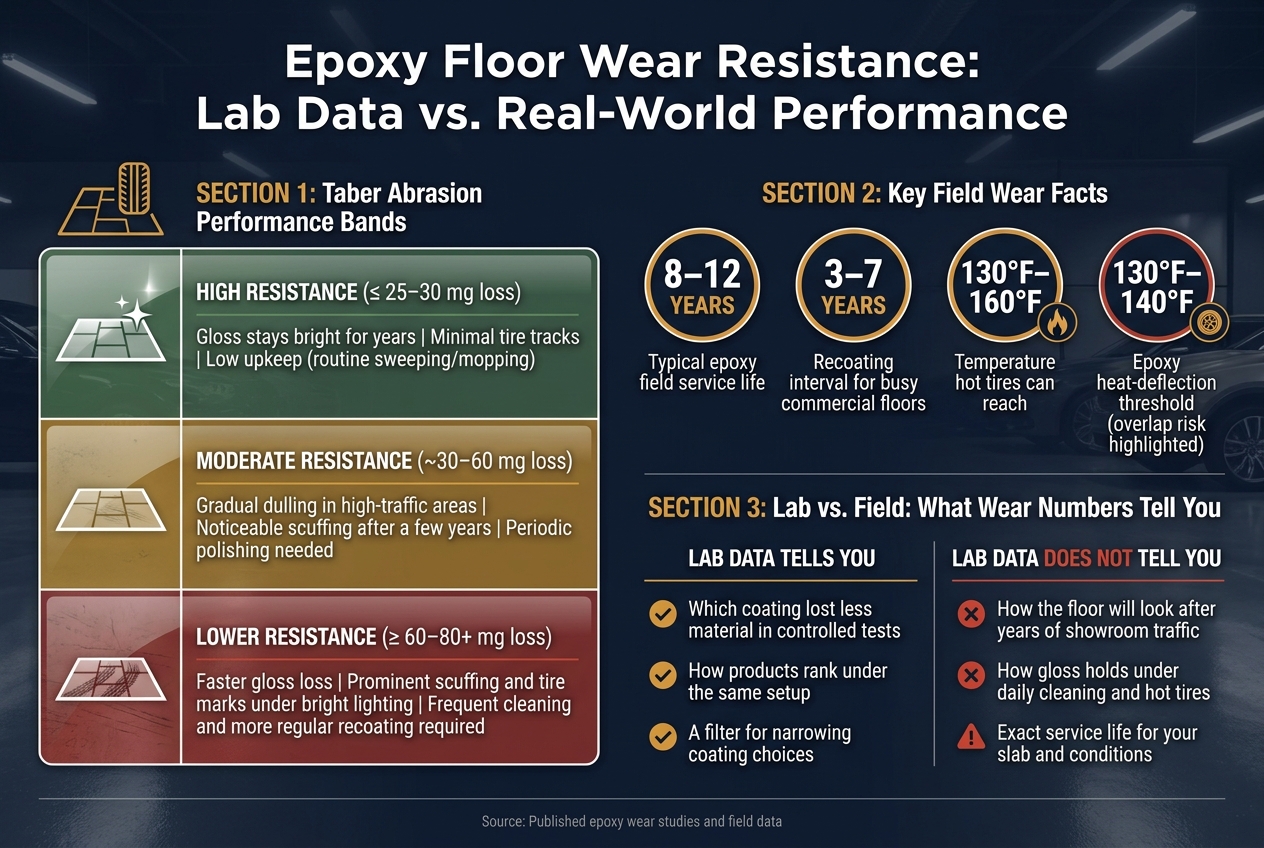
- Hot tires can reach about 130°F to 160°F, which overlaps with epoxy heat limits near 130°F to 140°F
- Busy commercial floors may need recoating in about 3–7 years
If I boil the article down even more, it says this:
- Use lab data to compare products
- Use field conditions to judge service life
- Pay close attention to surface prep, moisture, UV exposure, and tire heat
- Pick for looks and cleanability, not just abrasion numbers
| What to look at | What it tells you | What it does not tell you |
|---|---|---|
| Taber abrasion | How much material is worn off in a controlled test | How the floor will age in your showroom |
| Wear index / mass loss | Which coating did better under the same setup | Which one will keep gloss longer on your site |
| Field wear data | How floors tend to age over time | Exact life for your slab, traffic, and cleaning routine |
| Surface prep and moisture | Whether the floor is likely to stay bonded | How nice it will look without upkeep |
So if you want the plain-English takeaway, it’s this: don’t trust one wear number by itself. I’d use test data as a filter, then judge the coating by how it handles tire heat, sunlight, daily cleaning, and the way a showroom floor needs to look under bright lights.
Epoxy Floor Wear Rates From Published Studies
Published epoxy wear data doesn’t point to one universal benchmark. Results can swing a lot based on the epoxy formula and the test used. So the main thing is simple: know which wear metric a study is using before you compare numbers.
Abrasion and Wear Metrics Commonly Reported in Studies
The metric you’ll see most often is mass loss, measured in milligrams (mg). The idea is straightforward: less material lost means better wear resistance. Another common number is wear index, which normalizes wear to 1,000 cycles so you can compare products tested for different lengths of time. Lower wear index means better abrasion resistance.
Some studies go a step further and convert mass loss into volume loss. That helps because coatings don’t all have the same density. If one coating is heavier than another, mass loss alone can be a little misleading. Volume loss gives a cleaner side-by-side view across coating types.
In sliding or reciprocating wear tests, you’ll often see specific wear rate instead. This metric tracks volume loss against load and distance, usually in mm³/(N·m). Lower numbers mean the coating stands up better under mechanical stress.
Here’s the quick breakdown:
| Test Type | What It Measures | Common Units | How to Interpret |
|---|---|---|---|
| Taber Abrasion (ASTM D4060) | Mass removed by abrasion | mg per 1,000 cycles | Lower = more abrasion-resistant |
| Wear Index | Mass loss normalized to 1,000 cycles | mg/1,000 cycles | Lower = better; compare only within the same test setup |
| Volume Loss | Amount of coating volume removed | mm³ | Accounts for density differences between coatings |
| Specific Wear Rate | Volume loss per load and distance | mm³/(N·m) | Lower = coating holds up better under mechanical stress |
| Wear Cycles per Mil | Cycles needed to wear through a given film thickness | Cycles/0.001 in. | Helps relate lab data to real coating thickness |
One catch: these figures only line up cleanly when the test setup is the same. Change the wheel, load, cycle count, or sample prep, and the comparison can fall apart fast.
Reported Taber results for epoxy systems range from as low as 18–19 mg loss at 500 cycles and a 1,000 g load to as high as 150 mg loss at 1,000 cycles and a 1 kg load.
Why Published Results Differ Across Studies
A big reason for the spread is resin chemistry. Bisphenol-A epoxies, novolac epoxies, and polyamide-cured systems don’t wear the same way. In ASTM D4060 precision-and-bias data, polyamide/epoxy coatings averaged 129.6 mg and 109.1 mg of mass loss, which shows how much chemistry can affect durability.
Then you pile on other factors: fillers, curing conditions, and coating thickness. Those can shift wear results quite a bit. Test settings matter too. A different wheel type, load, or cycle count can change the outcome, which is why comparisons only make sense when studies use the same setup.
That’s why the test method matters just as much as the number itself.
sbb-itb-a0e5ae3
How Researchers Measure Wear on Epoxy Flooring
Each wear test looks at a different kind of damage, so the right test depends on how the floor is used. That’s a big deal for a showroom floor, where you often get both broad scuffing, anti-slip needs, and tight, repeated tire contact.
Taber Abrasion, Sliding Wear, and Reciprocating Wear Tests
The Taber abrasion test (ASTM D4060) is the one you’ll see most often in epoxy product data. In this test, a coated panel spins on a turntable while two abrasive wheels press down and wear the surface over a set number of cycles. It’s a good stand-in for repeated scuffing from foot traffic, carts, and tire debris. But it doesn’t cleanly separate out tire scrub or small, high-pressure contact points.
That’s where other methods come in.
Sliding wear tests move another surface across the coated sample under a fixed load, speed, and distance. That makes them useful for studying tire scrub and braking loads in showrooms.
Reciprocating wear tests move a ball or pin back and forth over a short stroke, putting repeated stress on the same spot. This helps model tight, repeated contact, like equipment feet or pivot points.
| Method | What It Simulates | Key Output |
|---|---|---|
| Taber Abrasion (ASTM D4060) | Rotary scuffing from wheels or foot traffic | Mass loss (mg), wear index |
| Sliding Wear | Tires or objects sliding across the floor | Volume loss, specific wear rate (mm³/N·m) |
| Reciprocating Wear | Repeated back-and-forth contact in a fixed zone | Worn-area volume or mass loss |
How to Read Mass Loss, Volume Loss, and Wear Rate Values
Use mass loss when you’re comparing results from the same test. Use volume loss and specific wear rate when you want a cleaner comparison across systems.
Mass loss, usually reported in milligrams, is easy to read. But there’s a catch: coatings with different densities can lose the same number of milligrams while losing different amounts of actual thickness. So two products can look similar on paper even when one has lost more of its protective layer.
Volume loss adjusts for density, which gives a clearer picture of how much coating is gone.
Specific wear rate, reported in mm³/N·m, takes volume loss and normalizes it against load and distance. That makes it useful when you’re comparing systems tested under the same load and travel distance.
Before comparing results across studies, check the test setup closely:
- wheel type
- load
- cycle count
- specimen thickness
If those don’t line up, the numbers may not mean much side by side.
These lab rankings mean the most when you line them up with the wear patterns seen on actual floors.
What Field Findings Show About Durability Over Time
Lab tests give you clean, controlled numbers. Field data shows what happens once a floor meets daily traffic, repeated cleaning, and the messiness of actual use. In a showroom, that gap matters. Floors often start looking worn well before they stop protecting the concrete underneath.
Common Wear Patterns on Commercial Floors
Commercial epoxy floors usually show wear in a familiar pattern: gloss fades, traffic lanes pick up scuffs, entrances start to look dull, and surface scratches build over time. That includes vehicle display lanes and main entry paths. In many cases, these are appearance issues first, not structural ones. The coating may still be doing its job even after the floor starts to look tired.
Routine cleaning also plays a part. Regular scrubbing and grit moving across the surface slowly wear down gloss. A floor can look older than it is, even while the coating still protects the slab.
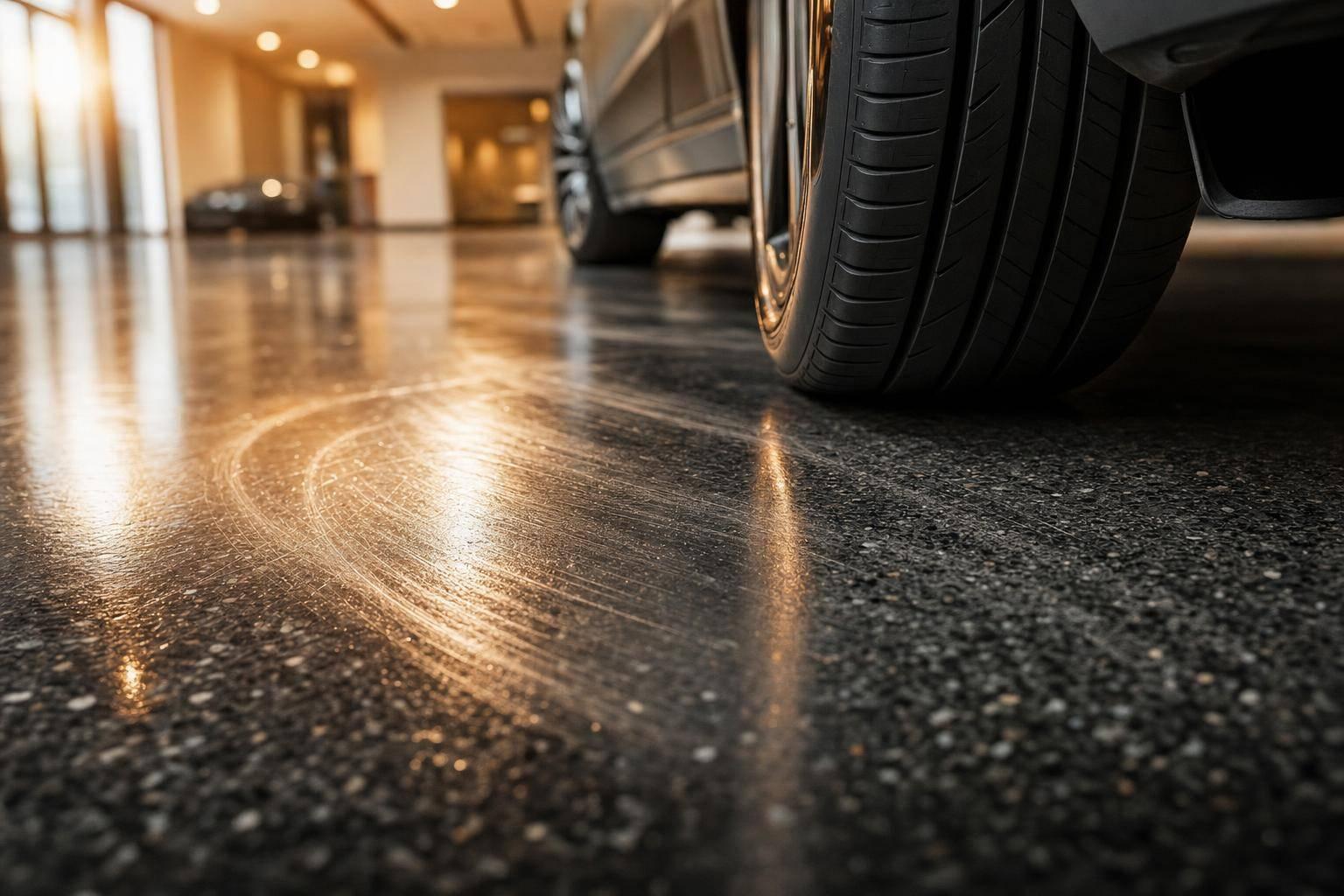
In automotive and showroom settings, the first trouble spots are often easy to predict. Tire contact zones near display positions, entry paths, turning areas, and places where vehicles are moved again and again tend to show black scuff marks, rubber transfer, and dull patches first. Tires heated by road use can reach about 130°F to 160°F, which overlaps epoxy’s heat-deflection range of roughly 130°F to 140°F. When that hot-tire exposure happens over and over, those contact areas can soften. Over time, that can lead to delamination in tire-contact zones and visible tire prints. Once those marks show up, cleaning habits and traffic volume play a big role in how fast they spread.
Factors That Affect Service Life in Practice
Coating chemistry matters, but it doesn’t tell the whole story. Surface preparation is the biggest variable in how long a floor lasts. Most epoxy failures trace back to poor surface prep, not the coating itself.
Epoxy bonds mechanically, so it needs the concrete surface to be profiled the right way. In most cases, that means an ICRI Concrete Surface Profile (CSP) of 3 to 5. If the surface profile is too smooth, adhesion can drop hard – from a rated 400 psi to below 150 psi. That’s a huge falloff, and it’s one of the main reasons a floor that looks fine at install can fail later.
Moisture is the other big issue. Concrete can wick moisture up from the ground, and vapor pressure coming through the slab is a leading cause of blistering and delamination. If moisture testing is skipped or slab prep is weak, the floor may not fail right away. But the problem is already there, waiting.
After prep and moisture, daily use takes over. Traffic intensity and load type shape how fast cosmetic wear shows up. A lightly used retail floor may keep its gloss for years. A busy showroom is a different story. If vehicles move daily, display spots change often, and people keep walking the same paths, visible lane dulling can appear much sooner when the coating system isn’t built for that level of use. Busy commercial floors often need recoating in 3 to 7 years.
Automotive fluids matter too. Motor oil, brake fluid, and gasoline should be removed fast, because they can stain or soften the resin if they sit on the surface. Maintenance isn’t separate from durability – it’s part of it. That’s why automotive showrooms need coatings picked not just for abrasion resistance, but also for how well they keep their appearance over time.
What the Data Means for Automotive Showrooms and Coating Selection
Epoxy Floor Wear Resistance: Lab Data vs. Real-World Performance
Why Abrasion Resistance Matters in High-Visibility Spaces
Field wear patterns matter even more in showrooms because customers notice everything. A floor might still function fine, but if it looks scuffed, dull, or marked up under bright lights, that becomes part of the customer experience.
Showroom floors need to do two things at once:
- Handle wear
- Stay clean-looking day after day
That second part is easy to overlook. Bright showroom lighting tends to expose scuffs, gloss loss, and tire marks fast. What looks minor in a warehouse can stand out right away in a customer-facing space.
Taber abrasion results usually fall into three practical bands:
| Taber Abrasion Loss (ASTM D4060, CS-17, 1,000 cycles) | Gloss Retention | Scuffs and Tire Marks | Upkeep |
|---|---|---|---|
| High resistance (≤ 25–30 mg) | High; stays bright under showroom lighting for years | Minimal; tire tracks and foot lanes develop slowly | Low; routine sweeping and mopping, infrequent recoating |
| Moderate resistance (~30–60 mg) | Moderate; high-traffic areas gradually dull | Noticeable scuffing in main walkways after a few years | Moderate; periodic polishing and mid-term recoating |
| Lower resistance (≥ 60–80+ mg) | Faster gloss loss; contrast between worn and unworn areas appears early | Prominent scuffing and tire marks under bright lighting | Higher; frequent cleaning, finish restorers or polishes, and more regular recoating |
For showroom selection, the main question isn’t only how surface hardness vs abrasion resistance affects material loss in lab tests. It’s how long the floor stays clear and presentable once people, tires, and daily cleaning start taking their toll.
Why Stronger Coating Systems Support Longer Service Life
Standard epoxy often tests at 60–80 mg per 1,000 cycles, while lower-loss systems can test below 30 mg. That gap matters in high-traffic, high-visibility spaces. Less loss in the test often means a better shot at holding gloss and resisting visible wear over time.
That’s why longer-life coating systems deserve a close look for showrooms. Croc Coatings‘ Penntek Evolution industrial coating system is marketed as 4x stronger than epoxy, UV-stable, and backed by a lifetime residential warranty, which supports longer service life in demanding showroom environments.
UV stability also matters in windowed showrooms. Sunlight can be rough on some floors, and epoxy can yellow or chalk over time. In a space built to make vehicles look their best, that kind of floor change can become hard to ignore.
Conclusion: How to Use Wear Studies When Choosing a Floor Coating
Published wear data is a starting point, not the whole story. For showrooms, low Taber loss, UV stability, and hot-tire resistance matter because they help preserve gloss, reduce visible tire marking, and push recoating further down the road in a customer-facing space.
It also helps to pair the coating system with proper surface prep and a meaningful warranty.
FAQs
Which wear test matters most?
The most important wear test is the ASTM D4060 Taber abrasion test, measured by mass loss in mg. This test best reflects the friction and grinding wear caused by vehicle tires and day-to-day traffic. Put simply, lower mg loss means the coating should resist wear longer.
In showrooms and similar spaces, strong abrasion resistance helps keep tire paths from turning dull. It can also cut down on the need for early replacement. Stronger systems like Penntek Evolution are designed to help extend that level of performance.
How long will an epoxy showroom floor stay presentable?
An epoxy showroom floor usually keeps its clean, polished look for 3 to 5 years. In some cases, professionally installed systems can last 5 to 10 years if they’re maintained with care. That said, high-traffic spots – especially tire paths – tend to show yellowing, dulling, and wear much sooner.
Croc Coatings’ Penntek Evolution system is built for a longer run. It offers stronger durability, UV stability, and chemical resistance, which helps the floor hold its polished appearance for 15 to 25 years.
What causes epoxy floors to fail early?
Epoxy floors often fail sooner than people expect because they form a hard, rigid bond with concrete. That sounds good at first, but it can backfire when the slab is under stress.
A few problems show up again and again. One is hot-tire pickup, where warm vehicle tires pull the coating up from the floor. Moisture is another big one, especially when hydrostatic pressure pushes water vapor up through the concrete. And if the surface wasn’t prepared the right way before installation, the coating may not bond well in the first place.
Sunlight can cause trouble too. Epoxy may yellow, fade, or chalk with UV exposure. On top of that, epoxy doesn’t have much flex, so it’s more likely to crack when concrete shifts or when freeze-thaw cycles put the slab through repeated stress.