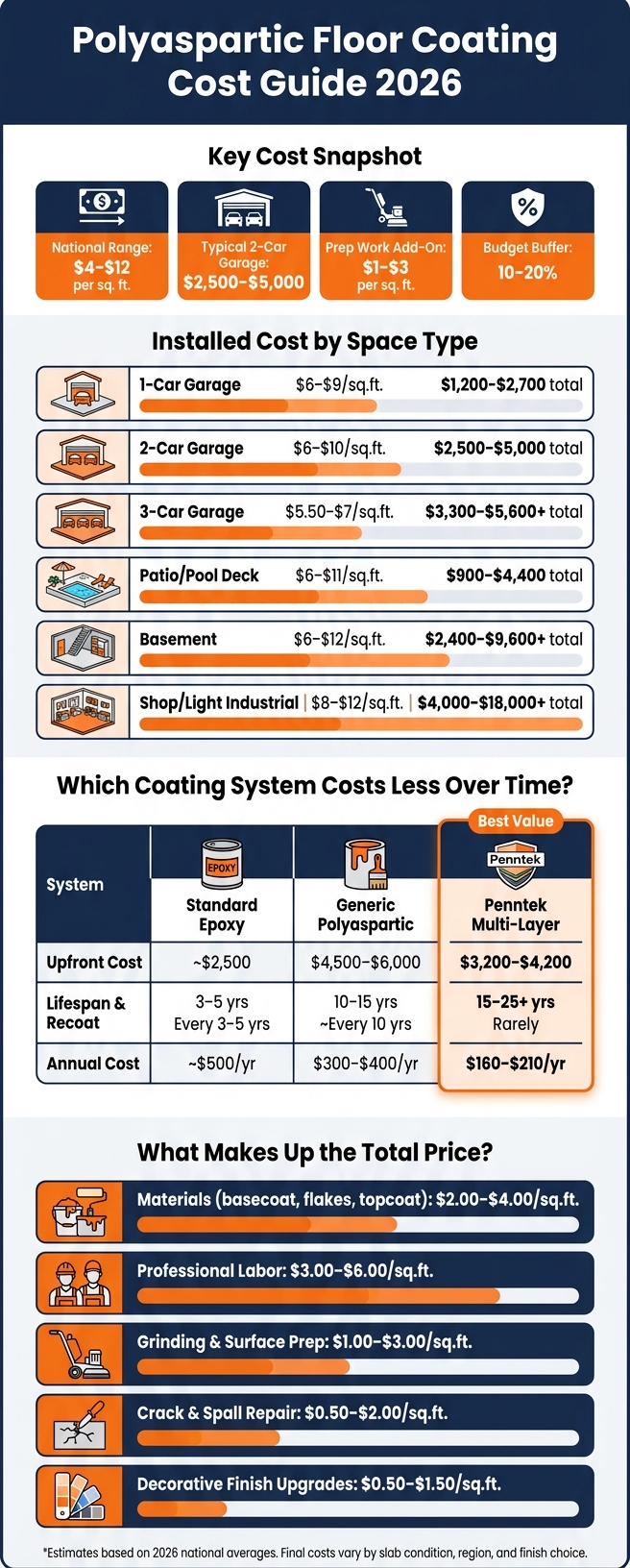
If I had to sum it up in one line: most professionally installed polyaspartic floors in 2026 land between $4 and $12 per sq. ft., with many garage jobs around $2,500 to $5,000 total.
If you’re pricing a garage, patio, basement, or shop floor, here’s what I’d keep in mind first:
- National price range: $4–$12 per sq. ft.
- Common local range in North Idaho and Eastern Washington: $7–$9 per sq. ft.
- 2-car garage: often $2,500–$5,000
- Prep work can add: $1–$3 per sq. ft.
- Crack and spall repair can add: $0.50–$2.00 per sq. ft.
- Decorative upgrades can add: about 15%–40%
- Budget buffer to plan for: 10%–20%
The main takeaway is simple: square footage is only part of the price. The final quote usually shifts based on surface prep, repairs, finish choice, moisture issues, and how hard the floor will be used.
I’d also look past the day-one price. A lower-cost system that needs replacement every 3–5 years can cost more over time than a polyaspartic floor that lasts 10–25+ years. That’s why this guide focuses on upfront cost, yearly cost, and what changes a quote.
Here’s a quick side-by-side view:
| Space | Typical Price |
|---|---|
| 1-car garage | $1,200–$2,700 |
| 2-car garage | $2,500–$5,000 |
| 3-car garage | $3,300–$5,600+ |
| Patio / pool deck | $6–$11 per sq. ft. |
| Basement | $6–$12 per sq. ft. |
| Shop / light industrial | $8–$12 per sq. ft. |
And when I compare coating types, the tradeoff is pretty clear:
| System | Upfront Cost | Life Span | Estimated Yearly Cost |
|---|---|---|---|
| Standard epoxy | Lower | 3–5 years | about $500/year |
| Generic polyaspartic | Mid to high | 10–15 years | about $300–$400/year |
| Penntek multi-layer system | Mid to high | 15–25+ years | about $160–$210/year |
So before you ask for a quote, I’d have these ready:
- Approximate square footage
- Photos of cracks, stains, or damage
- Whether there’s an old coating
- How the space is used: cars, storage, workshop, patio traffic, or basement use
That gives you a much better shot at getting a quote that matches the work the floor will need.
Polyaspartic Floor Coating Cost by Space Type & System (2026)
Every Step of a $6,000 Epoxy Garage Floor Install
sbb-itb-a0e5ae3
Average Polyaspartic Floor Coating Costs by Space Type in 2026
Polyaspartic floor coating prices shift a bit depending on the space. Smaller areas usually cost more per square foot because setup, prep, and crew time don’t change much just because the floor is smaller. Bigger jobs, like a 3-car garage or shop floor, often bring that per-square-foot number down a little. Here’s how those costs usually break out by space type
| Space Type | Typical Size | Avg. Installed Cost (per sq. ft.) | Typical Total Project Cost |
|---|---|---|---|
| 1-Car Garage | 200–300 sq. ft. | $6.00–$9.00 | $1,200–$2,700 |
| 2-Car Garage | 400–500 sq. ft. | $6.00–$10.00 | $2,500–$5,000 |
| 3-Car Garage | 600–800+ sq. ft. | $5.50–$7.00 | $3,300–$5,600+ |
| Patio/Pool Deck | 150–400 sq. ft. | $6.00–$11.00 | $900–$4,400 |
| Basement | 400–800+ sq. ft. | $6.00–$12.00 | $2,400–$9,600+ |
| Shop/Light Industrial | 500–1,500+ sq. ft. | $8.00–$12.00 | $4,000–$18,000+ |
Garage Floor Coating Costs
Garages are the most common starting point for homeowners in Coeur d’Alene, Hayden, Post Falls, and Spokane. That makes sense. Vehicle traffic, hot-tire contact, and deicing salt left over from Inland Northwest winters can be rough on bare concrete.
A 1-car garage usually costs $1,200–$2,700 installed. A standard 2-car garage – the most common project size – usually falls between $2,500 and $5,000. A 3-car garage often lands around $3,300 to $5,600+, and the per-square-foot price tends to dip a bit as fixed costs get spread across more space
Patios, basements, and shop floors work the same way on pricing at a high level, but things like moisture, sun exposure, and heavy use can move the final number.
Patio, Basement, and Shop Floor Coating Costs
These spaces don’t wear like garages, so the pricing looks a little different.
Patios and pool decks usually run $6–$11 per sq. ft.. That’s because surfaces with direct sun and wet conditions often need UV-stable topcoats plus slip-resistant texture.
Basements often come in around $6–$12 per sq. ft. when the job calls for moisture mitigation, vapor-barrier primers, or crack repair. Prep work can add $1–$3 per sq. ft. to the base price.
Shop floors and light industrial spaces usually fall near $8–$12 per sq. ft. when the floor needs thicker coating builds, heavier prep, or more chemical and impact resistance
What Drives Polyaspartic Coating Cost: Materials, Labor, Prep, and Finish
Two floors can be the same size and still come back with very different quotes. Why? Because the price usually shifts based on the slab’s condition, the amount of prep work, labor, and the finish you choose. In plain terms, the quote tends to jump when the concrete needs extra work or when you move past a standard residential system.
The table below shows what pushes a garage, patio, basement, or shop floor toward the low or high end of the range.
| Cost Component | Low (per sq. ft.) | High (per sq. ft.) | What Affects It |
|---|---|---|---|
| Materials (basecoat, flakes, topcoat) | $2.00 | $4.00 | System quality, number of coats, product grade |
| Professional Labor | $3.00 | $6.00 | Crew size, regional rates |
| Grinding & Surface Prep | $1.00 | $3.00 | Slab condition, contamination, existing coatings |
| Crack & Spall Repair | $0.50 | $2.00 | Severity, crack width, patching area |
| Decorative Finish Upgrades | $0.50 | $1.50 | Full flake, custom colors, slip-resistant texture, topcoat grade |
Material and Labor Cost Breakdown
Materials and labor make up most of the total quote. On many jobs, materials account for about 40% to 50% of the cost, while labor makes up the other 50% to 60%.
Here’s how the material side usually breaks down:
- Basecoat: $1.50 to $3.00
- Flakes: $0.50 to $1.50
- Topcoat: $1.00 to $2.00 per sq. ft.
Higher-grade resin systems land at the top end of the material range.
Labor can climb for a simple reason: crews have to move fast and get the finish right. Polyaspartic coatings have a pot life of only 20 to 30 minutes once mixed, so installers don’t have much room for delays. That speed requirement is built into the labor price. And if the slab is damaged or the finish gets upgraded, those base costs can climb in a hurry.
Floor Prep and Crack Repair Costs
Prep is often the biggest wildcard in the whole quote. If the concrete is in rough shape, poor slab conditions can add $1 to $3 per sq. ft. before repair work even starts. Oil stains, old coatings, and moisture issues can all mean more cleaning, grinding, or primer work.
Crack and spall repair is then priced based on how much damage is there. Wider cracks and broken patches can add about $0.50 to $2.00 per sq. ft. across the floor. On some jobs, heavier repair work may also be priced separately by linear foot or by repair area. Once the slab is sound, the finish usually becomes the next big thing that changes the final number.
Finish Options That Change the Final Price
After prep, finish upgrades are one of the easiest ways to move the quote up or down. They don’t just change how the floor looks. They can also change how it performs day to day.
- Full-flake broadcast adds about $0.50 to $1.00 per sq. ft. because it uses more material and labor. It also gives the floor a more even look and helps hide small surface flaws.
- Slip-resistant texture, added with grit in the topcoat, usually adds $0.25 to $0.75 per sq. ft. This matters most on patios, pool decks, and other areas that get wet.
- Heavier-duty topcoats for shop floors and light industrial spaces can add another $0.50 to $1.50 per sq. ft. beyond a standard residential finish.
Why Higher-Quality Coating Systems Can Cost More Upfront but Save Money Over Time
The main number to watch isn’t the day-one quote. It’s the total cost over the life of the floor. That’s where the math starts to look very different, especially in a garage that sees cars, tools, foot traffic, sunlight, and the usual wear.
Service Life and Annualized Cost Over Time
A simple way to compare systems is by annualized cost: the installed price divided by the expected service life. The table below uses a 450 sq. ft. garage as the baseline.
| Coating System | Example Installed Cost | Expected Service Life | Recoat Interval | Est. Annualized Cost | Key Notes |
|---|---|---|---|---|---|
| Standard Epoxy vs. Polyaspartic | About $2,500 | 3–5 years | Every 3–5 years | About $500/year | Lowest upfront cost; more likely to yellow in UV and pick up hot tires |
| Generic Polyaspartic | Roughly $4,500–$6,000 | 10–15 years | About every 10 years | About $300–$400/year | Better UV resistance, adhesion, and wear life than epoxy |
| Penntek Multi-Layer System | Roughly $3,200–$4,200 | 15–25+ years | Rarely | About $160–$210/year | 4x stronger than epoxy; UV-stable; strong adhesion and abrasion resistance |
These numbers are planning estimates, not fixed quotes. Final cost can shift based on floor condition, square footage, crack repair, and prep work.
This difference shows up most clearly in garages, workshops, and sun-exposed patios. Over 20 years, repeat grind-and-recoat cycles can wipe out epoxy’s lower starting price. A one-time install can also mean less downtime, less mess, and fewer labor costs hiding in the background.
Penntek Coating Strength and Warranty Value
Long service life only means something if the coating can take real use. Penntek’s 4x-stronger build, UV stability, and adhesion help cut the chance of chipping, peeling, and early wear.
For homeowners in North Idaho and Eastern Washington, Croc Coatings installs the Penntek Evolution system with a lifetime residential warranty that transfers with the home. That can lower long-term financial risk, though it’s still smart to read the warranty details closely and check what’s covered and what’s excluded before signing.
How to Budget for a Floor Coating Project in North Idaho and Eastern Washington
After service life and warranty, local slab conditions are usually the next biggest factor behind price.
Regional Conditions That Can Affect Your Quote
In this part of the Inland Northwest, weather can change prep needs fast. Freeze-thaw cycles in Coeur d’Alene, Spokane, and the LC-Valley can leave slabs with spalling, pitting, and cracks. Road salt can also soak into the surface and create contamination that takes extra work to remove. That extra prep can add $1–$3 per sq. ft. to the base price.
In the Tri-Cities and on patios with full sun, heat and UV exposure can yellow or dull lower-grade coatings. That’s why UV-stable topcoats matter for outdoor areas and garage thresholds that deal with hot-tire pickup.
Basements bring a different issue. Moisture vapor transmission from below-grade slabs may mean you need moisture mitigation or a vapor barrier before the coating goes down. It adds to prep costs, but it helps the coating stick over time.
Once you know what kind of weather- and slab-related damage you’re dealing with, you can start pulling together the details that shape the quote.
Key Points to Know Before You Request a Quote
Before you call, it helps to have a few basics ready:
- Approximate square footage
- Photos of visible cracks or stains
- Whether the space already has a coating
- How the space gets used day to day
That last one matters a lot. A garage with daily vehicle traffic and winter salt needs a tougher system than a finished basement that sees light use.
One thing catches many homeowners off guard: prep work can shift the final number once grinding exposes what’s under the surface. It’s smart to build in a 10%–20% contingency so you’re not blindsided.
Finish choices can move the price too. Decorative upgrades like custom flake, metallic, or non-slip finishes usually add 15%–40% to the base price, so it helps to pick your finish level before materials are ordered.
When you compare quotes, don’t just look at square footage. Look at whether each contractor is pricing the same scope. Put the details side by side:
- Moisture testing
- Prep method
- Repair scope
- Layer count
- Product system
- Warranty
That makes it much easier to see what you’re paying for – and where one quote may leave out work another one includes.
FAQs
How long does a polyaspartic floor usually last?
A professionally installed polyaspartic floor coating usually lasts 15 to 25 years with basic cleaning and maintenance. Higher-end industrial-grade systems often land in the 20- to 25-year range.
That long life comes down to how well polyaspartic holds up under pressure. It resists UV yellowing, chemical spills, and heavy foot or vehicle traffic, so the floor needs fewer repairs and less recoating over time.
What can make my quote go up after inspection?
A quote can go up after an on-site inspection because some things just can’t be checked from photos or a phone call, especially the actual condition of your concrete.
The most common reasons are:
- Extra surface prep
- Deep crack repair
- Oil removal
- Moisture testing
- Access issues, like stairs or tight spaces
- Upgraded finishes, such as premium decorative options or custom flake blends
That’s why the in-person visit matters. It helps confirm what the job will take before work begins.
Is polyaspartic worth the higher upfront cost?
Yes – if you plan to stay in your home for at least 7 to 8 years.
Professional polyaspartic installation usually costs $7 to $12 per square foot, while epoxy tends to run $5 to $7 per square foot. So yes, polyaspartic costs more up front.
But the longer timeline changes the math.
Epoxy may need recoating every 3 to 5 years. Polyaspartic, on the other hand, is built to last 15 to 25 years and often comes with a lifetime residential warranty. That means polyaspartic can end up costing less over time, even with the higher starting price.