If you coat concrete before it is dry enough, the floor can blister, peel, or come loose. In most cases, I’d test concrete moisture using three methods before any install: in-slab RH, surface vapor emission, and moisture meter readings – then match those numbers to the coating’s product sheet.
Here’s the short version:
- Many standard coatings are often limited to about 75%–80% RH
- Some moisture-tolerant systems may allow 85%–90% RH
- Many standard MVER limits fall around 3–5 lbs per 1,000 sq. ft. per 24 hours
- A slab can look dry after 28 days and still be too wet to coat
- In basements, garages, and wet-weather areas, drying can take 60–90 days or more
- If testing is skipped, a warranty claim may be denied, leading to moisture-related coating failures
A few points matter most:
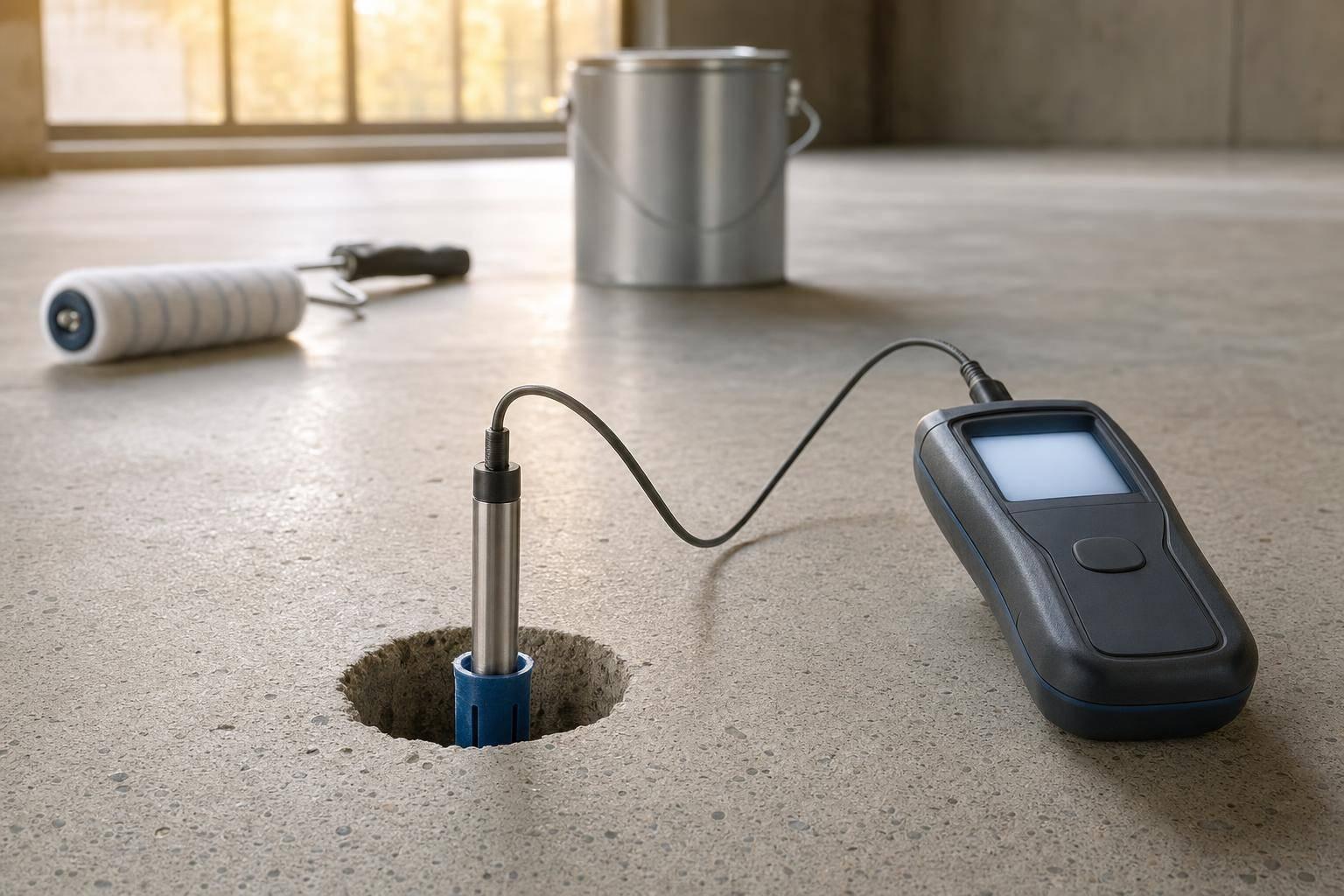
- ASTM F2170 checks moisture inside the slab
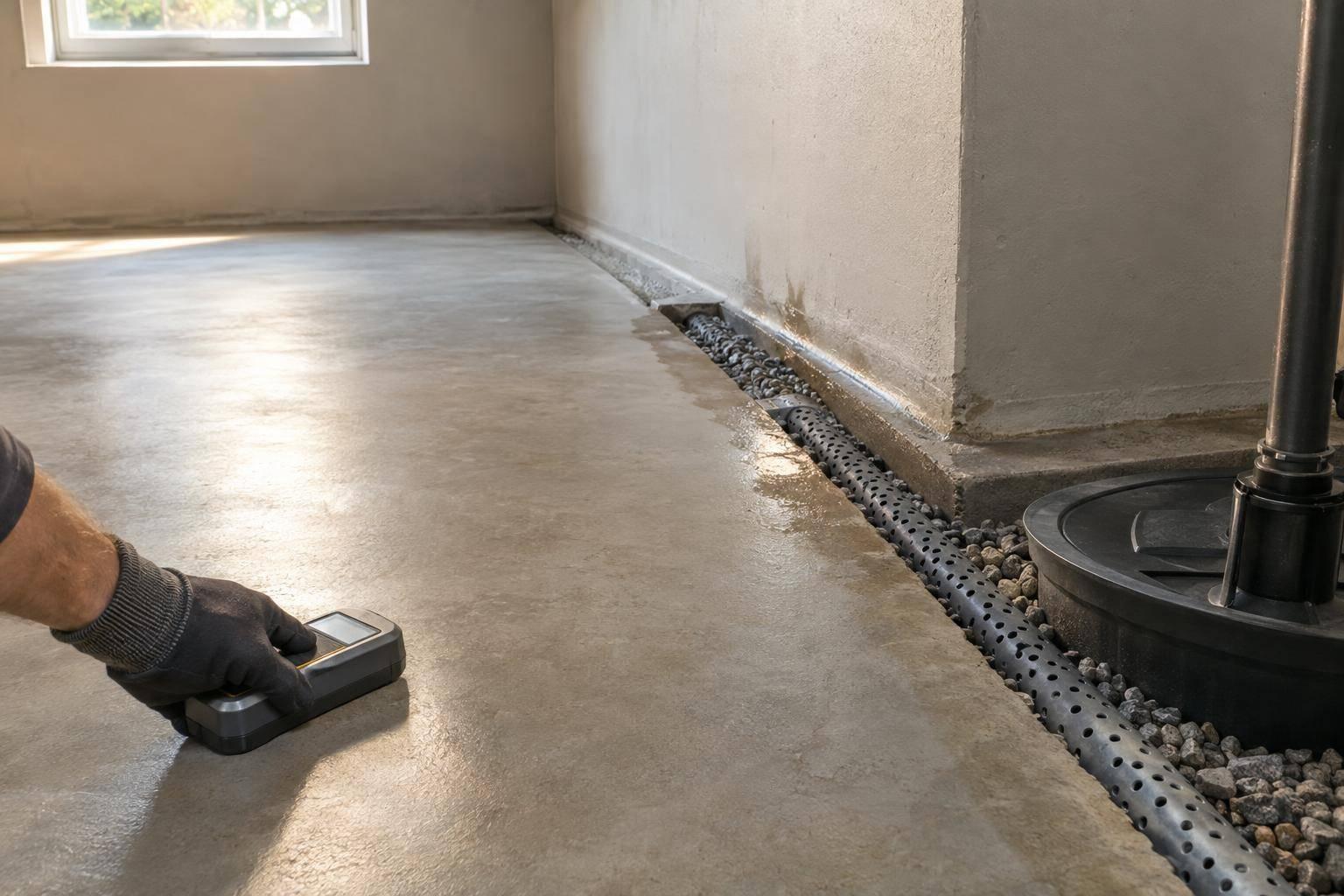
- ASTM F1869 checks moisture vapor coming off the surface
- Moisture meters help find wet spots fast, but they are usually a screening tool
- If numbers are too high, the fix is usually to wait, mitigate moisture, or switch systems
Here’s a quick side-by-side look:
| Test | What I’d use it for | Common range mentioned in the article |
|---|---|---|
| ASTM F2170 | Check internal slab moisture | 75%–80% RH for many standard systems; some go to 90% RH |
| ASTM F1869 | Check surface vapor emission | 3–5 lbs per 1,000 sq. ft. per 24 hours |
| Moisture meter | Fast screening | Some systems call for below 5.0% |
The main point is simple: I would never go by the calendar or by how the slab looks. I’d go by the test results and the coating manufacturer’s stated limits.
Two-Minute Lessons: Concrete Moisture Testing, It’s Important!
sbb-itb-a0e5ae3
How Concrete Moisture Is Measured and What Numbers Are Acceptable
Concrete Moisture Testing Methods: Thresholds & Use Cases for Floor Coatings
Before a coating goes down, contractors usually rely on three moisture testing methods. Those readings help answer a simple but high-stakes question: Can a standard coating go on now, or does the slab need more drying time, moisture mitigation, or a different system?
ASTM F2170, ASTM F1869, and Moisture Meters
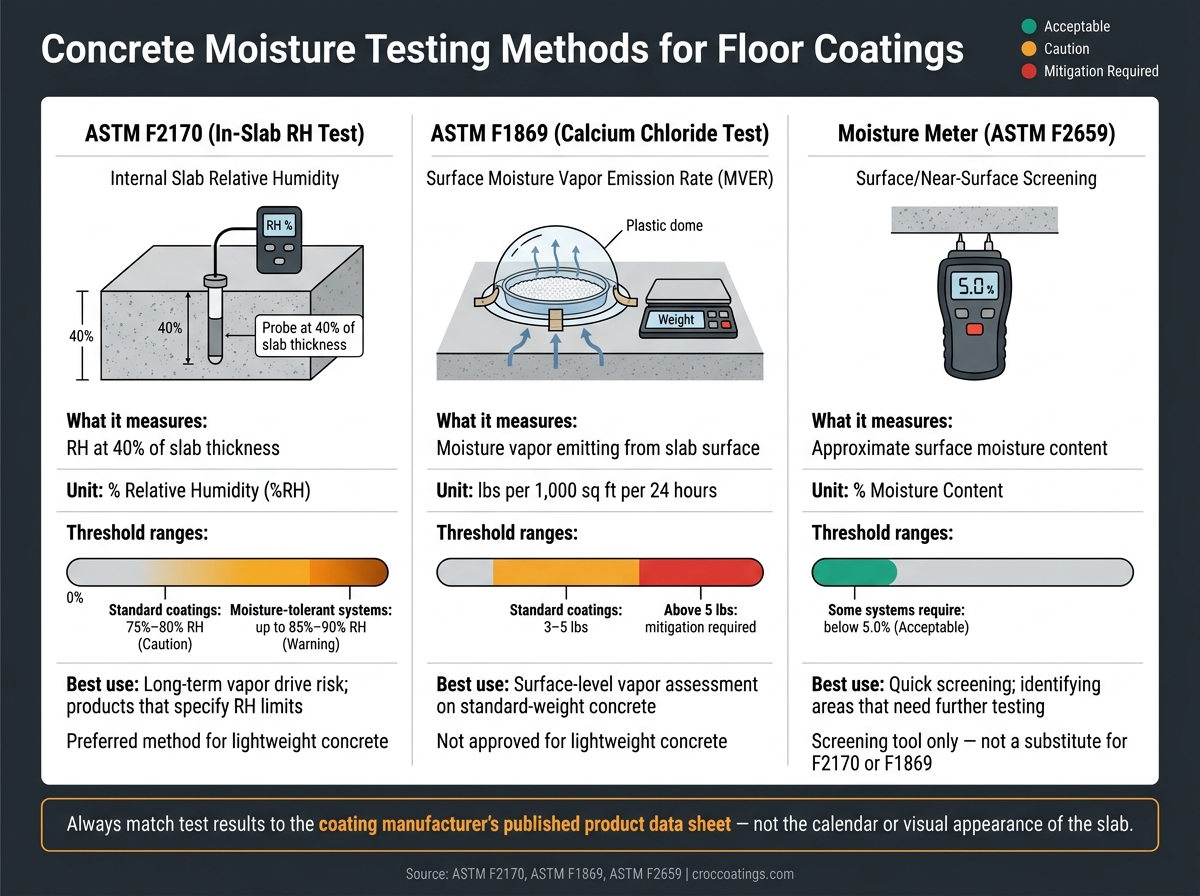
ASTM F2170 measures internal slab RH at the depth most likely to predict post-installation moisture. Results are reported as percent relative humidity (%RH). This test should only be done after the slab and the room have stabilized to service conditions.
ASTM F1869, the calcium chloride test, measures moisture vapor emitting from the slab surface. Results are expressed in lbs of water per 1,000 sq ft per 24 hours. The catch is that it only reflects near-surface conditions, so surface treatments or ambient conditions can skew the reading. ASTM standards have also disallowed F1869 for lightweight concrete and favor F2170 instead.
Moisture meters are fast screening tools used to spot areas that need more testing.
Typical Threshold Ranges for Coating Systems
These figures show up often in U.S. project specs, but they are only general benchmarks. The product data sheet and project specifications set the actual limit.
| Test Method | Unit | Common Benchmark Range |
|---|---|---|
| ASTM F2170 (in-slab RH) | %RH | 75%–80% for many standard coating systems; up to 85%–90% for some systems |
| ASTM F1869 (MVER) | lbs per 1,000 sq ft per 24 hours | 3–5 lbs for standard coatings; higher values typically trigger moisture mitigation |
| Moisture meter (ASTM F2659) | % moisture content | Below 5.0% for some systems |
Moisture-tolerant systems can allow higher readings, but the product data sheet is the final word. If the slab is over the limit, the team usually has three options: wait for more drying, install mitigation, or switch to another coating system.
Test Method Comparison Table
One test alone can miss moisture deeper in the slab. That’s why many installers use more than one method before making a coating call. It gives a better read on what the slab is doing now and what it may do after installation.
| Test Method | What It Measures | Unit | Typical Threshold Range | Best Use Case |
|---|---|---|---|---|
| ASTM F2170 | Internal slab RH at 40% of slab thickness | %RH | 75%–80% for many standard systems; up to 90% for specified moisture-tolerant systems | Long-term vapor drive risk; products that specify RH limits |
| ASTM F1869 | Surface moisture vapor emission | lbs per 1,000 sq ft per 24 hours | 3–5 lbs for standard systems; above 5 lbs often requires mitigation | Surface-level vapor assessment on standard-weight concrete |
| Moisture meter (ASTM F2659) | Approximate surface/near-surface moisture content | % moisture content | Below 5.0% for some systems | Quick screening; identifying areas that need further testing |
When readings come in above the limit, installers have to change the plan before coating starts. That’s why the moisture result has to line up with the coating spec from the start. The next piece is what those numbers mean for bond strength and installation timing.
Why Moisture Thresholds Affect Bond Strength and Installation Planning
What Happens When a Slab Exceeds the Coating’s Moisture Limits
Once readings go past the published limit, the problem is no longer about testing. It becomes a failure-risk issue. As moisture vapor builds beneath a coating, it increases pressure at the bond line between the slab and the coating. If that pressure gets higher than the adhesion strength or the concrete’s tensile strength, the bond starts to fail over time.
The usual warning signs are blistering, peeling, and delamination. In many cases, you’ll also see dampness or efflorescence on the underside.
Pull-off tests from failed spots often show far lower adhesion than tests from areas that still hold up. Some polyurea and polyurethane topcoats face another problem too: excess moisture can interfere with the chemistry. Isocyanates react with water and produce carbon dioxide gas, which can lead to foaming, pinholes, and voids in the coating. So even if the surface looks cured, the coating may still be weak in multiple places.
How Moisture Affects Scheduling in Local Conditions
After the moisture reading comes in, the install date depends on drying time, not the calendar. The 28-day cure is just the starting line. In Spokane, Coeur d’Alene, and the Tri-Cities, seasonal conditions can stretch drying well past that mark.
Thicker slabs need more time to dry through their full depth, especially when they’re poured over poorly drained soil. For basement slabs or enclosed garages during cooler months across the Inland Northwest, drying often takes 60 to 90 days or more. In the Tri-Cities, summer heat and drier air may dry the surface faster, but deeper moisture can still stay trapped. That’s exactly why testing at the right depth matters more than going by touch or by date alone.
The practical takeaway is simple: treat moisture testing as a project milestone, not a last-minute check. If you’re planning a new pour, allow the standard 28-day cure, then set aside extra time for drying and formal verification before booking an installation crew.
Project Records, Warranties, and Risk Control
Documented moisture readings help protect the warranty and make later failure reviews much clearer. Manufacturers often require proof that concrete conditions stayed within published limits at the time of installation. Without that record, warranty claims tied to blistering, peeling, or delamination may be denied.
If a failure does happen, the original MVER and RH readings, paired with post-failure pull-off test data, make it easier to pinpoint the cause. It could be a site moisture shift, a prep problem, or another jobsite issue. Moisture thresholds affect both coating choice and project timing, and the paperwork connects those two parts.
Keeping records doesn’t need to be complicated. A solid file usually includes:
- Test reports
- Application logs
- Batch data
- Photos taken before and during installation
Installation should follow the published moisture limits for the chosen system, not a visual guess. That distinction matters when it’s time to choose the coating system. That’s why system selection comes next.
How Penntek Floor Systems Handle Moisture in Practice

Where Penntek Fits: Garages, Basements, Patios, and Commercial Spaces
Croc Coatings installs Penntek Evolution on garage floors, basements, patios, pool decks, and commercial spaces across North Idaho and Eastern Washington. The system works well on occupied properties because it offers a one-day install, UV stability, and durability. That becomes a big deal when a concrete slab is getting close to its moisture limit.
Moisture Tolerance: Penntek Polyurea/Polyaspartic vs. Standard Epoxy Systems
At the bond line, moisture is where floor coatings either hold up or fail.
Penntek’s polyurea/polyaspartic chemistry reacts to moisture stress differently than standard epoxy-only systems. Standard epoxy tends to be more brittle. When moisture and soluble salts build pressure at the bond line, that brittleness can lead to delamination.
Penntek is built to reduce bond-line pressure from vapor and handle small amounts of substrate movement, which helps cut down the risk of delamination.
That said, better moisture tolerance doesn’t mean unlimited tolerance. Penntek can handle moisture better than epoxy-only systems, but the published Penntek data sheet still sets the final limit for each project. For bare concrete, one Penntek technical data sheet says ASTM F2659 electronic moisture meter readings should be below 5.0% before coating.
How Croc Coatings Handles Testing and Preparation on Local Projects

Before installation, Croc Coatings tests the slab against Penntek’s published limits. If the readings come in borderline or high, the team documents the test results and the product choices used on the job. That paper trail supports performance tracking and warranty coverage.
In plain terms, the install decision comes from the readings – not from how the slab looks on the surface.
Conclusion: The Moisture Numbers to Confirm Before Coating Concrete
Before you coat concrete, confirm ASTM F2170 RH, ASTM F1869 MVER, and moisture meter readings against the product data sheet. After the numbers come in, the product data sheet makes the call on whether the slab is ready. Many standard systems begin at 75% to 80% RH and 3 to 5 lbs/1,000 sq. ft./24 hrs MVER. The published limits control the install.
This affects the schedule before it affects the coating itself. If the slab tests above the coating’s limit, the job may need more drying time, moisture mitigation, or a system rated for higher moisture.
If moisture is high but still inside spec, system choice matters just as much as the test result. Penntek can handle borderline moisture conditions better within its published limits.
Save the test method, test locations, readings, and product used in the project file. If the floor is questioned later, those records can make all the difference.
Croc Coatings follows this process across North Idaho and Eastern Washington, using site-specific moisture testing and documented installation decisions on every project. The practical takeaway is simple: match the coating system to the slab’s moisture, not to the calendar.
FAQs
Which moisture test matters most for my floor?
The Relative Humidity (RH) probe test (ASTM F2170) is widely seen as the most accurate and reliable way to check whether a floor is ready for a coating.
Instead of only checking the surface, it measures moisture deeper in the slab. That gives you a reading you can trust more over time. In plain English: it shows what’s happening inside the concrete, not just on top.
Industry standards usually call for internal relative humidity below 75% to 85%. Staying in that range can help maintain bond strength and reduce the risk of blistering or delamination.
What should I do if my slab tests too wet?
Hold off on installation so the concrete has more time to dry. Keep the space steady by running the permanent HVAC system, and bring in a dehumidifier if moisture is still too high.
If the slab is structurally sound, talk with a pro about using a moisture-mitigating primer or a vapor barrier system before the topcoat. Then test again with professional-grade tools to make sure the slab meets your system’s moisture limits.
Can a moisture-tolerant coating still fail?
Yes. Even a moisture-tolerant coating can fail if the concrete goes past the manufacturer’s moisture limits.
When moisture vapor emission or internal relative humidity is too high, vapor can get trapped under the coating and build pressure. That pressure can weaken the bond and lead to blistering, peeling, or delamination.
Some systems, like Penntek Evolution, handle moisture better than many other options. But that doesn’t remove the need for proper testing and surface prep.