Polyurea vs. Epoxy: Cost Per Square Foot Comparison
February 16, 2026

Choosing between polyurea and epoxy coatings comes down to cost, durability, and long-term value. Here’s the key takeaway:
- Epoxy: Costs $4–$10 per square foot, lasts 5–10 years, and requires reapplications.
- Polyurea: Costs $5–$12 per square foot, lasts 20+ years, and resists wear better over time.
While epoxy is cheaper upfront, polyurea offers greater durability, faster curing times, and fewer maintenance needs. Over 20 years, polyurea often saves money long-term despite its higher initial cost.
| Feature | Epoxy | Polyurea |
|---|---|---|
| Cost per Sq. Ft. | $4–$10 | $5–$12 |
| Lifespan | 5–10 years | 20+ years |
| Curing Time | 12–16 hrs (foot); 2–7 days (vehicle) | 1–6 hrs (foot); 24 hrs (vehicle) |
| UV Resistance | Poor | Excellent |
| Durability | Moderate (prone to cracking) | High (flexible, strong) |
Polyurea coatings are ideal for long-term savings, especially in high-traffic or extreme conditions.
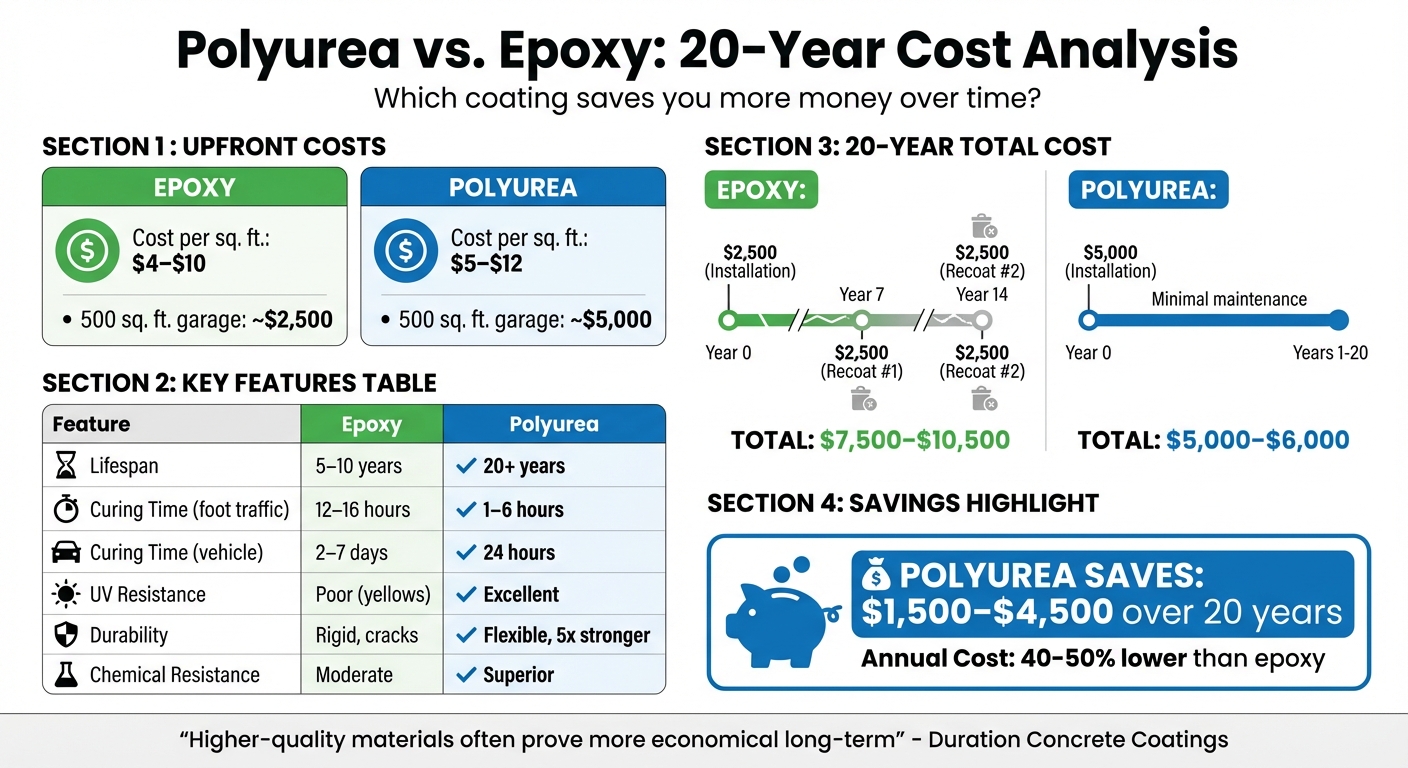
Polyurea vs Epoxy Coating Cost Comparison Over 20 Years
Epoxy Cost Per Square Foot Breakdown
Material and Installation Costs
When it comes to epoxy, water-based epoxy is the least expensive option, priced at $30–$50 per gallon. It covers about 250–300 square feet but offers the thinnest and least durable finish. Solvent-based epoxy comes in at around $45 per gallon, while 100% solid epoxy – the top-tier choice for professionals – ranges from $45–$150 per gallon, delivering exceptional durability.
Labor costs for professional installation vary, ranging from $1–$7 per square foot, depending on the level of surface preparation and the complexity of the design. Combining material and labor, the total installed price for epoxy typically falls between $3–$12 per square foot, with most residential projects averaging around $4–$10 per square foot.
"As an industry rule of thumb, you can expect to pay about $1,500 per garage stall for a floor coating." – Epoxy Depot Chicago
These figures provide a solid framework for estimating costs across different project sizes.
Cost Examples for Common Spaces
For a two-car garage (400–576 square feet), costs generally range between $1,600–$6,000, with the national average sitting at $2,441. A single-car garage (240–360 square feet) typically costs $750–$3,200, while a three-car garage (approximately 864 square feet) can range from $3,500–$10,400.
In a real-world example from January 2026, interior designer Gabriel S. McLain oversaw a project in Austin, TX, for a 400-square-foot double garage. The client opted for a professional mid-gray flake finish, including crack repairs, which totaled $3,050, or about $7.60 per square foot.
Basements can be trickier to price due to size and condition differences. A 500-square-foot basement might cost between $3,000–$12,000, while larger spaces could reach $20,000, especially if significant prep work is needed. For instance, a Chicago project in January 2026 involved a 400-square-foot basement that required extensive floor rehabilitation and three coating layers, bringing the total to $4,800, or over $12 per square foot.
Factors That Affect Epoxy Costs
Several factors influence the final cost of an epoxy project:
- Concrete condition: Simple cleaning and minor repairs add $1–$5 per square foot, while more intensive work, such as diamond grinding, can add $2–$7 per square foot. Removing old coatings may cost $3–$10 per square foot, and concrete patching materials can total up to $250.
- Moisture levels: Testing for moisture costs $200–$500. If high moisture vapor emission rates are detected, a moisture barrier may be required, adding $2–$10 per square foot.
- Customization options: Features like anti-slip additives, UV protection, or decorative flakes add $0.50–$3 per square foot.
- Type of epoxy finish: Solid color epoxy costs $3–$7 per square foot, flake or paint chip epoxy ranges from $5–$12 per square foot, and metallic epoxy is the most expensive, at $5–$15 per square foot.
It’s also worth noting that professional-grade coatings typically contain over 90% solids, ensuring better durability and performance. In contrast, DIY kits often contain as little as 30% solids, which can significantly affect their lifespan and effectiveness.
These details provide a clear picture of epoxy costs and set the stage for comparing its polyurea vs. epoxy cost and warranty differences.
sbb-itb-a0e5ae3
Polyurea Cost Per Square Foot Breakdown
Material and Installation Costs
Polyurea coatings typically range from $5 to $10 per square foot, broken down into $1 to $6 for materials and $3 to $6 for labor. This higher price reflects their standout features, including complete UV resistance and excellent chemical durability.
One major advantage of polyurea is its rapid curing time – it’s ready in about an hour, compared to epoxy’s 12–16 hours. This fast turnaround means projects can often be completed in a single day.
"A successful installation relies on proper surface prep – it’s about 75% of the whole job." – Duration Concrete Coatings
Surface preparation costs for polyurea and epoxy range between $240 and Surface preparation is a key part of the process and costs between $240 and $1,200.,200. Additional moisture testing, if required, can add $200 to $500. If moisture levels are too high, a moisture barrier may be necessary, costing $2 to $10 per square foot to ensure proper adhesion.
These costs provide a foundation for understanding how polyurea installations play out in different spaces.
Cost Examples for Common Spaces
Using the material and labor costs as a guide, let’s look at typical expenses for common spaces. For a two-car garage (400–576 square feet), polyurea coatings cost between $2,000 and $6,900. A single-car garage (240–288 square feet) comes in at $1,200 to $3,500, while a three-car garage (around 864 square feet) ranges from $3,500 to $10,400.
For larger projects – starting at roughly 500 square feet – a professional installation usually costs between $4,750 and $5,250. Larger areas often benefit from lower per-square-foot rates since fixed costs, like equipment setup and travel, are spread out over more square footage.
"Larger garages tend to have a lower cost per square foot." – Duration Concrete Coatings
Optional upgrades can increase costs. Removing old coatings adds $3 to $8 per square foot, while a protective topcoat costs an additional $0.50 to $2.00 per square foot. If the layout is complicated – think support columns, irregular shapes, or built-in cabinets – expect an extra $300 to $800 for the added precision required.
Factors That Affect Polyurea Costs
A variety of factors influence the final price of a polyurea installation. The condition of the concrete is one of the biggest variables. Minor repairs may only add a few hundred dollars, but significant issues like structural damage or large cracks can cost $1,000 or more to fix before application.
Customization also plays a role. Features like intricate color designs, company logos, or decorative touches require extra time and materials, which increases the cost.
Project size is another key factor. Larger installations often enjoy lower per-square-foot rates due to economies of scale, while smaller or more complex spaces – those with tight corners, unusual angles, or obstacles – demand extra effort, potentially adding a few hundred dollars to the total.
While polyurea has a higher upfront cost, its 15+ year lifespan far outlasts the 5–7 years typical of standard epoxy, making it a long-term investment that pays off over time.
Polyurea vs. Epoxy: Side-by-Side Cost Comparison
Cost and Feature Comparison Table
| Feature | Epoxy Coating | Polyurea/Polyaspartic |
|---|---|---|
| Cost per Sq. Ft. | $4 – $10 | $5 – $12 |
| Lifespan | 5 – 10 years | 20+ years |
| Curing Time | 12 – 16 hours for foot traffic, 2 – 7 days for vehicle traffic | 1 – 6 hours for foot traffic, 24 hours for vehicle traffic |
| Durability | Rigid; prone to cracking/peeling | Flexible; 5x stronger than epoxy |
| UV Resistance | Poor (yellows over time) | Excellent (UV stable) |
| Chemical Resistance | Moderate | Superior |
Epoxy may seem like the budget-friendly choice upfront, but polyurea’s durability and extended lifespan often result in greater savings over time.
"Higher-quality materials often prove more economical long-term, despite the higher upfront cost." – Duration Concrete Coatings
Now, let’s look at how these features affect durability and lifespan.
Durability and Lifespan
Polyurea’s flexibility is a game-changer. Unlike epoxy, which is rigid and prone to cracking or peeling when concrete expands or contracts, polyurea can stretch slightly while maintaining its bond. This makes it far better equipped to handle temperature changes and heavy use.
The lifespan difference is another standout. Polyurea can last over 20 years, while epoxy typically needs replacing every 5 to 10 years. Over the long haul, this means fewer recoating cycles with polyurea. For high-traffic areas like gyms, workshops, or even long-term residential use, this durability translates into fewer disruptions and lower maintenance costs.
"Polyurea is up to five times stronger than standard epoxy, showing better resistance to chemicals, abrasion, and impact." – Crayton Caudill, Expert, Level 10 Coatings
These durability perks also influence installation time, as we’ll see next.
Curing Time and Installation Speed
Polyurea’s fast curing time is a practical advantage. While epoxy takes 2 to 7 days to fully cure for vehicle traffic, polyurea is ready for foot traffic in as little as 1 to 6 hours and for vehicles within 24 hours. This speed allows most polyurea projects to be completed in just one day.
For businesses like warehouses or restaurants, this quick turnaround minimizes downtime and reduces lost revenue. Instead of closing for nearly a week, operations can resume the same day. Even for homeowners, having your garage ready to use in just 24 hours is a huge benefit.
Temperature flexibility is another plus. Polyurea can be applied in temperatures as low as –20°F, making it ideal for colder climates or unheated spaces. In contrast, epoxy requires at least 50°F to cure properly. This versatility makes polyurea a go-to choice for winter installations or areas with challenging conditions.
20-Year Cost Analysis
Epoxy: 20-Year Total Cost
While epoxy coatings come with a lower upfront cost, their shorter lifespan of 5–10 years means you’ll need to reapply them 2–4 times over a 20-year period. Each reapplication adds expenses for materials and the labor-intensive process of removing the old coating.
For a standard 500-square-foot garage, epoxy installation costs approximately $2,500 at $5 per square foot. Given its average lifespan, you’d likely replace the coating about every 7 years, resulting in three installations over two decades. That brings the total to around $7,500 – before even accounting for the cost of removing the old layers. Add in maintenance for common issues like hot-tire pickup or chemical staining, and the total cost can climb to $7,500–$10,500.
"Over a decade, you could end up replacing an epoxy floor two or three times, while a polyurea floor would still be going strong." – AllBright Painting
This frequent need for reapplication makes epoxy less economical when considering the short-term vs long-term costs of garage floor coatings.
Polyurea: 20-Year Total Cost
In contrast, polyurea coatings have a higher initial cost but deliver a much longer lifespan. For the same 500-square-foot garage, installation costs about $5,000 at $10 per square foot. With a lifespan exceeding 20 years, polyurea eliminates the need for reapplications or removal fees, keeping the total cost between $5,000 and $6,000.
Polyurea’s durability means it resists common issues like chemical spills, UV damage, and temperature fluctuations without cracking or peeling. This reliability translates to minimal maintenance and a significantly lower total cost of ownership over time.
"When you factor in a 20+-year lifespan, the polyaspartic system offers the lowest annual cost of ownership." – Cleveland Concrete Coatings
Cost Savings with Polyurea
The cost comparison makes it clear: polyurea coatings offer substantial financial advantages. Over 20 years, polyurea can save homeowners $1,500–$4,500 compared to epoxy, thanks to fewer installations and reduced maintenance needs.
Beyond the numbers, polyurea’s durability means fewer disruptions and less hassle, offering homeowners greater peace of mind. As Crayton Caudill from Level 10 Coatings explains:
"The reduced need for repairs and re-coatings may ultimately save you money in the long run, particularly if you plan on staying in your home." – Crayton Caudill, Expert, Level 10 Coatings
This analysis highlights how long-term durability isn’t just a convenience – it’s a smart financial decision when selecting a coating system.
Conclusion
Key Takeaways
When comparing epoxy and polyurea coatings, the differences in cost and longevity are striking. Epoxy costs between $4–$10 per square foot but typically lasts only 5–10 years. On the other hand, polyurea, with an upfront cost of $7–$12 per square foot, offers a lifespan of 15–20+ years, making it 2–4 times more durable than epoxy.
Over a 20-year span, polyurea proves to be the more economical choice, saving 40–50% by eliminating the need for frequent reapplications. Beyond cost, polyurea also cures within hours (compared to days for epoxy) and offers superior UV stability and resistance and hot-tire pickup. These factors make polyurea a practical and durable solution for long-term performance.
Why Choose Croc Coatings?
Croc Coatings delivers the durability and efficiency of polyurea through their Penntek Evolution system, which is up to 4x stronger than epoxy. Their streamlined, one-day installation minimizes disruptions, and every floor comes with a lifetime warranty for peace of mind.
Whether you’re upgrading a garage, beautifying a patio, or outfitting a commercial space, Croc Coatings provides a solution that lasts. Founded by Jim and Kelley Hobart, the company has built a reputation for quality and customer satisfaction, earning the title of "Best of North Idaho" in 2025.
If you’re ready to invest in a floor that’s built to last, Croc Coatings’ certified team takes care of everything – from diamond-ground surface preparation to custom finishes (which you can preview using our color chooser tool) – ensuring your floor performs flawlessly for years to come.
Polyurea vs. Epoxy Floor Coatings: Costs, Pros, Cons, and the Best Choice for 2025
FAQs
Which coating is better for my garage: epoxy or polyurea?
Polyurea is often the preferred option for garage floors because of its outstanding durability, resistance to UV rays, and extended lifespan. While epoxy is more affordable initially, costing around $5–$7 per square foot and lasting 5–10 years, polyurea comes in at $7–$9 per square foot but offers a lifespan of 15+ years with little maintenance. This makes polyurea a more economical choice over time, especially for garages exposed to heavy use or outdoor elements.
What makes a floor coating price go up per square foot?
The cost of a floor coating per square foot depends on several factors, including the quality of materials used, the size of the project, and the level of surface preparation needed. Adding extras like decorative finishes or custom colors can push the price higher. These choices not only affect the upfront cost but also impact the coating’s durability, appearance, and how well it holds up over time.
Do I need a moisture test or moisture barrier before coating?
Before applying coatings like epoxy or polyurea, it’s a good idea to perform a moisture test or use a moisture barrier – especially on new concrete or surfaces prone to moisture problems. Excess moisture can cause issues like bubbling, peeling, or even delamination. While polyurea tends to handle moisture better and can sometimes be applied to damp surfaces, testing helps ensure the coating lasts and performs as expected.
Related Blog Posts
- Epoxy Alternatives: Price Comparison 2025
- Polyaspartic vs Epoxy: Cost Breakdown
- Short-Term vs Long-Term Costs of Garage Floor Coatings
- Polyurea vs. Epoxy: Warranty and Cost Differences