If I’m checking a floor coating for code use, I start with ASTM E648/NFPA 253, not ASTM E84. That’s because coated concrete is judged as an interior floor finish, and the coating system – not the concrete slab – drives flame spread and smoke. In most cases, I’m looking for Class I for corridors and exit paths, Class II for many other interior areas, and I make sure the report matches the exact installed build.
Here’s the short version:
- ASTM E648 / NFPA 253 = floor test for critical radiant flux (CRF)
- Class I = ≥ 0.45 W/cm²
- Class II = ≥ 0.22 W/cm² and < 0.45 W/cm²
- ASTM E84 / UL 723 = wall and ceiling test, not a floor substitute
- ASTM E662 = smoke density test; many specs use Dm 450 as a limit
- Test results apply only to the exact tested system: substrate, primer, coats, aggregate, and thickness
Quick comparison
| Test standard | What I use it for | Main result | What to watch for |
|---|---|---|---|
| ASTM E648 / NFPA 253 | Floor finish fire spread | CRF in W/cm² | Main floor-coating code check |
| ASTM E84 / UL 723 | Wall/ceiling surface burning | FSI and SDI | Not interchangeable with E648 |
| ASTM E662 | Smoke blocking light | Dm | Shows visibility loss, not smoke toxicity |
| ASTM D2859 | Carpet ignition | Pass/fail style flooring check | Usually not used for resinous concrete coatings |
My rule is simple: I don’t approve a coating from a product sheet alone. I check the full lab report, confirm the tested assembly matches the job, and then match that rating to the part of the building where the floor will go.
sbb-itb-a0e5ae3
The Main U.S. Test Standards for Floor Coatings
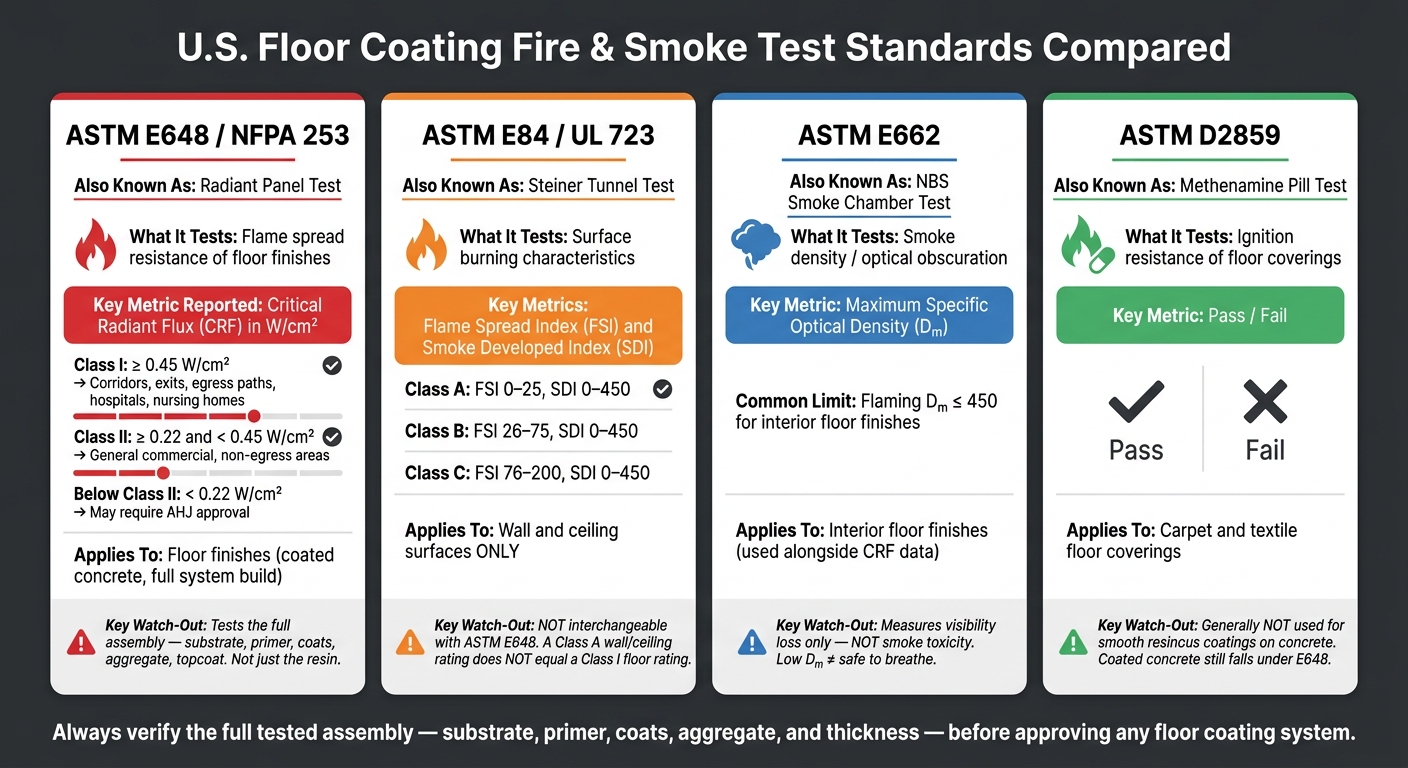
U.S. Floor Coating Fire & Smoke Test Standards Compared
Four standards matter most in the U.S. when people review top industrial floor coatings for fire and smoke performance. Each test looks at a different part of the problem, so one rating never tells the full story. Owners use these standards when they need to approve coated floor systems for corridors, exits, and occupied spaces.
ASTM E648 and NFPA 253: Radiant panel testing for floor finishes
ASTM E648 and NFPA 253 refer to the same floor-finish test. Both measure critical radiant flux (CRF) for floor finishes. Put simply, a higher CRF means the floor does a better job resisting flame spread.
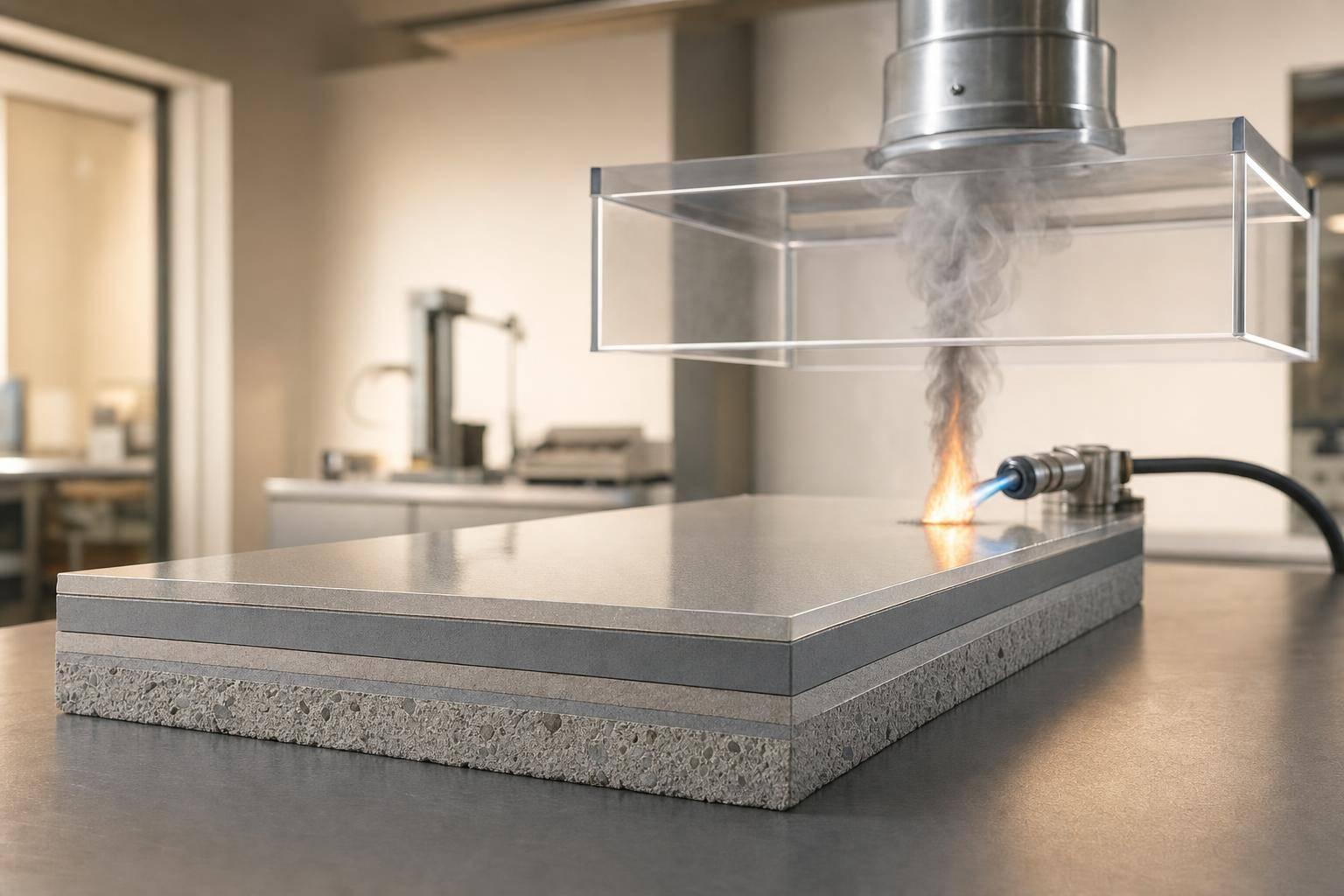
Just as important, the lab does not test the resin alone. It tests the full floor build-up: the concrete slab, primer, and coating or topcoat. That detail matters because the installed system is what performs in the field.
| Class | CRF Threshold | Typical Building Areas | What It Means for Coated Concrete |
|---|---|---|---|
| Class I | ≥ 0.45 W/cm² | Corridors, lobbies, stairways, exit routes, especially hospitals, nursing homes, day-care centers, and other institutional-type facilities | Highest resistance to flame spread across the floor surface |
| Class II | ≥ 0.22 W/cm² and < 0.45 W/cm² | General commercial construction and many non-egress interior floor areas | Often acceptable where Class I is not required |
| Below Class II | < 0.22 W/cm² | Low-risk or non-required areas | May not be acceptable in public circulation spaces without AHJ approval |
E648 is the key floor-finish standard. E84 may show up in submittals, but it applies to different surfaces, so it can’t stand in for CRF data.
ASTM E84 and UL 723: Flame spread and smoke-developed ratings
Owners often spot E84 on product sheets and assume it covers flooring. It doesn’t. It answers a different fire question.
ASTM E84 and UL 723 report flame spread and smoke-developed values for wall and ceiling exposure. ASTM E648 and NFPA 253 report CRF for floor exposure. They are not interchangeable.
This is where teams often get tripped up. A Class A rating under ASTM E84 is not the same as a Class I floor-finish rating. A product can have a Class A wall or ceiling rating and still lack the CRF data needed to judge how it performs as a floor finish.
ASTM E662 and ASTM D2859: Smoke density and special-case flooring tests
Flame spread is only one part of the picture. Smoke density comes next, because heavy smoke can cut visibility during evacuation.
ASTM E662 measures the specific optical density of smoke in a closed chamber. It reports smoke-density values tied to visibility, not toxicity. Many specs set a limit of flaming Dm 450 for interior floor finishes.
For coated concrete in enclosed commercial or industrial spaces, E662 works alongside CRF results. It helps show whether a coating gives off enough smoke to reduce visibility during a fire.
ASTM D2859 is different again. It’s a carpet-specific ignition test and is generally not used for smooth resinous coatings on concrete. In mixed-finish projects, D2859 applies to textile floor coverings. Coated concrete still falls under E648, with E662 added when smoke data are needed.
These standards help explain what a lab result is saying. The next step is matching those results to the building area and occupancy.
What Test Results Show and What They Do Not Show
For coated concrete floors, test numbers only mean something if they match the installed system.
How to read CRF, FSI, SDI, and smoke-density numbers
Use CRF, FSI, SDI, and Dm to decide whether a tested floor system fits the space.
Critical Radiant Flux (CRF) measures the lowest radiant heat level at which flame keeps spreading across a floor system. It is reported in watts per square centimeter (W/cm²). Higher is better.
Flame Spread Index (FSI) and Smoke Developed Index (SDI) are comparative ASTM E84 scores. Lower numbers mean less flame spread and less smoke.
Smoke density from ASTM E662 measures how much smoke blocks light in a closed chamber. It is reported as maximum specific optical density, or Dm. A higher Dm means smoke blocks visibility faster, which can affect what people can see while trying to get out.
One point gets missed all the time: FSI and SDI do not always move together. A product can post a low FSI and still make a lot of smoke, or the other way around. Looking at both numbers side by side gives a better read than looking at either one by itself.
These numbers show performance limits. By themselves, they do not equal approval.
Limits of small-scale lab testing
These tests are controlled lab measurements, not full-scale fire simulations. That matters because a flammability rating on paper may not match what happens in an actual fire. ASTM E648, E84, and E662 all run under fixed ventilation, set ignition sources, and defined heat levels. Change the fire conditions, airflow, or fuel load, and the result can change too.
They also do not replace whole-building fire protection design. A floor system with a strong CRF can still play a part in a serious fire if site conditions shift from the lab setup.
One limit surprises a lot of owners: ASTM E662 smoke results measure optical density, not toxicity. So a low Dm means less visual obscuration, but it does not mean the smoke is safe to breathe. Chemical-resistant polymer coatings can produce irritants and harmful combustion gases that standard optical tests do not measure. In plain English, even if the smoke looks “better” on a report, people still need to get out fast.
That is why the tested build, not just the product name, drives the approval decision.
Why the full system build matters more than the coating name
A test report applies only to the exact tested floor build. The CRF, FSI, or Dm value in the report belongs to the exact assembly that was tested: a specific concrete substrate, primer, basecoat, decorative aggregate broadcast, and topcoat, all installed at defined thicknesses.
Change any part of that setup and the fire or smoke behavior may change too. Skip the aggregate broadcast, use a thinner topcoat, or switch substrates, and now you’re outside the tested assembly. ASTM E662 says this plainly: results apply only to the tested specimen, and there is no standard formula for calculating smoke density for a different setup from the original data.
When you review a test report, focus on the layer-by-layer build description, not just the rating at the end. If your project uses a different aggregate, a heavier broadcast, or another topcoat, ask the manufacturer whether a report exists for that exact setup – or whether more testing is needed. Approve only a system whose layers, thicknesses, and substrate match the tested assembly.
Next, use the test report to match the system to the building area and occupancy.
How Building Owners Can Use Fire and Smoke Data to Choose a Coated Concrete System
Match the test report to the building area and occupancy type
Start with the area requirement, not the product.
First, figure out where the coated floor will be installed: corridor, enclosure, stair, showroom, service bay, or storage room. That location drives the floor-finish class you need. From there, use that code requirement to screen the test report.
Exit corridors and exit enclosures often require Class I. Spaces outside egress paths may allow Class II. That means a coating that works for a room may still fall short for a corridor.
Also, check the adopted code edition and any local amendments in the project jurisdiction. Small code differences can change what passes and what doesn’t.
What to check in a test report before approving a system
A sales sheet is not the same thing as a test report.
It may show a classification, but leave out the substrate, coating thickness, or the lab that ran the test. Before you approve any coated concrete system, get the full report and verify the details yourself.
| Item to verify | What to look for |
|---|---|
| Test standard | ASTM E648 or NFPA 253 for floors; ASTM E84/UL 723 if wall ratings are also required |
| Report date and lab | Dated report from a third-party accredited laboratory |
| Substrate | Confirm the test used concrete, or the same substrate your project has |
| Full system build | Primer, body coat, broadcast media, topcoat, and thickness match the tested assembly |
| Reported classification | CRF value in W/cm² and resulting Class I or Class II designation |
| Applicability notes | Any limits on occupancy type or corridor vs. room use |
If even one layer or the thickness is different, the report may not apply.
After that, compare the tested build to the system that will actually be installed. That’s the part people sometimes skip, and it’s where trouble starts.
How to use manufacturer data in a coating selection process
Once you have the report, compare the listed CRF to the minimum required for the space and occupancy. If the project also calls for wall or ceiling ratings, review any ASTM E84/UL 723 flame spread and smoke-developed data as well.
The basic screen is simple:
- If the report shows Class I and the corridor requires Class I, the system meets that threshold.
- If the report shows Class II and the space requires Class I, it does not.
Then look past the label. Check whether the test used the same coating thickness, broadcast density, and topcoat planned for the job. Ask for the report early so owners can compare the tested assembly with the project requirement before selection moves too far down the road.
When the report lines up with both the area requirement and the installed system, approval gets much easier.
Conclusion: Key Fire and Smoke Standards to Check Before You Choose
When you review a coated concrete system, start with the fire and smoke tests the code calls for. ASTM E648 and NFPA 253 are the main floor-finish tests. They measure CRF and set Class I and Class II ratings for the spaces that require them.
ASTM E84/UL 723 and ASTM E662 add supporting data on flame spread and smoke.
Don’t read a result by the number alone. Read it by the full assembly. A CRF or smoke result applies only to the exact substrate, layer stack, and thickness that were tested. Once the rating fits the space, make sure the tested build matches the installed build.
The main check is simple: ask for the full test report, not just the headline rating. Confirm that the substrate, each coating layer, the thickness, and any aggregates match what will be installed. If anything is different, ask the manufacturer for written documentation that explains whether the tested assembly still applies, or if added testing or a listing covers the exact setup.
That is the fastest path to a code-ready coated floor.
FAQs
When is Class I required?
A Class I fire rating is often required in places with strict safety rules meant to cut fire risk. That can include laboratories, food processing facilities, and high-risk industrial environments.
The exact requirement depends on the occupancy, the building type, and any local code changes. Because of that, it’s smart to check with your local Authority Having Jurisdiction (AHJ) to confirm whether a Class I rating is required for your project or facility.
Can one layer change the rating?
Yes. Changing even one layer can change the fire and smoke rating of a floor coating system.
These ratings are based on the full system as installed. That includes the primer, base coat, and topcoat. Each layer plays a part in flammability, smoke development, and heat resistance.
So if you swap out one component, the whole system should be tested again or reviewed again as a complete assembly.
Does low smoke mean safer smoke?
Not necessarily. Low smoke doesn’t mean the smoke is harmless. During a fire, it can still be toxic.
Low-smoke coatings can help people see better while evacuating. They may also lower some risks tied to toxic fumes and blocked sight lines. But they do not remove the danger from combustion byproducts.