Spokane and Coeur d’Alene face different basement waterproofing challenges due to climate and soil conditions. Spokane’s 16.7 inches of annual rain, clay-heavy soils, and freeze-thaw cycles create high water pressure on foundations. Coeur d’Alene, with 28.1 inches of rain, sandy soils, and lake proximity, deals with constant moisture and high water tables.
Key Points:
- Spokane: Clay soils retain water, increasing foundation pressure. Freeze-thaw cycles worsen wall stress. Snowmelt and concentrated wet seasons bring drainage issues.
- Coeur d’Alene: Sandy soils drain water quickly, but high rainfall and lakes raise groundwater levels. Persistent moisture is the main challenge.
Quick Comparison:
| Factor | Spokane, WA | Coeur d’Alene, ID |
|---|---|---|
| Annual Rainfall | 16.7 inches | 28.1 inches |
| Soil Type | Clay-heavy | Sandy and gravelly |
| Main Issue | Hydrostatic pressure | High water tables |
Tailored waterproofing strategies are essential for each city. Spokane benefits from exterior waterproofing and French drains, while Coeur d’Alene requires vapor barriers and systems to manage lake-driven moisture.
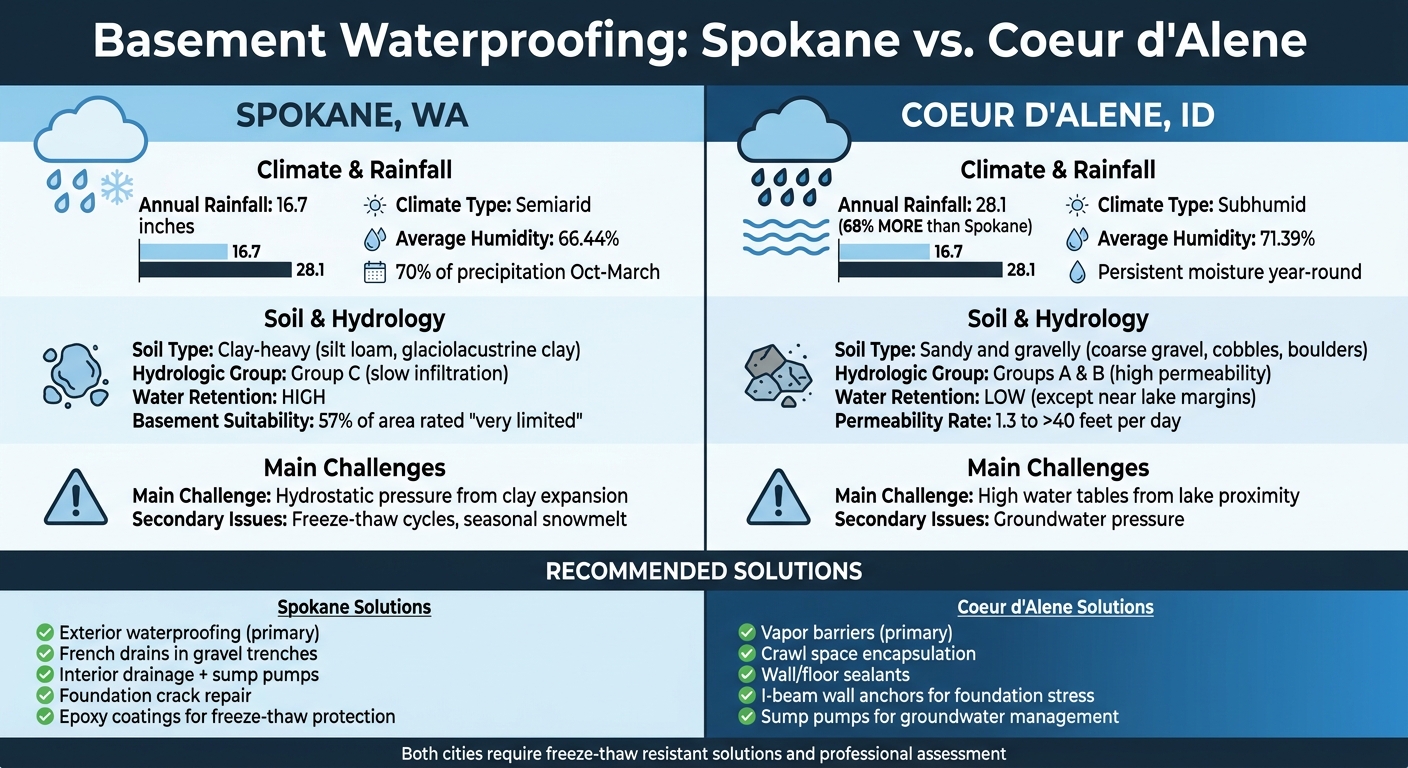
Spokane vs Coeur d’Alene Basement Waterproofing Comparison: Climate, Soil & Solutions
How Climate Affects Basement Waterproofing
Spokane: Snowmelt and Rain Challenges
Spokane’s semiarid climate brings unique waterproofing issues due to its seasonal moisture patterns. The city gets about 16.7 inches of precipitation annually, with most of it falling between October and March. This concentrated wet season means basements face heavy moisture pressure during specific months, rather than a steady threat year-round.
The area’s freeze–thaw cycles are a major factor. When temperatures swing above and below freezing, clay soils expand and contract, putting extra stress on basement walls. As spring arrives, the rapid snowpack melt leads to surface runoff, which can overwhelm drainage systems and further increase hydrostatic pressure on foundations.
"Approximately 70 percent of the total annual precipitation falls between the first of October and the end of March and about one‐half of that falls as snow." – U.S. Geological Survey
In addition to the moisture, Spokane’s extreme cold and icy conditions add another layer of strain on foundation materials. Between wet seasons, the drier conditions cause soil to contract, but when moisture returns, the clay-heavy soil expands again, pushing against basement walls. This constant cycle of expansion and contraction makes waterproofing a critical concern. Meanwhile, Coeur d’Alene faces its own set of challenges due to higher rainfall and proximity to lakes.
Coeur d’Alene: Lake Proximity and Persistent Moisture
Coeur d’Alene’s subhumid climate exposes basements to consistently higher moisture levels. With 28.1 inches of annual precipitation – about 68% more than Spokane – the city deals with frequent moisture exposure throughout the year, not just during winter and spring.
Its location near Coeur d’Alene Lake and Lake Pend Oreille adds to the challenge. The average relative humidity in Coeur d’Alene reaches 71.39%, compared to Spokane’s 66.44%. Additionally, lakes contribute to high groundwater levels in nearby areas. The shallowest water tables are found near the outlets of Coeur d’Alene and Hayden Lakes, which means homes in these areas face elevated hydrostatic pressure year-round.
December is typically the wettest month, bringing about 3.9 inches of precipitation over 17 days of rain or snow. Compounding the issue, fine-grained clay and silt deposits from the Latah Formation around the lakes trap moisture, limiting natural drainage and increasing pressure on basement walls.
Annual Precipitation and Freeze–Thaw Cycle Comparison
The table below compares the key climatic factors affecting basement waterproofing in Spokane and Coeur d’Alene.
| Climate Factor | Spokane, WA | Coeur d’Alene, ID |
|---|---|---|
| Annual Precipitation | 16.7 inches | 28.1 inches |
| Climate Type | Semiarid | Subhumid |
| Average Relative Humidity | 66.44% | 71.39% |
| Wettest Period | October–March (70% of total) | November–January |
| January Temperature Range | High: 33.3°F / Low: 23.3°F | High: 35.5°F / Low: 24.4°F |
| Primary Water Threat | Rapid snowmelt and spring rain | Higher rainfall and lake-driven moisture |
Both cities are heavily impacted by freeze–thaw cycles, as daytime temperatures often rise above freezing even in the coldest months. This means groundwater recharge can happen throughout the winter, not just during the spring thaw. Additionally, the Spokane Valley–Rathdrum Prairie aquifer beneath both cities allows snowmelt and surface water to influence groundwater levels quickly – sometimes within days of heavy precipitation. This rapid response underscores the importance of effective waterproofing strategies in both regions.
sbb-itb-a0e5ae3
7 Basement Waterproofing Solutions That Work
Soil Types and Waterproofing Requirements
Soil composition plays a critical role in determining the waterproofing needs of homes in different regions. In Spokane and Coeur d’Alene, the contrasting soil types create distinct challenges and solutions.
Spokane’s Clay Soils and Water Pressure
Spokane’s soil profile presents unique waterproofing challenges. The area is rich in fertile Mollisols and dense glaciolacustrine clay deposits, especially in regions like the Hillyard Trough and Little Spokane River areas. These fine-grained soils hold onto water, unlike coarser materials such as gravel.
Most of Spokane’s soils fall under Hydrologic Group C, characterized by slow water infiltration and moderate runoff. When rain meets these clay-heavy soils, water tends to pool, increasing hydrostatic pressure against basement walls. Layers of "blue or gray clay" act as barriers, trapping moisture and forming perched water tables that press directly against foundations. It’s no surprise that 57% of soils in Spokane County are considered "very limited" for homes with basements due to poor drainage and shallow bedrock.
One of the most extreme examples is the Hillyard Trough area in North Spokane. Here, fine-grained clay and silt layers can reach an average thickness of 215 feet. These soils expand significantly when wet, exerting intense pressure on basement walls. This cycle of expansion and contraction, combined with Spokane’s freeze-thaw weather patterns, makes robust external waterproofing and basement moisture solutions a necessity for homes in the area.
Coeur d’Alene’s Sandy and Mixed Soils
In Coeur d’Alene, the soil composition tells a different story. The city sits atop the Spokane Valley-Rathdrum Prairie aquifer, which is made up of coarse-grained sediments like gravel, cobbles, and boulders – deposited by massive glacial floods. These permeable soils allow water to drain quickly, reducing the likelihood of pooling near foundations.
With permeability rates ranging from 1.3 to more than 40 feet per day, water moves efficiently through the ground, lessening hydrostatic pressure on basement walls. However, near Coeur d’Alene Lake, finer sediments from the Latah Formation, such as silt and clay, create localized drainage issues.
Despite better soil drainage overall, Coeur d’Alene receives 28.1 inches of annual precipitation, significantly more than Spokane’s 16.7 inches. This higher rainfall, combined with the region’s permeable soils, calls for a different waterproofing strategy, such as using the best moisture-preventing concrete coatings, to manage the increased moisture exposure.
Soil Composition Comparison
The differences in soil types between Spokane and Coeur d’Alene highlight the need for tailored waterproofing approaches.
| Feature | Spokane, WA | Coeur d’Alene, ID |
|---|---|---|
| Primary Soil Types | Silt loam, ashy silt loam, glaciolacustrine clay | Coarse gravels, cobbles, boulders, sandy loam |
| Hydrologic Group | Group C (Slow infiltration) | Groups A and B (High permeability) |
| Permeability Rate | Moderate to Low | 1.3 to >40 feet per day |
| Water Retention | High in clay-heavy areas | Low in central valley; higher near lake margins |
| Hydrostatic Pressure | High (due to clay expansion and slow drainage) | Lower (due to rapid drainage in gravelly soils) |
| Basement Suitability | 57% of area rated "very limited" | Generally better drainage, but higher precipitation |
The contrast between the two cities is stark. Moving from Coeur d’Alene’s highly permeable soils to Spokane’s dense clay can result in a 10,000-fold reduction in drainage capacity. This dramatic difference profoundly influences the waterproofing decisions that homeowners in each region must consider.
Waterproofing Methods for Spokane and Coeur d’Alene
Waterproofing needs to be tailored to the specific climate and soil conditions of each city. Below, you’ll find methods that have been proven effective in Spokane and Coeur d’Alene.
Best Solutions for Spokane Homes
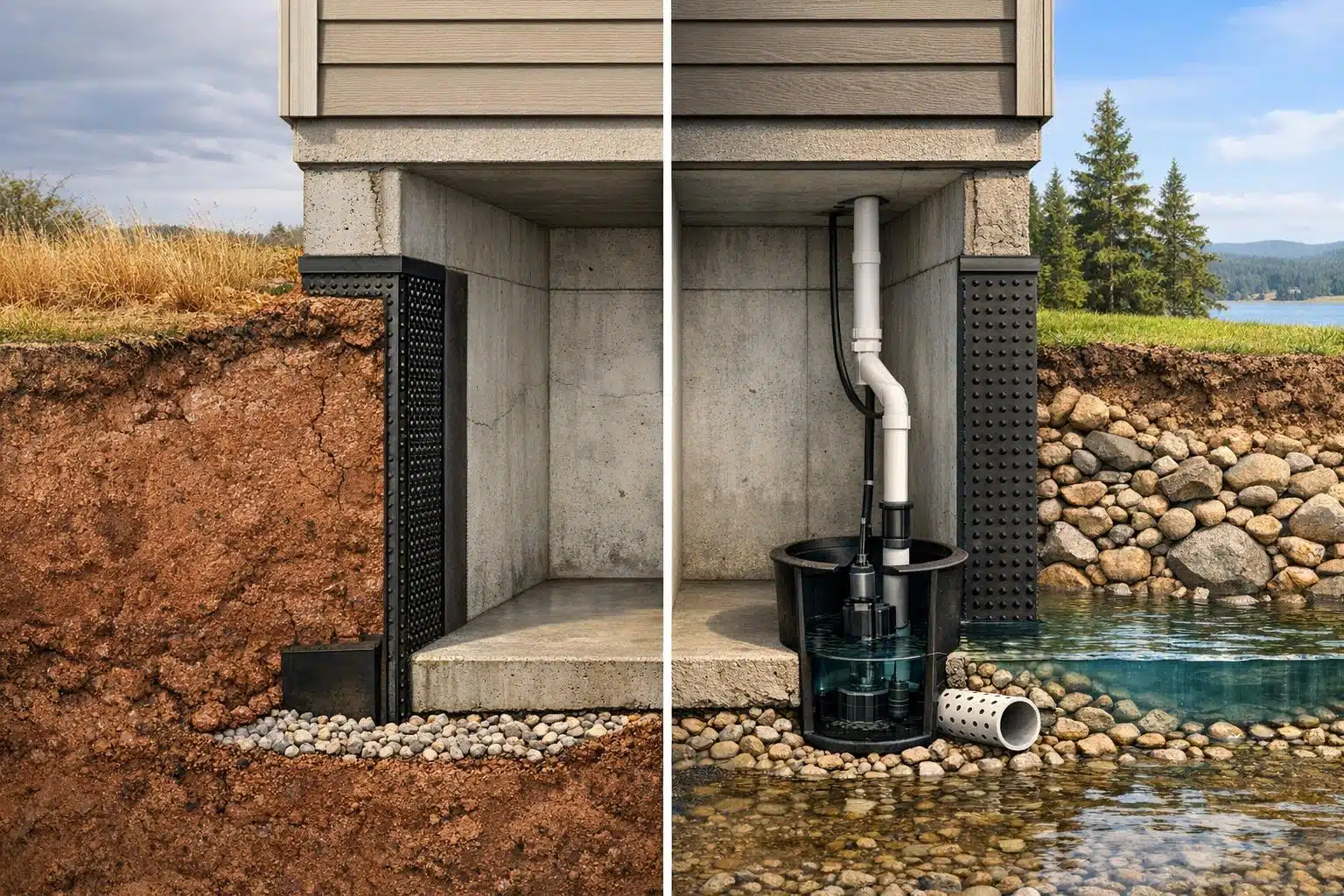
For Spokane, exterior waterproofing is often the go-to option for long-term basement protection. This approach involves sealing foundation walls from the outside and incorporating drainage systems to divert water before it reaches the basement. Spokane’s dense clay soils tend to trap moisture, which increases hydrostatic pressure on foundations. Tackling water infiltration at its source is essential here.
French drains are particularly effective in Spokane. These systems, installed in gravel trenches, help redirect water away from structures, even in water-saturated clay soils.
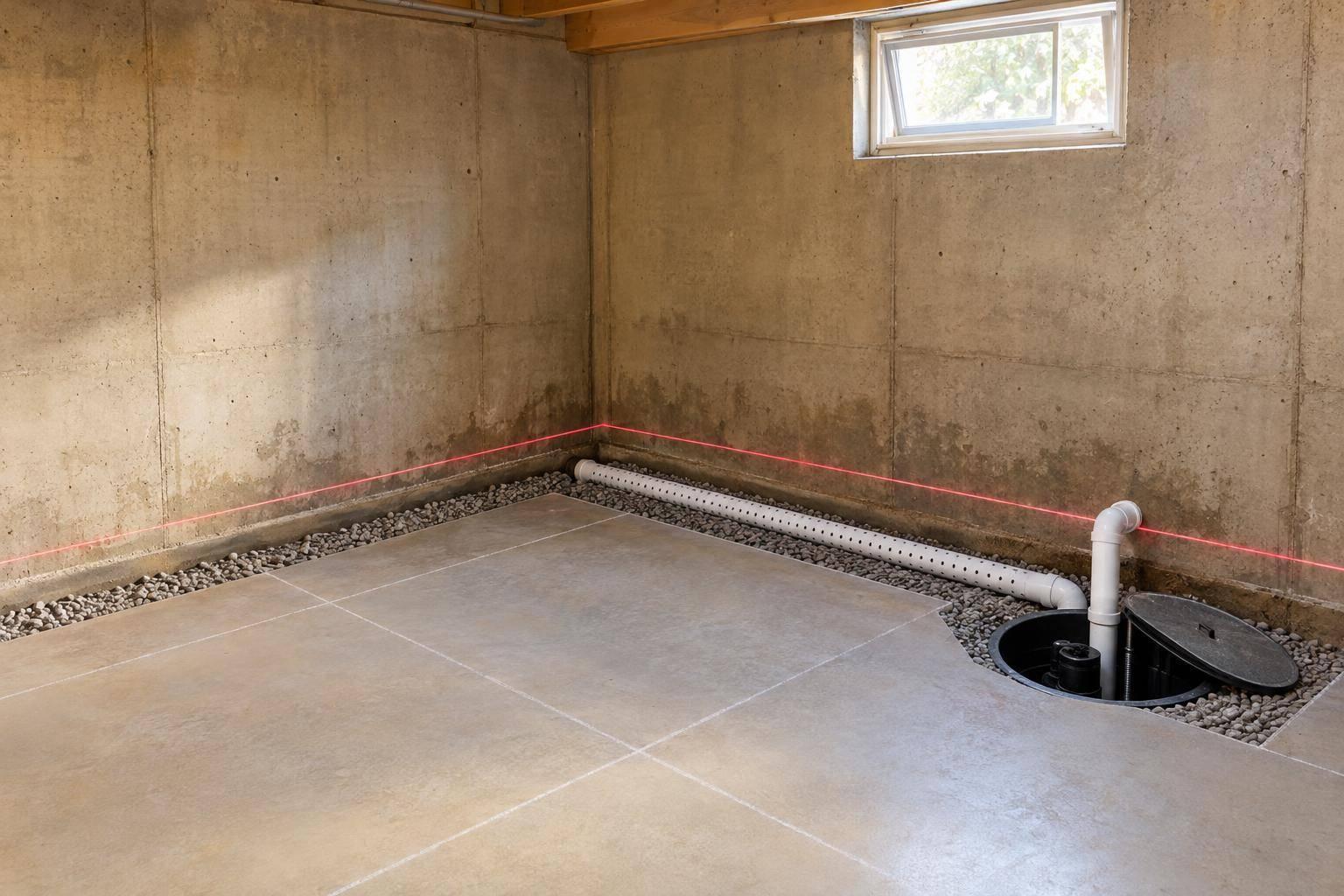
Interior drainage systems, paired with battery-backup sump pumps, are another layer of defense. These systems remove any water that infiltrates and are especially useful during storms or power outages. Repairing foundation cracks is also critical to maintaining structural stability and completing the moisture barrier.
Now let’s shift to Coeur d’Alene, where the challenges differ due to its unique environment.
Best Solutions for Coeur d’Alene Homes
While some methods overlap with Spokane, Coeur d’Alene requires specific waterproofing strategies due to its higher rainfall, sandy soils, and proximity to lakes and aquifers. According to Premier Basement Systems:
"Homes near lakes deal with different water pressure than hillside properties".
Professional evaluations are key here to identify whether water issues stem from lake-related pressure or aquifers, ensuring the right system is chosen.
Vapor barriers are a top priority in Coeur d’Alene, particularly for crawl space encapsulation. These barriers help control ground moisture and humidity, protecting both indoor air quality and the home’s structure. Additionally, wall and floor sealants tailored to the area’s soil and rainfall conditions provide targeted protection.
Older homes in Coeur d’Alene often face foundation stress. To address this, carbon fiber straps or I-beam wall anchors are used to stabilize and reinforce bowing walls caused by shifting soils and freeze-thaw cycles. As Premier Basement Systems explains:
"Using a discreet French drain system, we keep water at bay. Moreover, I-beam wall anchors restore basement walls to their stable, original positions".
Sump pumps and drainage systems are also essential for managing groundwater accumulation during heavy rains.
Waterproofing Methods Comparison
Here’s a quick breakdown of the effectiveness, use cases, and installation details for various waterproofing methods in both cities:
| Method | Effectiveness | Best For | Installation Complexity | Cost Range |
|---|---|---|---|---|
| Exterior Waterproofing | High | Spokane (clay soils) | Professional required | Higher upfront |
| French Drains | High | Both cities | Moderate to complex | Moderate |
| Vapor Barriers | Medium-High | Coeur d’Alene (sandy soils) | Moderate | Variable |
| Interior Drainage + Sump Pumps | Medium-High | Both cities | Moderate | Varies by system |
| Wall Reinforcement (I-Beams) | High | Coeur d’Alene (foundation stress) | Professional required | Higher |
| Crack Repair | Medium | Both cities | Simple to moderate | Lower |
| Epoxy Coatings | High | Both (freeze-thaw zones) | Professional recommended | $4–$6/sq. ft. |
Both cities face challenges from freeze-thaw cycles, making durable and flexible solutions a must. Epoxy basement floors and specialized basement sealants create a seamless, chemical-resistant layer that keeps moisture out, even in micro-cracks caused by temperature shifts. These coatings are ideal for basements and garages, offering reliable protection in areas prone to extreme weather.
Many local professionals provide free inspections and estimates, allowing homeowners to find the best combination of waterproofing methods for their needs.
Professional Waterproofing Services
Basement waterproofing demands a level of expertise that goes beyond basic repairs. Professionals focus on keeping moisture out of foundation walls and protecting basement floors while ensuring proper insulation. These steps not only protect the structure of your home but also help maintain better energy efficiency. Considering the unique moisture and soil conditions in Spokane and Coeur d’Alene, as discussed earlier, local experts customize their methods to tackle the specific challenges of Eastern Washington and North Idaho.
Professional waterproofing services address the needs outlined in earlier sections. This often includes tasks like improving gutter systems and drainage to keep water away from your home. They also apply sealants to close any gaps, preventing both moisture and air leaks.
Croc Coatings: Durable Basement Coatings

One standout solution in the region is Croc Coatings, which offers a specialized system built to handle the area’s unique conditions. Serving Spokane and Coeur d’Alene, Croc Coatings uses the Penntek Evolution industrial coating system. This system is four times stronger than traditional epoxy and creates a seamless, moisture-resistant barrier on basement floors. It’s designed to withstand the freeze-thaw cycles that are so common in these cities.
What’s more, the coating is UV stable, antibacterial, antimicrobial, and slip-resistant – perfect for basements where moisture control is a top priority. The system’s durability also extends to being chemical and impact-resistant, making it an ideal long-term solution for homes prone to water issues.
The best part? Installation takes just one day, and every residential coating comes with a lifetime warranty. For homeowners dealing with persistent moisture problems, this coating provides not only peace of mind but also a customizable, lasting fix.
Service Coverage in Spokane and Coeur d’Alene
Croc Coatings serves the entire North Idaho and Eastern Washington region, including Spokane and Coeur d’Alene. Their certified team understands the area’s specific waterproofing challenges, whether it’s Spokane’s clay soil or Coeur d’Alene’s proximity to the lake and higher humidity levels. They work closely with homeowners, offering custom quotes tailored to each basement’s unique needs.
Conclusion
The waterproofing needs of Spokane and Coeur d’Alene differ significantly due to their unique climates and soil conditions. Coeur d’Alene sees much more precipitation – 28.1 inches annually compared to Spokane’s 16.7 inches – requiring solutions that handle higher water volumes effectively. Meanwhile, Spokane’s clay and silt layers trap moisture, increasing hydrostatic pressure, while Coeur d’Alene’s coarse gravel soils drain better but contend with high water table issues.
These local differences mean that waterproofing strategies must be tailored to each area. In Spokane, addressing moisture retention in clay soils and mitigating pressure buildup is critical. On the other hand, homes near Coeur d’Alene’s lake margins need systems designed to manage high water tables and groundwater influences. Both cities also face freeze-thaw cycles, which put extra stress on foundation walls, highlighting the need for durable, professional installations.
Local expertise plays a crucial role in finding the right solution. As Premier Basement Systems emphasizes:
"This region has unique soil, weather, groundwater, and seasonal conditions. What works somewhere else does not always work here" – Premier Basement Systems.
Knowing whether your home is on Spokane’s South Hill or near Coeur d’Alene’s lakeshore is key to selecting the right waterproofing approach.
For basement floors, Croc Coatings’ Penntek Evolution system is a standout option for both cities. Its advanced formula, which is four times stronger than epoxy, creates a seamless moisture barrier, resists freeze-thaw cycles, and comes with a lifetime warranty. This highlights the importance of relying on local professionals who understand the region’s specific challenges.
FAQs
How do I know if my basement problem is runoff or groundwater?
To figure out if your basement problem is due to runoff or groundwater, pay attention to when and how water enters. Runoff typically happens during heavy rain, with water seeping in through foundation walls or cracks. Groundwater, on the other hand, is tied to high water tables and often causes ongoing dampness, even when the weather is dry. Local factors, such as the soil and climate in places like Spokane and Coeur d’Alene, can also play a role in how water impacts your foundation.
What’s the first waterproofing upgrade I should do at my home?
If you’re looking to protect your home from water damage, tackling basement water issues is a great place to start. For homeowners in Spokane and Coeur d’Alene, this means taking proactive steps to safeguard against moisture problems that could lead to costly repairs.
Begin by thoroughly inspecting your basement for any signs of leaks or dampness. Common solutions include sealing foundation cracks, installing effective drainage systems, or applying waterproof coatings to vulnerable areas. These measures not only shield your foundation but also help maintain a dry, safe, and mold-free basement throughout the year – a crucial consideration given the region’s specific climate and soil conditions.
Can a floor coating actually help with basement moisture?
A floor coating can play a big role in reducing basement moisture. It works by forming a waterproof barrier that prevents water from seeping through and shields the concrete from damage. This is particularly useful in regions like Spokane and Coeur d’Alene, where high humidity and freeze-thaw cycles can wreak havoc on unprotected surfaces.