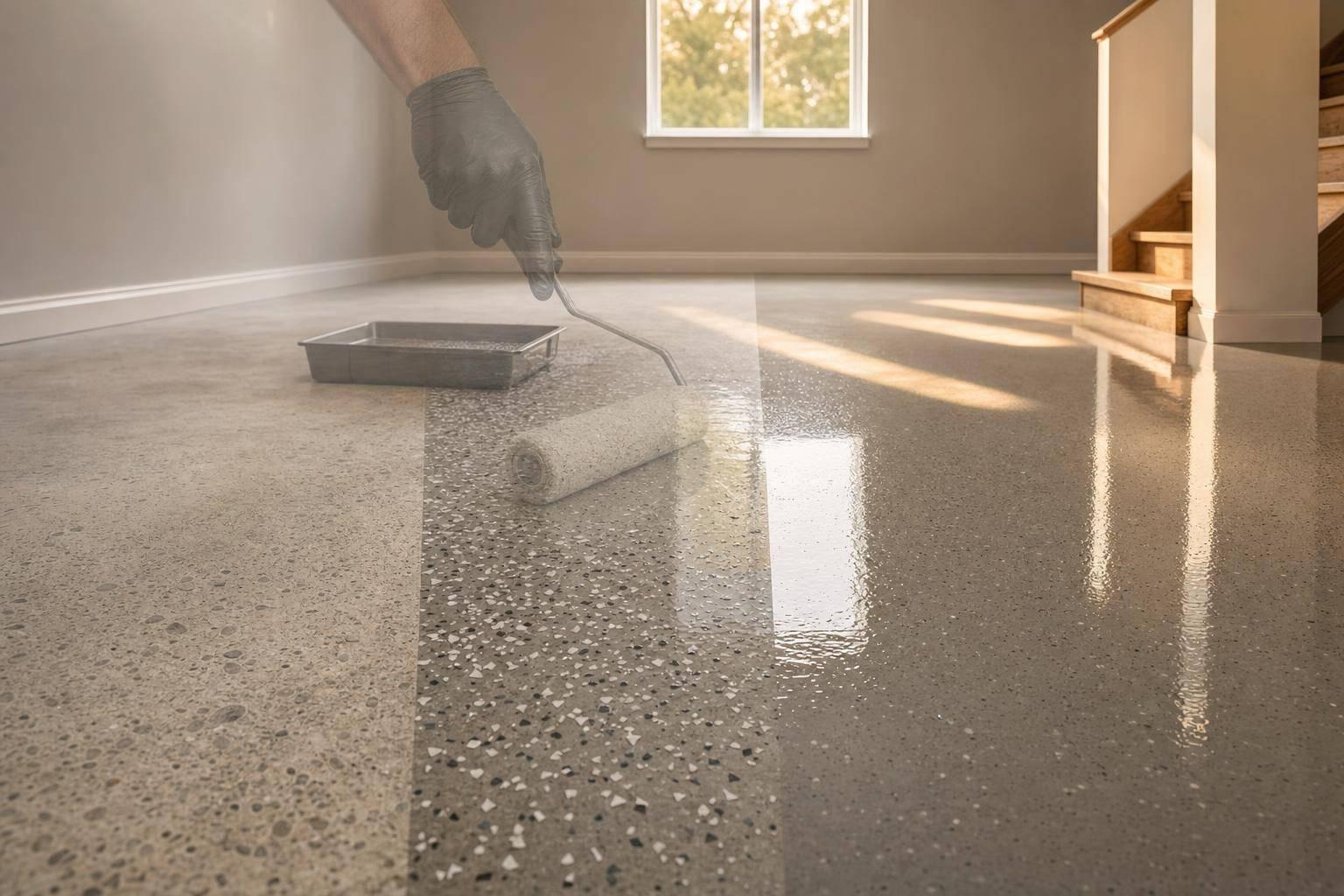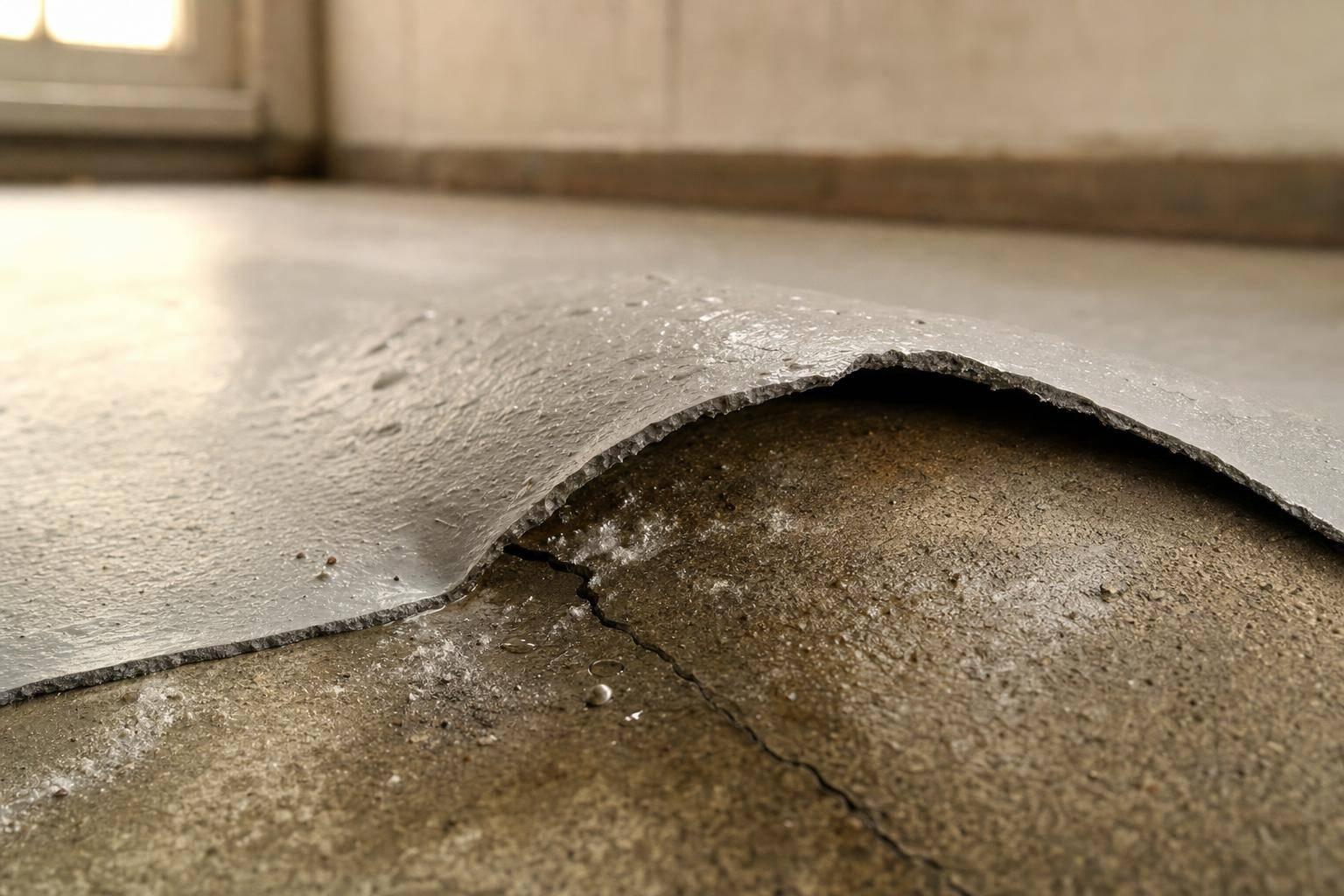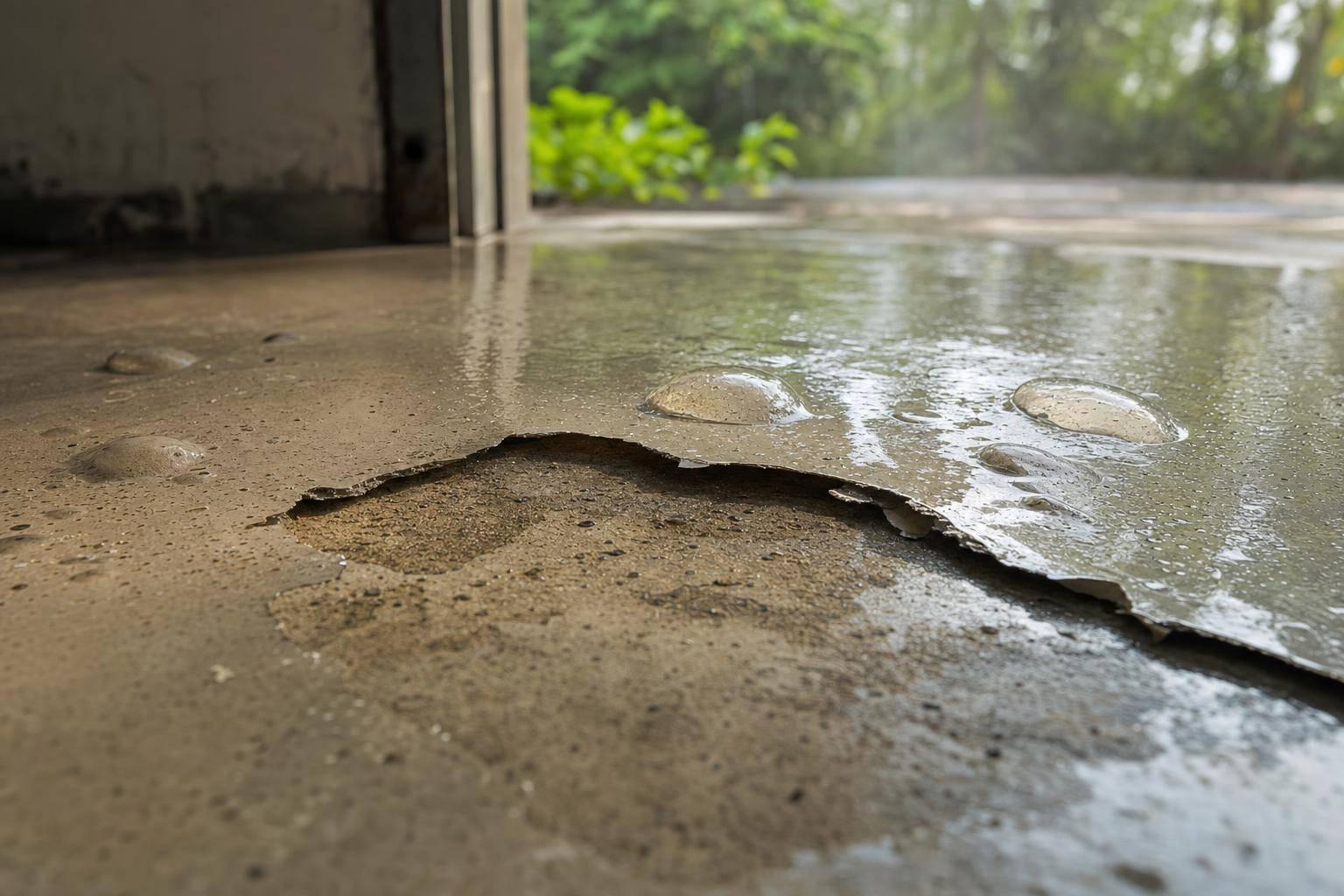
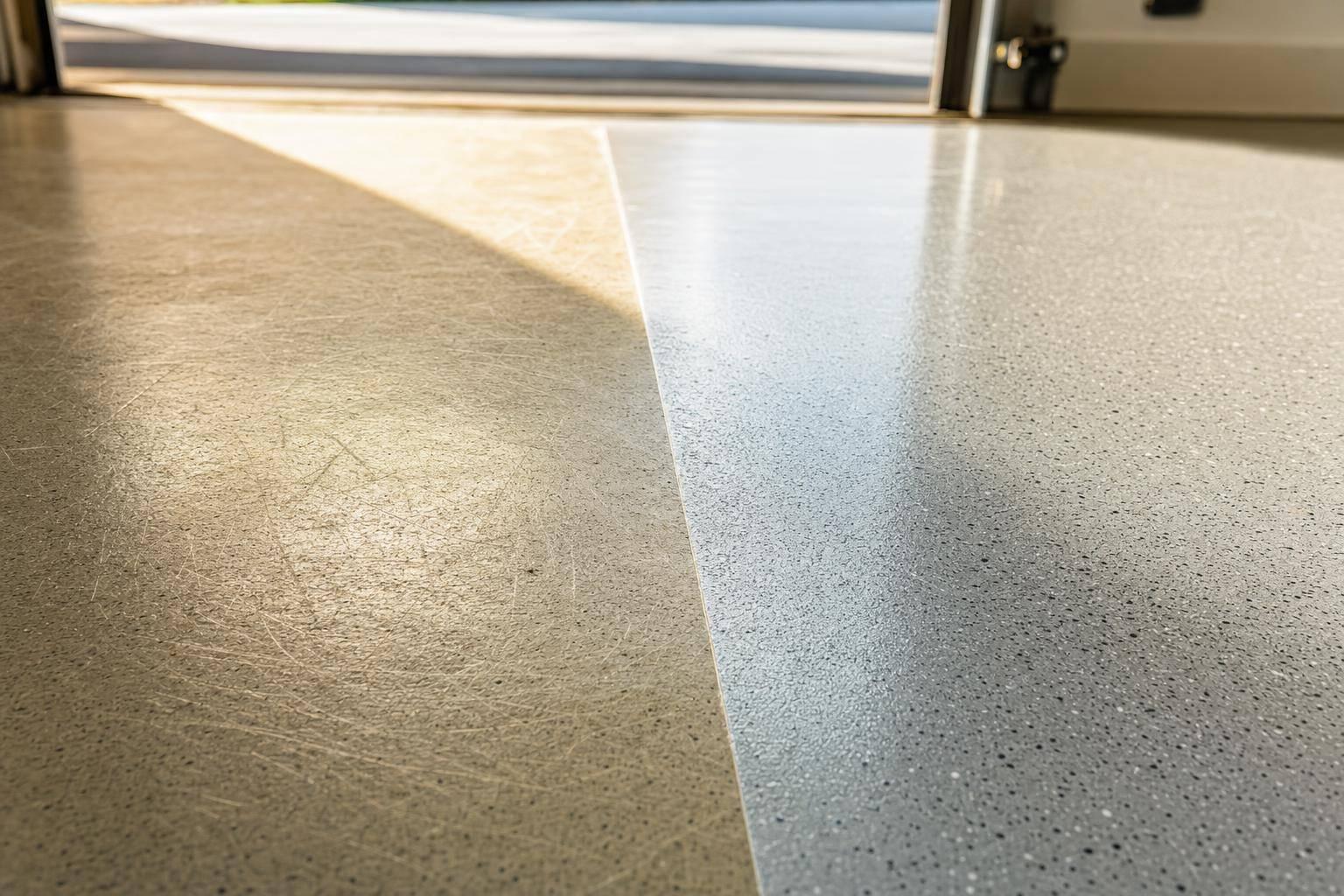
If your garage gets sun and daily traffic, coating type matters more than sales claims. From what I see in the data, epoxy tends to yellow faster and wear out sooner, while polyaspartic and aliphatic polyurea usually hold color better and lose less material in abrasion tests.
Here’s the short version:
- UV tests look at color shift and shine loss over time
- Abrasion tests look at how much coating wears away under friction
- Lower ΔE usually means less visible color change
- Higher gloss retention usually means the finish stays shinier
- Lower Taber mass loss usually means the surface wears more slowly
A few numbers stand out:
- In one UV test, gray epoxy hit ΔE 8.83 after 500 hours
- In that same type of test, gray polyaspartic measured 0.89
- Polyaspartic and aliphatic polyurea topcoats often test around 5–25 mg mass loss
- Epoxy systems often land around 20–45 mg, and some older epoxy results were 83–105 mg
- Acrylic and latex products often fall around 40–50 mg loss or more
If I were comparing products, I’d ignore broad labels like “UV-resistant” and check the actual test details instead:
- ASTM G154 or G155 for UV
- ASTM D4060 for abrasion
- Exposure hours
- Wheel type, load, and cycle count
- ΔE, gloss retention, and mass loss
That matters even more in North Idaho and Eastern Washington, where open garage doors, summer sun, winter grit, de-icer residue, and freeze-thaw stress all work against the floor.
The uv stability test: Penntek vs. Epoxy vs. Common Polyurea
sbb-itb-a0e5ae3
Quick comparison
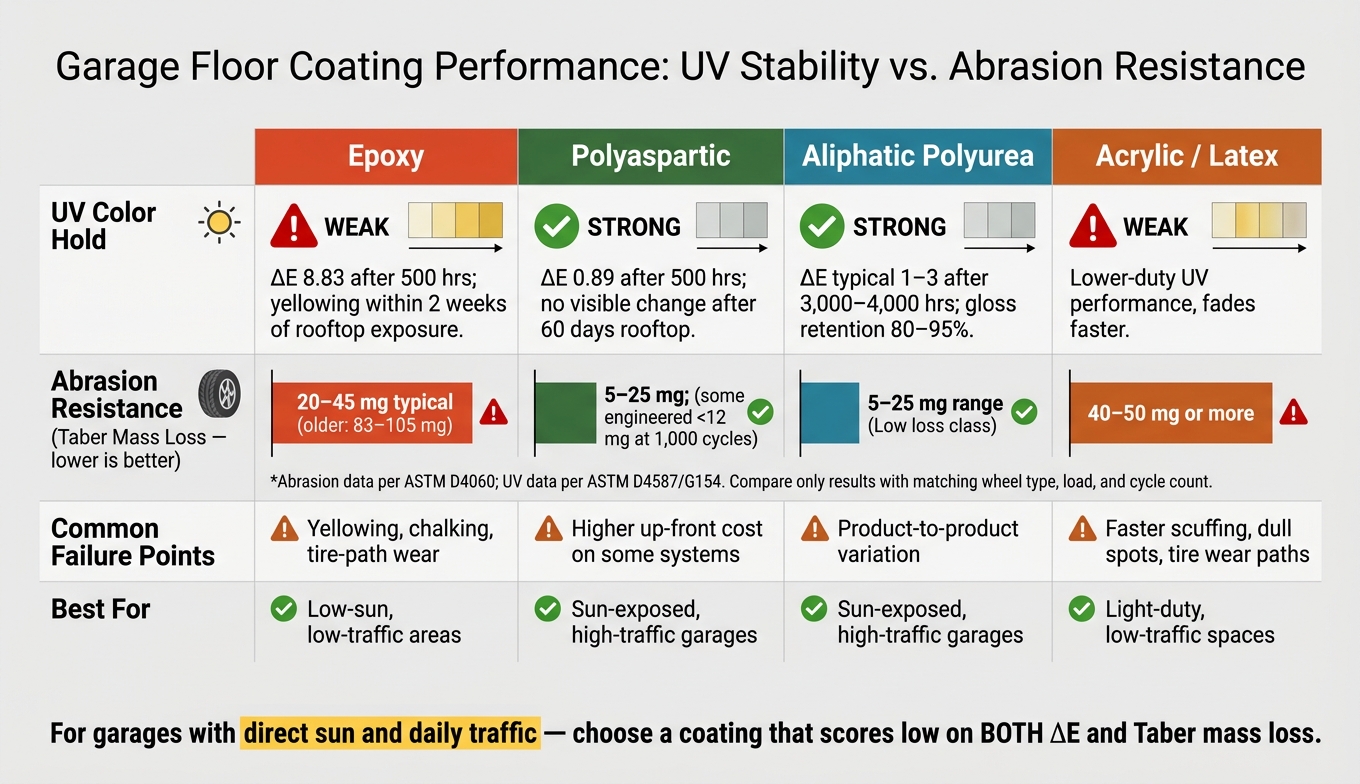
Garage Floor Coating Comparison: UV Stability & Abrasion Resistance by Type
| Coating type | UV color hold | Abrasion result | Common issue |
|---|---|---|---|
| Epoxy | Often weaker in sun | 20–45 mg typical; some older data 83–105 mg | Yellowing, chalking, tire-path wear |
| Polyaspartic | Usually strong | 5–25 mg | Higher up-front cost on some systems |
| Aliphatic polyurea | Usually strong | Often low loss, similar class to polyaspartic | Product-to-product differences |
| Acrylic/latex | Usually lower-duty | 40–50 mg or more | Faster scuffing and wear |
Bottom line: when I read the article, the main takeaway is simple: pick a coating that scores well in both UV weathering and abrasion testing, not just one.
How UV stability and abrasion resistance are measured
Labs use accelerated UV weathering and Taber abrasion tests to estimate how long a coating will hold up without waiting years to see what happens in the field.
UV weathering tests and how color change is measured
ASTM D4587 uses a QUV chamber to mimic repeated UV and moisture exposure. Coated panels are placed inside, and the machine cycles between UV light and condensation to simulate sun and moisture exposure. A common test cycle runs for 8 hours under UV light at 140°F (60°C), then 4 hours of condensation at 122°F (50°C). That pattern repeats for hundreds or even thousands of hours.
Most labs use UVA-340 bulbs. They’re chosen because their output at 340 nm closely matches peak summer noon sunlight. In plain English, that makes the test more representative than using UVB bulbs.
After the exposure period, a spectrophotometer checks how much the coating’s color has shifted. That change is reported as Delta E (ΔE), which is a single number showing how different the coating looks from its original color.
- A ΔE near 0 means little to no visible change
- 1 to 2 is barely noticeable
- Above 3 is easy to see
In one QUV study, gray epoxy reached a ΔE of 8.83 after 500 hours, while gray polyaspartic measured 0.89.
Another number worth watching is gloss retention. It shows how much shine the coating keeps after UV exposure. If you’re scanning a product sheet, this is one of the key metrics to check.
Taber abrasion tests and what mass loss numbers mean
ASTM D4060 measures how much a coating wears down under friction. In this test, a coated panel is mounted on a rotating platform. Two abrasive wheels press against the surface under a fixed load, usually 500 g or 1,000 g. The platform then spins for a set number of cycles, often 500 or 1,000, while the wheels wear away the coating. Afterward, the panel is weighed again, and the difference in milligrams is recorded as mass loss.
Lower mass loss means the coating resists abrasion better. That matters in garages, where tires, grit, and foot traffic keep grinding away at the floor.
There’s one detail that can trip people up: wheel type changes the numbers a lot. CS-10 wheels create milder abrasion, while CS-17 wheels are much more aggressive. So if you’re comparing test results, only compare products tested with the same wheel type and the same load.
These tests work best as relative comparisons, not as exact forecasts of field life. They don’t account for things like automotive fluids, road salt, or the concentrated pressure from jack stands or heavy equipment sitting on one small area. Still, when two products are tested side by side under the same method, the numbers give you a solid starting point based on lab data. Next, those methods show up as published results by coating type.
Published UV and wear results by coating type
The published data shows a pretty clear divide. Standard epoxy vs polyaspartic comparisons show epoxy tends to discolor sooner in sunlight, while aliphatic polyurea and polyaspartic keep their color longer and wear more slowly under traffic.
Epoxy: more yellowing and shorter life in sun-exposed areas
Standard epoxy is UV-sensitive because of its resin chemistry. In a 60-day rooftop exposure test, epoxy samples showed noticeable yellowing within the first two weeks of direct summer sun. That lines up with lab findings: sunlight pushes epoxy toward yellowing first, then chalking. In accelerated UV weathering tests, many epoxies reach ΔE values above 10 at 2,000 hours and can show chalking and gloss loss.
Wear numbers tell a similar story. Taber abrasion data shows epoxy systems posting higher mass loss than polyurea or polyaspartic coatings. Published figures often land in the 20–45 mg range, and older round-robin data for some polyamide/epoxy formulations reported 83–105 mg loss under similar test conditions. In garages, the first trouble spots usually show up at the door opening and along the tire paths.
Polyurea and polyaspartic: better color hold and lower wear loss
Aliphatic polyurea and polyaspartic handle UV exposure much better than standard epoxy. In the same 60-day rooftop exposure test, polyaspartic samples showed no visible change after direct summer sun. In accelerated UV testing, these coatings often keep more than 95% of their original color after 3,000–4,000 hours, with ΔE values around 1–3 and gloss retention in the 80–95% range.
The wear data shows the same gap. In Taber tests, polyaspartic and aliphatic polyurea topcoats often fall in the 5–25 mg loss range, while epoxy systems in similar test setups are usually higher. For an active home garage or a small commercial shop, that means slower wear in tire lanes, better color hold near the door, and a floor that stays easier to clean. These systems are also commonly rated for longer service life under heavy residential use.
Acrylic and latex: lighter-duty performance
Acrylic and latex garage floor products behave more like paint than high-build coatings. They wear faster under vehicle traffic, and Taber abrasion data often falls in the 40–50 mg loss range or higher.
On the floor, that usually means visible tire wear paths and scuffed, dull spots showing up sooner, sometimes within a couple of years of daily use. Parking and turning in place tend to wear down the garage entry first. These products can still work for light-duty spaces, but in garages with daily driving, heavier vehicles, or regular shop use, the wear data points toward thicker coating systems with better long-term performance.
These results set up the next thing to check on a product data sheet: the specs behind that performance.
How to use the data when choosing a garage floor coating
Use the data sheet to compare coatings by test method, exposure hours, and result – not by marketing labels. Start with the test method. Then compare the numbers.
The numbers worth checking on a product data sheet
A data sheet that only says "UV-resistant" or "industrial grade" doesn’t tell you much.
For UV stability, check for ASTM G154 or ASTM G155, the exposure hours, and either ΔE or gloss retention. Lower ΔE and higher gloss retention point to better UV stability. At 1,000+ exposure hours, a ΔE of 3 or less and gloss retention above 80% point to strong UV performance.
For abrasion resistance, look for ASTM D4060, the wheel type, the load, the cycle count, and the mass loss in milligrams. Only compare mass loss when the load, wheel type, and cycle count are the same. Lower mass loss means better abrasion resistance.
If a product makes a mass-loss claim but leaves out the wheel type, load, or cycle count, that data is incomplete.
What the test data means for North Idaho and Eastern Washington garages
Garages in North Idaho and Eastern Washington deal with two main problems: strong summer sun at the door opening and heavy winter grit in tire lanes.
That’s why low ΔE, high gloss retention, and low Taber mass loss matter so much here. These numbers connect straight to what a floor goes through day after day, especially in garages with direct sun at the door and grit in the traffic lane.
Where Croc Coatings fits into the research
Croc Coatings serves North Idaho and Eastern Washington with the Penntek Evolution industrial coating system, one-day installation, and a lifetime residential warranty. That lines up with this article’s focus on UV stability and abrasion resistance for sun-exposed, high-traffic garages.
Key takeaways on long-life garage floors
When you compare long-life garage floor coatings, focus on the numbers that tell you how the floor will hold up:
- UV stability: ASTM G154 or G155, exposure hours, ΔE, and gloss retention
- Abrasion resistance tests: ASTM D4060, wheel type, load, cycle count, and mass loss
- Apples-to-apples comparison: only compare results when the test setup matches
That’s the stuff that helps you cut through the sales language and judge coatings on actual performance.
Key takeaways on long-life garage floors
Once you have the test methods and published results in front of you, the decision gets a lot simpler: read both numbers together. A long-life garage floor needs to do two jobs at once. It has to resist UV-driven color shift, and it has to stand up to surface wear.
In plain terms, lower ΔE usually means better color stability, and lower Taber mass loss usually means less wear over time. Published Taber abrasion data shows a clear gap here. Some engineered polyaspartic systems report mass loss as low as 12 mg at 1,000 cycles, while some polyamide/epoxy coatings lose 109–130 mg under similar test conditions. That difference tends to show up where garage floors get punished first: tire paths and dull spots.
The UV data tells a similar story. In roof-exposure testing, epoxy samples began yellowing within two weeks, while polyaspartic samples showed no visible change after two months. That’s a simple, practical way to cut through sales talk and look at what the coating actually does.
For garages that get direct sun, the best pick is a coating that performs well on both measures. Systems built with aliphatic polyurea or polyaspartic chemistry, such as the Penntek Evolution system from Croc Coatings, are made for UV-exposed, high-traffic garages. In North Idaho and Eastern Washington, seasonal freeze-thaw cycles add more mechanical stress on top of UV exposure and traffic wear, so that two-part performance matters even more.
The bottom line is simple: choose a coating that performs well in both UV weathering and abrasion testing.
FAQs
How many UV test hours matter?
It depends on the checkpoints used in the test. UV exposure is often run on an 8-hour UV / 4-hour condensation cycle, with results checked about every 250 to 500 hours.
Common benchmarks fall in the 1,000 to 2,500 hour range. For example, ASTM D4587 uses 2,500-hour exposure cycles, while some results are also reported at 1,000 and 2,000 hours to estimate real-world fading and protection loss.
What Taber result is considered good?
A good Taber Abrasion result means low wear. In plain English, the lower the mg loss after the test cycles, the better the coating held up.
As a practical benchmark, high-performance polyurethane coatings often show 4 to 8 mg of loss. That’s excellent performance. Commercial-grade epoxy usually lands around 20 to 45 mg, which points to lower durability.
Which coating is best for sunny garages?
For sunny garages, polyurea and polyaspartic coatings are the best fit. Standard epoxy can yellow, fade, and wear down in direct sunlight. These systems hold up much better under UV exposure, helping your floor keep its color, gloss, and strength.
Croc Coatings offers the Penntek Evolution system, a proprietary polyurea coating made to resist cracking and peeling while delivering a long-lasting finish.