Key Takeaways
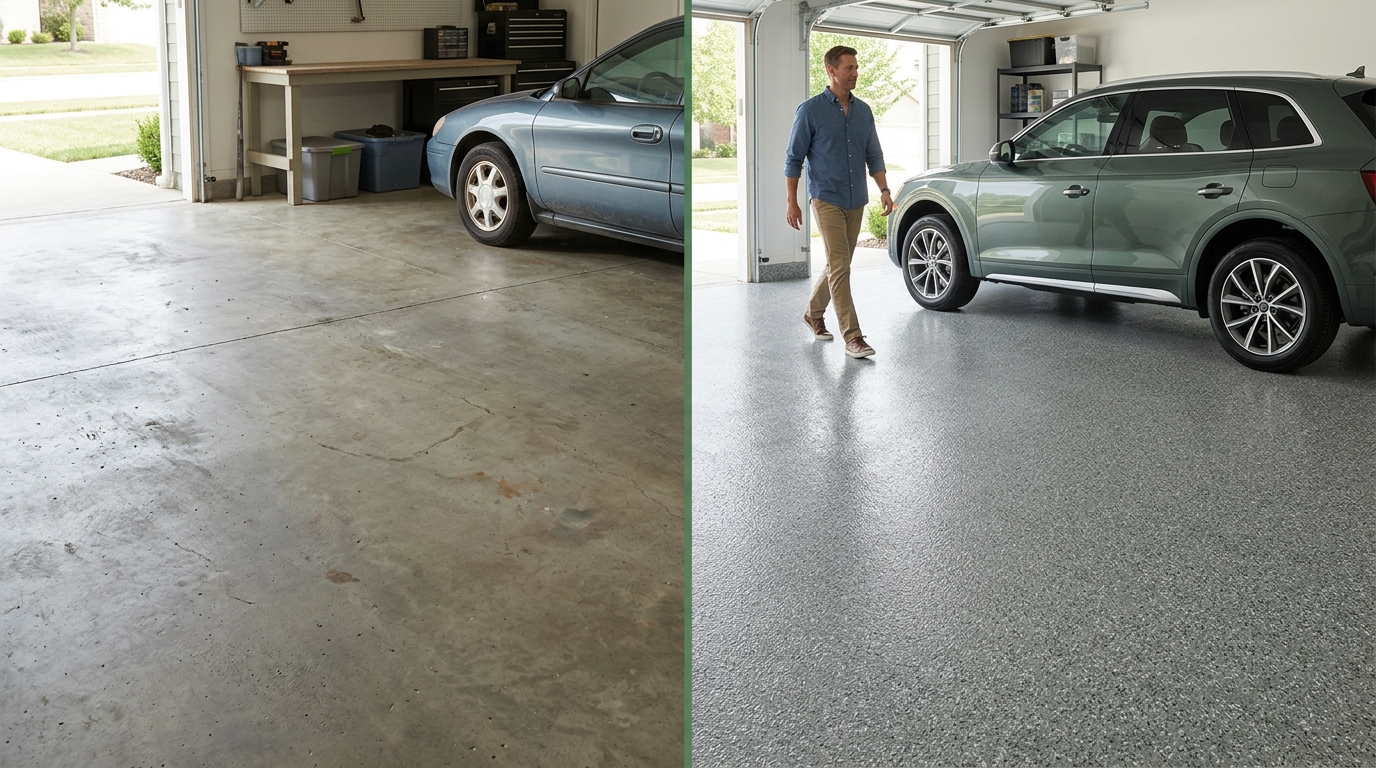
- Yes, polyaspartic/polyurea is better than epoxy for most garage and concrete floor coatings. It lasts 20–25 years vs 3–5, installs in one day instead of one week, and won’t yellow in sunlight.
- The upfront cost is higher — $7–$9/sq ft vs $5–$7/sq ft — but polyaspartic costs roughly half as much per year when you factor in epoxy’s re-coating cycle.
- Epoxy isn’t useless. For a budget-conscious DIY homeowner who can handle the prep work, a $200–$400 epoxy kit is still a valid choice — just one with trade-offs.
- "Harder" doesn’t mean "better." Epoxy scores higher on the Shore D hardness scale, but polyaspartic’s flexibility and impact resistance make it far more durable in real-world conditions.
The Short Answer: Yes, Polyaspartic Is Better Than Epoxy for Most Floor Coatings
If you’re a homeowner researching garage or concrete floor coatings and you typed "is polyaspartic better than epoxy" into Google, you want a straight answer — not 3,000 words of buildup. Here it is: yes, for the vast majority of use cases, polyaspartic (polyurea) is the better floor coating.
That doesn’t mean epoxy is useless. It isn’t. But the gap between the two has grown wide enough that, for most homeowners — especially those hiring a professional installer — polyurea wins on durability, speed, appearance, and long-term value.
Here’s the comparison at a glance before we dig into the details:
| Factor | Polyaspartic / Polyurea | Epoxy |
|---|---|---|
| Lifespan | 20–25 years | 3–5 years (professional); 1–3 years (DIY) |
| Installation time | 1 day | 3–5 days |
| Walk on it | 4–6 hours | 24 hours |
| Drive on it | 24 hours | 3–7 days |
| UV resistance | Won’t yellow or chalk | Yellows and chalks in sunlight |
| Bond type | Chemical bond with concrete | Mechanical bond (surface adhesion) |
| Upfront cost (installed) | $7–$9/sq ft | $5–$7/sq ft |
| 20-year cost | ~$7–$9/sq ft (one install) | ~$15–$28/sq ft (4–5 reinstalls) |
| DIY option | No (professional only) | Yes (kits $200–$400) |
| Warranty | Lifetime (manufacturer) | Limited (1–5 years typical) |
| Hot-tire resistance | Excellent | Poor — lifts and peels |
The rest of this page explains why polyaspartic wins across each of these dimensions — and the one scenario where epoxy is still the right call.
Durability & Lifespan: Why Polyurea Outlasts Epoxy
Durability is the single biggest reason homeowners switch from epoxy to polyaspartic — and it’s not close.
How Long Each Coating Actually Lasts
A professionally installed polyaspartic floor lasts 20 to 25 years with basic care. Epoxy, even when professionally installed, typically lasts 3 to 5 years before the first signs of failure appear. That’s not marketing spin — it’s the real-world experience of installers who work with both products, and it’s backed by what homeowners report.
The lifespan gap comes down to three fundamental differences:
1. Chemical bond vs mechanical bond. Polyurea systems like Penntek form a chemical bond with the concrete substrate — they penetrate and fuse at a molecular level. Epoxy relies on a mechanical bond, meaning it grips the surface texture. Under heat, moisture, and impact stress, a mechanical bond is far more likely to fail. A chemical bond holds.
2. Flexibility. Polyaspartic coatings have enough give to expand and contract with the concrete as temperatures shift. Epoxy is rigid. When the slab moves — and every slab does — rigid coatings crack and delaminate. Flexible ones don’t.
3. Hot-tire resistance. This is the failure mode homeowners see most often. A car’s tires come off the road at 120–140°F in summer. Park on an epoxy floor and the heat softens the coating, which then re-adheres to the tire. Pull out the next morning and the coating lifts with it — a phenomenon called hot-tire pick-up. Polyurea is engineered to resist this at temperatures well beyond what a hot tire generates.
The Real Failure Modes of Epoxy
Epoxy doesn’t fail because the material itself breaks down. Over 90% of floor coating failures are due to improper surface preparation, not the coating material. But here’s the catch: concrete is porous, wicks moisture from the ground, and is rarely perfectly prepared — especially in a residential garage. Epoxy’s mechanical bond leaves almost no margin for error.
The three most common epoxy failures:
- Peeling and delamination — the coating lifts in sheets, usually from moisture vapor pushing up from the slab.
- Hot-tire lift — the coating softens under tire heat, adheres to the rubber, and tears away.
- Moisture blistering — trapped moisture creates bubbles under the surface that eventually pop and leave craters.
Polyurea’s chemical bond and moisture tolerance make it dramatically less susceptible to all three.
Cost: Upfront Price vs Total Cost of Ownership
This is where the conversation usually starts — and where it should go deeper than the first number.
The Upfront Numbers
- Epoxy (professionally installed): $5–$7 per square foot
- Polyaspartic / polyurea (professionally installed): $7–$9 per square foot
For a standard two-car garage (roughly 400–500 sq ft), that’s:
- Epoxy: $2,000–$3,500
- Polyurea: $2,800–$4,500
A difference of $800–$1,000 upfront. That’s real money. But the upfront price is the wrong number to focus on.
The 20-Year Math
Epoxy’s 3-to-5-year lifespan means a homeowner who stays in their house for 20 years will re-coat the floor four to five times. Each re-coat requires more than just new epoxy — the old coating has to be ground off, the concrete re-prepped, and any damage from the failed coating repaired. The prep work for a re-coat often costs more than the original install.
When calculated over its full lifespan, polyaspartic can cost nearly half as much per year as epoxy. Over 20 years, a $3,000 epoxy floor becomes a $12,000–$15,000 expense. The $3,800 polyurea floor stays at $3,800 — with a lifetime warranty backing it.
For a deeper dive into the numbers, read our breakdown of the 5 cost factors for polyaspartic vs epoxy.
What That Warranty Is Worth
Epoxy warranties from professional installers typically run 1–5 years. Some exclude UV damage and hot-tire damage entirely — which happen to be the two most common failure modes. A lifetime manufacturer warranty on polyurea isn’t just marketing language; it means the manufacturer has enough confidence in the chemical bond to bet their own money on it.
Installation Speed: One Day vs One Week
This difference doesn’t show up on a spec sheet but it’s one of the first things homeowners comment on after the job is done.
The Polyaspartic Timeline
A professional polyurea floor installation follows a single-day sequence: diamond-grind the concrete, fill cracks and expansion joints, apply the polyurea base coat with decorative flakes, and seal with a UV-stable clear topcoat. Foot traffic is safe in 4–6 hours. Vehicles can park on it in 24 hours. The garage is out of commission for exactly one day.
The Epoxy Timeline
Epoxy requires multiple coats, each with its own cure window. A typical professional epoxy job takes 3–5 days: one coat, wait 12–24 hours, second coat, wait another 12–24 hours, topcoat, wait again. Vehicles can’t park on it for 3–7 days after the final coat.
In practice, that means a week or more without your garage. For a homeowner in North Idaho or Eastern Washington — where garages aren’t just parking spots but workshops, storage, and entry points — losing a garage for a full week is a genuine disruption. One day is an inconvenience. A week is a project.
Why the Speed Difference Matters for Quality
Polyurea’s fast cure isn’t just about convenience — it reduces the window for dust, bugs, and debris to land in wet coating. Fewer imperfections in the finish. Epoxy’s long open time, while necessary for DIY workability, means more opportunity for contamination.
UV & Weather Resistance: The Sunlight Doesn’t Lie
If your garage has windows, or if you’re coating a driveway, patio, or pool deck, UV resistance stops being a nice-to-have and becomes a dealbreaker.
What Sunlight Does to Epoxy
Epoxy is not UV-stable. Period. Exposure to sunlight triggers a chemical reaction that yellows the coating, then chalks it — a powdery white degradation on the surface. This isn’t a cosmetic issue; the chalking is the resin breaking down. In a garage with windows, the areas that catch afternoon sun will yellow within the first year or two. On a driveway or patio, the entire surface will deteriorate.
What Sunlight Does to Polyurea
Polyaspartic and polyurea coatings are inherently UV-stable. The clear topcoat contains UV inhibitors that prevent yellowing and chalking for the life of the coating. Floortek Coatings ran a 60-day roof-exposure test — polyaspartic samples showed no visible change after two months of direct summer sun. Epoxy samples yellowed within two weeks.
For a full technical breakdown, see our UV stability comparison: polyurea vs epoxy.
Where This Matters Most
- Garages with windows or side-facing doors — the sun hits part of the floor every day.
- Driveways — full sun exposure, plus tire heat. Epoxy fails on both fronts.
- Patios and pool decks — constant UV, plus water and chemical exposure. Polyurea is the only coating that makes sense here.
Appearance & Finish: What Your Floor Will Actually Look Like
Both epoxy and polyaspartic can look great on day one. The difference is what they look like on day 500.
The Flake and Color Options
Both coating types offer a wide range of decorative flakes, solid colors, and metallic finishes. You can get a showroom-quality look with either product. The application process — broadcasting flakes into a wet base coat — is similar.
Where Polyurea Pulls Ahead
Faster cure, cleaner finish. Polyurea’s rapid cure means less time for dust, debris, and insects to settle into the wet coating. Installers who work with both products consistently report fewer surface imperfections with polyurea.
UV-stable clear coat. The polyaspartic topcoat doesn’t just protect the floor — it keeps the finish looking new. Epoxy’s clear coat yellows, which shifts the entire color profile of the floor toward amber. A bright gray floor becomes a dingy beige-gray within a couple of years.
Hot-tire sheen loss. Epoxy floors develop dull, matte patches where car tires regularly sit. The combination of heat and rubber compounds breaks down the surface sheen. Polyurea’s hot-tire resistance preserves the gloss level across the entire floor.
Chemical & Stain Resistance: The Garage Test
Garage floors don’t just deal with cars. They deal with motor oil, gasoline, road salt, brake fluid, battery acid, transmission fluid, fertilizer, paint thinners, and whatever drips off the lawnmower. A floor coating has to stand up to all of it.
Floortek Coatings ran a 24-hour chemical-soak test on both epoxy and polyaspartic samples using motor oil, gasoline, and red wine. The polyaspartic showed no staining, softening, or discoloration after a full day of direct contact. The epoxy samples showed visible staining and surface softening — particularly from the gasoline.
For a working garage where spills happen, polyurea’s chemical resistance is a practical advantage, not a theoretical one. The dense, non-porous surface of a cured polyurea coating resists penetration by chemicals that would etch or stain an epoxy floor.
The Hardness Myth: Why "Harder" Doesn’t Mean "Better"
You’ve probably seen claims that polyurea is "4x harder than epoxy." It’s a catchy number. It’s also misleading — and understanding why makes you a smarter buyer.
The Actual Hardness Numbers
Hardness for coatings is measured on the Shore D scale. Here’s what independent testing shows:
- 100% solids epoxy: Shore D 80–90
- Polyaspartic / polyurea: Shore D 70–75
Epoxy is technically harder than polyaspartic. Not the other way around.
Hardness vs Toughness: Why It Matters
Hardness measures resistance to surface indentation — how hard you have to press to leave a mark. Toughness measures the material’s ability to absorb energy without fracturing. They’re different properties, and for a floor, toughness matters more than hardness.
Think of it like this: glass is harder than rubber. Drop a wrench on glass and it shatters. Drop a wrench on rubber and it bounces. A polyaspartic floor behaves more like the rubber — it flexes and absorbs the impact. An epoxy floor behaves more like the glass — hard, but brittle.
In a garage, toughness wins every time:
- Impact from dropped tools and equipment — polyurea flexes; epoxy chips.
- Thermal expansion and contraction — polyurea moves with the slab; epoxy cracks.
- Heavy rolling loads (floor jacks, tool chests, engine hoists) — polyurea resists gouging; epoxy doesn’t.
When someone says polyurea is "4x stronger," what they mean is that it’s more durable in the ways that matter for a floor that actually gets used. The Shore D number doesn’t tell the whole story — and now you know why.
The Honest Downsides of Polyaspartic Floor Coatings
No floor coating is perfect. If you’re doing your due diligence — and you should — here are the real drawbacks of polyaspartic:
1. Higher Upfront Cost
$7–$9 per square foot is more than epoxy’s $5–$7. For a large project — a three-car garage plus a patio, for example — the upfront difference can be $1,500–$2,500. The total-cost-of-ownership math favors polyurea over time, but you have to be able to afford the initial investment.
2. Professional Installation Only
Polyaspartic coatings are not a DIY product. The short pot life — the working time before the material begins to cure — means it has to be applied by trained crews with the right equipment. There is no "polyaspartic floor kit" at Home Depot, and there’s a good reason for that.
3. Short Pot Life Limits Correction
The same fast cure that gets your garage back in one day gives the installer a narrow window to work. Mistakes can’t be fixed by going back over the area — the material is already setting. This is why installer experience matters enormously for polyurea. A crew that’s done 1,700 floors knows the rhythm. A first-timer doesn’t.
4. Not Ideal for Every Substrate
Polyaspartic bonds best to properly prepared concrete. On certain substrates — old, oil-saturated slabs or wood subfloors — the chemical bond may not form as intended. A reputable installer will assess your specific floor before recommending a coating system.
When Epoxy Still Wins: The Case for Going Budget
It’s easy to write a comparison that makes epoxy sound like a mistake. That wouldn’t be honest. Epoxy is the right call in exactly one scenario — and it’s a common one.
The Budget DIY Homeowner
If you meet all three of these conditions, epoxy is worth considering:
-
You’re installing it yourself. A DIY epoxy kit for a one-car garage runs $200–$400. A professional polyurea installation for the same garage starts around $2,000. That’s a 5–10x difference. If you have more time than money, the math flips.
-
You’re willing to do the prep work right. Remember: over 90% of coating failures start with bad prep. Renting a diamond grinder, filling cracks, testing for moisture, and etching the surface takes a full weekend of hard work before you even open the epoxy can. Skip the prep and you’re re-doing the floor in a year.
-
You accept the shorter lifespan. A DIY epoxy floor in a working garage will realistically last 1–3 years before it needs attention. If you’re planning to sell the house in that timeframe, or if the garage is lightly used storage rather than a workshop, that might be fine.
What Epoxy Gets Right
Epoxy floors look good when they’re new. The high-gloss finish, especially with flakes, rivals polyurea on day one. For a showroom or a garage that’s more about appearance than function — and won’t see much sun, tire traffic, or chemical exposure — epoxy does the job at a lower price.
The key is going in with eyes open: you’re trading lifespan, UV stability, chemical resistance, and hot-tire performance for a lower upfront cost. That trade-off works for some homeowners. It doesn’t work for most.
Final Verdict: Is Polyaspartic Better Than Epoxy?
For the homeowner who wants a floor coating done once and done right — who doesn’t want to think about re-coating in three years, who values getting the garage back the next day, who wants the finish to look the same in year ten as it did on day one — polyaspartic / polyurea is the clear winner.
The upfront premium of $2–$3 per square foot buys you a floor that lasts four to five times as long, won’t yellow in sunlight, won’t lift under hot tires, and carries a lifetime warranty. Over any timeline longer than five years, polyurea is the less expensive option — and the less frustrating one.
At Croc Coatings, we’re the exclusive Penntek-certified installer in North Idaho and Eastern Washington, with over 1,700 projects completed and 340+ five-star reviews. We install polyurea because we’ve seen what happens to epoxy floors in this climate — the freeze-thaw cycles, the hot summer sun through garage windows, the road salt in winter. Polyurea handles all of it. We install it in one day and back it with a lifetime manufacturer warranty.
For a deeper dive into every aspect of this comparison — including installation processes, substrate preparation, and more — read our complete guide to epoxy vs polyaspartic garage floors.
Frequently Asked Questions
Is polyaspartic worth the extra money?
Yes — when you look at total cost of ownership rather than the upfront price. Polyaspartic costs $7–$9/sq ft vs epoxy’s $5–$7/sq ft, but epoxy needs re-coating every 3–5 years. Over a 20-year period, polyaspartic costs roughly half as much per year. Add in the lifetime warranty, one-day installation, and UV stability, and the value proposition is strong for anyone planning to stay in their home.
Does polyaspartic scratch easily?
No. Polyaspartic coatings have high impact and abrasion resistance. While no floor coating is scratch-proof — dragging a heavy steel workbench across any surface will leave a mark — polyurea resists everyday scratches from foot traffic, pet claws, and normal garage use better than epoxy. Its flexibility absorbs impacts that would chip a harder but more brittle epoxy surface.
What are the negatives of polyurea?
The main drawbacks are higher upfront cost ($7–$9/sq ft), mandatory professional installation (no DIY option due to short pot life), and the need for an experienced installer who can work within the material’s fast-cure window. Polyurea also requires properly prepared concrete to achieve its chemical bond — heavily oil-saturated or damaged slabs may need extra prep work.
Can you put epoxy over polyaspartic?
Technically, you can — but there is almost never a good reason to. Polyaspartic outlasts and outperforms epoxy on every meaningful metric. Putting epoxy over polyaspartic would mean downgrading to a shorter-lifespan, UV-sensitive coating on top of a perfectly good long-life surface. If a polyaspartic floor has been damaged, the correct approach is to have it repaired by a professional, not to cap it with a lesser coating.
How much does a polyurea floor cost for a two-car garage?
A standard two-car garage (roughly 400–500 sq ft) with a professional polyurea installation typically runs $2,800–$4,500, or $7–$9 per square foot. The final price depends on the condition of the concrete, the flake and color choices, and any add-ons like custom color blends or additional topcoats. This is a one-time cost — the floor is designed to last 20–25 years with a lifetime manufacturer warranty. For comparison, epoxy for the same garage runs $2,000–$3,500 upfront, but will likely need re-coating every 3–5 years.