If a food plant floor traps water, cracks at drains, or stays down for days during repairs, it can turn into a sanitation and production problem fast. I’d sum it up this way: polyurea often fits USDA food floors better because it handles moisture, impact, hot-and-cold washdown cycles, and short install windows better than many basic epoxy systems.
Here’s the plain-English version:
- USDA and FDA focus on the installed floor, not the product label
- Floors need to be nonporous, easy to clean, durable, and sloped to drain
- Trouble usually starts at drains, wall joints, thresholds, and repair seams
- Moisture trouble goes up when MVT is over 3 lb/1,000 sq ft/24 hours or slab RH is over 80%
- Food floors may swing from 40°F to 160°F+ during washdowns, or -30°F to 120°F+ in freezer areas
- Basic epoxy installs can take 5+ days, while polyurea systems may return areas to service the same day or next day
- The full build matters: prep, base layer, cove base, slope, drain detail, and topcoat
If you’re comparing polyurea to epoxy for temperature durability, the short answer is simple: polyurea tends to flex more, resist thermal expansion and shock better, and cut downtime. But no coating fixes bad prep, poor drainage, or weak drain transitions.
| Factor | Polyurea | Epoxy |
|---|---|---|
| Moisture handling | Better in damp-service settings | More moisture-sensitive |
| Movement and impact | More flex under stress | Harder and more crack-prone |
| Hot/cold washdowns | Better at temperature swings | More likely to fail under shock |
| Return to service | Often same day or next day | Often takes days |
| Best result depends on | Full system build and install quality | Full system build and install quality |
So when I look at a USDA-regulated food floor, I don’t just ask, “What coating goes on top?” I ask: Will this system stay cleanable, stay bonded, and get the room back online without a long shutdown? That’s the standard that matters.
Seamless Hygienic Flooring Upgrade – Polyurea Case Study
sbb-itb-a0e5ae3
Common Floor Problems in Food Facilities
Food facility floors usually start failing in the same places: drains, wall joints, thresholds, and patch seams. Those spots tend to take the most abuse, so they often show the first signs of moisture damage, wear, and costly shutdown time.
Moisture Intrusion, Bubbling, and Bond Failure
In wet food floors, moisture is often where trouble starts. Concrete gives off moisture vapor from below. In wet-service food areas, that vapor can get trapped under the coating. When that happens, you can end up with blistering, bubbling, and the coating pulling loose from the slab.
The risk goes up when MVT is above 3 lb per 1,000 sq ft per 24 hours or when in-slab relative humidity is above 80%, which increases debonding risk in many coating systems. If a floor goes in without proper moisture testing, it can fail far sooner than expected.
Small defects make the problem worse. Cracks, pinholes, and failed drain edges let water slip under the coating, weaken adhesion, and trap residue and bacteria in damaged areas. That’s not just a flooring issue. It’s also a sanitation problem.
Impact Wear, Thermal Shock, and Chemical Breakdown
Heavy daily traffic slowly wears floors down. Forklifts, carts, and dropped loads grind through traffic lanes and chip away at edges. Once raw concrete is exposed, the floor gets harder to clean and easier for liquids to soak into.
Temperature swings add another layer of stress. A floor might move from 40°F production conditions to 160°F+ washdowns, or from -30°F in blast-freezer areas to 120°F+ cleaning water. That kind of swing can be brutal. If the coating expands and contracts at a different rate than the concrete below, the surface can crack and delaminate.
Chemicals can also wear floors down from the top. Caustic cleaners, sanitizers, fats, sugars, and acids may soften or break down surfaces that weren’t built to handle that exposure.
Long Cure Times That Force Extended Shutdowns
Floor repair or replacement means part of the facility has to stop running. And in food production, that lost time adds up fast.
With standard multi-coat epoxy systems, it can take 24 hours or more between coats, and total install and cure time can stretch to five days or longer for a standard processing area. That kind of delay can throw off production schedules, labor planning, and inventory movement. If a packaging zone or prep room stays offline too long, the slowdown can spread through the rest of the plant.
Shutdown time isn’t a side issue. It’s a major part of the flooring decision.
Why Polyurea Works Better for USDA Food Floors in Many Settings
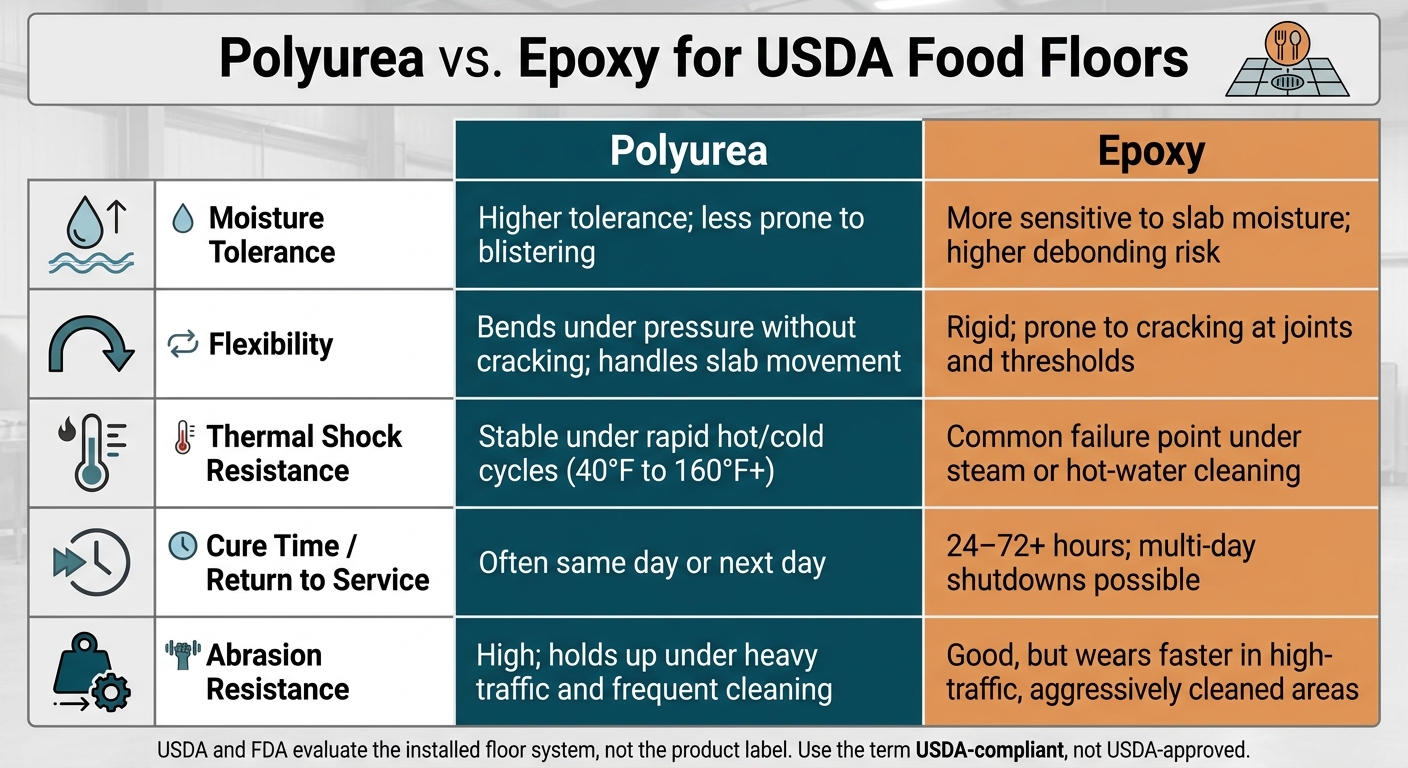
Polyurea vs. Epoxy for USDA Food Floors: Key Performance Factors
Those failures all come back to the same thing: the coating has to survive actual food-plant conditions, not just look good on a spec sheet. Polyurea performs better in many of those settings because it stays dense, has some give, and cures fast even in wet-service areas.
Nonporous, Durable Surfaces That Handle Moisture and Traffic
Polyurea cures into a dense, nonporous surface. Liquids, fats, sugars, and cleaning chemicals can’t soak into it. That’s a big deal in the places that usually fail first: drains, wall joints, cracks, and thresholds. Once moisture gets under a coating in those areas, bond failure often starts there.
Compared with rigid coatings, polyurea offers more flexibility. In plain terms, it can bend a bit under pressure and then return to shape without cracking. So when a forklift hits a drain edge, or a cold-room threshold expands and contracts during the day, the coating moves with the slab instead of resisting it. That helps keep the film continuous, which supports USDA’s rule that floors stay in good repair and remain easily cleanable.
Performance Under Washdowns, Temperature Swings, and Cleaning Chemicals
Polyurea is made for better thermal shock resistance than many rigid coatings, especially when it’s part of a full washdown-rated system. That matters in food plants, where floors can swing from cold-room temperatures to hot-water washdowns and back again. A system that can’t handle that cycle may blister or delaminate. Polyurea is better suited for that kind of stress.
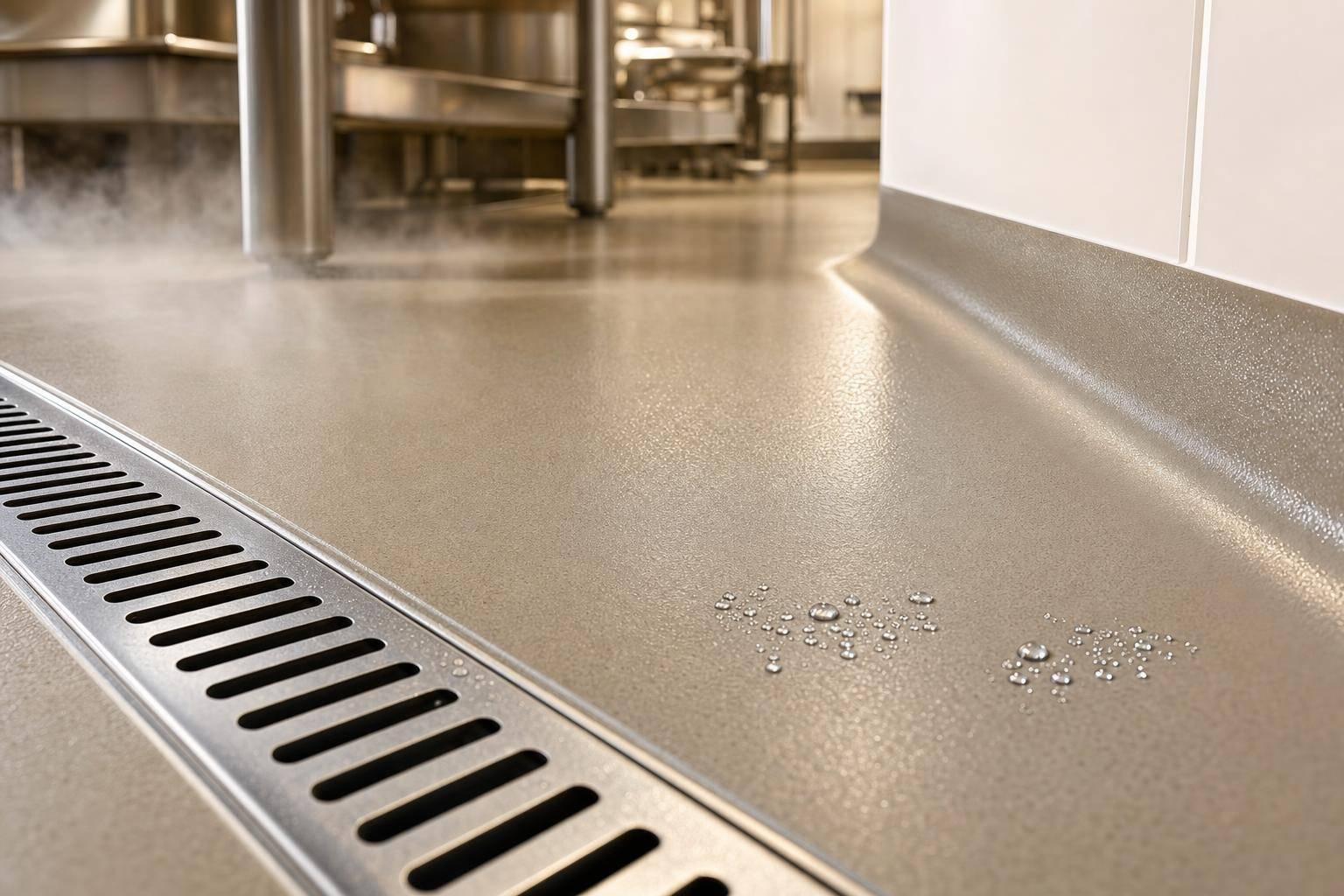
For sanitation details, polyurea systems can also include slip-resistant broadcast media such as quartz, flake, or aluminum oxide. These materials are set into intermediate coats and sealed in with the polyurea topcoat. The result is better traction in wet processing areas without turning the floor into something tough to clean. Integral cove bases that run up the wall and remove the floor-to-wall joint also cut down on spots where residue and moisture can collect.
Polyurea vs. Epoxy for Food-Floor Performance
| Factor | Polyurea System | Conventional Epoxy |
|---|---|---|
| Moisture tolerance | Higher tolerance; less prone to blistering from slab moisture | More sensitive to slab moisture; higher debonding risk |
| Flexibility | More flexibility; handles slab movement and impact without cracking | More rigid; prone to cracking at joints and thresholds |
| Thermal shock resistance | Better stability under rapid hot/cold cycles from washdowns | Common failure point under steam or hot-water cleaning |
| Cure time | Often hours; same-day or next-day return to service | Often 24–72 hours before full service; longer shutdowns sometimes needed |
| Abrasion resistance | High; holds up under heavy traffic and frequent cleaning | Good, but wears faster in aggressively cleaned, high-traffic areas |
One wording point matters here. USDA and FDA look at the installed system, not just the label on a bucket or data sheet. So the right phrase is "USDA-compliant," not "USDA-approved."
That level of performance depends on building the full system the right way.
How to Build a Polyurea Food Floor System
USDA-level performance doesn’t come from the topcoat alone. It comes from the whole floor system: surface prep, base layers, and sanitary detailing. Miss one of those pieces, and even a strong topcoat can still fail inspection. Once you’ve chosen the material, the way it’s installed is what decides how long the floor holds up.
Surface Prep, Base Layers, and Sanitary Detailing
Each step targets the problems food floors run into most often: moisture, damaged edges, and spots that trap grime. Before any coating is applied, the concrete should be checked for cracks, spalling, contamination, flatness, and moisture.
Shot blasting or diamond grinding removes laitance, old coatings, and surface contamination. It also opens up the slab so the primer can bond well. Any open cracks, pits, or chips should be repaired before sealing so the finished floor stays smooth and easy to clean.
Once the slab is ready, a moisture-tolerant primer or base coat goes down first. In wet rooms, that first layer is often urethane cement or a specialty resin base made to bond to damp concrete and stand up to moisture pressure. The polyurea wear surface is then applied over that base.
Sanitary detailing matters just as much as the coating itself. That usually means:
- Integral 4-inch cove bases with a 3/8-inch radius
- Seamless drain transitions mechanically locked at the drain ring to help cut down on cracking
- A slope of 1/8 to 1/4 inch per foot to drains
- Resin-sealed column and equipment bases with no gaps or joints that can trap soil
Matching the System Build to Each Area of the Facility
Not every room fails in the same way. A wet processing space deals with constant washdowns. A loading dock gets hit with tire traffic and impact. A freezer has to deal with thermal cycling. Because of that, the floor build should match the stress in each area.
| Zone | System Build | Key Priorities |
|---|---|---|
| Wet processing rooms | Thicker base coat (urethane cement or high-build resin) + textured polyurea topcoat + integral coves + slope to drain | Moisture resistance, slip safety, washdown tolerance |
| Dry packaging/staging | Thinner primer + medium-build resin + smoother polyurea finish | Abrasion resistance, easy sweeping, forklift traffic |
| Coolers / freezers | Moisture-tolerant, temperature-stable base + moderate-texture polyurea | Thermal cycling resistance, condensation handling, cleanability |
| Loading docks/receiving | Medium to high-build primer + tough polyurea topcoat + more aggressive texture at ramps | Impact resistance, tire load durability, sealed dock-plate transitions |
In plain terms, the floor in a washdown room shouldn’t be built the same way as the floor in a staging area. Matching the system to the room is what gives each zone the performance it needs in actual North Idaho and Eastern Washington facilities.
What This Means for Food Facilities in North Idaho and Eastern Washington
In North Idaho and Eastern Washington, winter moisture and sharp temperature swings can make floor problems spread fast. A small crack or weak spot doesn’t stay small for long. What starts as a routine repair can turn into a much bigger shutdown.
That hits hardest in plants that can’t afford to be offline for several days. Polyurea cures fast, which means facilities in Spokane, Coeur d’Alene, and the Tri-Cities can often handle major floor upgrades over a single weekend instead of stretching the work into a multi-day shutdown.
For USDA-regulated plants, a properly installed polyurea system creates a seamless, nonporous surface that helps keep the facility audit-ready. Croc Coatings works across North Idaho and Eastern Washington, offering one-day industrial coating installs and sharing project examples on its YouTube channel.
FAQs
How do I know if slab moisture is too high for a new food floor?
Have the slab checked by a pro for moisture before installation. If MVER is above 3–5 lbs per 1,000 sq ft in 24 hours, moisture may be too high. That can cause blistering or delamination.
Common tests include the calcium chloride test (ASTM F1869) and RH probes (ASTM F2170). Ambient humidity should also stay below 85% so the material can cure the right way. If moisture is high, a moisture-mitigating primer may be used.
Where do food plant floors usually fail first?
Food plant and commercial kitchen floors often fail first through delamination. High heat from cooking equipment, mixed with moisture, grease, and oils that soak into porous surfaces, can trap air and weaken the bond between the floor and the concrete below.
Heavy foot traffic adds more stress. So do areas where equipment gets dropped or dragged. Over time, those spots are more likely to show cracks, chips, and wear, especially when the flooring material is rigid.
What floor build works best for washdown rooms or freezers?
For washdown rooms and freezers, a polyurea-based floor system like the Penntek Evolution system is usually the best fit. It stays flexible during extreme temperature swings, so it’s less likely to crack or peel when conditions get harsh.
The seamless, non-porous surface also helps stop moisture, bacteria, and food acids from building up. Add wall-base coving and a slip-resistant textured finish, and you get a tough, sanitary floor made for high-moisture areas.