A concrete coating job can cost anywhere from about $2,500 to $15,000+, so the best financing option is the one that fits your payment limit, timeline, and risk level.
If I were comparing choices for a garage, patio, basement, or shop floor, I’d focus on a few things first:
- Contractor financing for simple approval and fixed payments
- Home equity loans for lower rates on larger jobs, but with your home on the line
- HELOCs for phased projects, though rates can change
- Personal loans for fixed payments without using home equity
- Credit cards for small jobs only, especially if a promo rate ends soon
- Staged payments if I want to avoid interest and can pay in parts
A standard two-car garage often lands around $3,000 to $7,500, while larger bundled projects can move well into five figures. That’s why it helps to compare APR, fees, term length, promo rules, and total paid – not just the monthly number.
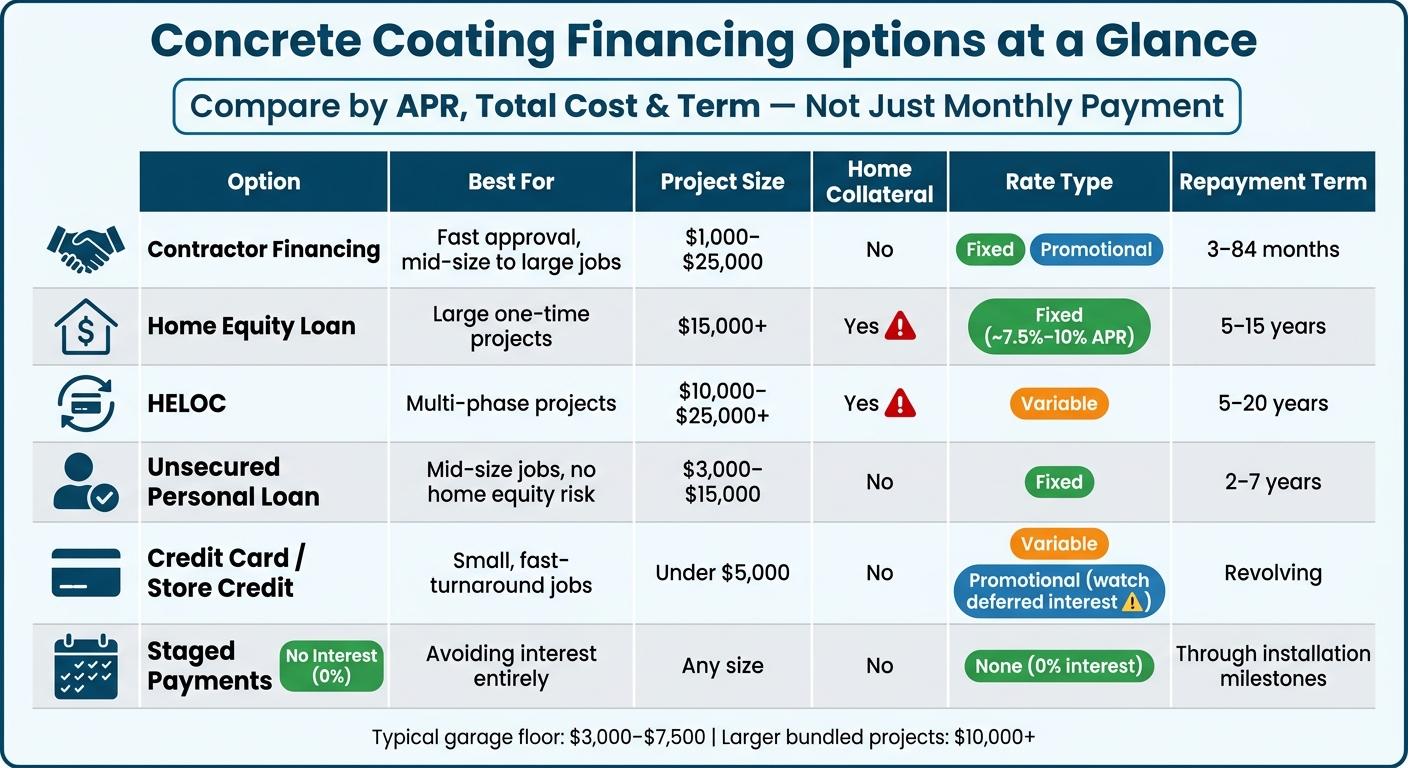
Concrete Coating Financing Options Compared: Rates, Terms & Best Use
Quick Comparison
| Option | Best For | Home Collateral | Rate Type | Common Range |
|---|---|---|---|---|
| Contractor financing | Fast approval, mid-size to large jobs | No | Fixed or promo | $1,000 to $25,000 |
| Home equity loan | Large one-time projects | Yes | Fixed | Often $15,000+ |
| HELOC | Multi-phase work | Yes | Variable | Often $10,000 to $25,000+ |
| Personal loan | Mid-size jobs | No | Fixed | $3,000 to $15,000 |
| Credit card/store credit | Small jobs | No | Variable or promo | Under $5,000 |
| Staged payments | Paying over install steps | No | None | Any size |
Bottom line: if I wanted the shortest path, I’d start with contractor financing or a personal loan. If I wanted the lowest rate for a big project, I’d look at home equity. If I had cash flow but wanted no interest, I’d ask about staged payments first.
sbb-itb-a0e5ae3
Why Financing Matters for Garage, Patio, and Shop Floor Upgrades
A standard two-car garage, usually around 400–500 sq. ft., often costs $3,000–$7,500 installed. The final price depends on the coating system, surface prep, and whether the concrete needs crack repair first. Once you move into larger garages, patios, or shop floors, the budget can climb into the five figures or more.
That range is a big reason financing often becomes part of the decision. It can give you room to choose the right system for the space instead of settling for the cheapest short-term option.
Local Weather and Heavy Use Can Justify a Better Coating System
North Idaho and Eastern Washington can be rough on concrete. Snow, ice, salt, and repeated freeze-thaw cycles all take a toll. Concrete is porous, so it pulls in moisture. When that moisture freezes and expands, the surface can crack and spall. That means a basic coating may not last as long as you hoped.
The problem gets worse in garages and shops that handle trucks, RVs, and chemical exposure. In those spaces, a tougher coating system can help limit early wear and cut down on future repair needs.
That’s where financing can help. Paying over time may make it easier to step up to a higher-grade system like Penntek Evolution, which is made for heavier use and UV exposure.
Compare Financing by Total Cost, Not Just Monthly Payment
Monthly payment matters, of course. But it doesn’t tell the whole story.
The better way to compare financing is to look at APR, loan term, fees, and promo terms. A lower monthly payment can look good at first glance, yet still leave you paying much more over time. Deferred interest is one of the biggest things to watch. If part of the balance is still unpaid when the promo period ends, some lenders charge backdated interest at a much higher rate.
Before you sign anything, check whether a 0% offer is actual zero-interest financing or a deferred-interest deal.
| Factor to Compare | Why It Matters |
|---|---|
| APR | Shows how much interest you’ll pay over the life of the loan |
| Repayment term | Longer terms can lower monthly payments but often mean more interest overall |
| Fees | Origination, closing, or prepayment fees add to the full cost |
| Promotional terms | “0% for 12 months” may include deferred interest, so read the fine print |
| Collateral required | Secured loans, such as home equity, may have lower APRs but put your home on the line |
1. Contractor Financing Through Croc Coatings
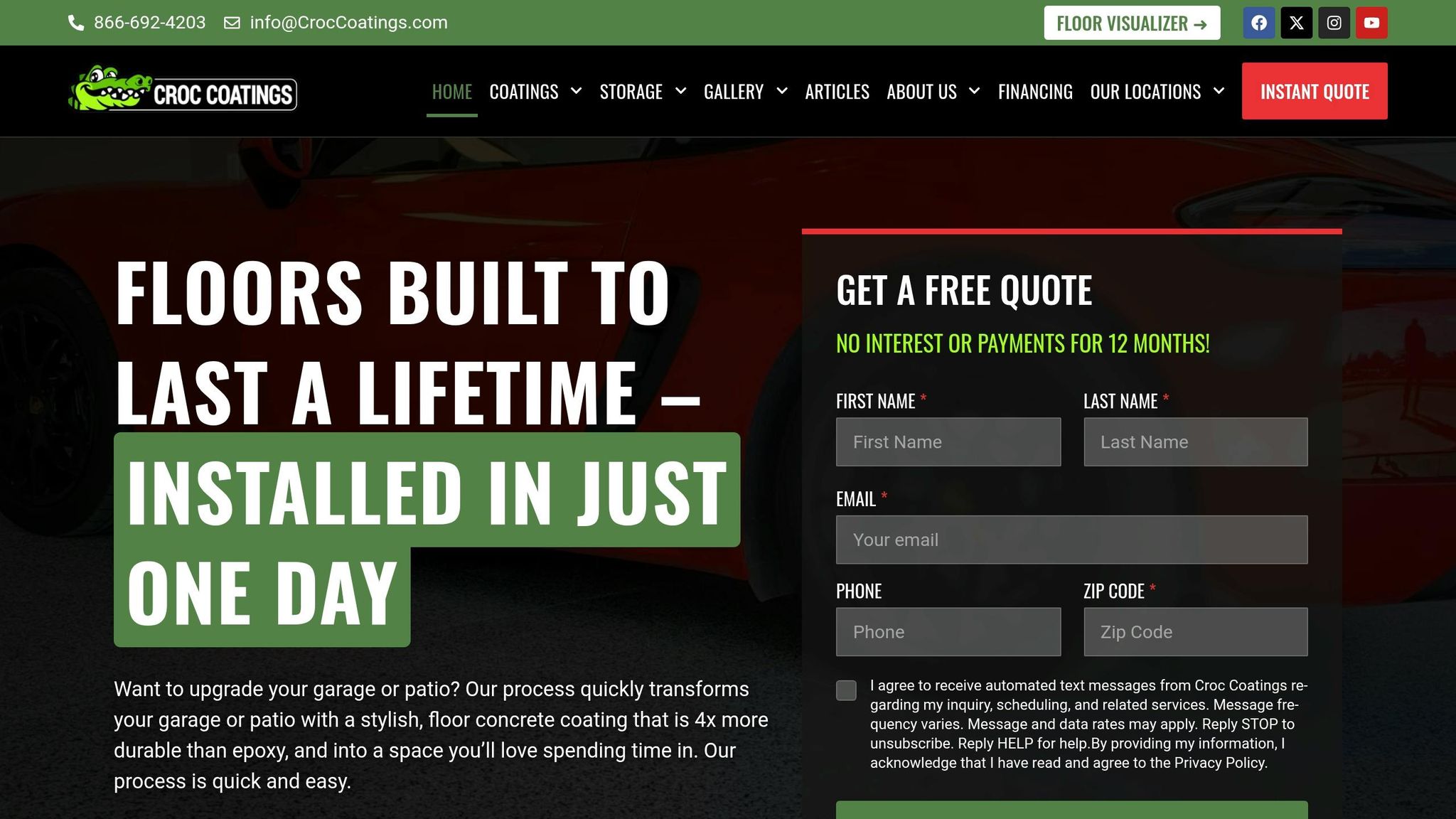
For bigger garage, patio, basement, or shop floor jobs, Croc Coatings offers financing through its lending partner, Upgrade. That makes this a good fit for homeowners who want a contractor-managed payment path from the quote stage through installation.
This option does not require home equity as collateral. There’s also a 10% down payment option, so you can get the project started and pay the rest after completion. Croc Coatings also offers promotional financing with deferred-start terms.
The process begins with a free in-home consultation and an on-site quote. Written estimates stay valid for 30 days.
If you’d rather have fixed monthly payments through a separate lender, the next option breaks down how that setup works.
2. Fixed Monthly Payment Plans Through Other Contractor Lenders
Alongside contractor financing, third-party contractor lenders are another common way to get fixed monthly payments without tapping home equity. These loans come from a lender the contractor works with, and approval is often fast.
In most cases, these loans are unsecured, which means your home isn’t used as collateral. So if avoiding a home lien matters to you, this option can make sense. It’s often a good match for coating jobs where the price is high enough that spreading payments out feels a lot easier on the budget.
These fixed monthly plans usually fit mid-size to larger projects, often in the $3,000 to $15,000+ range. Rates are usually fixed for the full term, so your payment stays the same month after month. That’s helpful when you want a clear budget and no surprises.
There’s a trade-off, though. A longer term can shrink the monthly payment, but you’ll pay more in total interest over time. Some programs also include promotional periods, like 0% for a set stretch, before the loan shifts to the standard rate. That can sound great up front, but you need to watch the promo end date. If there’s still a balance left, the unpaid amount can move to the lender’s regular rate.
3. Home Equity Loans
If you want predictable monthly payments and would rather borrow against your home’s equity, this is often the next option to look at. A home equity loan gives you a lump sum secured by your home, which you pay back in fixed monthly installments. That setup can work well for garage, patio, and shop floor projects. It also tends to come with lower rates than unsecured loans. Recent averages are about 7.5% to 10% APR, depending on your credit and loan term.
This option usually makes more sense for larger, clearly scoped projects. Why? Closing costs can run about 5% of the loan amount. On a small job, that extra cost can sting. On a bigger garage, shop floor, or whole-property coating project, it’s often easier to justify. So the rate matters, yes, but the loan structure and the risk tied to repayment matter just as much.
The biggest plus is payment stability. With a fixed rate, your monthly payment stays the same. And terms of 5 to 15 years give you room to choose between a lower monthly bill or paying less interest overall.
The downside is serious: if you miss payments, you could face foreclosure, even if your main mortgage is still current. Borrowing is also usually limited to 80% to 85% of your home’s appraised value, minus what you still owe on your mortgage. It’s smart to plan early so the loan closes in time for installation.
4. HELOCs (Home Equity Lines of Credit)
A HELOC is a revolving line of credit backed by your home equity. You borrow only what you need, pay back what you use, and then borrow again during the draw period. Once that draw period ends, new borrowing stops and repayment begins, usually over 10 to 20 years.
This option can fit larger garage, patio, and shop floor upgrades when you want access to money over time instead of getting one lump sum up front. Say you coat the garage now and add a patio or shop floor later. A HELOC lets you pay for the first phase, pay some of it down, and then draw again for the next phase from the same approved line. That setup can be handy for work that happens in stages. Many lenders set minimum HELOC limits at about $10,000 to $25,000, so it tends to make more sense for bigger jobs or for updating more than one space.
During the draw period, many lenders allow interest-only payments. That can keep monthly payments lower while the work is in progress. But there’s a catch: when the repayment period starts, your payment usually goes up. It’s smart to look at that jump before opening the line, not after.
The main downside is the rate structure. HELOCs usually come with variable interest rates tied to a benchmark like the prime rate. If rates go up, your payment can go up too. Some lenders offer a fixed-rate advance, which lets you lock in part of what you borrow for more steady payments. If you want more predictability, ask about that before you sign anything.
There’s also real risk here. Since the HELOC is secured by your home, missed payments can lead to foreclosure. Most lenders also cap total secured debt at around 80% to 90% of your home’s appraised value. And before you move ahead, check whether the line includes a balloon payoff at the end of the draw period.
If you’d rather not borrow against your home equity, the next option looks at unsecured home improvement loans.
5. Unsecured Home Improvement or Personal Loans
An unsecured home improvement or personal loan gives you a lump sum without using your home equity as collateral. Lenders usually look at your credit score, income, and debt-to-income ratio when deciding whether to approve you. That makes this a solid middle-ground option after home equity financing.
This route works well for mid-sized concrete coating jobs, like a single garage floor, a patio, or a small shop floor upgrade. You get fixed monthly payments and, in many cases, access to funds faster, which helps when you already have a clear budget in mind.
Before you borrow, check that the loan amount covers the full job, including prep work, repairs, and any add-ons. And don’t just look at the monthly payment. Compare the APR and the total amount repaid, since some lenders add origination fees. Because the loan is unsecured, rates are usually higher than with secured financing.
If you need a smaller, shorter-term option, the next choice is credit cards or store credit.
6. Credit Cards or Store Credit
For smaller projects that need money fast, credit cards and store credit are the shortest-term choices. They tend to work best for smaller coating jobs when you want fast approval and don’t want to put up collateral. Approval is based on your credit profile, not the project itself.
These options usually make the most sense for small to mid-sized jobs, often around $1,000–$5,000. A 0% promo card can help, but only if you pay the balance off before the promo period ends. If you don’t, the standard APR can make the job far more expensive.
Store credit calls for extra caution. In many cases, it uses deferred interest, not a true 0% APR. Miss the deadline, and interest can be added back to the original purchase date.
For larger jobs, credit cards often get expensive once the balance climbs because standard APRs are usually high. If you use a low-APR or 0% card, go in with a clear payoff plan and set a payoff deadline before you charge the project. If your project needs more breathing room over time, staged payments can be a cleaner fit.
7. Staged Payments and Milestone Billing
If you want to avoid interest, staged billing is usually the cleanest path. Instead of paying the full project price upfront, you pay the contractor in installments tied to clear parts of the job. That keeps the project at the contract price, with no interest added.
This setup makes the most sense for larger, multi-day jobs. When payments are spread out, it can take some pressure off your cash flow. For small jobs – like a single patio or entryway under $2,000 – a simple deposit-plus-final-payment setup is often enough.
A bigger project might be split into payments like:
- a deposit
- a prep-stage payment
- a coating-stage payment
- a final walkthrough payment
For larger shop floors or bundled spaces, a contractor may also divide billing by area or by inspection point.
For one-day residential installs, the schedule is often much simpler: a deposit, an install-day payment, and a final walkthrough payment.
The big upside is simple: you avoid financing charges. The downside is that you need cash ready at each milestone. So this option fits best when you can line up payments with savings or other money you already have. Before work starts, put every milestone in writing – scope, amount, and the exact payment trigger. Those written milestones make it much easier to compare this option with monthly loan offers next.
How to Compare Financing Options Side by Side
Compare each option on the same terms: total cost, rate type, term length, collateral, and funding speed. The big idea is simple: start with the same project amount for every option, then compare the actual cost over time – not just the monthly payment.
| Financing Option | Best Project Size | Requires Home Collateral? | Rate Structure | Typical Repayment Term | Best Use |
|---|---|---|---|---|---|
| Contractor Financing | $1,000–$25,000 | No | Fixed or promotional | 3–84 months | Projects that need quick approval |
| Home Equity Loan | $15,000+ | Yes | Fixed | 5–15 years | Large residential renovations |
| HELOC | $10,000–$25,000+ (multi-phase projects) | Yes | Variable | 5–20 years | Multi-phase residential projects |
| Unsecured Personal Loan | $3,000–$15,000 | No | Fixed | 2–7 years | Residential or small-business projects |
| Credit Cards | Under $5,000 | No | Variable or promotional | Revolving credit | Minor repairs or touch-ups |
| Staged Payments | Any size | No | N/A | Through installation | Budget-conscious residential or small-business shop floors |
Once you can see the options in one place, the next move is to test them using the same cost, rate, and timing assumptions. That’s how you get an apples-to-apples comparison.
Use the Same Project Cost for Every Option
Pick one project total and use it across every offer. For example, you might use $7,500 for a two-car garage or $15,000 for a bundled garage-plus-patio upgrade.
Doing this makes the comparison much more honest. A lower monthly payment can look good at first glance, but if the term is much longer, you may pay more overall.
Check Whether Rates Are Fixed, Variable, or Promotional
Before you sign anything, look closely at how the rate works. That part can change the full cost more than people expect.
Promotional rates on contractor financing can last 6, 12, or 18 months. After that, the rate may change, so it’s worth checking what kicks in when the promo ends and whether deferred interest applies. A fixed-rate loan keeps the same payment for the full term. A HELOC, on the other hand, moves with the market.
Review Approval Speed and Funding Speed
Timing can matter just as much as price. In North Idaho and Eastern Washington, weather-sensitive projects and packed install calendars can turn financing speed into a make-or-break issue.
Contractor-integrated financing can often be approved within minutes, while home equity products usually need an appraisal and extra underwriting. If your install date is already on the calendar, that gap in timing can be a big deal.
Budgeting Tips Before You Apply
Before you apply, pin down three numbers: your total project cost, your monthly payment ceiling, and the loan terms you can’t live without.
Estimate the Full Installed Cost Before Choosing Financing
Start with the installed price, not the ad rate. A price shown per square foot often leaves out part of the job, so it can give you the wrong budget from the start.
Your working total should include:
- surface prep, such as grinding, shot-blasting, and crack filling
- any concrete repairs
- the coating system
- add-ons like anti-slip texture or decorative flake blends
The final price will depend on the slab’s condition, how much prep it needs, any repairs, and the type of coating you choose.
It also helps to get a written quote that spells out prep, materials, labor, and any cabinet or storage upgrades before you pick a financing amount. That way, you’re borrowing based on an actual number, not a ballpark estimate.
Set a Monthly Payment Limit Before Reviewing Offers
Set your top monthly payment before you look at offers. That gives you a simple filter: if a plan goes over your limit, it’s out.
Then model the same project cost at 12, 36, and 60 months. Seeing those options side by side makes it much easier to spot which term keeps the payment in range without drifting into a plan that looks fine at first glance but strains your budget month after month.
Watch for Fees, Deferred Interest, and Prepayment Rules
Before you apply, check the fine print on these items:
- Origination fees: Often 1%–8% of the loan amount. On a $10,000 project, a 5% fee adds $500 before your first payment.
- Deferred interest: Offers like 0% for 12 months can turn costly if you don’t pay off the full balance by the deadline. Many lenders then add interest back to the original balance at a high rate.
- Late fees: One missed payment can push your total cost past what you planned.
- Prepayment penalties: If you plan to pay the loan off early, this fee can eat into the interest savings you expected.
Check Whether Bundling Spaces Lowers Your Per-Square-Foot Cost
Bundling a garage, patio, basement, or shop floor into one job can lower the per-square-foot price because the crew only mobilizes once and setup costs get spread across more space. For example, a Tri-Cities homeowner coating a three-car garage plus a large patio might save 5%–10% by bundling.
Still, the lower unit cost doesn’t always mean the better move. Run that bundled total against your monthly payment limit first. If the payment gets too high, phasing the job can make more sense: coat the highest-priority space now, then add the rest later as cash flow allows. That’s often the clearest way to decide whether to finance one area today or split the project into stages.
Conclusion
There’s no one-size-fits-all financing option for every project. The right choice depends on your budget, your equity position, how you want to pay, and how soon you want the installation done. That matters even more for larger garage, patio, and shop floor projects, where the monthly payment needs to work with your long-term cash flow.
Match the Financing Option to Both the Project and the Repayment Plan
Short-term promos tend to make more sense for smaller jobs. For larger projects, fixed installment loans are often a better fit because they give you steady monthly payments you can plan around. If you’d rather not tap your home equity, contractor-linked financing may be the better route. The point isn’t just to get a lower payment. It’s to get the right coating system installed on schedule without putting too much pressure on your budget.
Get Written Terms Before Work Begins
After you narrow down the loan type, the last step is to confirm the exact terms in writing. Use the written estimate as your starting point, then verify the APR, fees, payment dates, and promo deadlines before any work begins. Read the terms closely, decide on your monthly payment limit ahead of time, and don’t sign anything until the written agreement matches the quote. The best plan makes the coating fit your budget without hiding what it will actually cost.
FAQs
Which financing option is best for my project size?
The best financing option comes down to two things: your project budget and how fast you want to pay off the balance.
For smaller or mid-sized upgrades, short-term no-interest plans can be a good fit if you’re confident you can clear the balance within 6 to 12 months. That setup can save money, but only if the payoff timeline works for your budget.
For larger residential or commercial projects, longer-term installment loans usually make monthly payments easier to handle. And if you want some room to move, many plans also let you pay early without penalties.
How can I tell if a 0% offer is truly interest-free?
Check the loan terms for hidden fees and deferred interest. A true 0% plan gives you a set window, like 6, 12, or 18 months, when no interest builds on the principal balance.
That’s the part you want to verify. Some offers look interest-free at first glance, but they’re actually deferred-interest plans. In plain English, that means interest sits in the background and can be added later if you don’t pay off the full balance before the promo period ends.
So read the terms closely. Make sure the offer is interest-free for the entire term, not just delayed. If it’s deferred, you could get hit with retroactive charges at the end of the promotional period.
Should I use home equity or avoid putting my home at risk?
Using home equity for a concrete coating project puts your house on the line. If you miss payments, your home could be at risk because it serves as collateral.
That’s why many homeowners go with unsecured financing instead. It can come with monthly payments that feel easier to handle and, in some cases, zero-interest promotional periods – all without putting the home up as security.