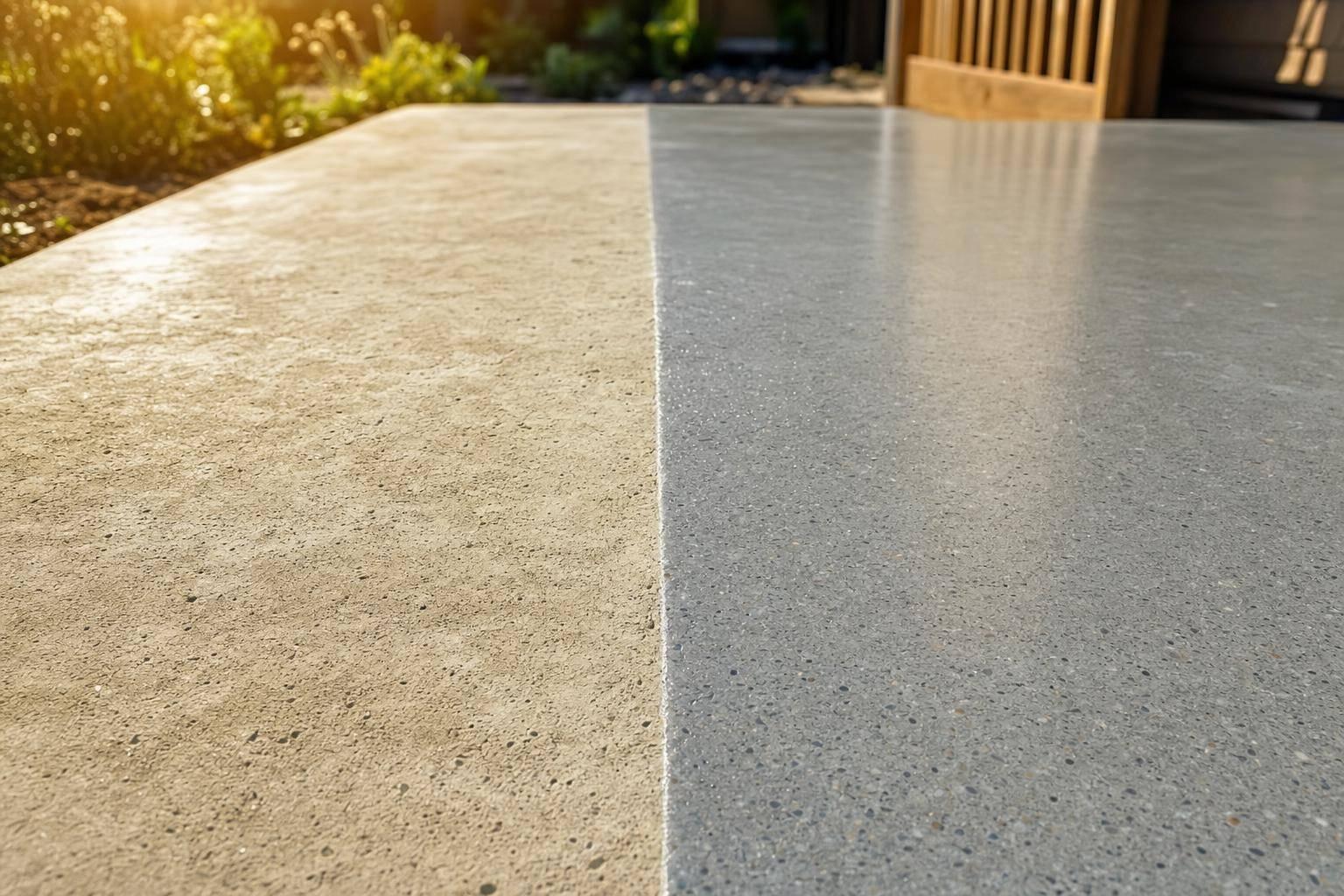
If a coating sits in direct sun, UV stability is what decides how long it keeps its color, gloss, and bond. In this research summary, I found a clear split: aliphatic polyurea holds up far better outdoors than aromatic polyurea, while aromatic systems usually need a UV-stable topcoat if appearance matters.
Here’s the short version:
- Sunlight breaks coatings down at the chemical level
- Aromatic polyurea yellows and loses gloss much faster
- Aliphatic polyurea keeps color and strength much longer
- Lab tests show aliphatic systems can stay at ΔE ≤ 3.0 after 4,000 hours of QUV exposure
- They can also retain 90%+ tensile strength and 88%+ elongation after 5,000 hours of Xenon Arc weathering
- Install details matter too, especially surface prep, film thickness, mix ratio, and temperature control
- For patios, pool decks, and walkways, that means less fading, less chalking, and fewer recoats over time if you follow proper maintenance for outdoor floors
A few numbers stand out. Research cited here shows aliphatic polyurea can keep 85%+ gloss after 4,000 hours, while aromatic systems can show severe yellowing and much lower gloss retention. The article also points out that UV stabilizer packages can cut photodegradation rates by 85% to 92% in protected formulas.
Here’s a fast side-by-side view:
| System | Color hold | Gloss hold | Outdoor use |
|---|---|---|---|
| Aromatic polyurea | Poor in sun | Low over time | Better as a base coat |
| Aliphatic polyurea / polyaspartic | Strong | Strong | Best fit for direct exterior exposure |
| Aromatic with UV-stable topcoat | Better than aromatic alone | Mid-range | Good when built as a multi-layer system |
So if I boil the article down to one point, it’s this: for outdoor concrete, the best sun performance comes from aliphatic or UV-stabilized polyurea systems installed the right way.
How UV Light Affects Polyurea Coatings
UVA, UVB, and How Sunlight Breaks Down Coatings
That chemistry difference shapes how each system behaves once sun exposure starts.
UVA and UVB damage polyurea because those wavelengths trigger oxidation, chain scission, and surface breakdown. When sunlight hits the coating, it activates UV-sensitive parts of the material and creates reactive molecules that break the polymer chains.
The first signs often show up fast. Visible yellowing can start within weeks and then move toward dull, discolored surfaces, highlighting the benefits of UV-stable polyurea coatings. At the same time, the coating can lose gloss, form microcracks, and become more water-attracting.
Researchers tie that color shift to UV-driven photodegradation in the coating structure.
In plain terms, the surface usually looks worn before the deeper damage becomes obvious. That’s why researchers track both appearance and mechanical change, not just one or the other.
How Researchers Test UV Aging in Coatings
To estimate long-term sun damage without waiting years, researchers use accelerated aging tests. QUV chambers (ASTM G154) cycle through UV and condensation phases, while xenon arc testing (ISO 4892-2) simulates a broader mix of sunlight and moisture cycles. Natural weathering is used too, with samples placed outdoors at a 45° angle facing west.
Common UV-aging metrics include:
| Measurement | Test Method | What It Shows |
|---|---|---|
| Color difference (ΔE) | Colorimetry | Yellowing level |
| Gloss retention | Gloss meter at 60° | Surface wear and cracking |
| Carbonyl Index | FTIR spectroscopy | Chain scission and oxidation |
| Water contact angle | Sessile drop / goniometry | Loss of water resistance |
| Dynamic modulus | DMA | Stiffness change |
| Pull-off strength | Pull-off test (MPa) | Remaining bond strength |
Each test looks at a different part of the story. Color difference shows how much the coating has yellowed. Gloss retention points to surface wear. FTIR-based Carbonyl Index helps spot oxidation and polymer damage. Water contact angle shows whether the surface still resists water. DMA tracks stiffness shifts, and pull-off strength checks how much bond strength is left.
Some systems show short-term stiffening from heat, but longer UV exposure still cuts performance.
So these tests don’t just show whether a coating fades. They show whether it can still protect the surface underneath.
The next section compares those test results across polyurea systems.
sbb-itb-a0e5ae3
What is 3rd Generation Aliphatic Polyurea?
What Research Shows About UV Resistance and Durability
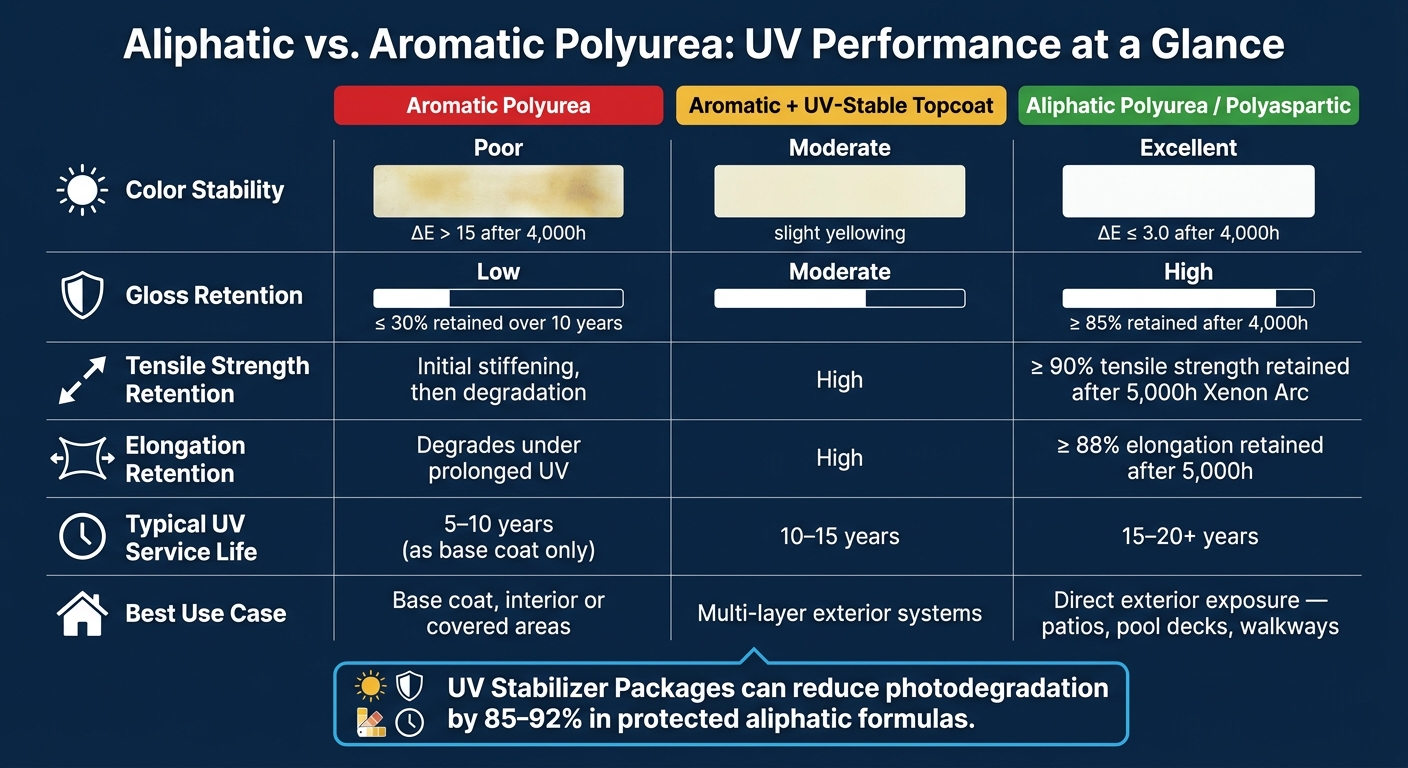
Aliphatic vs. Aromatic Polyurea: UV Performance Comparison
Lab Results: Color, Gloss, and Mechanical Property Retention
Lab testing shows a pretty sharp split between these chemistries, and it shows up fast in color, gloss, and strength.
Aliphatic polyurea, including epoxy and polyaspartic systems, performs well in accelerated weathering tests. After 4,000 hours of QUV exposure, it keeps a color difference (ΔE) of ≤ 3.0, gloss retention of ≥ 85%, and a chalking grade of zero. FTIR analysis also shows its Carbonyl Index stays at ≤ 0.15 after 4,000 hours, which points to limited molecular chain breakage.
You can see these lab trends first in the finish, then in the coating’s mechanical behavior.
Aromatic polyurea follows a different path. After 18 weeks, exposed samples changed from transparent yellow to opaque tan, while dynamic modulus increased early and then flattened out. That early stiffening lines up with post-hardening and increased cross-linking. In plain English, the material gets harder at first under UV exposure, which is why aromatic systems can still work well as base coats when looks matter less.
Tensile strength retention makes the gap even clearer. Aliphatic systems retain ≥ 90% of tensile strength and ≥ 88% of elongation at break after 5,000 hours of Xenon Arc weathering. That matters because outdoor coatings need both strength and flexibility. If a coating keeps one but loses the other, cracks and coating failure aren’t far behind.
The same pattern carries into outdoor exposure.
Field Performance on Outdoor Concrete and Steel
Lab data helps, but field results show what happens when coatings sit outside year after year. In a 5-year tracking study on coastal bridges, aliphatic polyaspartic polyurea showed only an 18% adhesion decay rate, along with a color change of just ΔE = 2.3. By contrast, less UV-stable coatings on those structures showed severe chalking and adhesion loss.
Composite UV and salt spray testing tells a similar story. After 100 cycles under ASTM D5894, aliphatic systems kept pull-off adhesion at ≥ 3.5 MPa, with a loss rate under 20%. That’s a big deal on outdoor concrete and steel, where moisture and salt keep pushing on the bond line.
Field research also shows that moisture and salt can wear down performance faster than UV alone. That’s part of the reason aliphatic systems hold up so well in coastal and high-humidity settings. They’re not just dealing with sunlight. They’re dealing with the full outdoor mix.
Comparison Table: UV Performance by Polyurea System Type
| Performance Category | Aromatic Polyurea | Aliphatic Polyurea (Polyaspartic) | Aromatic Polyurea with UV-Stable Topcoat |
|---|---|---|---|
| Color Stability | Poor – severe yellowing, ΔE > 15 | Excellent – ΔE ≤ 3.0 after 4,000h | Moderate – slight yellowing |
| Gloss Retention | Low – ≤ 30% over 10 years | High – ≥ 85% after 4,000h | Moderate |
| Strength and Flexibility | Initial stiffening under UV exposure | Very high – ≥ 90% tensile strength and ≥ 88% elongation retained | High |
| Typical UV Service Life | 5–10 years (as base coat) | 15–20+ years | 10–15 years |
These results depend a lot on formulation and installation details. Small choices in mix design, surface prep costs, film build, and topcoat use can change how the system handles sun, salt, and moisture over time.
The next section explains which formulation and installation factors most affect sun protection outdoors.
What Determines Sun Protection in Outdoor Installations
Formulation, Stabilizers, and Topcoat Design
Lab results only tell part of the story. In outdoor use, sun protection comes from both the formula and the way the coating is installed. Those two things shape how well the surface holds its color, keeps its bond, and lasts on patios and pool decks.
UV absorbers stop UV energy before it does damage, while HALS deal with the free radicals that UV exposure creates. When those parts work together, the payoff is big. Research shows that pairing benzotriazole and triazine UV absorbers can cut photodegradation rates by 85–92% compared with unprotected systems.
The kind of UV absorber matters too. Some standard additives can migrate or leach out over time, with retention falling to 60–75% after 2,000 hours of accelerated weathering. Reactive UV absorbers behave differently. Because they bond directly to the polyurea backbone, they keep more than 95% retention over that same period. Over years outside, that gap can turn into a clear difference in appearance and service life.
This edge becomes even more important when a coating needs to stay stable without a topcoat. Aliphatic polyurea uses IPDI, which is less sensitive to UV exposure and can often reduce the need for a separate UV topcoat. That can mean fewer application steps, lower labor costs, and reduced floor maintenance needs over time.
Surface Preparation, Thickness, and Installation Conditions
Even a UV-stable coating can fail if the substrate prep is poor. Bad prep shortens coating life fast, and polyurea’s very fast cure leaves almost no time to fix errors once spraying begins.
Film thickness plays a big part as well. Aliphatic polyurea can go down in thick, continuous layers and form a seamless coating. That makes it a strong fit for outdoor jobs where waterproofing and structural protection matter most.
Installation conditions shape long-term results too. Research points to a correct mix ratio of 1.05–1.15 isocyanate index, spray temperatures of 140–175°F (60–80°C), and substrate temperatures between 68–95°F (20–35°C) for controlled curing. Post-cure conditioning within those ranges for 2–4 hours can improve long-term UV resistance by 15–25%.
Polyurea also becomes tack-free in just 40–120 seconds, which leaves very little time for dust or moisture to interfere during installation. On patios, pool decks, and walkways that deal with daily sun and foot traffic, details like prep, thickness, temperature, and mix control can make or break the result.
What These Findings Mean for Patios, Pool Decks, and Walkways
Practical Benefits for Residential Outdoor Spaces
Now that the science is clear, the next step is simple: what does this mean in day-to-day life?
A UV-stable polyurea system keeps its look longer. It resists chalking and yellowing, which means fewer recoats and less upkeep over 5–10 years.
In the Inland Northwest, weather puts outdoor concrete through a lot. Polyurea vs. epoxy freeze-thaw resistance is a major factor because these cycles can be rough, with cold winter nights followed by warmer daytime temperatures. Polyurea has enough flexibility to move with the concrete as those swings happen, which helps cut down the risk of peeling or cracking. On pool decks and walkways, anti-slip additives or textured chip blends can help with traction when the surface is wet. And on hot days, lighter colors stay cooler than dark concrete, which makes a difference when people are walking barefoot around a pool.
Cleaning is simpler too. Because the surface is seamless and non-porous, dirt, algae, and spills stay on top instead of soaking in. Most messes wash off with a rinse or a light scrub. For small businesses with outdoor entrances or seating areas, that can mean less time spent dealing with maintenance.
How Croc Coatings Applies UV-Stable Systems Outdoors
This is the kind of UV-stable system Croc Coatings installs on outdoor residential surfaces in North Idaho and Eastern Washington. The Penntek Evolution proprietary polyurea-based system is made for outdoor settings and stands up to four-season wear, including summer sun, deicing salts, patio furniture, and foot traffic with grit tracked in from gravel or snow.
The installation process takes one day. It starts with mechanical grinding, then fast-curing layers bond before moisture or dust can get in the way. This is one of the key polyaspartic fast-cure advantages that professional installers rely on. That fast cure matters in the Inland Northwest, where the weather can change fast. Croc Coatings also offers a rubberized pool-deck coating built for wet-area traction and comfort, with texture and color options matched to the space. The system comes with a lifetime warranty for residential installations.
Conclusion: Why Polyurea Works Well in Sun-Exposed Applications
Polyurea brings together fast cure, strong adhesion, flexibility that bridges cracks, and UV-stable chemistry. That mix makes it a good fit for outdoor concrete in the Inland Northwest, where sun, rain, and freeze-thaw cycles can all hit in the same year. Aliphatic and UV-stabilized systems hold color and gloss better than aromatic systems when that long-term appearance matters. For patios, pool decks, and walkways in this region, that gap becomes clear in how the surface wears over years of outdoor use.
FAQs
How do I know if a coating is aliphatic or aromatic?
Check the product label and the chemical makeup. Aliphatic polyurea is made without the benzene ring structures found in aromatic compounds.
Aliphatic coatings are usually labeled for UV resistance, and they tend to hold their color and gloss better over time. Aromatic coatings are tough, but they’re more likely to yellow when exposed to UV light. Before you buy, make sure the product is clearly marketed as UV-resistant.
How long can a UV-stable polyurea coating last outdoors?
When it’s formulated as a UV-stable aliphatic system, a polyurea coating can last 15 to 20 years or more outdoors. It’s made to stand up to fading, yellowing, and brittleness, while still holding its protective performance and clean appearance over time.
Croc Coatings uses the industrial-grade Penntek Evolution system, built for this kind of long-term durability and backed by a lifetime warranty for residential and commercial applications.
When does polyurea need a UV-stable topcoat?
Aromatic polyurea needs a UV-stable topcoat because those diisocyanates tend to yellow, fade, and break down in sunlight.
That matters a lot on outdoor surfaces like patios, driveways, and pool decks. A common setup is an aromatic polyurea base coat for strength, then an aliphatic polyurea or polyaspartic topcoat to handle sun exposure.
Without those UV-stable layers, direct sunlight can cause fast deterioration.