Before I approve a residential floor coating, I check its category, VOC level, and the rule at the project address. The federal floor-coating limit is 400 g/L, but state or local limits may be lower. Federal compliance alone does not confirm that a coating can be used at your home.
For a Croc Coatings project in North Idaho or Eastern Washington, my checklist is:
- Confirm the category: Epoxy, polyurea, and polyaspartic describe chemistry – not the legal coating category.
- Check the local rule: Verify the governing agency, dates, exemptions, and sale or application restrictions.
- Get product records: Request exact system names, labels, technical data, and mixed-product VOC calculations. “Low odor” is not proof of compliance.
- Review the pre-installation work plan: Confirm floor preparation, moisture limits, ventilation, curing conditions, and separate times for walking, parking, and occupancy.
My bottom line: <u>check the paperwork before ordering or starting work</u>. VOC compliance and safe return-to-use are separate checks – and I want both settled in writing.
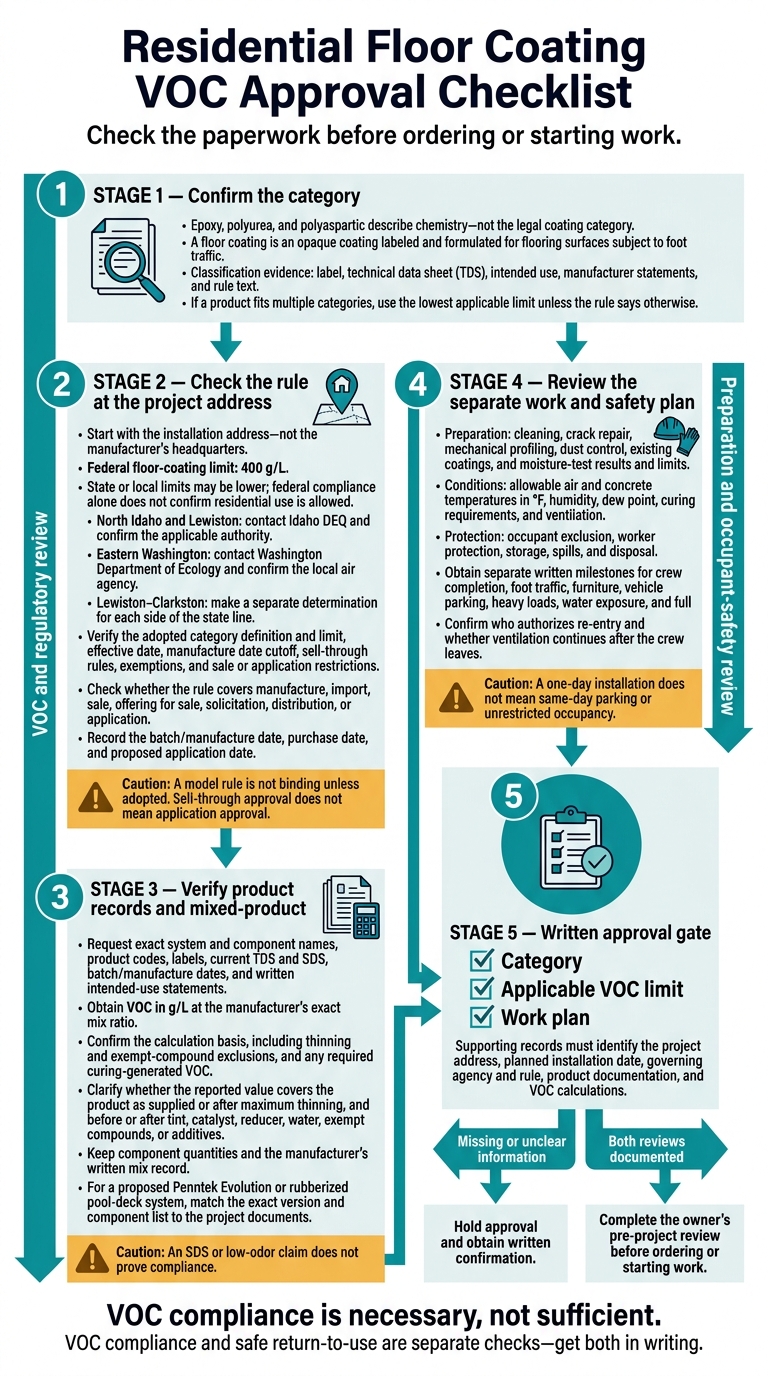
Residential Floor Coating VOC Approval Checklist
Coating Categories and VOC Limits
Floor Coatings and Other Regulatory Categories
Epoxy, polyurea, and polyaspartic describe a coating’s chemistry – not its VOC category. A floor coating is an opaque coating labeled and formulated for flooring surfaces subject to foot traffic.
Classification depends on the label, technical data, intended use, and manufacturer statements. Other categories apply only if the product meets their definitions. Check any residential-use restrictions before work begins.
If a product fits multiple categories, use the lowest applicable limit unless the rule says otherwise. Ask for a written classification basis backed by the label, technical data, and intended-use statements. This classification determines which VOC cap applies.
The Federal 400 g/L Limit and Stricter Limits
The federal floor-coating limit is 400 g/L. Some jurisdictions set stricter limits. Idaho and Washington may differ, so confirm the rule adopted for the project before approving a product.
Ohio and Connecticut have 250 g/L floor-coating limits.
| Category | Residential use | Federal limit | Classification evidence |
|---|---|---|---|
| Floor coating | When the product meets the floor-coating definition | 400 g/L | Label, technical data sheet (TDS), intended use, rule text |
| Concrete protective coating | When the product meets the technical definition | 400 g/L | Manufacturer statements, TDS, rule text |
Use the applicable category limit as your benchmark before checking state adoption.
How to Compare Reported VOC Values
Compare VOC in g/L, not a vague VOC claim. Use the federal calculation basis, including thinning and exempt-compound exclusions.
Ask for the mixed-product VOC at the manufacturer’s exact mix ratio, including any required curing-generated VOC. For Croc Coatings’ Penntek Evolution system, request the exact product version, calculation basis, and compliance statement. An SDS or low-odor claim does not prove compliance.
Then verify the project’s local rule and documentation before ordering products or scheduling work.
sbb-itb-a0e5ae3
Federal, Idaho, and Washington Rules
Find the Project’s Air-Quality Jurisdiction
Once you know the coating category and VOC limit, identify the agency that governs its use at the project address. Start with the installation address – not the manufacturer’s headquarters.
For Coeur d’Alene, Hayden, Post Falls, and Lewiston, contact Idaho DEQ. For Spokane, the Tri-Cities, and Clarkston, contact the Washington Department of Ecology and confirm which local air agency has jurisdiction. Lewiston–Clarkston projects require a separate determination for each side of the state line.
Federal AIM mainly governs manufacturers and importers. State or local rules may also cover sellers, installers, or users. Check which activities the rule covers: manufacture, import, sale, offering for sale, solicitation, distribution, or application. Keep the governing agency, rule citation, and agency contact in the project file.
Check Adopted Rules and Effective Dates
A model rule is not binding unless adopted. Before buying or installing the coating, check the adopted rule text for the exact project address. Verify the category definition, effective date, manufacture date cutoff, sell-through rules, exemptions, and application restrictions.
For Idaho and Washington, confirm adoption details directly with the agency that governs the project address.
| Project area | Definition and limit to verify | Dates and restrictions to verify | Official source |
|---|---|---|---|
| North Idaho: Coeur d’Alene, Hayden, Post Falls | Adopted state/local floor-coating definition and limit | Effective date, manufacture cutoff, inventory exemptions, sale and application restrictions | Idaho DEQ and applicable local authority |
| Lewiston, Idaho | Address-specific floor-coating definition and limit | Adopted edition, sell-through rules, seller/applicator obligations | Idaho DEQ |
| Spokane, Washington | State/local floor-coating definition and limit | Local adoption, effective dates, exemptions, application restrictions | Washington Department of Ecology and local air agency |
| Tri-Cities and Clarkston, Washington | Address-specific floor-coating definition and limit | Manufacture date conditions, sale and application restrictions | Washington Department of Ecology and local air agency |
Obtain the coating’s batch or manufacture date, along with its purchase date and proposed application date. Sell-through approval does not mean application approval. If the rule is unclear on this point, get written clarification from the agency before installation.
Rule Examples from Other Jurisdictions
Other states’ rules can serve as reference points when reading local requirements. The examples below show different approaches; they do not set the rules for Idaho or Washington.
Jurisdiction Category and reported limit Rule feature Official text Ohio Floor coatings: 250 g/L Includes inventory conditions Ohio architectural-coating provisions District of Columbia Floor coatings: 250 g/L Covers manufacture, blending, supply, sale, offering for sale, application, and solicitation District architectural-coating provisions New York Floor coatings: 250 g/L; flow coatings: 250 g/L Applies to coatings manufactured on or after January 1, 2005 New York architectural-coating provisions
How to Determine Compliance with VOC Standards
Pre-Project Checklist for Croc Coatings Customers
Once you’ve confirmed the coating category and applicable limit, check the paperwork and installation plan before ordering.
Request Product Labels and VOC Records
For each component, request the product name, product code, batch/manufacture date, current TDS, SDS, label, and written intended-use statement. These documents should spell out the intended use, application limits, required personal protective equipment, ventilation, curing conditions, and any “professional use only” or “not for residential use” restrictions. Keep the records with the project’s jurisdiction and applicable limit.
Ask for the VOC value in g/L, with a clear explanation of what that number covers: the product as supplied or after maximum thinning, and before or after tint, catalyst, reducer, water, exempt compounds, or additives. Record the quantity of each component and keep the manufacturer’s written mix record.
With the paperwork checked, review the prep and cure requirements.
Confirm Floor Preparation and Return-to-Use Times
Compliance also depends on preparation, curing, and re-entry timing.
Request a separate preparation and occupant-safety plan. It should cover cleaning, crack repair, mechanical profiling, dust control, existing coatings, moisture-test results and limits, and allowable air and concrete temperatures in °F. Include humidity, dew-point, and curing requirements, plus ventilation, occupant exclusion, worker protection, storage, spills, and disposal. VOC compliance does not replace SDS precautions, exposure controls, or manufacturer instructions.
Get separate return-to-use milestones in writing for crew completion, foot traffic, furniture, vehicle parking, heavy loads, water exposure, and full use. Confirm who authorizes re-entry and whether ventilation must continue after the crew leaves. A one-day installation does not mean same-day parking or unrestricted occupancy.
Check the Selected Croc Coatings System
For a Croc Coatings project, match the written system documents to the project address and surface.
Request the exact Penntek Evolution or rubberized pool-deck system proposed for the site, then confirm its component list and VOC records. This is an owner compliance check, not a certification. Also confirm the schedule and return-to-use instructions.
Conclusion: Confirm the Category, VOC Limit, and Work Plan
Confirm the applicable AIM category and local VOC cap. The federal floor-coating limit is 400 g/L, but local rules may be stricter. For example, Washington VOC rules impose specific requirements on garage floor projects.
Before approving a Croc Coatings project, get written confirmation of the requirements for the project address, planned installation date, and governing jurisdiction. Support that confirmation with current product labels and VOC calculations.
The approval packet must state the category, VOC limit, and work plan before work starts. If any of those details are missing, hold approval until they’re confirmed.
Check preparation, ventilation, curing, and return-to-use timing separately from the VOC review. VOC compliance is necessary, not sufficient.
FAQs
What if my coating’s VOC category is unclear?
Don’t go by the label alone. Match each product to the category defined in your project standard, whether it’s a primer, base coat, seal coat, or adhesive. Check the technical data sheet (TDS), too. If it conflicts with the label, keep both documents and record which version was used on-site.
For multi-component systems, request VOC-content data for the mixed product as installed, rather than data for each component.
What if local VOC rules change before installation?
Review the entire coating assembly and update the project’s compliance matrix to reflect the new limits. Compliance depends on the ready-to-use VOC content of the mixed system.
Before work starts, have the approving authority address gaps in the compliance documentation and approve any required material substitutions in writing. Keep the project file complete and up to date so it can verify compliance with applicable federal, state, and local rules.
How do I confirm it’s safe to reenter my home?
Follow the manufacturer’s guidelines for curing times and safe reentry. You can typically walk on the newly coated floor after 4 to 6 hours and park or drive on it within 24 hours.
Before heavy use, press your thumb firmly against the surface. If the coating feels sticky or moves under pressure, give it more time to cure.