

I check the whole floor system – not just the topcoat – before approving materials. My starting point is a one-page list of every installed layer and built-in storage component, matched to the project’s requirements.
A 100% solids label or one-day cure does not prove eco-friendly coatings for low-emitting compliance. VOC content and VOC emissions need separate checks.
For projects in North Idaho and Eastern Washington, I focus on four steps:
- Set the requirements: Confirm the residential, commercial, or green-building approval path and each product’s category.
- Check the records: Match product names, mixed formulations, and covered cabinet materials to the required certificates or test reports.
- Close the gaps: Track each item as documented, covered by a written exemption, or missing records. Get approval before installation.
- Plan the work: Put installation order, ventilation, worker protection, cure time, and access limits in writing. Keep substitution and installation records.
My rule: <u>approve the installed assembly, not just the product label.</u>
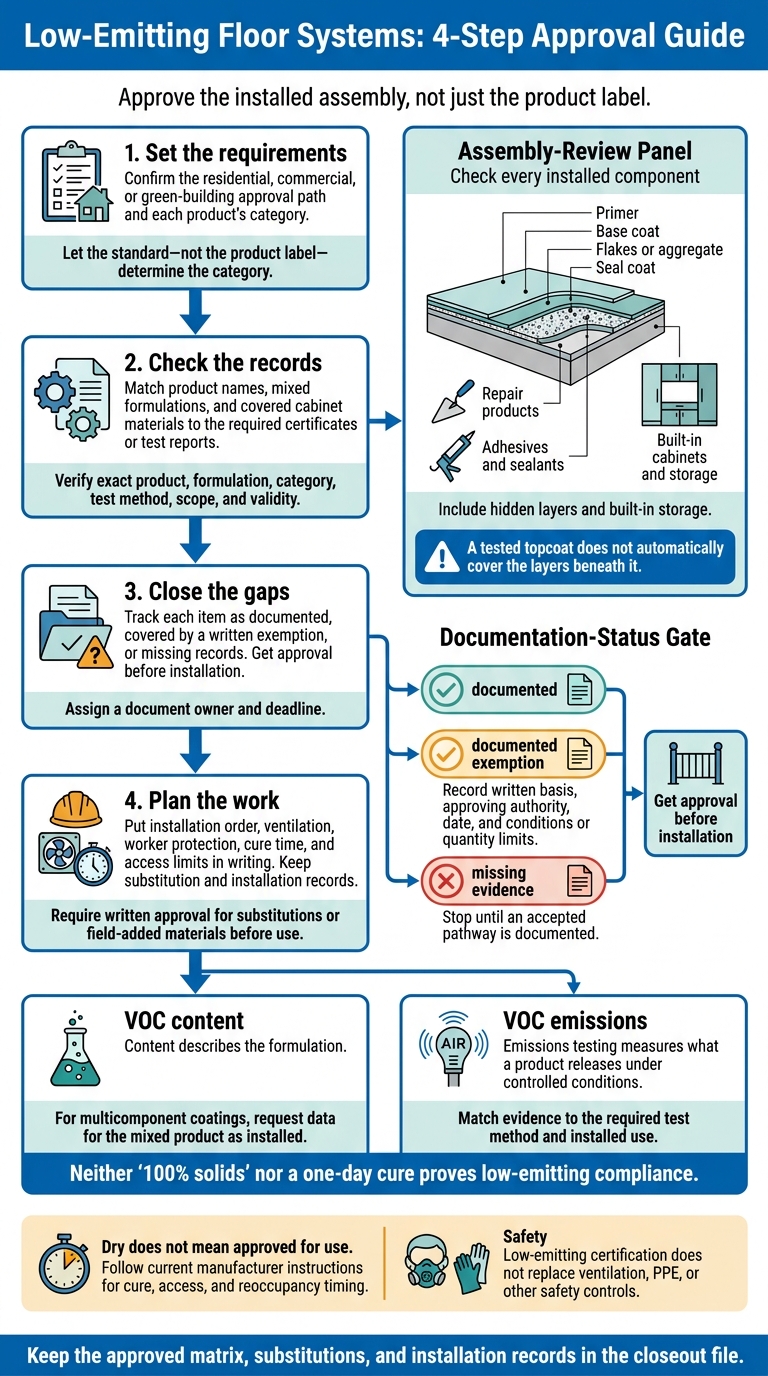
Low-Emitting Floor Systems: 4-Step Approval Guide
What is necessary for LEED Low Emitting Materials compliance?
sbb-itb-a0e5ae3
Confirm Your Project’s Low-Emitting Requirements
Use the layer-by-layer inventory from the prior section to match each requirement to the right product. Identify the governing standard for the full floor and storage assembly before choosing materials. For a residential garage, confirm whether emissions documentation is a disclosure item or a contract requirement. For commercial work in North Idaho or Eastern Washington, check the owner’s specifications, applicable jurisdictional rules, and green-building criteria separately.
Assign Each Product to Its Required Category
Before reviewing products, map each one to the category named in the project standard. Let the standard – not the product label – determine the category. This applies to primers, base coats, seal coats, flakes, adhesives, sealants, and cabinet-related materials.
CDPH Standard Method v1.2 tests emissions under defined conditions. Check that each report matches how the product will be used once installed. Then verify that each product’s documentation matches the required test method.
Understand VOC Content and VOC Emissions
VOC content and VOC emissions measure different things. Content describes the formulation; emissions testing measures what a product releases under controlled conditions.
For a multicomponent coating, request VOC-content data for the mixed product as installed, rather than separate Part A and Part B records. Use those mixed-product records as the basis for the compliance matrix in the next section.
Check Every Component’s Compliance Records
Build a Floor-System Compliance Matrix
Give each installed product its own row. Split repair products and cabinet materials into separate rows when needed. Include hidden layers and built-in storage – the review should cover the whole assembly, not just the visible topcoat.
Use the table as a submittal checklist, not proof of compliance. Enter the exact manufacturer and product for every installed item. Assign just one status: documented, documented exemption, or missing evidence. For each exemption, record the written basis, approving authority, date, and any conditions or quantity limits.
| System component | Product name and manufacturer | Function in the assembly | Required category | VOC-content documentation | VOC-emissions documentation | Certification or test standard | Installation limitations | Responsible party | Submittal status |
|---|---|---|---|---|---|---|---|---|---|
| Primer | Bonding and substrate preparation | Paints/coatings or project-defined category | Obtain manufacturer VOC-content record | Obtain emissions report or approved pathway | Identify applicable standard and certificate scope | Record substrate, mixing, temperature, and cure limits | Coating installer/manufacturer | ||
| Base coat | Main resinous floor layer | Paints/coatings or flooring, as assigned | Obtain formulation-specific VOC record | Confirm emissions evidence for installed formulation | Record test method and certificate scope | Record component ratio, pot life, and ventilation requirements | Manufacturer/installer | ||
| Flakes or aggregate | Decorative or broadcast media | Flooring, coating accessory, or separate exemption pathway | Confirm whether VOC content is relevant | Determine whether system testing covers the product or it needs separate evaluation | Record system certificate or approved exemption | Record broadcast rate and encapsulation requirements | Manufacturer/installer/design reviewer | ||
| Seal coat | Encapsulation and protection | Paints/coatings | Obtain product-specific VOC record | Obtain emissions documentation for exact formulation | Record applicable certification or test standard | Record number of coats and cure time before occupancy | Installer/manufacturer | ||
| Repair products | Substrate repair and leveling | Patching compound, coating, or other assigned category | Obtain VOC-content data | Confirm emissions evidence or documented exemption | Record test standard or project approval | Record thickness, cure, and compatibility limits | Subcontractor/installer | ||
| Adhesives and sealants | Bonding, joints, transitions, or detailing | Adhesives and sealants | Obtain VOC-content record | Confirm emissions documentation where required | Record applicable certification/test pathway | Record bead size, open time, and ventilation | Installer/manufacturer | ||
| Built-in cabinets and storage | Enclosed storage or built-in cabinetry | Composite wood, coatings, or furniture, as assigned | Obtain coating, composite-wood, or adhesive data | Confirm emissions evidence for the assembled product where required | Record certificate scope and component coverage | Record installation location and ventilation before use | Cabinet manufacturer/installer |
Assign a document owner and deadline before procurement or installation. Call the assembly compliant only when the accepted pathway is documented. Use the matrix to verify each installed layer before approving submittals.
Review Coating Layers, Flakes, and Cabinet Materials
Check the exact installed formulation – not just the system family name. Use each item’s matrix row to confirm the installed version.
Review every primer, base coat, seal coat, crack filler, and patch against its assigned category and EPA VOC guidelines for coatings. Record the exact product code and mixed formulation. For two-component products, the evidence must cover the complete mixed formulation, not just the resin, hardener, or another individual component.
For flakes, confirm the exact grade, color, binder, and application method covered by the test or certification. A tested topcoat does not automatically cover the layers beneath it. If evidence is missing, mark the component missing evidence and stop until an accepted pathway is documented.
Review cabinet panels, doors, liners, backers, finishes, and field-applied adhesives separately from floor-coating records. Collect the applicable composite-wood and formaldehyde records along with the required emissions evidence.
Verify Certificates and Test Reports
After reviewing each product, match its records to the delivered material and installed location. Check each certificate against the exact manufacturer, product, formulation, color or sheen, category, test method, scope, and validity. A floor system is compliant only when every layer and storage component matches its own record.
Keep technical data sheets, safety data sheets, product labels, VOC-content records, emissions reports or certifications, manufacturer declarations, batch or lot numbers, invoices, and installation records. Check the certificate number against the delivered product. An SDS or raw-ingredient certificate does not prove installed-product compliance. Leave mismatches unverified.
Plan Low-Emitting Upgrades in North Idaho and Eastern Washington
Once each product is documented, match the project type to the right approval path and installation sequence.
Compare Residential and Commercial Requirements
Classify the project by use, occupancy, and approval path before scheduling work. These categories can overlap, so check the owner’s specifications. Review emissions approval separately from durability, chemical resistance, slip resistance, installation speed, and worker safety. Evidence for one does not prove the others.
| Project type | Documentation | Installation planning |
|---|---|---|
| Residential garage | Product data, SDSs, ventilation instructions, and emissions evidence for coatings and storage materials. | Check doors, ducts, and penetrations that connect to living areas. Plan isolation, ventilation, and reoccupancy using manufacturer guidance. |
| Commercial garage or industrial floor | Owner specifications, performance data, a worker-protection plan, and required emissions evidence. | Coordinate shutdowns, surface preparation, temperature and moisture limits, ventilation, and equipment reentry. |
| Occupied commercial interior | Product-specific emissions evidence, HVAC coordination, occupant notices, and reoccupancy criteria. | Isolate work zones, coordinate HVAC operation, and control worker and occupant access separately. |
| Green-building project | Required emissions certificates, test reports, and rating-system calculations. | Confirm the rating system, substitutions, calculations, and approval process before purchasing materials. |
Once you’ve defined the project type, use that compliance path to guide local scheduling and product approval.
Coordinate Floor Coating and Cabinet Installation
Croc Coatings serves North Idaho and Eastern Washington with concrete coatings and custom garage cabinets. Before booking, request evidence for each proposed coating layer and covered storage component. Put the floor-and-cabinet installation sequence in writing.
Dry does not mean approved for use. Follow current manufacturer instructions for cure, access, and reoccupancy timing. A dry surface alone does not mean it’s ready for cabinet installation or reoccupancy.
With the installation sequence set, secure approvals before materials arrive.
Approve Materials and Keep Installation Records
Approve materials, ventilation, worker protections, and access scheduling before work begins. Require written approval for substitutions or field-added materials before use, then update the compliance matrix.
Follow manufacturer limits for substrate and ambient temperatures in °F, moisture, relative humidity, mixing, curing, and reoccupancy. Record actual site conditions. Low-emitting certification does not replace ventilation, PPE, or other safety controls.
Assign duties in writing. The installer logs delivered and installed products against the approved matrix and records site conditions. The general contractor or owner controls substitutions and access. Where applicable, the architect or certification consultant checks rating-system evidence and calculations. Resolve documentation gaps before occupancy.
Conclusion: Verify the Whole Assembly Before Installation
Approve the whole assembly after the compliance review – not just the topcoat. Request a completed compliance matrix that names every primer, base coat, seal coat, decorative flake, topcoat, and storage material the project requires. Each entry should include its category, evidence, and status. A topcoat label does not establish compliance for the layers beneath it.
Treat VOC content and VOC emissions separately. Neither “100% solids” nor a one-day cure proves low-emitting compliance.
Have the approving authority resolve every evidence gap before installation. Keep the approved matrix, substitutions, and installation records in the closeout file. That file should document the installed assembly, not just the proposal.
FAQs
Who decides which low-emitting rules apply to my garage?
Federal and state regulations set low-emission limits for your garage’s entire floor system, including primers, base coats, and sealers. Property owners, contractors, and coating manufacturers share responsibility for meeting those limits.
Choose professional installers who check product compliance using batch codes and manufacture dates. These checks help ensure your project meets the requirements.
What if one floor-system component lacks emissions testing?
One untested component can leave the entire installation’s safety and regulatory compliance in question. Low-emitting material rules apply to every layer – primers, base coats, flakes, and seal coats – not just the topcoat. Components without emissions testing may release harmful gases.
To support indoor air quality, compliance, and performance, choose an integrated system, such as the Penntek Evolution industrial coating, with every layer engineered to meet strict VOC benchmarks.
How do I confirm my garage is safe to reoccupy?
You can typically walk on your newly coated floor within 4 to 6 hours after installation. Parking or driving on it is generally safe within 24 hours.
Before heavy use, try a thumb test: press your thumb against the surface. If it feels sticky or shifts under pressure, give it more time to cure. These short turnaround times are a key feature of the Penntek Evolution system.