
There is no single EPA VOC form for most coating jobs. What you need is a job file that shows what product you used, how you mixed it, and whether it met the VOC limit when applied.
If I had to boil the article down to the parts that matter most, I’d say this:
- Keep one file per job
- Save the label, TDS/PDS, and SDS
- Save invoices and purchase records
- Track daily usage logs
- Keep mix sheets and VOC calculations if anything was thinned or catalyzed
- Save test reports when compliance depends on lab data
- In most cases, plan to keep records for 5 years
- For many federal rules, keep the first 2 years on site and the next 3 years archived but easy to produce
That’s the core issue. An inspector usually wants a clear paper trail from bought to mixed to applied. And yes, a missing record can still cause a violation even if the coating itself met the limit, though VOC rules don’t reduce coating durability.
A few points stand out:
- SDS alone is usually not enough to prove VOC compliance
- Mixing can change VOC content, so “as supplied” data may not be enough
- Manufacturers and contractors may have different retention periods
- If more than one rule applies, I’d keep records for the longest period
My short take: if your team can pull a file in minutes and show product ID, VOC basis, quantities, and mix details, you’re in much better shape for a review.
The rest of the article explains which records belong in that file, what inspectors tend to ask for first, and how long those records should stay on hand.
EPA VOC Coating Compliance: What to Keep on File & How Long
How to Determine Compliance with VOC Standards
sbb-itb-a0e5ae3
Documents That Should Stay on File
A complete coating compliance file needs a few different records, and each one does a different job. The main pieces are the label, the purchase trail, the usage log, and any test or mix data. Put together, they let an inspector trace what product was picked, how it was used, and which VOC basis backed the job.
Labels, Product Data Sheets, and SDS
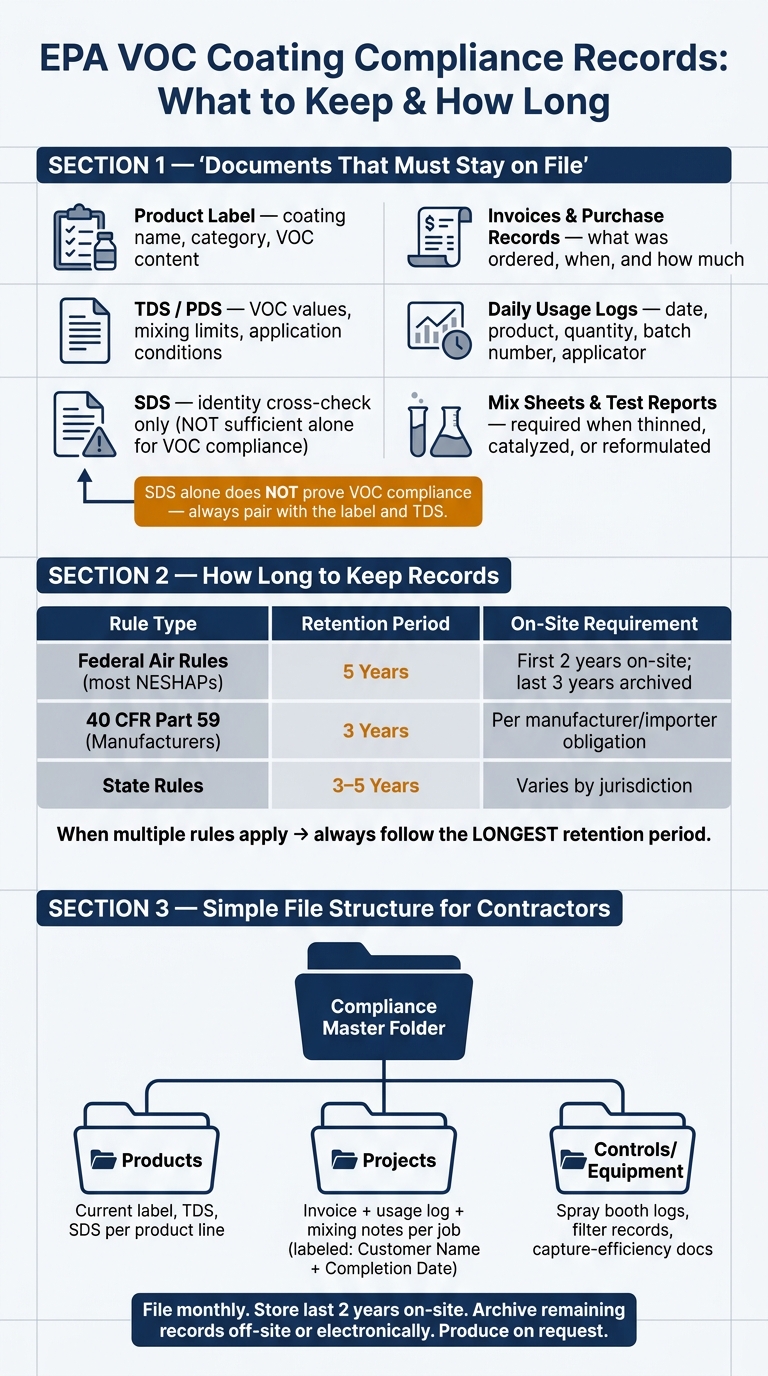
The product label shows the coating name, category, and VOC content. That makes it the starting point for the product’s compliance basis before application. The technical data sheet (TDS), sometimes called the product data sheet (PDS), adds more detail, including VOC values and mixing limits. It can also list regulatory VOC, solids content, application conditions, and allowed thinning or mixing directions.
An SDS helps confirm product identity and ingredient profile, but on its own, it often does not give enough category-specific VOC data to prove compliance. Use the SDS as a cross-check for identity, not as the main VOC record. If the label and TDS don’t match, keep both and note which version was used on site.
Those records should match the invoices and the field logs. If they don’t, that’s a red flag.
Invoices, Purchase Records, and Usage Logs
Invoices and purchase records show what was ordered, when it was bought, and in what quantity. They help prove that the right product and amount came onto the job, and they should line up with what the usage log says was applied on site.
A usage log should record:
- Date
- Project name or address
- Product name
- Quantity used
- Batch or lot number, if available
- Person responsible for the application
It should also list related materials such as reducers, catalysts, hardeners, sealers, and cleanup solvents. Those materials can change the final VOC calculation or affect compliance status. For multi-day jobs, daily logs are the way to go.
When materials are changed on site, the mix record becomes the main proof.
Test Data, VOC Calculations, and Mixing Records
If a coating is thinned, catalyzed, or changed in any other way before application, the as-supplied VOC number no longer gives the full picture. Mixing records should show the starting product, the amount of each additive, the final batch volume, and the VOC content as applied. A coating that met the limit as supplied can drift over the line once reducer is added, so that mix data has to stay in the file.
Lab reports, Method 24 results, or similar test data also belong in the file when compliance depends on a measured VOC result. This matters most for specialty coatings, custom blends, and reformulated products. The test report should identify the tested formulation, the test date, the method used, and the final VOC result. If the product was reformulated later, the current job file should not rely on an old test report unless someone has confirmed that the formulation matches the batch that was used.
Once the file is complete, the next issue is retention: how long these records must stay on file.
How Long to Keep Coating Compliance Records
Once the file is complete, keep it for as long as the rule says. For most U.S. coatings contractors, 5 years is the default retention period unless another rule requires more time.
Typical Federal and State Retention Periods
Many federal air rules require coating records to be kept for 5 years. The first 2 years must stay on site and be available for inspection. The remaining 3 years can be archived off site, as long as they can be produced promptly during a review.
Under 40 CFR Part 59, manufacturers and importers generally keep certain architectural-coating records for 3 years. That difference matters. A product manufacturer’s recordkeeping duty is not always the same as a contractor’s job-level recordkeeping duty, and contractors often need to keep their own files longer.
State rules often land in the 3- to 5-year range, so local requirements may be shorter or longer than the federal rule.
What to Do When More Than One Rule Applies
When a job falls under more than one rule – such as a state VOC limit, a federal NESHAP, and an air permit – follow the longest retention period that applies. If you rely on a shorter state rule while a 5-year federal rule also applies, you could throw away records that the law still requires you to keep.
For contractors working across state lines, a single company-wide policy set at 5 years cuts out a lot of guesswork. In plain English, it gives your team one rule to follow instead of a patchwork of state-by-state timelines.
A practical setup looks like this:
- Keep one complete file per job
- Store the most recent 2 years on site and ready for inspection
- Archive the remaining records off site or electronically
- Make sure archived records can be produced promptly when requested
That approach helps meet the most common federal and state requirements without forcing your team to manage a different filing system for each jurisdiction.
After retention is set, the next question is where the records are stored and how quickly they can be produced.
How to Organize Files for a Compliance Review
Once retention is in place, the next step is simple: make the file easy to produce. You want a setup where anyone on your team can pull the right records fast.
What an Inspector Will Expect to See
Inspectors usually review a standard set of documents in a pretty predictable order:
- Current product list – every coating used during the review period, including product name, manufacturer, and coating category
- Label + TDS + SDS – VOC records showing VOC content in grams per liter and any VOC category or exemption that applies
- Invoices + usage logs – purchase and application records that show what was bought matches what was applied
- Mix sheets or test reports – needed when a product was thinned, catalyzed, or changed before application, or when compliance depends on a measured result
For multi-component systems such as polyaspartics, epoxies, or polyurethanes, inspectors often want mixing records or batch sheets that show component ratios and list any reducers or additives. If control equipment is used to cut emissions, they may also ask for maintenance logs, operating settings, and capture-efficiency records. In plain terms, the file should show one clear path: purchased, documented, applied.
Paper vs. Electronic Files
That checklist gets much easier to manage when your filing system stays consistent. Electronic records are fine as long as they are complete, readable, and easy to pull without special access.
For most coating contractors, a hybrid setup works best. Crews can fill out paper usage logs and keep original labels or batch stickers in a physical project folder. Then office staff can scan those records into matching digital project folders on a set schedule. Using the same project names and dates in both paper binders and digital folders makes it much easier to move between formats during a review.
A Simple File Structure for Coating Contractors
Use one master compliance folder with three subfolders:
| Subfolder | What Goes Inside |
|---|---|
| Products | One folder per product line with the current label, technical data sheet, and SDS |
| Projects | One folder per job (customer name + completion date) with the invoice, usage log, and mixing notes |
| Controls/Equipment | Spray booth logs, filter change records, and capture-efficiency documentation |
File documents monthly so the record is ready before an inspection starts.
With the file organized, the last question is which records matter most.
Conclusion: The Records That Matter Most
The records that matter most are the ones that connect the product to the job and show the VOC basis for that job: labels, tech sheets, SDS, invoices, usage logs, VOC calculations, and test data. Those documents do the heavy lifting. Once they’re in place, the next question is simple: how long do you need to keep them?
Keep records for the longest period that applies; for most contractor files, that means 5 years. In practice, that turns retention into a filing rule, not just office upkeep. And if you’re dealing with proprietary coating systems, keep manufacturer VOC certification letters, product test reports, and job-level mixing records with the standard file set.
The bottom line is simple: complete, organized files make compliance reviews faster and easier to defend. If records are missing or scattered, you can still face a recordkeeping violation even when the job itself met the limit.
FAQs
Do I need an EPA VOC form for every coating job?
Not necessarily. You might not need a separate, standalone EPA VOC form for every coating job.
But you do need a complete project file that shows the job met federal and local VOC rules.
That file should include:
- Product name and SKU
- SDS
- Technical data sheets
- VOC compliance statement
- Batch numbers
- Any lab test results showing the coating met VOC limits at the time of application
In plain English: the goal isn’t just to have a form. It’s to have a paper trail that proves the coating you used was within the allowed limits when it was applied.
What records prove VOC compliance?
Keep a complete project file for the coating. At a minimum, include:
- product name and SKU
- SDS
- TDS
- official VOC compliance statement
- batch numbers
- any relevant lab test results
Compliance is based on ready-to-use VOC content. So your records need to show the mixed-system value and confirm that it meets the federal, state, or local limit that applies to the job.
How long should I keep coating VOC records?
Retention periods for VOC records can vary based on local rules and the size of the job. So it’s smart to keep detailed records of product use and emissions in case an inspector asks for them or a compliance issue comes up.
It also helps to keep installation paperwork, moisture test results, and maintenance logs. Those records can support Croc Coatings warranty claims later on. Digital backups make the process easier and help show due diligence.