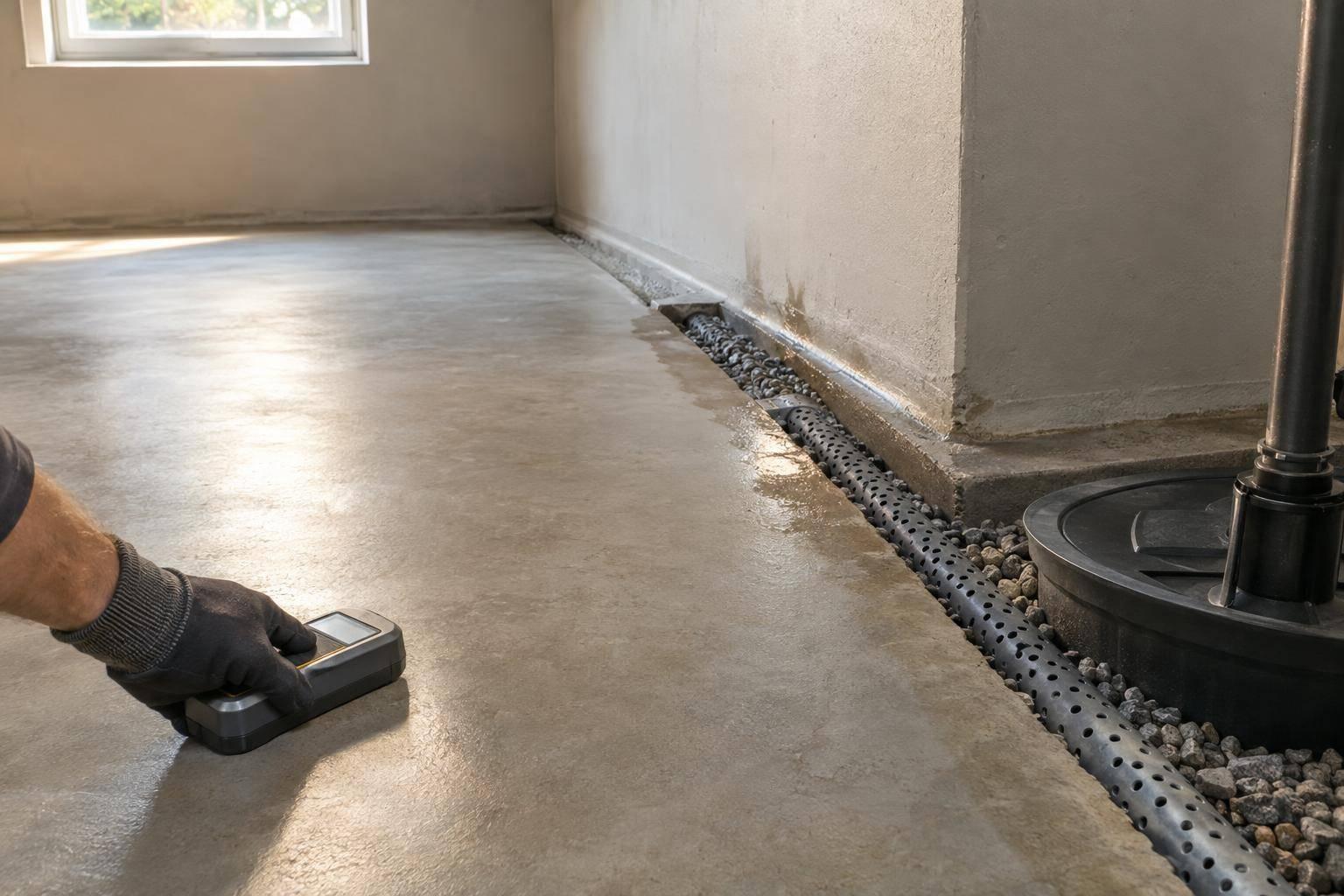
If I get just four things right, I avoid most VOC mistakes: the coating category, the job location, the mixed VOC number, and the product paperwork.
VOC rules are not one national limit. In the U.S., I start with the federal baseline, then check state and local rules that may be much lower. A coating that passes at 400 g/L or 450 g/L under a federal category can still fail in a local district at 100 g/L or even 50 g/L. And with two-part systems like epoxy or polyurea, the number that counts is the ready-to-use mix, not Part A or Part B alone.
Here’s the short version:
- VOC is measured by rule, not by sales language.
- g/L and lb/gal are the common units; 120 g/L is about 1 lb/gal.
- Category controls the limit. “Industrial maintenance” and “floor coating” can have different caps. Use an industrial floor coating planner to help navigate these requirements during the project design phase.
- Lower local limits win when federal, state, and local rules differ.
- Mixed-system VOC content is what I check for multi-component coatings.
- Labels matter. How a product is described can affect which rule applies.
- Product VOC content and facility emissions are two different checks.
- Canada, the EU, and the UK use different categories, limits, and test methods, so I do not compare claims across markets without checking the rule behind them.
Industrial Surface Coating VOC and HAP regulation update (October 2018 Technical Subcommittee)
sbb-itb-a0e5ae3
Quick comparison
| Topic | What I check first | Why it matters |
|---|---|---|
| U.S. federal rules | EPA coating category | Sets the base VOC cap |
| State/local rules | Air district or state rule | May be much lower than federal |
| Two-part coatings | Mixed VOC content | That is the compliance number |
| Low-VOC claims | Actual g/L and rule cited | “Low-VOC” alone does not prove anything |
| Global products | Region-specific category and method | Canada, EU, and UK do not match U.S. rules |
Bottom line: before I approve any floor, garage, patio, or shop coating, I match the product to the right category, right place, right mixed VOC number, and right documents.
VOC Basics and How Coatings Are Classified
To read VOC rules the right way, start with the units and the coating categories regulators use.
VOC, g/L, and lb/gal: What the Numbers Mean
Regulators judge VOCs based on what gets counted and which test method is used. So compliance comes from the rule’s VOC definition and test method, not from marketing copy. In plain English: the mixed product is what counts, not the sales pitch.
VOC content is usually shown in g/L, though some U.S. rules still use lb/gal. A handy rule of thumb is that 120 g/L is roughly 1 lb/gal.
For compliance, the number that matters is the mixed VOC content – the VOC level after all parts are combined at the manufacturer’s stated mix ratio. That’s a big deal with two-component systems like polyurea and epoxy. Looking at Part A by itself won’t tell you if the product complies. Regulators look at the formulation after all required components are mixed together.
Industrial Coatings, Industrial Maintenance Coatings, and Floor Coatings: Key Differences
People often use these terms loosely, but the regulatory category is what sets the VOC limit.
Industrial coatings are the broad bucket. Industrial maintenance coatings and floor coatings are narrower end-use categories. Industrial maintenance coatings are usually meant to protect existing structures, equipment, or surfaces in harsh service conditions, such as water immersion, corrosive chemicals, high heat, or heavy abrasion.
Floor coatings are defined by how they’re used. That means the same product can land in different regulatory categories depending on where and how it’s sold – for example, a residential garage, a commercial showroom, or an industrial maintenance setting.
That distinction changes the VOC limit that applies.
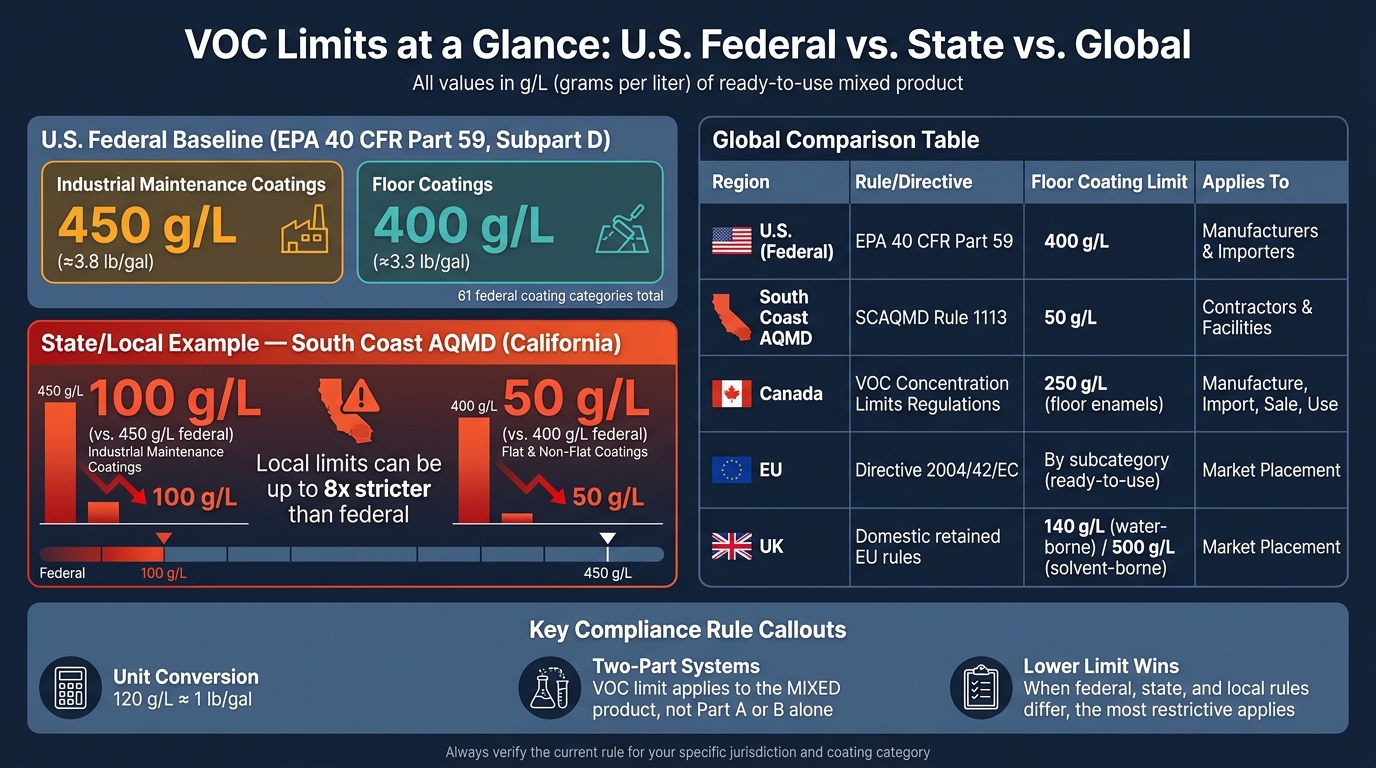
Federal tables list industrial maintenance coatings at 450 g/L (3.8 lb/gal) and floor coatings at 400 g/L (3.3 lb/gal). That 50 g/L gap can make or break compliance, depending on the product’s classification.
EPA guidance also says that when a product fits more than one category, the lower, more restrictive limit generally applies. Label claims matter too. A product can qualify for a category based on how it’s represented on the container, not only on its chemistry. In other words, the label isn’t just packaging – it can affect the rule that applies.
Product VOC Content vs. Facility Emissions
These are two separate compliance questions.
Product VOC content is the VOC amount in the coating itself – the figure you see on the technical data sheet. Facility emissions are the VOCs released over time through manufacturing, storage, spraying, curing, and cleaning. Those emissions are covered by a different set of rules.
For floor projects, product VOC content is usually the main compliance check. But larger sites can also face separate emissions rules. Some rules set hard thresholds for site-wide emissions. One example is 2.7 tons per 12-month rolling period. Crossing that line can trigger added duties such as permitting, recordkeeping, or emissions controls that go beyond what’s on the product label.
With those basics in place, the next step is how federal rules assign limits by coating type.
U.S. VOC Rules: Federal Baselines and Stricter State or Local Limits
VOC Limits by Region & Coating Category: 2026 Compliance Guide
U.S. VOC compliance does not come down to one rule. It works as a layered system: federal rules set the baseline, and states or local air districts can set lower limits. So the first step is simple, but easy to miss: figure out which layer applies to your project.
How Federal Rules Define Coating Categories
EPA’s Architectural Coatings rule, codified at 40 CFR Part 59, Subpart D, sets federal VOC limits for 61 coating categories, measured in g/L less water and exempt compounds. Industrial maintenance coatings are set at 450 g/L (≈3.8 lb/gal), and other categories such as chemical-resistant floor coatings have their own category-specific limits.
The key point is this: compliance turns on EPA category definitions, not product marketing names. A label can say one thing, but the legal category is what counts. The rule uses EPA Method 24, or an equivalent method, to measure VOC content. Manufacturers and importers carry the main compliance duty, not applicators.
Still, contractors aren’t off the hook in practice. They need to check that the product they buy fits the right category for the intended use. If a product is misclassified, a project can fall out of compliance before the first coat goes on. And that federal baseline is only the starting line – local rules can drop the limit fast.
State and Local Rules Can Set Lower Limits
Federal limits set the floor. EPA explicitly advises regulated entities to check state and local requirements, which may be stricter.
California shows how far that gap can go. South Coast AQMD Rule 1113 caps industrial maintenance coatings at 100 g/L – far below the federal 450 g/L limit. Flat and non-flat coatings in that district are capped at just 50 g/L. Other state programs also use tighter category limits than the federal baseline.
State and local rules also get more specific. Federal rules use broad categories, but local programs often split them into narrower ones, such as floor coatings, traffic marking coatings, waterproofing membranes, or essential public service coatings. Each one can carry its own VOC cap. That means a product that fits neatly into one federal category might fall into a different – and more restrictive – local category based on how it’s used and where it’s applied.
Federal vs. State and Local Enforcement: A Side-by-Side Look
Enforcement follows that same layered setup. Federal enforcement targets manufacturers and importers – EPA checks whether products sold nationwide meet category limits and labeling rules. State and local agencies handle what happens on the ground: jobsite inspections, product checks, and permit compliance for facilities that apply coatings on a regular basis.
A practical way to think about it: federal rules deal with product compliance, while state and local agencies often deal with site-level permitting and use.
| Factor | Federal (EPA) | State and Local (Air Districts) |
|---|---|---|
| Primary rule | 40 CFR Part 59, Subpart D | State architectural coating rules; local district rules (e.g., SCAQMD Rule 1113) |
| Who is regulated | Manufacturers and importers | Contractors, facility operators, and sometimes manufacturers |
| VOC limits | Baseline, such as 450 g/L for industrial maintenance coatings | Often stricter, such as 100 g/L in South Coast AQMD |
| Category detail | 61 broad categories | More granular; may include floor, traffic, and waterproofing subcategories |
| Enforcement focus | Product formulation and labeling | Jobsite use, permit conditions, usage records |
Large facilities may also face separate emissions permits, recordkeeping duties, or control requirements that go beyond product VOC limits.
Once the U.S. baseline is clear, the next step is reading low-VOC claims under Canada, EU, and UK rules.
Global VOC Frameworks and Common Label Terms
Canada, EU, and UK VOC Rules at a Glance
Outside the U.S., VOC rules don’t line up neatly. Canada, the EU, and the UK use different product categories, different limits, and different enforcement points. That matters when you’re reading a product data sheet or choosing polyurea or epoxy coatings for a project that crosses borders. Before you compare two products, make sure you’re comparing them under the same rule set.
Canada regulates architectural coating VOCs through the Volatile Organic Compound (VOC) Concentration Limits for Architectural Coatings Regulations. The rules cover 53 coating categories with limits from 100 g/L to 800 g/L, depending on the product type. Floor enamels and other opaque floor coatings usually sit under a 250 g/L cap. The Canadian rules apply to manufacture, import, sale, and offer for sale – and sometimes use. For multi-component products, the limit applies after all parts are mixed according to the manufacturer’s instructions. So for floor coatings, the number that counts is the mixed g/L value, not just the base component on its own.
The EU regulates paints and varnishes under Directive 2004/42/EC, often called the Decopaint Directive. It sets ready-to-use VOC limits by product subcategory. For industrial floor work, the main category to watch is two-pack reactive performance coatings for specific end use such as floors. The directive focuses on market placement, which means manufacturers and importers have to meet the g/L cap before sale. If you’re checking a floor product for an EU project, confirm the product’s EU subcategory first. Otherwise, the g/L figure can be misleading.
The UK follows the same general setup, but its guidance uses domestic limits and test methods. For floor applications, two-pack reactive performance coatings are capped at 140 g/L (water-borne) and 500 g/L (solvent-borne), measured by EN 11890-2. In the UK market, that category is the starting point for a floor-coating check.
How to Read Low-VOC and VOC-Compliant Claims
Terms like low-VOC, VOC-compliant, and exempt solvent show up all the time on product data sheets. The catch is simple: they do not have one shared legal meaning across all markets. The practical test is straightforward: does this product meet the rule that applies to this job?
"Low-VOC" is mostly a marketing or purchasing term. Unless you’re working within a defined purchasing standard, check the measured g/L number and the product category tied to it.
"VOC-compliant" means the product meets the limit for the category and market in question. But categories and limits change by region, so a product can comply in one place and still fail somewhere else. A compliance claim should say which rule it refers to.
"Exempt solvent" means the product contains volatile compounds that some rules leave out of the VOC total because of low photochemical reactivity. That can change how the g/L number is calculated, so don’t assume a product is low-VOC just because exempt solvents are involved.
"Ready-to-use VOC content" is the clearest term to look for on a label. EU, UK, and Canadian rules all apply limits to the product as prepared for application. In plain English, that means you want the figure for the mixed product – not the resin alone, and not the hardener alone.
The table below shows how the main regions handle these terms in practice.
U.S., Canada, EU, and UK: Regulatory Comparison Table
| Region | Regulatory Focus | Enforcement Target | Floor Coating Treatment |
|---|---|---|---|
| Canada | VOC concentration limits across 53 architectural coating categories | Manufacture, import, sale, offer for sale, and in some cases use | Floor enamels and opaque floor coatings capped at 250 g/L; limits apply to ready-to-use mixtures |
| EU | Maximum ready-to-use VOC content under Directive 2004/42/EC | Market placement | Two-pack reactive performance floor coatings; ready-to-use limits apply by subcategory |
| UK | Retained EU-style solvent limits in domestic regulations | Market placement | Two-pack reactive performance floor coatings: 140 g/L (water-borne) and 500 g/L (solvent-borne); EN 11890-2 test method |
Once you know the category, the limit, and what the label term is actually pointing to, you can check whether the product fits the rule for the jobsite. To find the right balance of compliance and performance, use an industrial floor durability analyzer to compare options for your specific environment.
Compliance Steps and Low-VOC Polyurea for Floor Projects
A Step-by-Step VOC Compliance Checklist
Start by pinning down the exact regulated coating category and the jurisdiction that applies. That part matters more than it may seem, because the VOC limit depends on the category the product falls into. If a product could fall under more than one category, the most restrictive limit governs.
The gap between rules can be huge. South Coast AQMD, for example, caps floor coatings at 50 g/L, while the federal baseline is 400 g/L. Once you know the jurisdiction, check the ready-to-use VOC content. That means the VOC level of the mixed system after all required components have been combined.
Then move to the paperwork. Review the SDS, TDS, label, and compliance statement side by side. Keep a project file with:
- Product name and SKU
- SDS
- Technical data sheet
- VOC compliance statement
- Batch numbers
- Any lab test results
If the coating’s VOC status gets challenged after installation, that file is the record that backs up the claim.
Once the category and jurisdiction are locked in, the next move is simple: check the mixed-system VOC number.
Where Low-VOC Polyurea Fits in Garages, Patios, and Industrial Floors
After compliance, the next step is picking the right system. Low-VOC polyurea can work well for enclosed spaces and high-wear floor projects such as garages, basements, patios, pool decks, and industrial floors, as long as the full mixed system meets the local VOC limit.
The two questions that matter are pretty direct: What is the VOC content of the complete system as applied? And does that number meet the limit for this jurisdiction? That’s the heart of it.
Primers, body coats, and topcoats may each have different VOC profiles. So the number that counts is the VOC content of the full system, not just one part of it.
Conclusion: What to Check Before You Approve a Coating
Use the same four-step check for every floor system: identify the exact regulated category, confirm the governing jurisdiction, verify the ready-to-use mixed-system VOC content, and review the SDS, TDS, label, and compliance statement together. Approve the coating only when the category, jurisdiction, mixed VOC content, and documents all line up with the rule.
FAQs
How do I find the right coating category?
Start by checking the product label for its classification, such as architectural or industrial, and its VOC content in g/L. VOC limits depend on how the product is meant to be used, so make sure the product lines up with the right standard.
If the label doesn’t say enough, look at the manufacturer’s technical data sheet. For residential projects, low- or zero-VOC formulas can be a better choice when indoor air quality matters.
Which VOC number counts for a two-part coating?
For a two-part coating system, the VOC content that matters is the value for the mixed material after the components are combined.
With reactive systems, testing usually includes an induction period before volatile content is measured. In most cases, that means 1 hour at room temperature. Manufacturers must report this VOC content in g/L, excluding water and exempt compounds.
Can a coating be federally legal but fail locally?
Yes. A coating that meets federal VOC rules can still be illegal locally if a state or air district has stricter limits.
Federal EPA rules set the baseline. But some jurisdictions enforce lower VOC caps to protect local air quality. So before application, check local rules along with federal requirements.