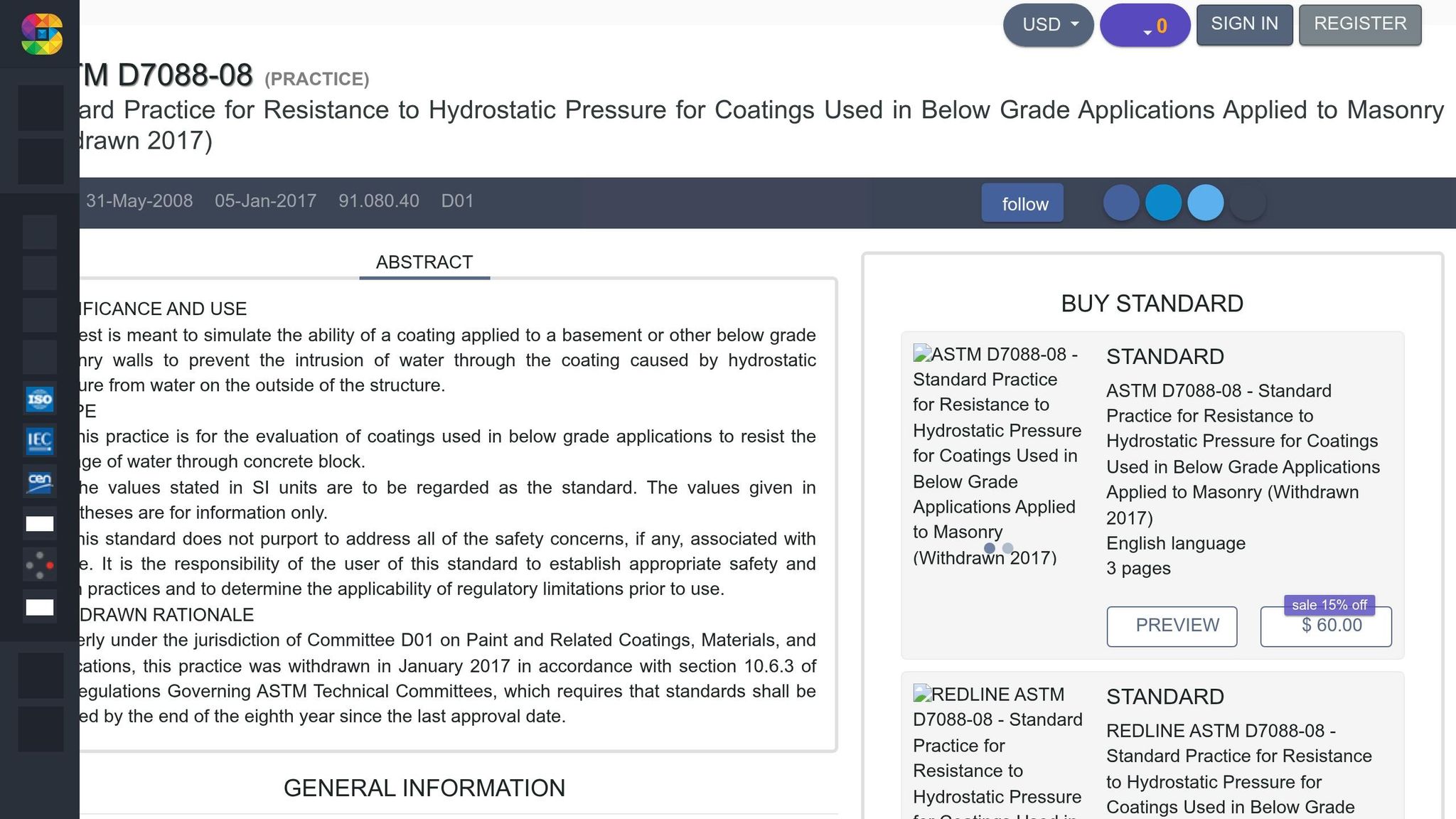
If water is pushing through concrete from below, ASTM D7088 tells me only one thing: whether a coating held up in a lab test under about 4 psi of back-side water pressure.
Here’s the short version:
- ASTM D7088 is about hydrostatic pressure, not general dampness
- The test uses 8 in. × 8 in. × 8 in. concrete block units
- The coated block sits with water in its core for 7 days
- After that, pressure is added to check for:
- blistering
- droplets
- bond failure
- softening
- discoloration
- A pass means the coating stayed intact on the tested block assembly
- A pass does not mean the coating will work the same on every basement floor or job site
What matters most? If I’m looking at a basement floor coating moisture problems, I should read ASTM D7088 as a narrow lab result, not a blanket promise about wear, UV exposure, cracks, drainage, or long-term service life.
This matters in places with wet soil, snowmelt, or groundwater pressure, because even a small pressure load can push moisture through porous concrete and lead to common coating failures.
The article below explains how to test for hydrostatic pressure, how the setup works, what a passing result means, and where that result fits when I’m judging coatings for moisture-prone concrete spaces.
ASTM D7088 and Hydrostatic Pressure Resistance
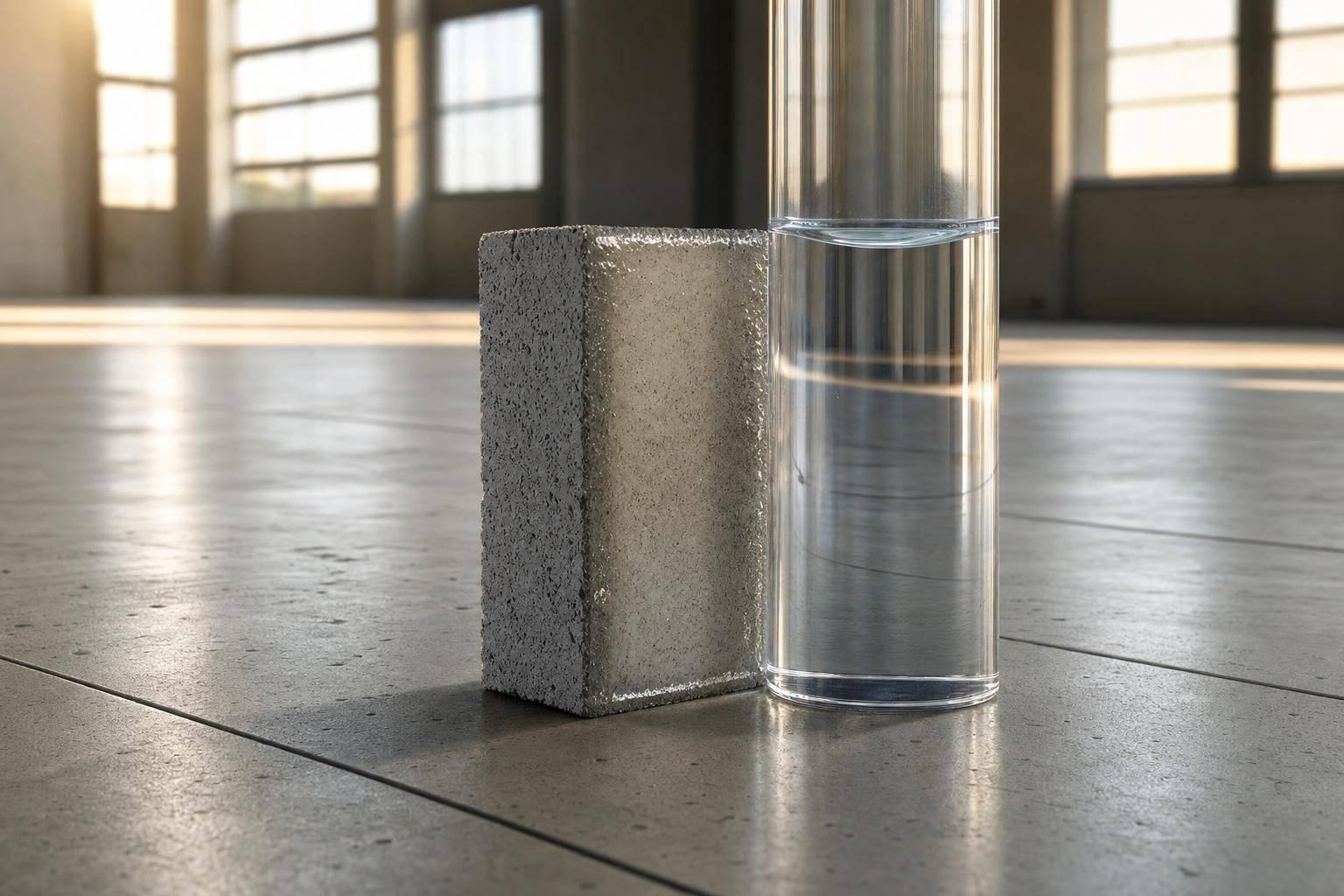
Hydrostatic pressure is water pressure that pushes moisture through concrete from below or from the outside. ASTM D7088 tests how well a below-grade coating stands up to that pressure on the negative side. That means the water pushes on the side of the coating bonded to the concrete, not the side you can see.
That detail matters. Below-grade coatings don’t fail the same way surface coatings do, because the pressure comes from behind. ASTM D7088 is built to mimic water pressure moving through below-grade concrete floors and walls from the outside.
When a coating can’t handle that pressure, the failure pattern is usually pretty clear: common coating defects like blistering, delamination, and dark staining. Those are signs that the bond between the coating and the concrete has started to give way.
Why Below-Grade Concrete Is Exposed to Water Pressure
The pressure builds when the soil around the concrete stays saturated. Below-grade concrete is in direct contact with soil, and soil holds water. After rain, snowmelt, or heavy irrigation, that soil can load up with moisture and push it through the pores in the concrete.
This is common in Spokane, Coeur d’Alene, and the Tri-Cities, where snowmelt and irrigation can saturate soil around below-grade concrete. As that happens, water pressure pushes moisture upward through the concrete’s pores and can lift the coating away from the substrate. That is the same kind of back-side pressure ASTM D7088 is meant to reproduce.
sbb-itb-a0e5ae3
What ASTM D7088 Measures and How the Test Works
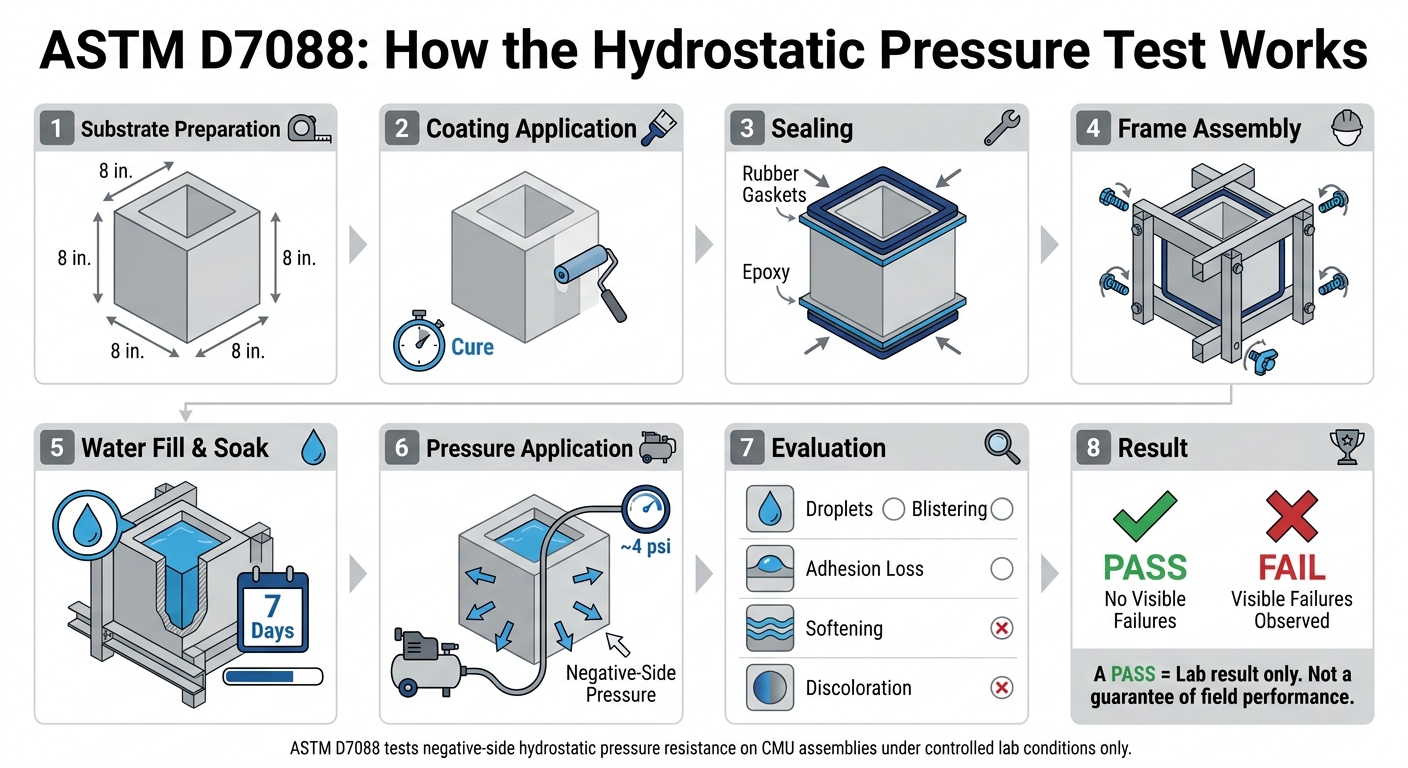
How ASTM D7088 Hydrostatic Pressure Test Works
What the Test Measures
ASTM D7088 has a tight purpose: it checks whether a below-grade CMU coating can resist water intrusion caused by exterior hydrostatic pressure. It does not measure general moisture exposure. That distinction matters when designing concrete floors for hydrostatic pressure control in basements and other below-grade areas.
The test is built around a lab setup, and that shapes what a passing result means. ASTM D7088 simulates outside water pressure on a below-grade CMU assembly under controlled conditions. So a pass applies to that test setup and that CMU substrate used in the standard. It doesn’t automatically prove the coating will perform the same way in every jobsite condition. This is why professionals often compare industrial floor coatings to find the right balance of durability and application requirements for specific environments.
How the Test Is Conducted
The standard uses 8 in. × 8 in. × 8 in. hollow-core concrete blocks as the substrate. Technicians coat all four faces, let the coating cure, and then seal the top and bottom with rubber gaskets and epoxy. After that, they secure the block in a galvanized steel frame with bolts and wing nuts.
Next, the hollow core is filled with water and left in place for seven days before pressure is added. Then air pressure is brought up to about 4 psi with either a compressor or a hand pump.
From there, evaluators look for visible signs of failure, such as:
- Droplets
- Blistering
- Adhesion loss
- Softening
- Discoloration
Those visible changes decide whether the coating passes or fails. A passing result means the coating resisted hydrostatic pressure on the tested assembly under the stated lab conditions. For below-grade floors, that’s the point of the method: it shows only minimal visible failure during the test, not blanket proof of field performance in every situation. What counts as a pass is the part that shapes how the standard should be used.
How to Interpret ASTM D7088 Results for Concrete Floor Coatings
Reading a Passing Result
A passing ASTM D7088 result means the coating blocked visible water intrusion in the tested masonry unit under hydrostatic pressure without visible failure. That’s useful information. But it only applies to this narrow lab setup.
A pass does not prove field performance on other substrates or under different surface prep, crack, or drainage conditions. It also says nothing about UV stability, abrasion, chemical resistance, or other durability limits.
ASTM D7088 Results at a Glance
Read the result as a lab pass, not a blanket performance promise.
- Hydrostatic pressure resistance: The coating resisted water passage and kept its film intact under about 4 psi in a controlled lab setting. But field results may differ if surface prep, cracks, or drainage conditions don’t match the test setup.
- Visual film integrity: No blistering, softening, or discoloration showed up during the pressure cycle. Still, the test does not cover long-term UV stability, color retention, or resistance to abrasion and mechanical wear.
- Adhesion and discoloration: The coating stayed bonded to the masonry unit and showed no discoloration under external water pressure. But it does not cover adhesion on contaminated or poorly profiled surfaces.
That narrow scope is why the next section focuses on where ASTM D7088 applies.
Where ASTM D7088 Applies in Below-Grade Spaces
Basements, Utility Areas, and Moisture-Prone Commercial Spaces
Once you have the lab result, the next step is figuring out where it matters on the job. ASTM D7088 is most useful for concrete block or masonry units in below-grade spaces where groundwater infiltration is a risk. In plain terms, these are areas dealing with moisture pressure pushing in from outside the structure.
For below-grade concrete floors, D7088 should be treated as one sign of moisture resistance, not a full rating of how a product will perform in every condition. That narrow use case is exactly why the test helps with site selection instead of broad durability claims.
If you’re planning a basement or below-grade coating project in North Idaho or Eastern Washington, ask for product data sheets that cover hydrostatic pressure resistance and how moisture affects coating performance. Croc Coatings works with residential and commercial customers across the region and can help you figure out whether a coating system fits your space.
Conclusion: Key Points From ASTM D7088
ASTM D7088 is a narrow test for below-grade masonry exposed to outside water pressure. Use it to judge hydrostatic pressure resistance in basements, utility rooms, and similar moisture-prone spaces.
FAQs
Does ASTM D7088 apply to concrete floors or mainly CMU block?
ASTM D7088 is used mainly to evaluate coatings on concrete block or masonry units in below-grade applications, like basement walls. It looks at how well a coating resists water moving through concrete block walls.
It is not the standard used to test hydrostatic pressure resistance on horizontal concrete floors. For concrete floor slabs, Croc Coatings uses the Penntek Evolution industrial coating system for moisture-resistant protection.
Is a passing ASTM D7088 result enough to choose a coating?
No. A passing ASTM D7088 result by itself is not enough to choose a coating.
That test shows how well a coating stands up to hydrostatic pressure in below-grade masonry. But it does not replace site-specific moisture testing or proper surface prep.
You still need to check internal moisture before application using standards like ASTM F2170 or F1869.
What site conditions can cause failure even if a coating passes?
Even when a coating stands up to hydrostatic pressure, it can still fail because of osmotic pressure. Here’s what that means in plain English: soluble salts or other contaminants in the concrete can draw moisture through the slab. As that moisture builds, it creates pressure under the coating and can make it lift.
A few other things can cause the same kind of failure:
- Poor surface preparation
- Excess moisture vapor transmission above 80% relative humidity
- Missing vapor barriers
- Shear stress caused by different expansion rates between concrete and rigid coatings
It’s a bit like putting a stiff shell over a surface that keeps moving underneath. If the concrete and coating expand at different rates, that stress has to go somewhere – and often, the coating pays the price.