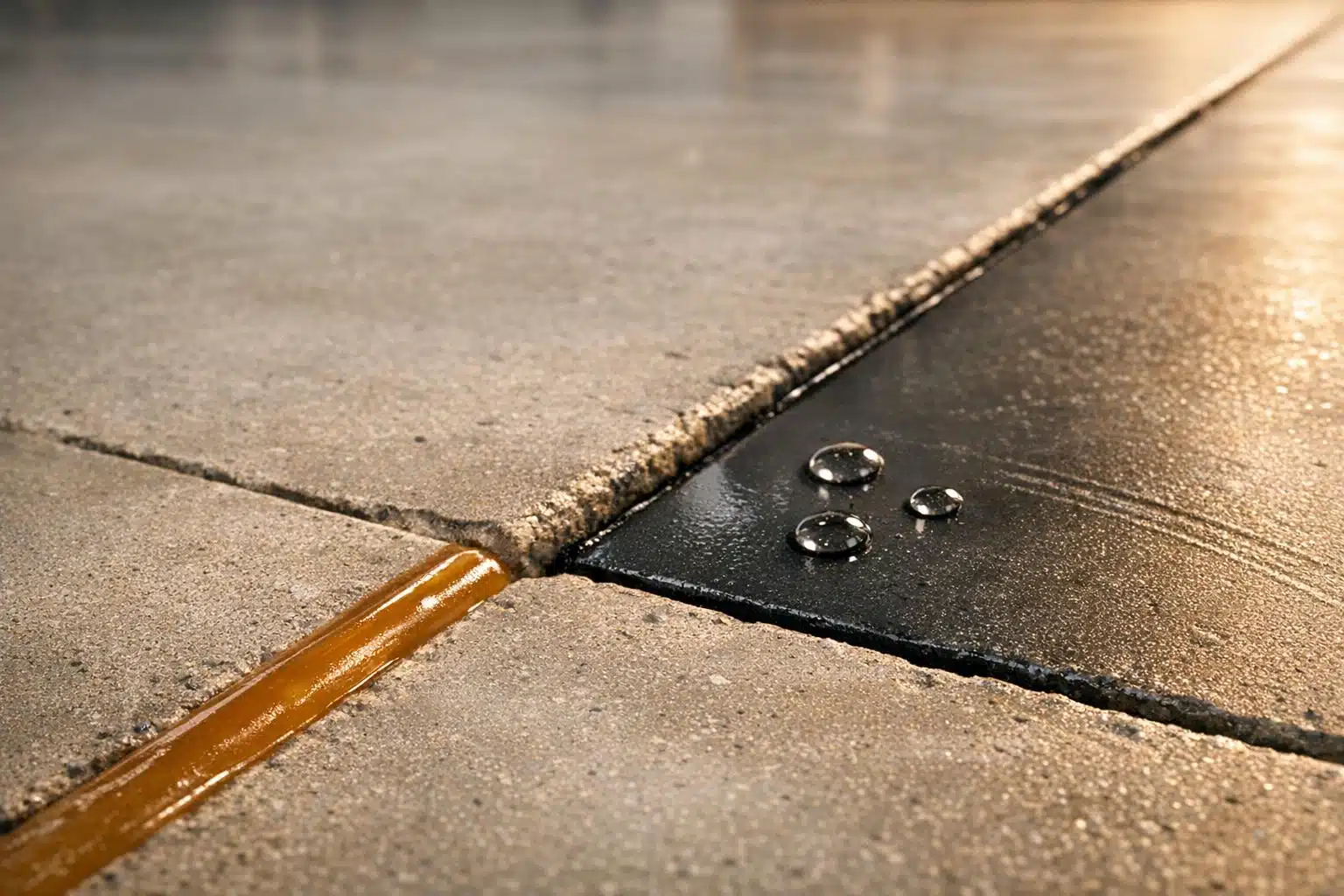
When it comes to repairing concrete joints, polyurea and epoxy are the two most common options. Choosing the right material depends on factors like flexibility, cure time, temperature conditions, and project requirements. Here’s a quick breakdown:
- Polyurea: Best for projects requiring fast curing (1–2 hours) , a hallmark of rapid cure coatings, extreme temperature durability (as low as -25°F), and high flexibility (up to 400% elongation). Ideal for cold storage or high-movement areas but requires specialized equipment for application.
- Epoxy: Great for heavy traffic areas, damp substrates, and chemical resistance compared. Slower to cure (12–24 hours) and less flexible but easier to apply for smaller projects or DIY jobs.
Quick Comparison
| Feature | Polyurea | Epoxy |
|---|---|---|
| Cure Time | 1–2 hours | 12–24 hours |
| Flexibility | Up to 400% elongation | 5%–50% elongation |
| Temperature | Cures as low as -25°F | Requires above 40°F |
| Application | Requires specialized tools | Easier for DIY/manual use |
| Durability | High abrasion resistance | Better for static joints |
| Cost | $50–$80 per gallon | $20–$40 per gallon |
Key takeaway: Use polyurea for fast, durable results in tough conditions, and epoxy for cost-effective, smaller-scale projects with heavy traffic or chemical exposure.
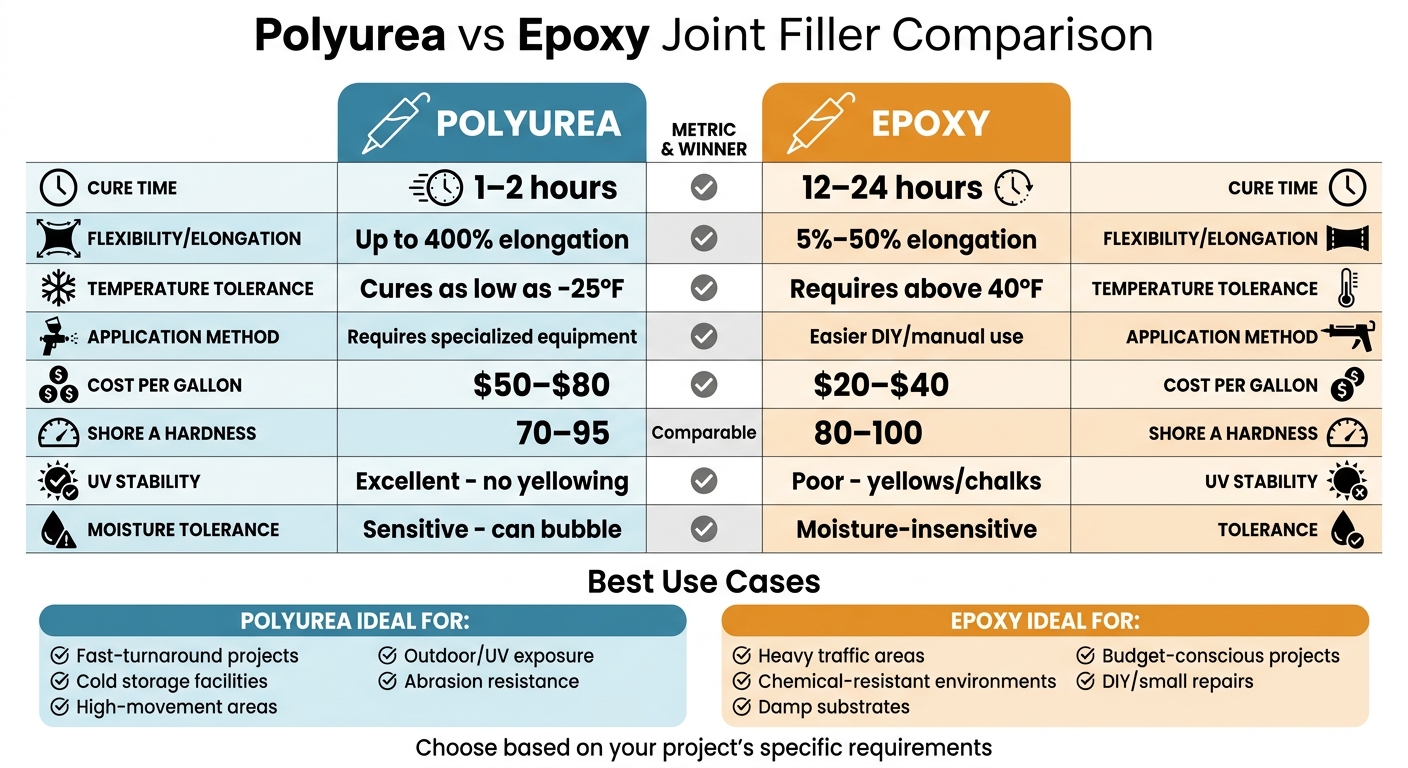
Polyurea vs Epoxy Joint Filler Comparison Chart
Fastest Way to Fix Floor Cracks | Polyurea Joint Filler for Concrete Floors
sbb-itb-a0e5ae3
Epoxy Joint Fillers: Properties and Uses
Epoxy joint fillers are semi-rigid materials specifically designed to protect the edges of concrete joints. With a Shore A hardness rating of 80–85, they are built to handle the demands of heavy, hard-wheeled traffic – like forklifts moving across warehouse floors.
How Epoxy Performs
The strength of epoxy lies in its durability and adhesion, not its flexibility. High-performance epoxy formulations can reach a tensile strength of 770 PSI after seven days and boast 290 PSI adhesion. However, they offer limited flexibility, with only 53% elongation and a tolerance for 5%–8% lateral expansion before failure. This means epoxy fillers are designed to stay firmly in place under stress, but they don’t stretch much.
Temperature plays a critical role in epoxy application. It requires ambient temperatures above 40°F (4°C) to cure properly, and freezing conditions can halt the process entirely. Additionally, curing takes time – epoxy needs 12 to 24 hours before it can be shaved flush with the floor, while polyurea curing vs epoxy times differ significantly, with polyurea curing in just 15 to 30 minutes. Finishing epoxy also requires heated tools to avoid "chattering" due to its rigidity.
One area where epoxy stands out is its moisture tolerance. Unlike polyurea, which reacts poorly to moisture and can result in off-gassing or bubbling, epoxy is moisture-insensitive. This makes it suitable for damp joints or less-than-ideal substrate conditions. As John Bors from ChemCo Systems explains:
"When the substrate is damp, wet, or contaminated, an unprimed epoxy has a better chance of bonding to the sides of the joint than a high speed polyurea."
These characteristics make epoxy a reliable choice for certain industrial floor applications.
Benefits of Epoxy
Epoxy excels in environments with heavy traffic, such as warehouses where forklifts and pallet jacks are common. Its hardness prevents damage to joint edges, even under high point loads. John Love, National Sales Manager at SpecChem, highlights this advantage:
"Epoxy joint fillers offer optimal hardness, typically 80-85 Shore A durometer, while maintaining enough flexibility to help prevent welding the slabs together."
With a 20-minute pot life per gallon, epoxy is easy to apply manually using bulk caulk guns, making it ideal for smaller projects or repairs. It also performs well in chemical-sensitive environments, such as facilities using organic solvents, acids, or sanitizers like bleach, where its chemical resistance surpasses that of polyurea. Another practical benefit is that epoxy can be cleanly removed with a saw if needed, unlike polyurea, which tends to shred during removal.
Drawbacks of Epoxy
Despite its strengths, epoxy has some notable limitations. Its slow cure time is a major drawback, often extending project schedules and increasing labor costs. While polyurea can be ready for traffic in as little as one to two hours, epoxy may take up to 24 hours before it can be shaved flush. This delay can be costly in commercial settings where downtime impacts revenue.
Another issue is epoxy’s limited flexibility. Its tolerance for only 5% to 8% lateral expansion makes it prone to splitting or losing adhesion as concrete slabs shrink. This often results in a "leap-frog" pattern of separation.
Epoxy also struggles with UV stability. Prolonged exposure to sunlight or certain types of interior lighting causes discoloration, turning the material yellowish or greenish over time. This makes it unsuitable for outdoor use or areas with significant natural light. Lastly, its temperature sensitivity eliminates it as an option for cold-storage facilities or freezers, where polyurea is the better choice.
Polyurea Joint Fillers: Properties and Uses
Polyurea joint fillers are highly flexible, fast-setting materials designed to protect concrete joints effectively. With a Shore A hardness of 80–85, they can handle heavy traffic while offering quick installation and excellent durability.
How Polyurea Performs
Polyurea stands out for its impressive tensile elongation of about 400%, far surpassing epoxy’s 25%. This flexibility allows it to handle concrete movement better than many alternatives. However, it does have limitations. Polyurea tolerates only 5%–15% lateral expansion before it splits or loses adhesion, compared to epoxy’s 5%–8% range. When joints expand too much, polyurea tends to separate continuously along one side, while epoxy often shows a "leap-frog" separation pattern.
Its pot life is just a few seconds, requiring specialized meter-mix pump equipment for application. However, once applied, polyurea can be traffic-ready in just 30–60 minutes. It also cures in temperatures as low as –20°F (–29°C), making it a go-to choice for cold-storage facilities and freezers. These characteristics highlight its practicality and efficiency.
Benefits of Polyurea
Polyurea offers several practical advantages, starting with its rapid installation. Unlike epoxy, which can require extended downtime, polyurea allows projects to be completed in hours, cutting labor costs and minimizing disruptions. For example, Croc Coatings uses polyurea’s quick curing ability to finish joint filling within a single day, seamlessly integrating it into larger floor coating projects without delaying timelines. Despite its speed, polyurea still provides the hardness needed to protect joint edges from heavy machinery impacts.
Another major advantage is its reliability in extremely cold environments. Ice rinks, refrigerated warehouses, and similar facilities benefit from polyurea’s ability to cure in sub-freezing temperatures, even well below 32°F (0°C). While both polyurea and epoxy can discolor under prolonged UV exposure or strong interior lighting, polyurea shows slightly better resistance to such effects.
Drawbacks of Polyurea
Despite its strengths, polyurea has some downsides. Its extremely short pot life necessitates the use of specialized meter-mix pump equipment, making it less suitable for small-scale repairs or DIY projects. Additionally, if repairs or replacements are needed, removing polyurea can be a challenge. It tends to shred when cut with a sawblade, unlike epoxy, which can be removed more cleanly.
Polyurea vs Epoxy: Side-by-Side Comparison
Property Comparison Table
This table highlights how polyurea and epoxy perform across various properties, emphasizing their impact on joint integrity and application suitability:
| Property | Polyurea | Epoxy | Advantage |
|---|---|---|---|
| Shore A Hardness | 70–95 | 80–100 | Polyurea (flexible) |
| Elongation | 300–800% | 5–50% | Polyurea |
| Cure Time | 5–15 minutes | 24–72 hours | Polyurea |
| Adhesion (psi) | 2,000–3,000 | 1,500–2,500 | Polyurea |
| UV Stability | Excellent (no yellowing) | Poor (yellows/chalks) | Polyurea |
| Application | High-pressure spray | Pour/roller | Epoxy (small jobs) |
| Ease of Removal | Difficult (grinding) | Easier (sanding/peeling) | Epoxy |
What the Differences Mean
This comparison highlights key distinctions between polyurea and epoxy, helping to clarify which material fits specific needs.
Polyurea stands out for its durability and flexibility, making it the go-to choice for concrete joints that endure frequent movement or outdoor conditions. Its impressive elongation range of 300–800% prevents cracking in high-movement areas, while epoxy’s limited elongation (5–50%) makes it more prone to failure under stress. Polyurea also offers a rapid cure time of just 5–15 minutes, allowing for same-day project completion, compared to epoxy’s extended 24–72 hour curing period. For outdoor use, polyurea resists yellowing and chalking, maintaining its appearance over time. Its strong adhesion (2,000–3,000 psi) ensures a reliable bond even on less-than-perfect concrete surfaces, requiring less surface prep compared to epoxy’s 1,500–2,500 psi adhesion. Companies like Croc Coatings take advantage of these benefits with their Penntek Evolution system, which is engineered to be four times stronger than traditional epoxy and comes with a lifetime warranty for residential and commercial concrete coatings.
On the other hand, epoxy is a solid choice for smaller-scale projects. Its straightforward application – using a pour or roller – makes it accessible for DIY enthusiasts who don’t have access to specialized spray equipment. Additionally, epoxy is typically more affordable, costing around $20–$40 per gallon versus polyurea’s $50–$80 per gallon. This cost difference makes epoxy appealing for budget-conscious projects where flexibility and UV resistance aren’t priorities. Epoxy is also easier to remove if rework is needed, as it can be sanded or peeled off, unlike polyurea, which often requires grinding. For static, indoor joints – like those in basements or areas with minimal temperature changes – epoxy delivers dependable performance at a lower price point.
Understanding these differences can help guide you in how to choose a garage floor coating and the right joint filler based on the demands of your project.
How to Choose Between Polyurea and Epoxy
When Polyurea Is the Better Choice
Polyurea is a go-to option when time is of the essence. For businesses like retail stores or 24/7 warehouses, its ability to allow traffic in just 1–2 hours makes it invaluable. This quick curing aligns perfectly with Croc Coatings’ one-day installation process, minimizing downtime so your operations can resume promptly.
It also thrives in extreme conditions. Thanks to its low-temperature curing capabilities, polyurea is well-suited for cold storage facilities and harsh winter climates. Unlike epoxy, which won’t cure below 32°F to 40°F, polyurea remains effective even in freezing environments. Additionally, in areas exposed to heavy UV rays – like outdoor patios or pool decks – polyurea resists yellowing and chalking, maintaining its appearance far better than epoxy. Croc Coatings’ proprietary Penntek Evolution system capitalizes on these strengths, delivering installations that are four times stronger than traditional epoxy and come with a lifetime warranty for residential use.
Polyurea also stands out in high-abrasion settings. Taber abrasion tests reveal that polyurea experiences about 40% less weight loss after 1,000 cycles compared to epoxy, making it more durable under mechanical stress and constant wear. However, its fast gel time requires advanced meter-mix pump equipment, meaning it’s not suited for DIY projects.
On the other hand, epoxy has its own advantages, particularly in environments dealing with chemicals or moisture.
When Epoxy Is the Better Choice
Epoxy’s chemical resistance makes it a strong contender for industrial environments. It holds up well against organic solvents, acids, and sanitizers like bleach, making it ideal for manufacturing plants, food processing facilities, and laboratories where chemical spills are common. Its higher durometer (hardness) also makes it better equipped to handle heavy loads, such as steel-wheeled pallet jacks or large machinery.
Epoxy also performs well in damp conditions. When dealing with wet or moist substrates, it’s less prone to adhesion failures compared to polyurea, which can foam or gas when exposed to moisture. Additionally, epoxy is easier to remove during repairs – it can be cleanly saw-cut from joints, unlike polyurea, which tends to shred saw blades and complicate the process. For smaller projects or DIY applications, epoxy’s longer pot life and compatibility with manual tools like rollers and bulk caulk guns make it a more accessible choice.
Other Factors to Consider
Installation timing and proper substrate preparation play a significant role in deciding between the two materials.
Delay joint filling until after the concrete slab has had time to shrink. This reduces the risk of separation and extends the life of the filler. For older slabs with moisture issues, using an epoxy primer can prevent adhesion problems or foaming during application.
If you’re working on a project in North Idaho, Eastern Washington, Spokane, or the Tri-Cities area, consulting professionals like Croc Coatings can save you from costly errors. Their certified team has the expertise and equipment to handle both polyurea and epoxy applications, ensuring your concrete joints are installed correctly and built to last.
Conclusion
Deciding between polyurea and epoxy for joint filling comes down to the specific needs of your project. Polyurea offers quick curing – just 1–2 hours – and can handle temperatures as low as -25°F. It also resists UV damage better than epoxy and shows 40% less wear in abrasion tests. However, it does have its drawbacks, including sensitivity to moisture and the need for specialized equipment during application.
On the other hand, epoxy shines in chemically demanding environments. Its harder surface handles heavy point loads, like those from steel-wheeled equipment, and it bonds well to damp substrates where polyurea may struggle. Epoxy is also easier to remove during repairs and more forgiving for manual applications. The downside? It cures more slowly and works best in temperatures above 32°F–40°F.
Both materials meet Shore A 80–85 standards, but polyurea stands out with up to 400% elongation, compared to the 5%–15% lateral expansion tolerance of both materials. These differences make it clear why waiting for maximum slab shrinkage before joint filling is essential for long-term durability.
For property owners in North Idaho and Eastern Washington (including Spokane and the Tri-Cities), professional expertise can make all the difference. Croc Coatings specializes in both polyurea and epoxy applications, using their proprietary Penntek Evolution system. This system is four times stronger than standard epoxy, and their one-day installation process, paired with a lifetime warranty for residential projects, ensures your concrete is protected without the hassle.
Choosing the right joint filler not only safeguards concrete edges but also prevents debris build-up and reduces maintenance costs over time.
FAQs
How long should I wait to fill new concrete joints?
When working with new concrete, it’s important to wait 4 to 8 hours after pouring before filling the joints with epoxy. However, for the strongest bond and lasting results, give the concrete enough time to fully cure and dry – this usually takes around 28 days. Proper curing ensures the epoxy adheres well and supports long-term durability.
Can I use polyurea or epoxy on damp concrete?
Polyurea and epoxy coatings are not suitable for damp concrete. Both materials need a completely dry surface to adhere properly and cure effectively, which is crucial for their durability and performance.
Which joint filler is best for outdoor sun exposure?
Polyurea tends to outperform epoxy when it comes to outdoor sun exposure. While epoxy can yellow or develop a chalky appearance under UV radiation, polyurea offers better resistance to sunlight. Its UV stability makes it a more durable choice for outdoor settings, ensuring it holds up better over time in sunny conditions.