Polyurea is a top choice for concrete coatings due to its zero VOC emissions, long lifespan, and fast application process. Compared to alternatives like epoxy and polyaspartic coatings, polyurea offers:
- Zero VOCs: Safe for indoor use, with no harmful solvent odors.
- Durability: Lasts 15–20+ years (up to 50 years in industrial settings), far outlasting epoxy.
- Flexibility: Over 300% elongation, preventing cracks during temperature changes.
- Chemical Resistance: Withstands harsh substances like acids and industrial contaminants.
- Quick Curing: Ready for foot traffic in 12 hours and vehicles in 24–36 hours, significantly faster than epoxy curing times.
While epoxy is cheaper and polyurea vs polyaspartic comparisons show the latter offers UV stability, polyurea combines strength, speed, and safety, making it ideal for demanding projects needing long-term performance.
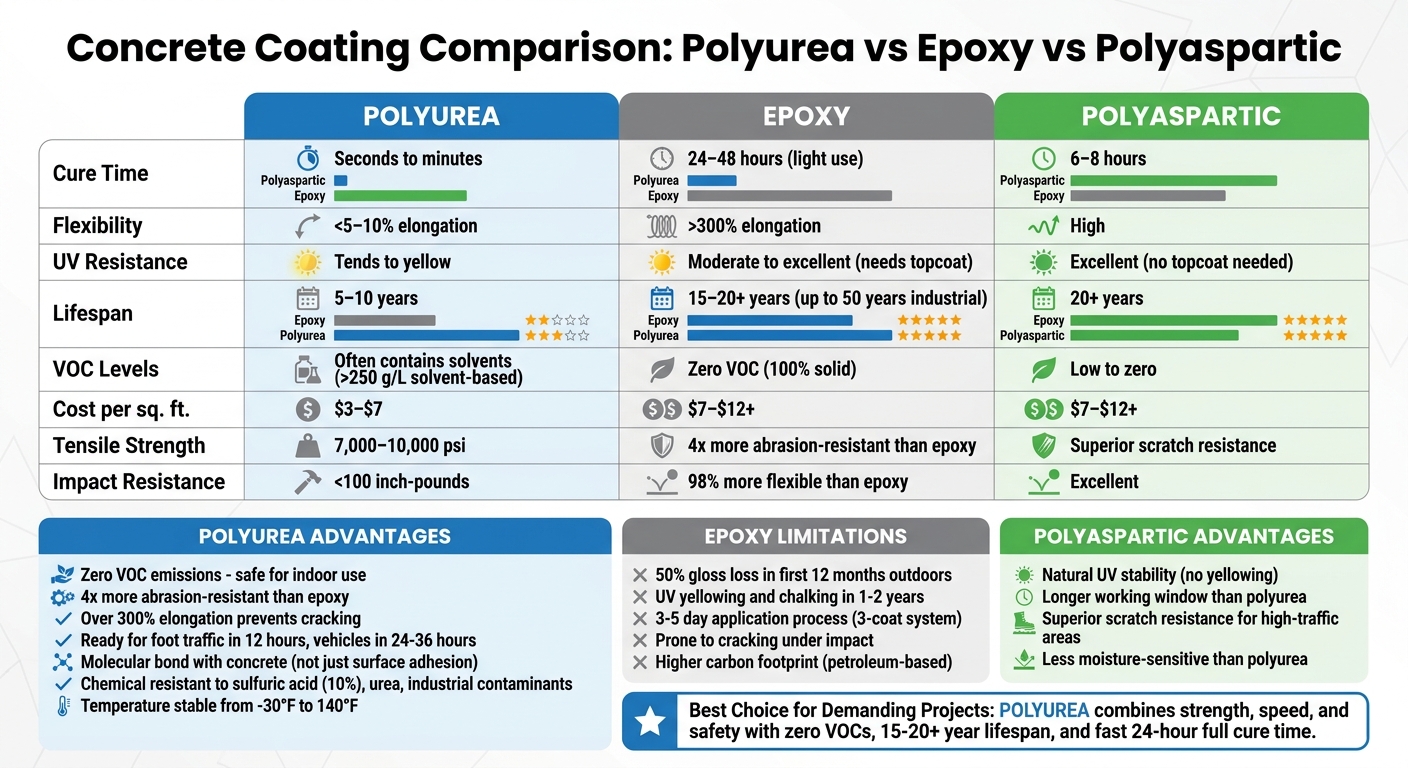
Polyurea vs Epoxy vs Polyaspartic Coatings Comparison Chart
1. Polyurea Coatings
Strength and Durability
Polyurea coatings don’t just sit on the surface – they form a molecular bond with concrete, unlike epoxy, which merely adheres to the top layer. This bond is a big reason why polyurea coatings are four times more abrasion-resistant than traditional epoxy. Plus, with 98% more flexibility than epoxy, polyurea can expand and contract alongside concrete during temperature swings without cracking. It’s not just tough – it’s adaptable. The material’s chemical makeup, a blend of isocyanate and synthetic resin, gives it impressive tensile strength, allowing it to stretch over 500% without breaking, making it ideal for bridging cracks.
"Polyurea resin coatings are well-known for their excellent mechanical behaviour, high chemical resistance, and watertightness even under harsh climatic conditions." – Scientific Reports
Its chemical resistance is another standout quality. Polyurea can handle exposure to harsh substances like sulfuric acid (up to 10% concentration), urea, and various industrial contaminants. It also remains stable in extreme temperatures, making it a reliable option in areas with significant seasonal climate changes. These properties not only boost its abrasion resistance but also contribute to its long-term durability.
In essence, polyurea’s combination of flexibility, chemical resistance, and toughness means fewer cracks, less wear, and a longer lifespan – reducing maintenance over time.
Longevity and Environmental Impact
When it comes to lifespan, polyurea coatings outlast many alternatives. Residential installations usually last 15 to 20 years, while industrial applications can stretch to 25 to 30 years, and in some cases, even up to 50 years. Compare that to epoxy, which often needs replacement within 2 to 5 years. While polyurea may come with a higher initial price tag, its durability means fewer repairs, less downtime, and a far better return on investment over time.
Its extended lifespan also means fewer recoating cycles, which translates to less material waste and lower environmental impact over the long haul.
Application Efficiency
Polyurea doesn’t just perform well – it’s quick to apply. Thanks to its fast curing process, projects can be completed in record time. Foot traffic is typically possible within 12 hours, and full vehicle traffic within 24 to 36 hours. This makes one-day installations a reality for many residential and commercial jobs.
"The quick cure time of polyurea… means your business can resume normal operations sooner without lengthy downtimes." – Floor Shield Coatings
That said, the rapid cure time comes with challenges. The short working window requires precision during application. Additionally, polyurea is sensitive to moisture – damp surfaces or high humidity can lead to bubbling or blistering if not carefully managed. Proper concrete moisture testing is essential to identify these risks before application. For outdoor use, pairing polyurea with a polyaspartic topcoat is a smart move to prevent UV-related yellowing.
In short, polyurea combines durability, longevity, and speed, making it a top choice for those seeking efficiency without sacrificing quality.
sbb-itb-a0e5ae3
2. Epoxy Coatings
Strength and Durability
Epoxy coatings are well-suited for moderate-traffic floors, offering tensile strength between 7,000–10,000 psi and compressive strength up to 14,000 psi. They create a strong bond with concrete, achieving bond strength over 300 psi, and show good resistance to oils and acids. However, epoxy’s low elongation – less than 5% – makes it prone to cracking under impact or when concrete moves due to temperature fluctuations. Its impact resistance, below 100 inch-pounds, further highlights its vulnerability to thermal shock and substrate shifts. Abrasion tests (Taber) indicate epoxy loses under 100 mg, which is decent but falls short when compared to polyurea’s performance. These factors collectively limit epoxy’s durability in demanding conditions.
Longevity and Environmental Impact
Epoxy coatings typically last 5–10 years, extending up to 15 years in light commercial settings. Outdoor applications face quicker degradation due to UV exposure, which can lead to yellowing and chalking within 1–2 years (see our polyurea vs. epoxy UV stability comparison), along with a 50% gloss loss in the first 12 months. Moisture during curing can cause amine blush, accelerating wear over time. Water-based epoxies emit less than 50 g/L VOCs, aligning with low-VOC standards, but solvent-based options release over 250 g/L. Additionally, the petroleum-based resins used in epoxy contribute to a higher carbon footprint, and curing amines can affect air quality. In humid environments, delamination caused by moisture vapor can result in failure rates exceeding 20%.
Application Efficiency
Applying epoxy coatings is a slower process compared to polyurea. The surface must first be prepared, typically by grinding the concrete to CSP 3. The two-part resin, mixed at a 1:1 ratio, is then applied at a coverage rate of 200–300 square feet per gallon. Each coat requires a pot life of 30–45 minutes, with 12–24 hours between applications, making a three-coat system take 3–5 days to complete. Full curing takes an additional 24–72 hours. For optimal results, the substrate must have moisture levels below 4%, temperatures between 50°F and 90°F, and humidity under 85% to avoid issues like amine blush. This extended timeline highlights epoxy’s limitations in terms of application speed and efficiency when compared to polyurea.
3. Polyaspartic Coatings
Strength and Durability
Polyaspartic coatings stand out for their impressive resistance to scratches and scuffs, making them perfect for high-traffic areas. While polyurea is valued for its quick curing and flexibility, polyaspartic coatings go a step further by offering added protection against wear and tear, helping floors retain their fresh appearance longer. One of their standout features is natural UV stability – they don’t yellow or degrade under sunlight. In contrast, polyurea needs a protective topcoat to prevent discoloration and surface damage. This makes polyaspartic coatings a smart pick for outdoor spaces like patios and driveways.
"In environments with heavy traffic or abrasive conditions, polyaspartic coatings provide that extra level of durability that keeps floors looking newer, longer." – Floor Shield Coatings
These qualities not only enhance durability but also reduce maintenance demands over time.
Longevity and Environmental Impact
Polyaspartic coatings naturally resist UV damage, maintaining their color and finish without needing a protective topcoat. This durability means fewer reapplications are needed throughout their lifespan, which can save time and money in the long run, even if the initial costs are higher. Their ability to withstand both UV exposure and physical wear makes them a reliable option for long-term performance.
Application Efficiency
Unlike polyurea, which cures almost instantly and leaves little room for adjustment, polyaspartic coatings offer a longer working window, making them easier to apply. Products like Opalon W-90 can be pre-mixed and applied using a roller or standard airless spray equipment, eliminating the need for specialized systems. While polyurea sets in seconds, polyaspartic coatings allow foot traffic in about two hours, giving installers more flexibility during application. Additionally, polyaspartic coatings are less sensitive to moisture, reducing the chances of bubbling or blistering when the substrate isn’t in perfect condition. For outdoor projects, the built-in UV resistance of polyaspartic coatings removes the need for an additional UV-protective topcoat, simplifying the process even further.
E-GREEN Polyurea 1 DAY Flake System
Advantages and Disadvantages
When it comes to choosing the right coating, understanding the trade-offs is key. Each type of coating – polyurea, epoxy, and polyaspartic – has its own strengths and limitations (see our comparison of polyaspartic vs epoxy), making them suitable for different applications.
Polyurea is prized for its incredible flexibility (over 300% elongation) and lightning-fast curing time. It sets within seconds to minutes and reaches full strength in just 24 hours, making it perfect for one-day installations. Additionally, its zero VOC content makes it a safe choice for confined spaces, especially when adhering to VOC rules for garage floor coatings. However, aromatic polyurea can yellow when exposed to UV light unless a protective topcoat is applied. Its quick curing process also requires specialized equipment and skilled application.
Epoxy coatings are budget-friendly, typically costing $3–$7 per square foot. However, they come with some compromises: longer curing times, lower flexibility (less than 10% elongation), and a shorter lifespan. These coatings are prone to cracking and usually last only 5–10 years, which is about half the lifespan of polyurea systems. Another drawback is their limited UV stability, which can cause yellowing and degradation over time.
Polyaspartic coatings are known for their superior scratch resistance and excellent UV stability, eliminating the need for an additional topcoat for outdoor use. They also offer a manageable application window, making them easier to work with. However, the upfront cost is higher, ranging from $7–$12+ per square foot. That said, the reduced maintenance costs over time can help offset the initial investment.
Here’s a quick side-by-side comparison of the key properties:
| Property | Epoxy | Polyurea | Polyaspartic |
|---|---|---|---|
| Cure Time | 24–48 hours (light use) | Seconds to minutes | 6–8 hours |
| Flexibility | <5–10% elongation | >300% elongation | High |
| UV Resistance | Tends to yellow | Moderate to excellent | Excellent |
| Lifespan | 5–10 years | 15–20+ years | 20+ years |
| VOC Levels | Often contains solvents | Zero VOC | Low to zero |
| Cost per sq. ft. | $3–$7 | $7–$12+ | $7–$12+ |
This table highlights why polyurea is often the go-to choice for projects requiring quick application, durability, and low environmental impact.
For projects where rapid turnaround and long-term performance are crucial, polyurea stands out. Products like Croc Coatings‘ Penntek Evolution, which boasts four times the strength of epoxy, showcase polyurea’s ability to deliver exceptional durability with minimal downtime, making it an ideal solution for demanding applications.
Conclusion
Polyurea stands out among low-VOC coatings for its exceptional flexibility, long lifespan, and safety. With over 300% elongation and a 15–20+ year lifespan, it far exceeds epoxy coatings, which typically last only 5–10 years. These features translate into fewer repairs, lower costs, and improved efficiency over time.
Its environmental benefits are equally impressive. Polyurea formulations are 100% solid and contain zero VOCs, making them ideal for indoor use and confined spaces. Unlike solvent-based coatings, polyurea doesn’t emit harmful compounds during application or curing, and it can even be recycled after its service life.
"Polyurea’s flexible durability means fewer shutdowns for maintenance, which is a major life-cycle cost advantage." – Marvel Coatings
Additionally, polyurea cures fully in just 24 hours, can be applied in temperatures ranging from -30°F to 140°F, and performs well in high-humidity environments where epoxy often fails. This adaptability minimizes weather-related delays and speeds up project timelines.
From industrial settings to residential applications, polyurea offers exceptional strength, durability, and quick installation. Products like Croc Coatings’ Penntek Evolution highlight how modern polyurea technology can be four times stronger than epoxy while maintaining the flexibility and low-VOC characteristics that today’s projects require. For projects prioritizing speed, resilience, and environmental safety, polyurea is the clear choice.
FAQs
Is polyurea safe to install indoors?
Polyurea can be safely installed indoors as long as proper safety measures are in place. The process involves reactive chemicals, including isocyanates, which can cause respiratory or skin irritation if not handled correctly. Installers should wear appropriate protective gear, such as masks and gloves, to minimize exposure. Additionally, maintaining good ventilation during the application is crucial to ensure a safe working environment.
Will polyurea yellow in sunlight?
Polyurea tends to yellow and fade when exposed to sunlight because it lacks natural UV stability. Without a protective topcoat, prolonged UV exposure can cause ambering and surface deterioration.
What makes polyurea bond better to concrete?
Polyurea adheres more effectively to concrete because it actively interacts with moisture during application. This unique property enables it to penetrate deeply into the concrete when moisture levels are just right, creating a strong bond and enhancing long-term durability.