Slip-resistant concrete coatings are essential for safety in garages, patios, and commercial spaces. International standards like ANSI A326.3 (U.S.), BS EN 16165 (Europe), and AS/NZS 4586 (Australia) define the friction requirements and testing methods for these surfaces. These guidelines influence industrial floor coating selection, surface preparation, and testing to reduce slip risks and ensure compliance with ADA and safety regulations.
Key points:
- Dynamic Coefficient of Friction (DCOF) is now the standard for measuring slip resistance in motion, with a wet DCOF of 0.42 required for level surfaces.
- Slip-resistant additives like aluminum oxide and polymer microspheres are used to meet these standards.
- Testing methods vary: the U.S. uses tribometers, Europe employs Pendulum and Ramp Tests, and Australia uses Wet Pendulum and Inclining Platform Tests.
- Slip-resistant coatings help prevent accidents, which cost the U.S. $16.5 billion annually in workers’ compensation.
Manufacturers like Croc Coatings meet these standards with products like the Penntek Evolution system, offering durable, slip-resistant surfaces backed by warranties for long-term performance.
How Do I Make Concrete Slip Resistant? FAQ Video by CoverTec Products
sbb-itb-a0e5ae3
Major International Slip Resistance Standards
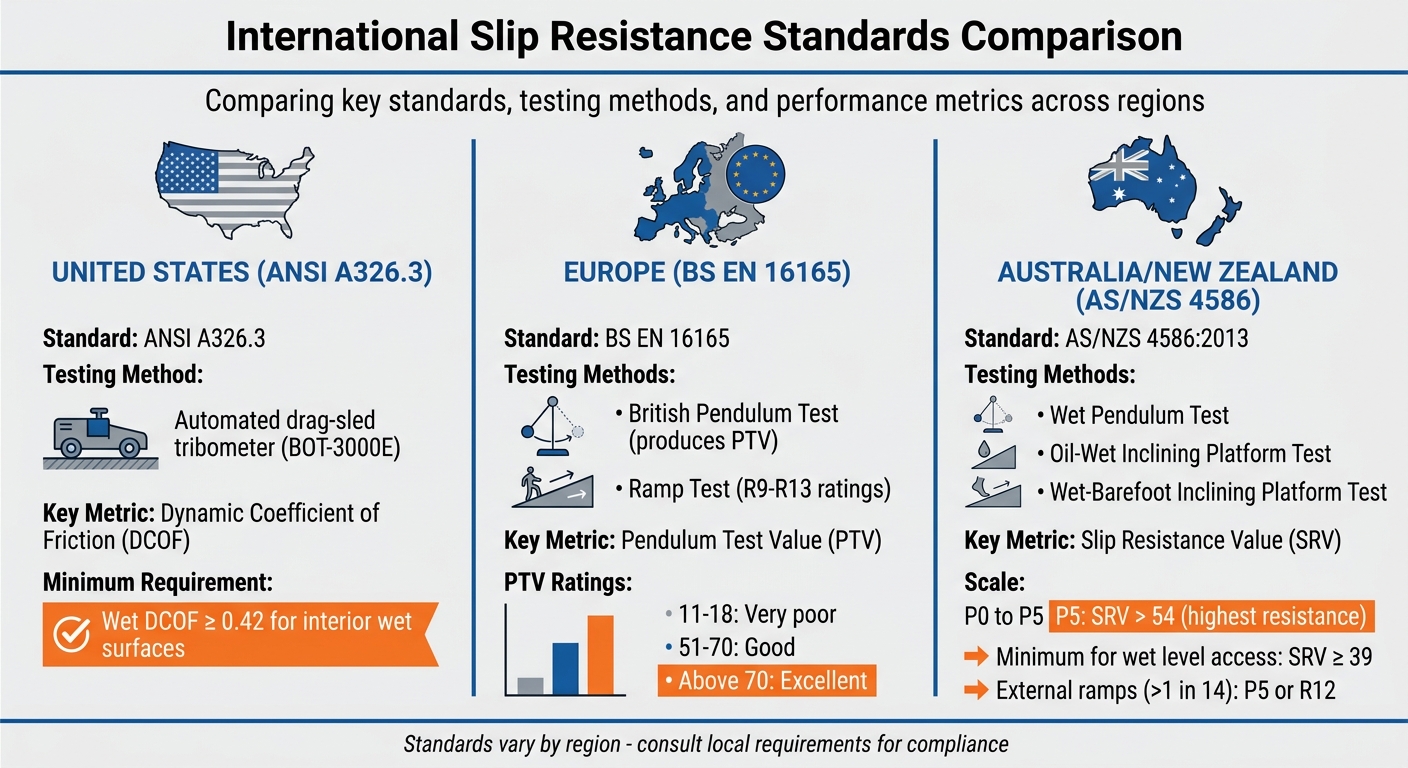
International Slip Resistance Standards Comparison: ANSI, BS EN, and AS/NZS
Slip resistance standards differ across regions, each employing unique testing methods and benchmarks. For designers, navigating these variations is essential, as they directly impact material choices and surface preparation. Comparing the approaches in the U.S., Europe, and Australia highlights why these standards lead to distinct design practices.
ANSI A326.3 (United States)
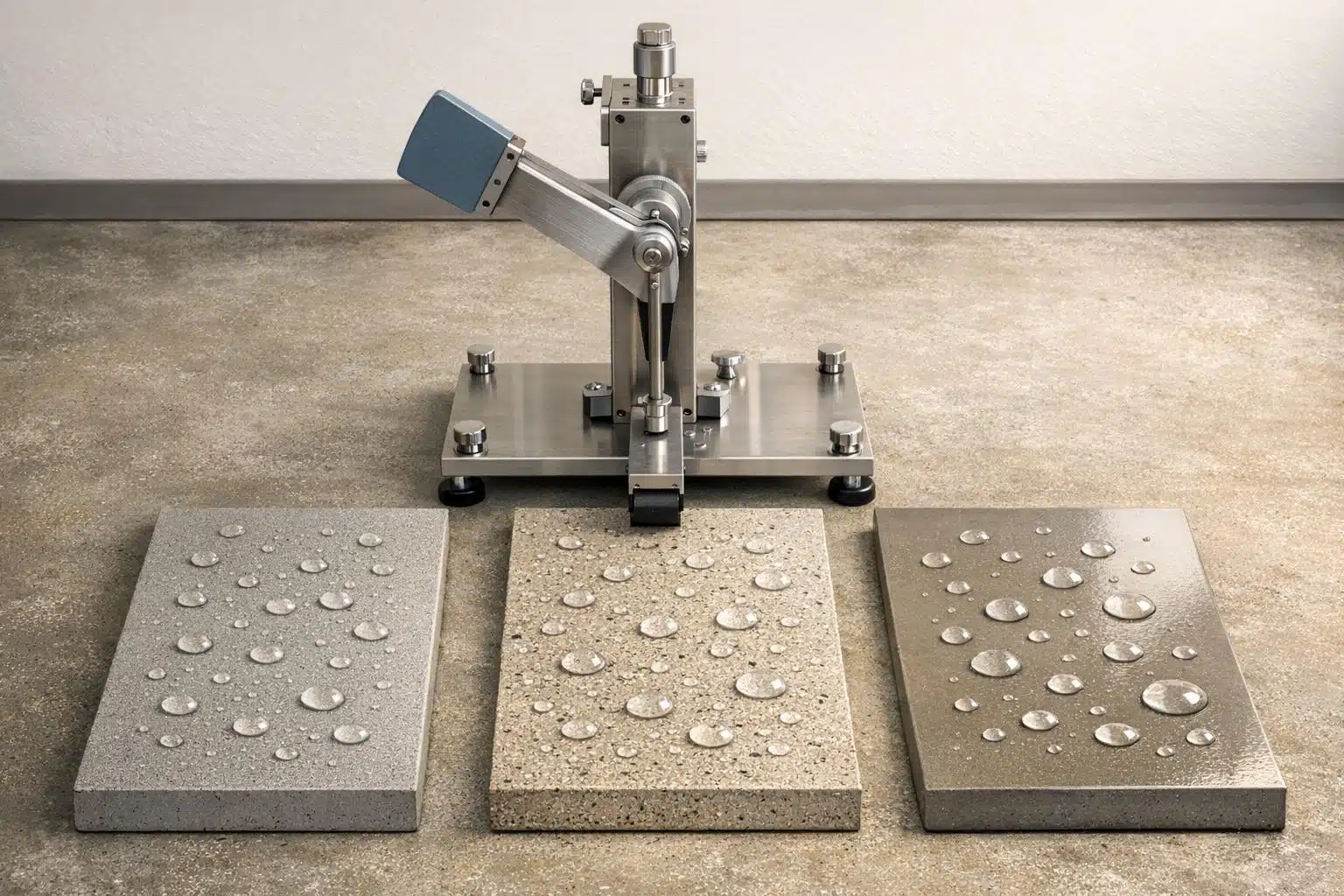
The U.S. relies on the ANSI A326.3 standard, officially titled "American National Standard Test Method for Measuring Dynamic Coefficient of Friction of Hard Surface Flooring Materials." This guideline uses an automated drag-sled tribometer, such as the BOT-3000E, to simulate the motion of a foot. For interior spaces that may be wet, a minimum wet Dynamic Coefficient of Friction (DCOF) of 0.42 is required. To meet this standard, coatings are often enhanced with textured additives, which help create slip-resistant surfaces while considering maintenance needs.
BS EN 16165 (Europe)
Europe’s BS EN 16165 standard incorporates two key methods: the British Pendulum Test and the Ramp Test.
- The British Pendulum Test uses a swinging arm to mimic a heel strike, producing a Pendulum Test Value (PTV).
- The Ramp Test measures slip resistance by determining the angle at which slippage begins, assigning ratings from R9 to R13.
PTV ratings are categorized as follows:
- 11–18: Very poor
- 51–70: Good
- Above 70: Excellent
While these tests complement one another, their results are not directly comparable. This often requires designers to tweak formulations, such as adding coarse aggregates, to meet multiple standards.
"Since the environmental conditions for each test is not the same, there isn’t a direct correlation between results, and this is why… a consensus method for rating slip resistance remains elusive." – Jes Grant, Marketing Engagement Manager, Sherwin-Williams
AS/NZS 4586 (Australia)
Australia’s AS/NZS 4586:2013 standard outlines three primary testing methods: the Wet Pendulum Test, the Oil-Wet Inclining Platform Test, and the Wet-Barefoot Inclining Platform Test.
- The Wet Pendulum Test assigns a Slip Resistance Value (SRV) on a scale from P0 to P5. P5 (SRV > 54) represents the highest level of slip resistance.
- For areas like level access routes expected to get wet, an SRV of at least 39 is recommended.
- External ramps steeper than 1 in 14 need coatings that meet P5 or R12 classifications, while barefoot areas, such as pool surrounds, should achieve a Class B or C rating.
The updated AS/NZS 4586 replaced older V-to-Z classifications with the P0-to-P5 scale, accompanied by additional guidance in the SA HB 198:2014 handbook. These updates ensure clearer alignment between testing outcomes and application needs.
These international standards not only define testing protocols but also shape how materials and designs are chosen for specific applications, ensuring safety and functionality across diverse environments. This is particularly vital when selecting slip-resistant coatings for harsh climates where extreme weather impacts durability. For a deeper look at implementation, see our guide to slip resistance for concrete floors.
How Standards Affect Coating Design
International slip resistance standards play a key role in shaping how concrete coatings are designed, applied, and tested. These standards set specific friction thresholds, which influence everything from the materials used to the testing methods employed.
Material Selection and Additives
When designing coatings for ramps that require a Static Coefficient of Friction (SCOF) of 0.8, coarse 36–60 grit aluminum oxide is often added at 12–16 oz/gal. This creates a highly textured surface that meets safety standards but can be tougher to clean due to its rough profile.
For commercial interiors, where a wet Dynamic Coefficient of Friction (DCOF) of at least 0.42 is required, manufacturers tend to use additives like polymer microspheres or fine-particle aluminum oxide (80–150 mesh). These are mixed directly into the topcoat at 4–8 oz/gal, resulting in a smoother finish that’s easier to maintain. This approach is especially useful for UV-stable topcoats, which don’t distribute broadcast aggregates evenly.
The environment also affects material choices. For areas exposed to oil contamination, materials such as crushed glass, carborundum, or silica sand may be better options. Each material responds differently to specific hazards, so testing is crucial to confirm their suitability and ensure the coating remains compliant throughout its use.
Testing and Quality Control
Thorough testing is essential to validate material choices and confirm long-term performance. Tools like the BOT-3000E tribometer are used to verify that the DCOF meets the required 0.42 threshold. On-site, the Wet Pendulum Test provides additional verification by measuring slip resistance as a rubber slider moves across a 126 mm (about 5 inches) path.
"The measured DCOF value shall not be the only factor in determining the appropriateness of a hard surface flooring material for a particular application." – ANSI A326.3 Standard
Continuous quality control is vital, monitoring factors such as wear, cleaning methods, and contaminants to maintain compliance over time.
How Croc Coatings Meets International Standards
Penntek Evolution System Features
The Penntek Evolution system is built to meet and surpass international slip resistance standards like ANSI A326.3, BS EN 16165, and AS/NZS 4586. This system achieves a wet Dynamic Coefficient of Friction (DCOF) of 0.42 or higher for level interior spaces. For more demanding applications, such as ADA-compliant ramps, it can reach a Static Coefficient of Friction (SCOF) of 0.8 or above by incorporating coarser aggregates – such as 36-grit aluminum oxide.
Key features include UV stability, antimicrobial properties, and durability that’s four times greater than standard epoxy coatings. The UV-stable topcoat resists sunlight degradation, ensuring slip resistance remains consistent over time. To meet strict international standards, the system optimizes additive distribution in its polyaspartic topcoats, ensuring an even texture and reliable performance.
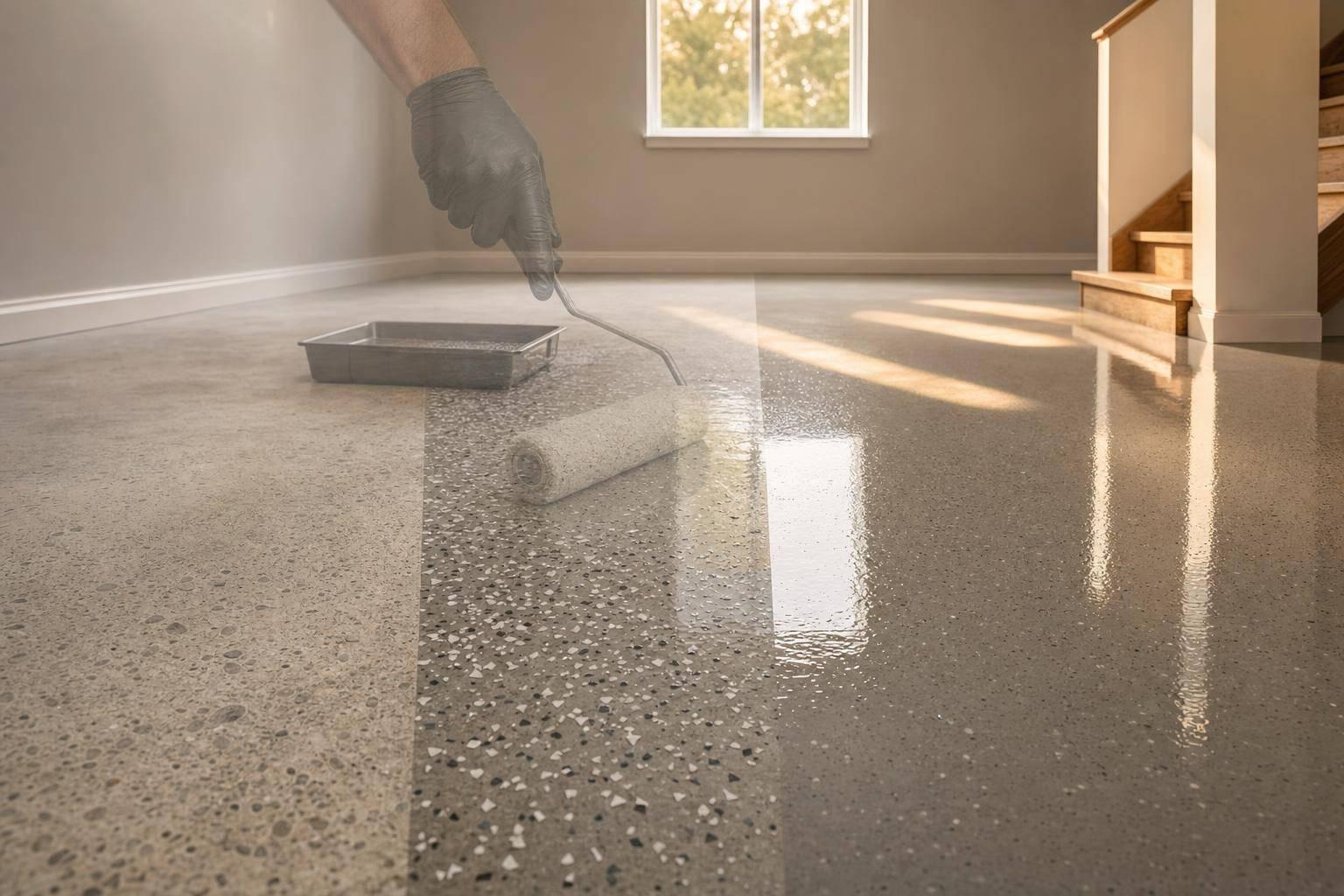
The British Pendulum Test results validate the system’s compliance, with scores in the "good" to "best" range (51–70+ PTV) under BS EN 16165 standards. The installation process involves diamond grinding or shot blasting to achieve an optimal Concrete Surface Profile (CSP). This meticulous preparation enhances both mechanical bond strength and baseline friction, allowing for a streamlined installation that can be completed in just one day.
One-Day Installation Process
Croc Coatings offers a complete multi-layer, slip-resistant installation in just one day, all while maintaining strong adhesion and compliance with safety standards. The rapid curing properties of epoxy and polyaspartic coatings make this possible. Even with the expedited process, the required CSP (ranging from 1 to 9) is achieved, ensuring the coating adheres permanently and provides consistent slip resistance.
Maintaining slip resistance is essential for long-term compliance. ANSI A326.3-2021 emphasizes the importance of considering "expected wear" and "expected maintenance" to ensure floors remain safe over time. This efficient installation process supports durability and safety, setting the stage for the system’s long-term performance, which is backed by a comprehensive warranty.
Lifetime Warranty and Long-Term Performance
The Penntek Evolution system doesn’t just meet slip resistance standards at installation – it’s designed to maintain these safety features over time. A lifetime residential warranty and a 5-year commercial warranty underscore the system’s ability to retain its structure and slip resistance, even under daily use. This aligns with ANSI A326.3-2021, which highlights the importance of sustained performance, not just initial compliance. Achieving a 0.42 DCOF at the start is only part of the equation; the coating must continue to deliver safe conditions throughout its lifespan.
"The specifier shall determine materials appropriate for specific project conditions, considering by way of example… expected wear, and manufacturers’ guidelines and recommendations."
- ANSI A326.3-2021
This long-term assurance is critical for facilities that must meet OSHA 29 CFR 1910.22 requirements. These regulations demand that walking-working surfaces maintain their slip resistance, with adherence documented through coating specifications. Thanks to its enhanced durability, the Penntek Evolution system ensures consistent safety and performance in high-traffic areas like garage floors, commercial kitchens, pool decks, and industrial facilities across North Idaho, Spokane, and the Tri-Cities area.
Conclusion
International slip resistance standards have reshaped how concrete coatings are designed, offering clear safety benchmarks that benefit both property owners and users. Standards like ANSI A326.3, BS EN 16165, and AS/NZS 4586 provide measurable criteria – such as a wet DCOF of at least 0.42 for level interior surfaces – to reduce risks and enhance safety. These guidelines influence every aspect of design, from the choice of additives to the selection of durable topcoats, often requiring a detailed industrial floor coating planner.
The stakes are high: slips, trips, and falls lead to 9 million hospitalizations annually, with each incident costing an average of $20,000. Research indicates that maintaining a floor-shoe interface at or above a DCOF of 0.42 can lower the likelihood of slipping to 1 in 1,000,000 or better. For regions like North Idaho and Eastern Washington – including Spokane and the Tri-Cities – these standards are particularly valuable. They help ensure safety across a variety of settings, from garage floors and pool decks to commercial kitchens and industrial spaces, often outperforming traditional options like epoxy in North Idaho, even in the face of the region’s diverse weather conditions.
Beyond guiding design, these benchmarks serve as proof of product performance. Croc Coatings exemplifies this by adhering to international standards, with the Penntek Evolution system consistently meeting or exceeding slip resistance requirements. This commitment to compliance not only ensures safety but also provides peace of mind through a lifetime residential warranty limitations and a 5-year commercial warranty. As ANSI A326.3-2021 highlights, factors like wear and maintenance must be considered to keep floors safe over time.
FAQs
Which slip standard applies to my project?
The relevant slip standard is ANSI A137.1, which requires a minimum wet Dynamic Coefficient of Friction (DCOF) of 0.42 for hard surfaces in flat, interior spaces. This standard helps ensure slip resistance, promoting both safety and regulatory compliance.
Do slip ratings change as the floor wears or gets cleaned?
Yes, slip ratings can shift over time. Everyday wear can smooth out surface textures, lowering slip resistance. On the other hand, cleaning can have mixed effects – it might improve slip resistance by clearing debris, or it could reduce it if abrasive cleaning methods make the surface rougher. Consistent maintenance is key to keeping the slip resistance of concrete coatings as originally intended.
What texture level meets safety without being hard to clean?
A surface with a DCOF of at least 0.42 strikes a good balance between slip resistance and ease of cleaning. This level provides safety while keeping the texture smooth enough to avoid trapping dirt, making it a practical choice for both residential and commercial areas.