Slip resistance is one of the most consequential safety properties of any floor — yet it’s also one of the least understood. ASTM slip resistance standards provide the testing framework that property owners, facility managers, and specifiers rely on to measure traction, reduce fall risk, and demonstrate regulatory due diligence. Here’s what you need to know at a glance:
- Two kinds of friction: Static Coefficient of Friction (SCOF) measures the force to start movement on a stationary surface. Dynamic Coefficient of Friction (DCOF) measures resistance during motion — and because most slips happen while someone is already walking, DCOF is the measurement that actually predicts real-world slip risk.
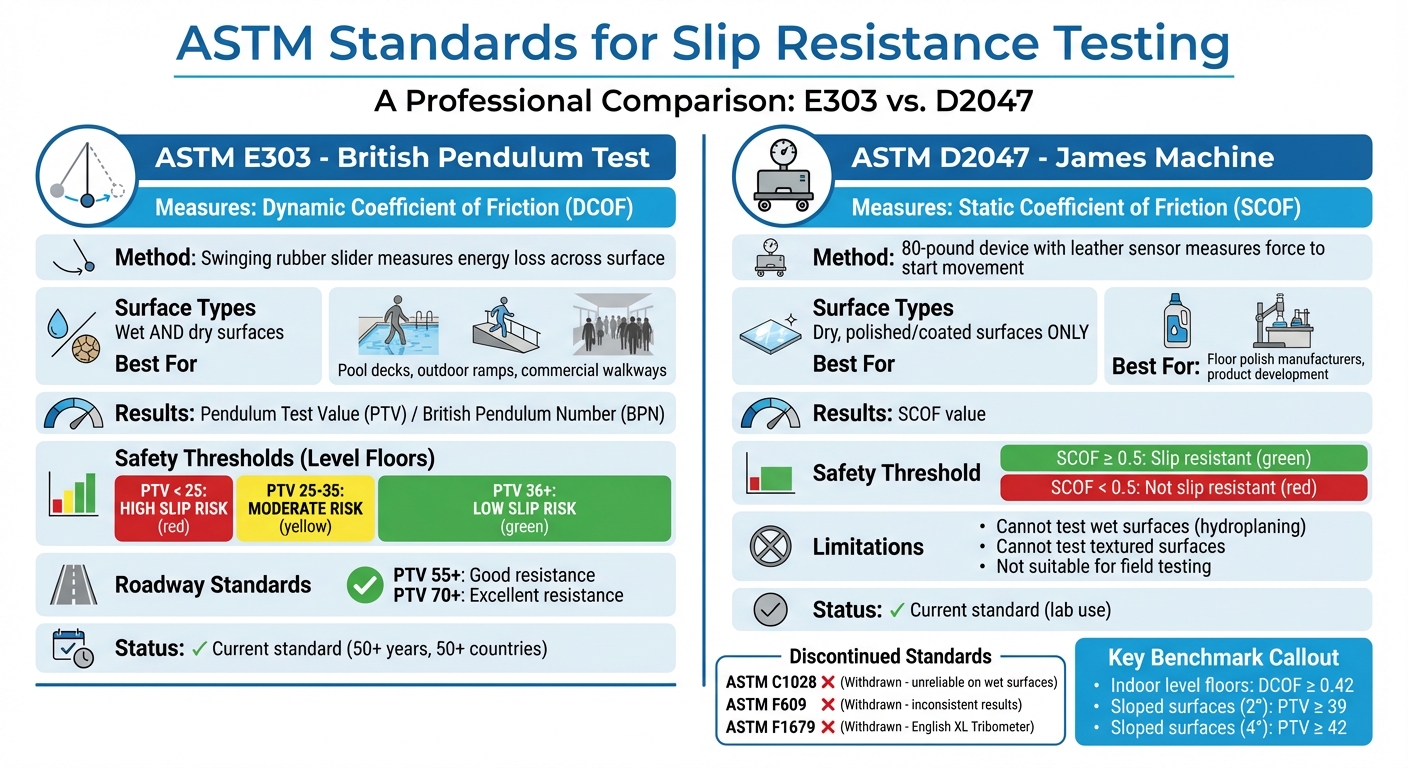
- The gold standard: ASTM E303 uses the British Pendulum Tester to measure DCOF on wet and dry surfaces. It is a national standard for pedestrian slip resistance in over 50 countries.
- The lab standard: ASTM D2047 uses the James Machine to measure SCOF on dry, polished surfaces. It is widely used for floor polish quality assurance — but cannot assess wet slip risk.
- The modern tile standard: ANSI A326.3 (referenced by the International Building Code) requires a wet DCOF of 0.42 or greater for level interior tile, measured with the BOT-3000E tribometer.
- Why older standards failed: ASTM C1028, F609, F1677, and F1679 were all withdrawn — each for a specific technical reason rooted in the SCOF-vs-DCOF distinction explained below.
- Quick-reference thresholds:
| Condition | Standard / Authority | Threshold |
|---|---|---|
| Level interior floors (wet) | ANSI A326.3 / IBC | Wet DCOF ≥ 0.42 |
| Level floors (general) | UK HSE (pendulum) | PTV ≥ 36 |
| External walkways | Australian HB 198:2014 | PTV ≥ 45 |
| Ramps (sloped surfaces) | Australian HB 198:2014 | PTV ≥ 54 |
| Dry, polished surfaces | ASTM D2047 / OSHA recommendation | SCOF ≥ 0.50 |
| Food courts / spill-prone areas | Australian HB 198:2014 | PTV ≥ 35 |
Slip resistance testing bridges the gap between surface safety and legal accountability. By understanding which ASTM standards apply — and which ones no longer do — you can make informed decisions about flooring materials, coatings, and ongoing maintenance.
SCOF vs DCOF: Why the Distinction Matters
Before evaluating any individual standard, you need to understand the measurement that underpins every one of them. Slip resistance is quantified as the Coefficient of Friction (COF): the ratio of the friction force between two surfaces to the force pressing them together. A higher COF means more grip.
But there are two fundamentally different ways to measure it — and the distinction explains why some standards work while others were withdrawn.
Static Coefficient of Friction (SCOF)
SCOF measures the force required to initiate movement between two stationary surfaces. Think of it as the "breakaway" friction — how hard you have to push before something starts sliding.
The problem is that SCOF measures a stationary situation. Most slips don’t happen from a dead stop; they happen when a foot is already in motion, when the heel strikes the floor at an angle, or when a surface condition changes mid-stride. A surface can post a passing SCOF score while still being dangerously slippery under walking conditions — particularly when wet.
This is the root cause behind every withdrawn ASTM slip resistance standard: they all measured SCOF, and SCOF alone cannot predict real-world pedestrian slip risk.
Dynamic Coefficient of Friction (DCOF)
DCOF measures the resistance between two surfaces while they are already in motion. This reflects what actually happens during a slip: the foot is moving, the heel contacts the surface, and the friction available at that moment of sliding determines whether the person falls.
"The focus on coefficients of friction to assess slip resistance stems from the fact that the COF and the force required to slide an object are directly proportional — the greater the COF the greater the resistance to sliding."
The industry’s shift from SCOF to DCOF testing is not a trend — it is a correction. DCOF better replicates walking biomechanics and produces results that correlate with actual slip-and-fall incidents. This is why the modern standards that matter — ASTM E303 and ANSI A326.3 — both measure dynamic friction.
ASTM E303: The Pendulum Test — The Gold Standard
ASTM E303-22 is the current version of the standard that defines how to measure surface frictional properties using the British Pendulum Tester. It is, by any reasonable measure, the most trusted slip resistance test method in the world.
How It Works
The British Pendulum Tester uses a swinging arm with a standardized rubber slider at its tip. As the slider sweeps across the test surface, the surface’s friction absorbs energy from the pendulum — the more friction, the less the pendulum swings on the far side. The result is a Pendulum Test Value (PTV), sometimes called the British Pendulum Number (BPN).
Unlike the James Machine (D2047), the pendulum can test both wet and dry surfaces. It works on flat floors, curved surfaces, ramps, and textured coatings. It is portable enough for field use and precise enough for laboratory work. And because the rubber sliders can be swapped — soft rubber (TRL) for barefoot areas, hard rubber (Four S) for shoe traffic — it can simulate the actual conditions people experience on a given surface.
PTV Thresholds: What the Numbers Mean
For level pedestrian surfaces, the UK Health and Safety Executive (HSE) has established clear risk bands based on decades of data:
| PTV Range | Slip Risk Classification |
|---|---|
| 0–24 | High slip risk |
| 25–35 | Moderate slip risk |
| 36+ | Low slip risk |
On sloped surfaces, the bar rises. Australian Standard HB 198:2014 provides one of the most detailed reference frameworks available:
| Surface / Environment | Minimum PTV |
|---|---|
| Level indoor floors (dry) | 25 |
| Elevator lobbies | 25 |
| Food courts and spill-prone areas | 35 |
| Level external walkways | 45 |
| External ramps (sloped) | 54 |
| Swimming pool surrounds | 54 |
These are not arbitrary numbers. They come from correlation studies matching PTV measurements against actual slip-and-fall incident data — which is why the pendulum test has held up across 50+ nations and five continents.
International Adoption and the E303-22 Update
The British Pendulum test is a national standard for pedestrian slip resistance in at least 50 countries. The UK HSE formally endorses it. Australian HB 198:2014 builds its entire framework around it. The 2022 revision of ASTM E303 (E303-22) updated the standard to align more closely with international methods — further cementing its role as the global benchmark.
"The pendulum DCOF tester is easily the world’s most widely-accepted, well-researched, and universally-trusted tribometer for measuring the frictional properties of a surface to assess safety."
ASTM D2047: The James Machine for Static Friction
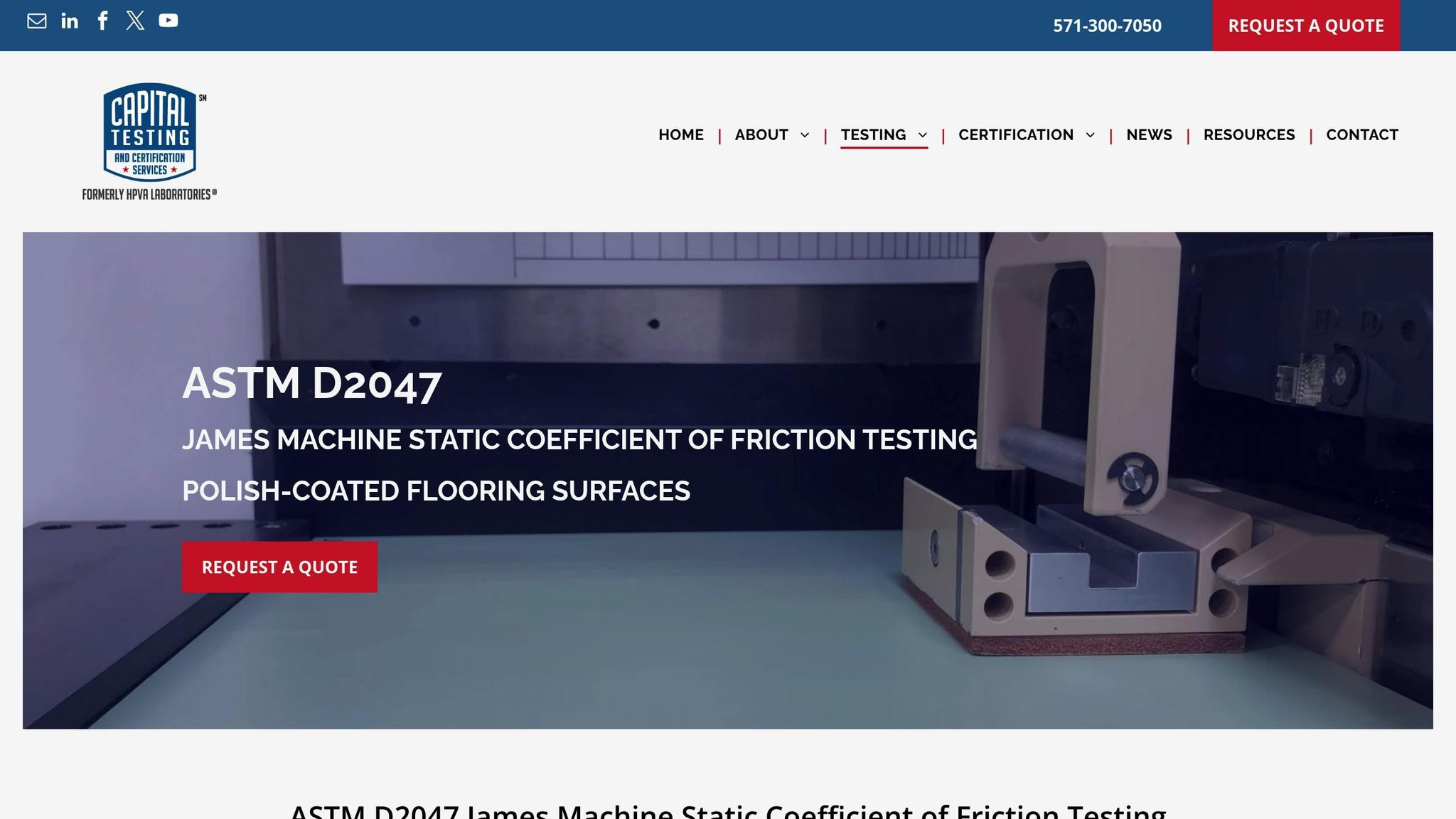
ASTM D2047 is the standard that defines static coefficient of friction testing for polished floor surfaces using the James Machine. It celebrated its 50th anniversary in 2014 and remains the reference method for one specific application: quality control of floor polishes and coatings on dry, smooth surfaces.
What D2047 Does Well
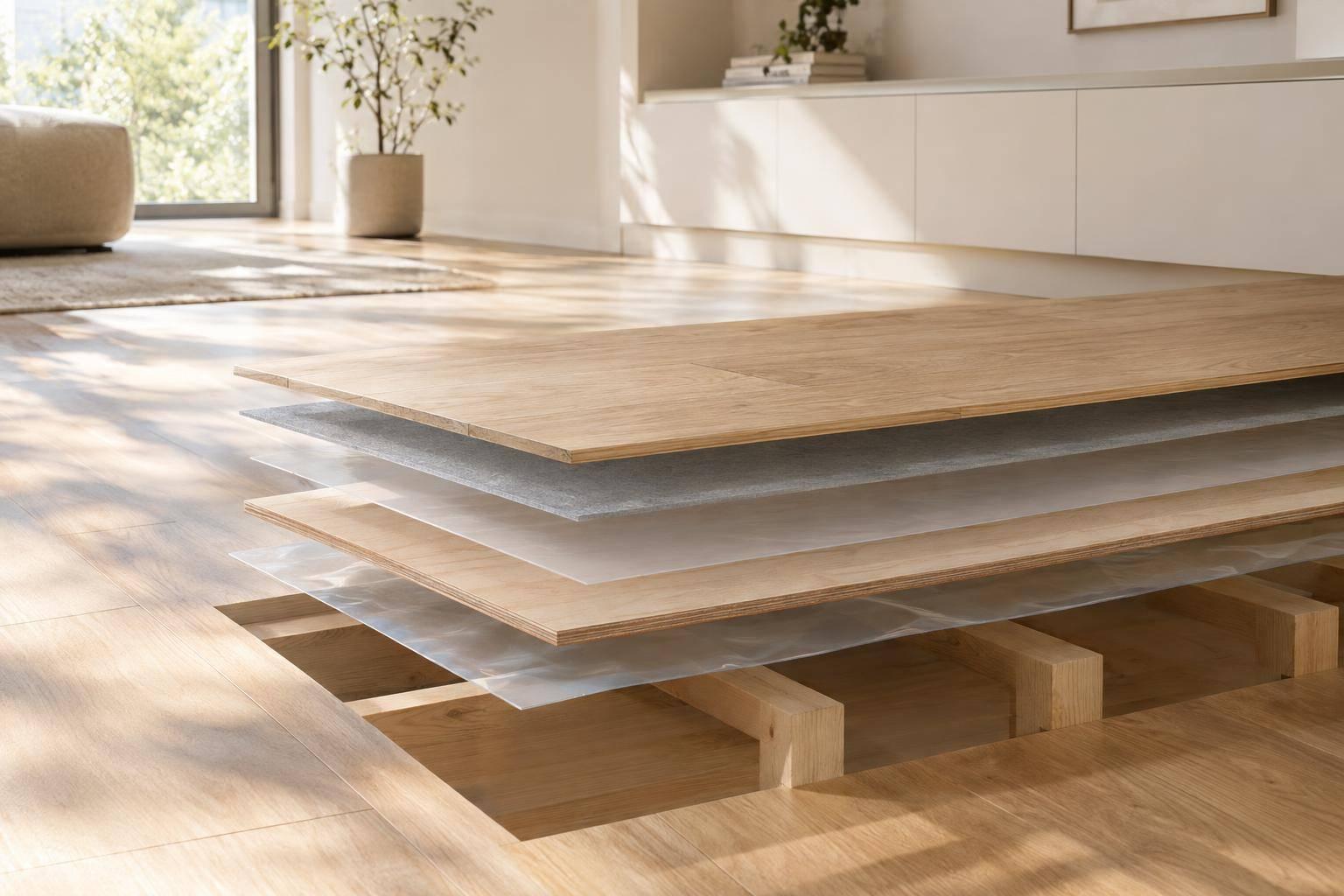
The James Machine is an 80-pound device that uses a standardized leather pad as the sensor. It measures the force required to initiate sliding between the leather pad and the tested surface — a pure SCOF measurement. A surface that scores 0.50 or higher is classified as "slip resistant" under D2047. ASTM lists wood among the polished indoor flooring substrates D2047 covers — alongside vinyl composition, terrazzo, vinyl, marble urethanes, concrete and ceramics — so a polished wood floor finish is measured against that same 0.50 static-friction criterion. The standard’s limits still apply: D2047 tests a clean, dry, smooth, polished surface only, so it says nothing about how a wood floor behaves once it is wet or textured.
This benchmark is not arbitrary. It is based on decades of data collected from billions of pedestrian interactions with polished floors between the 1940s and 1970s. When a floor polish manufacturer wants to verify that their product meets minimum dry-traction standards during development, D2047 is the tool for the job. Flooring manufacturers and polish formulators have used a slip-resistant coating calculator alongside D2047 testing to dial in formulations that pass the 0.50 threshold. Facility managers can then use a slip-resistant coating selector to match tested products to their environment.
What D2047 Cannot Do
D2047 has three hard limitations that anyone specifying slip resistance needs to understand:
- Dry surfaces only. The leather sensor hydroplanes on wet or textured surfaces, producing results that bear no relationship to real-world traction. A floor that passes D2047 at 0.55 on a dry day might be dangerously slippery when damp — and D2047 would never tell you.
- Smooth, polished surfaces only. The James Machine’s leather pad was designed for the hard, polished floors of mid-century commercial buildings. It cannot reliably test textured coatings, exposed aggregate, or any surface with significant profile.
- SCOF, not DCOF. As covered above, static friction is not dynamic friction. D2047 measures the breakaway force — not the friction available once your foot is already sliding. This is the fundamental reason D2047 cannot stand alone as a safety assessment for any surface that might get wet.
The balanced view: D2047 is a legitimate lab standard for its narrow purpose. It is not a scam — but it is not a safety test for real-world conditions either. If you need to assess slip risk on a surface that sees water, texture, or foot traffic, you need E303 or ANSI A326.3 testing instead.
ANSI A326.3 and the BOT-3000E: The Modern North American Tile Standard
For years, North America lacked a unified dynamic slip resistance standard for flooring. That changed with ANSI A326.3, the American National Standard for measuring the dynamic coefficient of friction of hard surface flooring materials.
The 0.42 DCOF Threshold
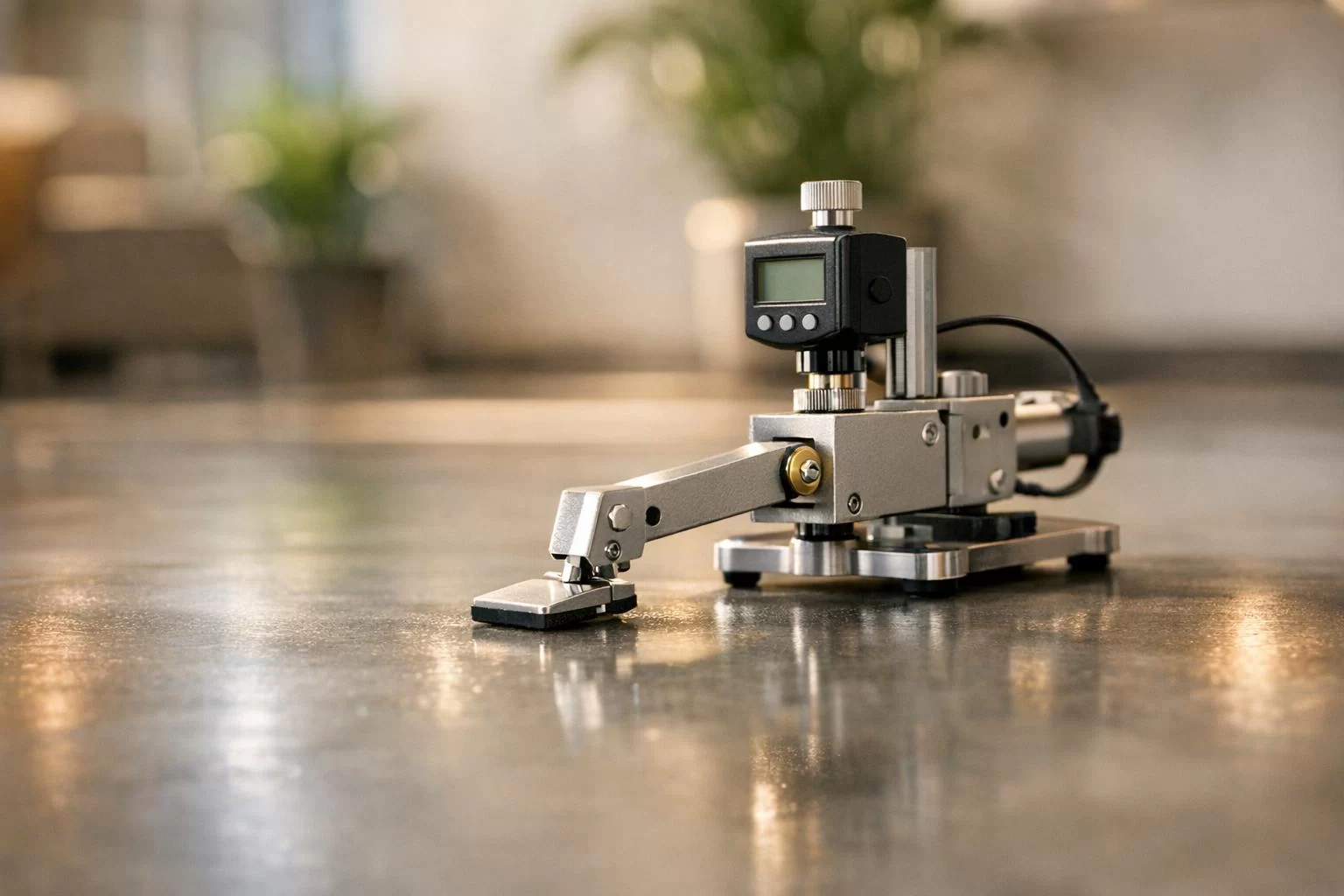
ANSI A326.3 specifies that tile and hard-surface flooring intended for level interior spaces expected to be walked upon when wet must achieve a wet DCOF of 0.42 or greater. This threshold is measured using the BOT-3000E digital tribometer — a robotic device that drags a standardized sensor across a wetted surface under precisely controlled conditions.
The 0.42 number was not pulled from thin air. It was established through extensive interlaboratory studies and validated against real-world slip-and-fall data. It represents the minimum DCOF at which a wet floor provides adequate traction for the average pedestrian.
How It Connects to the IBC
The International Building Code (IBC) references ANSI A326.3 through ANSI A137.1, the standard specification for ceramic tile. In practice, this means that tile flooring in commercial and multifamily projects subject to the IBC must meet the 0.42 wet DCOF requirement for any interior space where water is expected — bathrooms, entries, kitchens, and any area with a drain.
What This Means for Concrete Coatings
ANSI A326.3 was written for tile, but its 0.42 DCOF threshold has become a de facto benchmark across hard-surface flooring. For concrete coatings — polyurea, epoxy, and acrylic systems applied to garage floors, patios, pool decks, and commercial slabs — the same DCOF measurement provides an objective, defensible safety metric. A properly formulated coating with aluminum oxide or polymer bead additives should comfortably exceed 0.42 wet DCOF on the BOT-3000E, and a PTV of 36+ on the pendulum. Property owners who want to check their own surfaces can use tools that apply the same DCOF principles.
Withdrawn ASTM Standards: What Went Wrong
Several ASTM slip resistance standards that were once widely cited are now withdrawn. Each failed for a specific technical reason — and understanding those reasons protects you from specifying obsolete tests or citing invalid compliance benchmarks.
ASTM C1028 — Withdrawn 2014
C1028 used a horizontal pull slipmeter to measure SCOF. The operator placed the device on the floor and pulled it horizontally, measuring the force needed to start movement. The problems were fundamental:
- SCOF only. Like D2047, C1028 measured static friction — the breakaway force on a stationary object. It told you nothing about how the surface behaved in motion.
- Poor wet-surface reproducibility. When surfaces were wet, results varied dramatically between operators and labs. The precision statement was effectively meaningless.
- Stiction error. On smooth, wet surfaces, the slipmeter sometimes registered artificially high readings due to suction between the sensor pad and the water film — making dangerously slippery floors appear safe.
C1028 was withdrawn without replacement. ASTM Committee D21 explicitly noted that the standard could not reliably differentiate safe from unsafe surfaces.
ASTM F609 — Withdrawn 2022
F609 specified the Horizontal Pull Slipmeter (HPS), a specific SCOF device. The standard was withdrawn because the HPS is no longer manufactured. Without an available instrument, the standard could not be followed — and its SCOF-only methodology would not meet current safety expectations even if the device were still produced.
ASTM F1677 and F1679 — Withdrawn 2006
F1677 used the Brungraber Mark II articulated-strut tribometer, and F1679 used the English XL Variable Incidence Tribometer (VIT). Both devices operated on a similar principle: a weighted foot strikes the surface at an angle, and the angle at which slip occurs determines the COF.
Both standards were withdrawn when ASTM determined that neither device could produce a valid precision-and-bias statement. The English XL had an additional problem: it used disposable CO2 cartridges to fire the test foot, introducing variability that gravity-based instruments (like the pendulum) eliminate. The devices themselves are still manufactured, but without active ASTM standards governing their use, they cannot be used for formal compliance testing.
The common thread: every withdrawn standard relied on SCOF measurement or produced results that could not be replicated across labs. The standards that survived — E303 and ANSI A326.3 — measure dynamic friction and produce repeatable, defensible results.
The Regulatory Landscape: ADA, IBC, and OSHA
Slip resistance testing does not happen in a vacuum — it serves regulatory requirements and liability protection. Here is what the three main regulatory frameworks actually say.
ADA: Accessible Design Standards
The Americans with Disabilities Act (ADA) requires that accessible floor and ground surfaces be "stable, firm, and slip resistant." But the ADA Accessibility Guidelines (ADAAG) do not specify a minimum coefficient of friction or a required test method. The U.S. Access Board has repeatedly declined to adopt a specific COF threshold, noting that "a consensus method for rating slip resistance remains elusive."
This does not mean slip resistance is optional under the ADA. It means the obligation to provide a slip-resistant surface exists — and property owners must be prepared to demonstrate that they took reasonable steps to meet it. Following ASTM E303 testing and documenting PTV results is a defensible way to do that. For more on this topic, see our guide on why ADA slip resistance matters for concrete floors.
IBC: The International Building Code
The IBC takes a more prescriptive approach — at least for tile. Through its reference to ANSI A137.1 (the ceramic tile specification) and, in turn, ANSI A326.3, the IBC effectively requires a minimum wet DCOF of 0.42 for tile flooring in level interior spaces expected to be walked on when wet. This applies to commercial construction, multifamily housing, and any jurisdiction that has adopted the IBC — which is most of the United States.
OSHA: General Duty and the 0.5 SCOF Recommendation
OSHA does not have a regulation that specifies a minimum COF for walking surfaces. However, OSHA has issued interpretive guidance stating that a static coefficient of friction of 0.50 is recommended for walking and working surfaces under dry conditions. Critically, OSHA does not specify how this COF should be measured — leaving open the door for testing methods that do not reflect real-world conditions.
Under the General Duty Clause, employers are required to provide a workplace "free from recognized hazards that are causing or are likely to cause death or serious physical harm." Slip-and-fall hazards fall squarely under this provision. A documented slip resistance testing program using E303 or ANSI A326.3 methods is one of the strongest defenses an employer or property owner can have.
The Scale of the Problem
The stakes are not theoretical. According to the CDC, over 14 million older adults — 1 in 4 Americans aged 65 and older — report falling each year. About 37% of those falls result in injuries requiring medical treatment or restricted activity, totaling an estimated 9 million fall injuries annually. And in the workplace, the CDC’s NIOSH division estimates that fall injuries cost approximately $70 billion each year in workers’ compensation and medical expenses. Slip resistance testing is not a formality — it is a frontline risk management tool.
sbb-itb-a0e5ae3
Slip Resistance Testing for Concrete Coatings
Applications in Residential and Commercial Spaces
Concrete coatings face a wider range of conditions than almost any other flooring surface. A coated garage floor contends with rainwater dripping from vehicles, occasional oil and chemical spills, and heavy foot traffic. A pool deck is wet almost continuously and walked on barefoot. A commercial kitchen floor endures grease, water, and constant movement.
Because these conditions vary so dramatically, testing for slip resistance must match the environment. The ASTM E303 pendulum test is particularly well-suited here because it can use different rubber sliders to simulate real usage:
- Soft rubber (TRL) sliders replicate barefoot skin — the standard for pool decks, locker rooms, and shower areas.
- Hard rubber (Four S) sliders replicate shoe traffic — the standard for garages, commercial floors, and walkways.
Surface-Specific Thresholds
Different environments demand different levels of traction. The following benchmarks, drawn from UK HSE guidance and Australian HB 198:2014, provide a practical reference:
| Environment | Recommended Minimum PTV | Reasoning |
|---|---|---|
| Residential garage (dry) | 25–35 | Low exposure to water; shoe traffic |
| Residential garage (wet) | 36+ | Water from vehicles; moderate risk |
| Patio / exterior walkway | 45+ | Rain exposure; shoe and barefoot traffic |
| Pool deck (flat) | 45+ | Continuous wet; barefoot traffic |
| Pool deck ramp | 54+ | Wet + slope = highest risk |
| Commercial kitchen | 35–45 | Grease and water; shoe traffic; rapid pace |
| Basement floor | 25–36 | Typically dry; moderate foot traffic |
For more detail on specific environments, see our ultimate guide to slip resistance for concrete floors and our recommendations for anti-slip solutions for garage floors.
How the Penntek Evolution System Meets Safety Standards
Concrete coatings must deliver slip resistance that lasts — not just a high number on the day of installation, but consistent traction after years of foot traffic, UV exposure, and cleaning. This is where the Penntek Evolution system, installed by Croc Coatings, distinguishes itself.
Aluminum Oxide: The Durable Anti-Slip Additive
The Penntek Evolution system incorporates aluminum oxide (alumina) and polymer beads of graduated diameters into the coating matrix. Aluminum oxide is a 9 on the Mohs hardness scale — second only to diamond — which means the abrasive particles retain their sharp, slip-resistant profile even after hundreds of thousands of footfalls.
This matters because not all anti-slip additives hold up. Silica sand, a common alternative, has brittle, angular particles whose sharp points fracture and round off under foot traffic. As Safety Direct America notes:
"Sand (silica) is not a durable abrasive for creating slip resistance. The sharp points are brittle, meaning that they soon break off under foot traffic."
Aluminum oxide avoids this failure mode entirely. The particles are hard enough to resist wear and angular enough to provide consistent traction throughout the coating’s service life — what the industry calls Sustainable Slip Resistance.
Built for the Long Haul
Beyond traction, the Penntek Evolution system is formulated for durability in demanding environments. Its polyurea base provides UV stability that prevents the yellowing and degradation common with epoxy coatings, and its chemical resistance holds up to oil, gasoline, and cleaning chemicals. A high-traffic garage floor or a sun-blasted pool deck will maintain its slip resistance — and its appearance — for the long term. The system is backed by a lifetime manufacturer warranty and installed in a single day.
Conclusion
Key Takeaways
ASTM slip resistance standards give property owners a reliable, evidence-based way to evaluate and document surface safety. The standards that matter today — ASTM E303 and ANSI A326.3 — both measure dynamic coefficient of friction, because DCOF reflects what actually happens when someone walks across a floor. Static-only standards like D2047 have legitimate but narrow uses, and every withdrawn standard (C1028, F609, F1677, F1679) failed for the same fundamental reason: SCOF cannot predict real-world slip risk.
The regulatory picture reinforces the importance of getting the test method right. ADA requires slip resistance but specifies no minimum COF — putting the burden on property owners to choose a defensible testing approach. IBC mandates wet DCOF of 0.42 for tile through ANSI A326.3. OSHA recommends 0.50 SCOF but leaves the measurement method undefined.
For concrete coatings specifically, the right combination of testing and materials produces surfaces that are both safe and durable. A coating system that integrates aluminum oxide anti-slip additives — like the Penntek Evolution system from Croc Coatings — can achieve PTV scores well above 36 and wet DCOF above 0.42, and maintain those numbers for the life of the floor.
Whether you are specifying a new floor, assessing an existing one, or defending a liability claim, the principle is the same: test for dynamic friction, test under the conditions the surface will actually experience, and document the results.
FAQs
What is the difference between ASTM E303 and ASTM D2047 slip resistance tests?
ASTM E303 measures dynamic coefficient of friction using the British Pendulum Tester. It works on both wet and dry surfaces, can be used in the field or the lab, and applies to flat, curved, and textured surfaces. However, E303 does not define a single universal pass/fail threshold — acceptable PTV varies by surface type and environment.
ASTM D2047 measures static coefficient of friction using the James Machine with a leather sensor pad. It provides a clear compliance threshold (SCOF ≥ 0.50 for "slip resistant"), but is limited to dry, smooth, polished surfaces. It cannot assess wet slip risk and is primarily used for floor polish quality control.
The two standards serve different purposes. For real-world safety assessment on any surface that might get wet, E303 is the appropriate choice.
Why is Dynamic Coefficient of Friction (DCOF) preferred over Static Coefficient of Friction (SCOF)?
DCOF measures friction during motion — the condition under which most slips actually occur. When a heel strikes the floor and begins to slide, the friction available at that moment determines whether the person recovers or falls. SCOF measures only the breakaway force from a stationary position, which does not replicate walking biomechanics. The industry’s shift from SCOF to DCOF is driven by data: DCOF measurements correlate with real-world slip-and-fall incidents in ways that SCOF measurements do not.
Why were ASTM C1028, F609, F1677, and F1679 withdrawn?
All four standards were withdrawn because they either relied on SCOF measurement (which cannot predict real-world slip risk), could not produce reproducible results across laboratories, or specified instruments that are no longer manufactured. C1028 (horizontal pull slipmeter) was withdrawn in 2014 for poor wet-surface reproducibility and stiction errors. F609 (HPS device) was withdrawn in 2022 because the instrument is no longer available. F1677 (Brungraber) and F1679 (English XL) were withdrawn in 2006 after failing to produce valid precision-and-bias statements.
What does ANSI A326.3 require for slip resistance?
ANSI A326.3 requires hard-surface flooring intended for level interior spaces expected to be walked upon when wet to achieve a wet DCOF of 0.42 or greater, measured with the BOT-3000E digital tribometer. This requirement is incorporated into the International Building Code through ANSI A137.1. Tile flooring in commercial and multifamily projects must meet this threshold for bathrooms, entries, kitchens, and any interior area subject to water exposure.
How does the Penntek Evolution coating provide long-lasting slip resistance?
The Penntek Evolution system incorporates aluminum oxide (alumina) anti-slip additives into a polyurea coating matrix. Aluminum oxide — 9 on the Mohs hardness scale — resists wear far better than silica sand, maintaining its angular, high-traction profile through years of foot traffic. The polyurea base adds UV stability and chemical resistance, preventing degradation that would otherwise compromise the surface’s slip-resistant properties.
What is a good slip resistance score for a concrete floor?
For a level concrete floor that may get wet — a garage, patio, or basement — aim for a PTV of 36 or higher on the ASTM E303 pendulum test, or a wet DCOF of 0.42 or higher per ANSI A326.3. For exterior walkways and ramps, target PTV 45+ (walkways) or PTV 54+ (ramps) per Australian HB 198:2014 thresholds. For pool decks, PTV 45+ on flat surfaces and 54+ on sloped approaches.
Related Blog Posts
- Ultimate Guide to Slip Resistance for Concrete Floors
- Slip Resistance Test Methods Explained
- Slip Resistance Standards for Concrete Floors
- Why ADA Slip Resistance Matters for Concrete Floors
- ASTM D2794: Impact Resistance Test Explained
- Top Anti-Slip Solutions for Garage Floors
- Decorative Coatings for Pool Decks: Slip Resistance Guide
Ready to make your floors safer? Contact Croc Coatings for a free in-home consultation and quote. Our polyurea coating systems are engineered to exceed ASTM E303 and ANSI A326.3 slip resistance thresholds — installed in one day, backed by a lifetime warranty.